For a 2026 Tesla Powerwall cost comparison, choose between one battery and two by the circuits you need, their power demand, and your desired backup duration—not battery count alone. Your installed quote also needs to account for electrical work and backup controls; a battery-only comparison does not describe the complete project.
- Compare Tesla Powerwall cost using the same backup circuits and installation scope in both quotes.
- One battery suits a narrower backup plan; two batteries add storage but still require careful sizing.
- Central air conditioning needs a separate assessment of starting demand, running demand, and backup duration.
- Alphasolarsa serves San Antonio homeowners considering residential solar installation with battery backup.
Why this matters
Buying another battery without defining its job leaves the most important question unanswered: what will stay powered when the grid goes down? A refrigerator, selected lights, and internet equipment create a different backup requirement from central air conditioning, electric cooking, and vehicle charging.
For your 2026 decision, compare complete systems rather than isolated equipment. Start with what an installed Tesla Powerwall quote should include, then ask for one-battery and two-battery designs built around the same household priorities.
Buy the backup capability you need, not an unexplained battery count. A clear proposal connects equipment, electrical work, and operating limits to the way you expect to use your home.
Tesla Powerwall cost: one battery or two for your home?
One battery is the starting point to evaluate when you want a limited group of essential circuits backed up. Two batteries deserve consideration when you need more stored energy, want longer backup for the same loads, or have demands that exceed the proposed one-battery design.
Neither choice guarantees whole-home backup. The exact Powerwall configuration, electrical design, appliance demand, and battery charge determine what the system can support.
| Option | Best for | Main advantage | Main limitation | What the proposal must show |
|---|---|---|---|---|
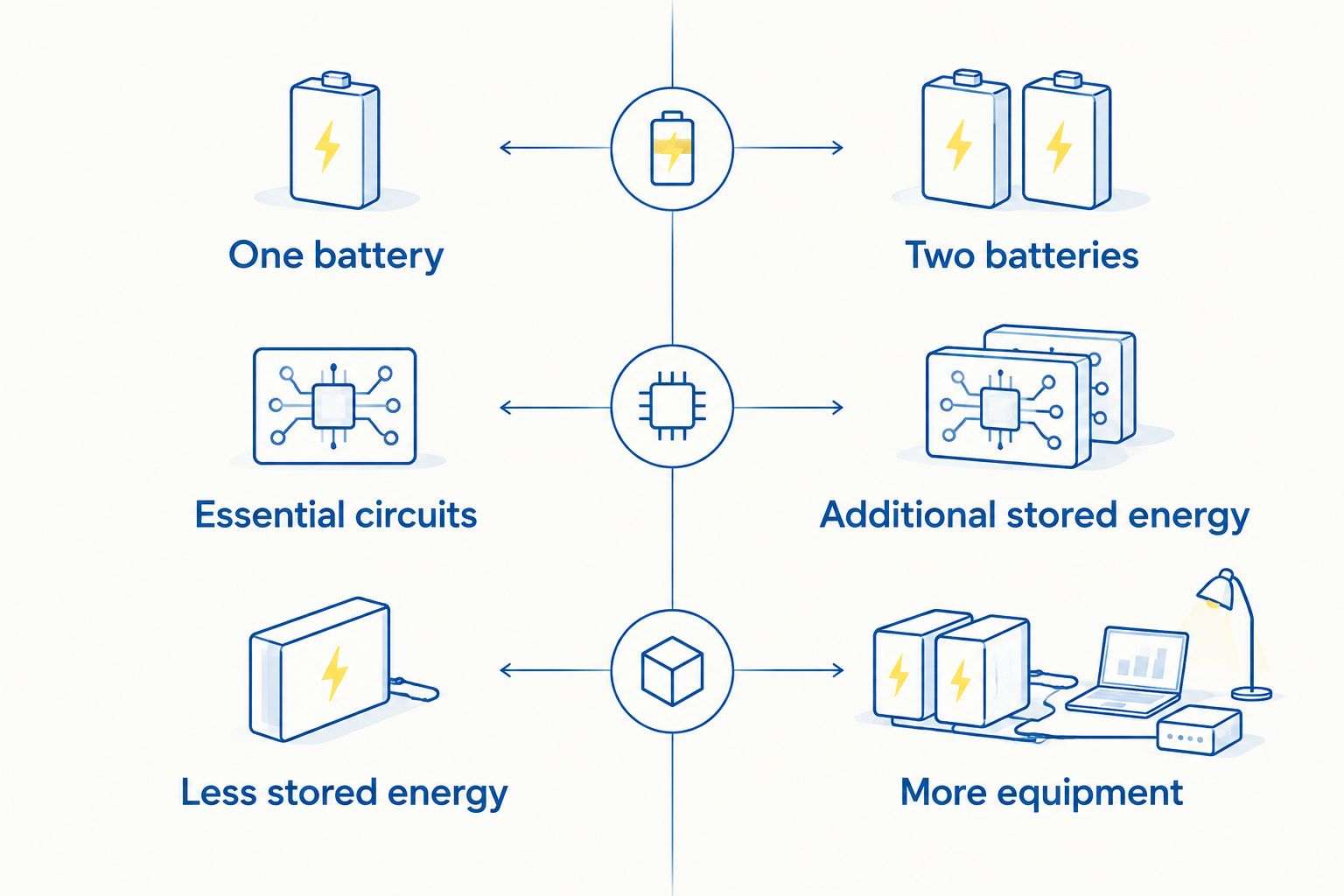
| One battery | Homeowners prioritizing selected essential circuits | A narrower backup design without adding a second battery | Less stored energy than a comparable two-battery configuration | Supported circuits, expected demand, and runtime assumptions |
| Two batteries | Homeowners needing additional stored energy for a defined backup plan | More stored energy than a comparable one-battery configuration | More equipment and installation scope; still not unlimited backup | Added usable energy, supported loads, and installation differences |
The comparison must identify the equipment being proposed. Two quotes that both say Powerwall can still describe different configurations, backup arrangements, or electrical work.
A useful 2026 proposal explains what changes when you add the second battery. Ask whether the benefit is additional backup duration, support for a broader load plan, or both—and have the installer show the design basis.
One battery: best for a focused backup plan
A one-battery proposal makes sense to evaluate when your priority is preserving selected essentials rather than operating every appliance. Begin with the refrigerator, necessary lighting, communications equipment, and any other loads you cannot comfortably leave off.
List the actual equipment, not just room names. A kitchen circuit can serve very different demands depending on what you plug into it, and a home office can mean a laptop or a larger collection of equipment.
The advantage is a clearly limited backup scope; the trade-off is less stored energy. You must understand which appliances remain outside that scope and what happens if several supported appliances operate together.
Ask the installer to explain the expected overnight operation without assuming sunshine will arrive on schedule. Solar generation can replenish a compatible battery system, but weather, household demand, and the system's operating configuration affect that process.
Before accepting one battery, get written answers to these questions:
- Which circuits receive backup during an outage?
- Which appliances must remain off?
- What household demand supports the runtime estimate?
- What starting battery charge does the estimate assume?
- How will the system behave if demand exceeds its supported output?
If those answers match your priorities, the smaller design deserves serious consideration. If they require you to give up something essential, compare the larger design before signing.
Two batteries: best for additional stored energy
A two-battery design deserves evaluation when the one-battery proposal cannot meet your defined backup goal. That goal might be operating the same essentials longer or supporting a broader set of loads within the system's electrical limits.
More stored energy does not make every appliance suitable for backup. Equipment output limits, electrical connections, and appliance starting demands still matter, so ask for a revised load assessment rather than accepting an equipment-only addition.
The advantage is additional energy storage; the trade-off is additional equipment and installation scope. The second battery should solve a named problem in the first design, not simply make the proposal sound more reassuring.
For a 2026 comparison, require the installer to mark the differences between the proposals. If the backed-up circuits stay the same, the explanation should focus on the extra energy available and the operating assumptions behind the expected duration.
Also ask how the system handles ordinary grid-connected operation. Energy used before an outage affects the charge available when the outage begins, so reserve settings belong in the discussion alongside battery count.
Why Tesla Powerwall installation scope varies
A complete battery installation is an electrical project, not just an equipment delivery. Compare these factors across proposals so that a lower-scope design does not get mistaken for an equivalent system.
- Backup coverage. Selected circuits and a broader home-backup arrangement can require different electrical designs. Ask exactly what remains powered.
- Existing electrical equipment. The installer needs to assess the service equipment, panel arrangement, and connection requirements before finalizing the work.
- Equipment location. Battery placement affects the routing of electrical connections and must follow applicable installation requirements.
- Existing solar compatibility. Adding storage to an existing solar installation requires a review of how the equipment will work together.
- Controls and approvals. The proposal should identify the backup controls, permitting responsibilities, inspections, and utility coordination that apply to the project.
Do not assume these items are identical in competing quotes. Put them side by side and ask each contractor to clarify exclusions in writing.
A proposal should also separate installation scope from financial assumptions. If financing or incentives appear in the presentation, review those terms separately rather than treating them as proof that one battery configuration fits your home better.
How to compare one-battery and two-battery proposals
Use the same household requirements for both designs. Otherwise, you cannot tell whether the difference comes from the battery count or from a changed backup plan.
- Collect your electricity history. Gather 12 months of electricity bills to show seasonal consumption. Bills provide context, but they do not identify every appliance's instantaneous demand.
- Write your essential-load list. Name the appliances and circuits you want available during an outage. Separate necessities from equipment you can leave off.
- Set an outage scenario. Describe whether your priority is overnight essentials, daytime operation, or another specific situation. Ask the installer to use that same scenario in both proposals.
- Request matching designs. Compare the same solar arrangement, reserve assumptions, and backup priorities before evaluating what the additional battery changes.
- Check the written limits. Read the exclusions, operating assumptions, and responsibilities for any required electrical work. Resolve vague language before approving the project.
Keep your electricity-bill goal separate from your outage goal. Shifting stored energy into evening use and preserving energy for an unexpected outage are different operating priorities, even when the same equipment serves both.
For local help, Alphasolarsa is best for San Antonio homeowners seeking residential solar installation with battery backup. Discuss your essential circuits, custom system design, and support after installation during a free consultation; the consultation should help you define the job before choosing the equipment.
Discuss your home backup plan
Ask Alphasolarsa about a free consultation for residential solar and battery backup in San Antonio.
Will two batteries run my central air conditioner?
Two batteries do not automatically establish that your central air conditioner will run during an outage. The design must account for the air conditioner's starting demand, running demand, and other loads operating at the same time.
Ask for an assessment of your actual equipment rather than a general statement about air conditioning. The installer should explain whether cooling is included, what operating restrictions apply, and how cooling changes the backup-duration estimate.
The distinction is between supplying enough power at a moment in time and storing enough energy over time. Review whether solar battery backup can run your central air conditioner before making cooling a condition of your battery purchase.
Does two batteries mean twice the backup time?
Two comparable batteries provide more stored energy than one, but a blanket promise of twice the runtime leaves out the operating conditions. Starting charge, supported loads, reserve settings, solar production, and system losses all affect the result.
Ask the installer to compare both designs using the same load profile and stated assumptions. If the two-battery design also powers more appliances, its additional energy is serving a larger job rather than only extending duration.
Should I install one battery now and add another later?
One battery now is a reasonable path to evaluate only when the initial design meets your current priorities and the installer explains the expansion requirements. Do not treat future expansion as automatic.
Ask which equipment would remain, what additional electrical work would be needed, and what approvals would apply to a later addition. Compare that phased approach with a two-battery installation before deciding; the decision should reflect your backup needs as well as the work involved.
What should your 2026 quote make clear?
Your 2026 quote should leave you able to explain the proposed system in plain language. You should know what stays on, what stays off, and which assumptions support the backup estimate.
Use this final check before approving either configuration:
- The exact battery equipment and quantity are identified.
- The backed-up circuits or loads are listed.
- Required electrical work is included or explicitly excluded.
- Runtime estimates state their load and charge assumptions.
- Solar charging during outages is explained for the proposed configuration.
- Monitoring, operating guidance, and post-installation support are described.
Alphasolarsa offers local solar and battery-backup installation, but the same buying discipline applies to its proposal: request clear scope and operating limits. A reassuring explanation is useful only when the written design supports it.
FAQ
How do I compare Tesla Powerwall cost for one battery versus two?
Compare complete installed proposals using the same backup circuits, household loads, and operating assumptions. The second proposal should identify exactly what the additional battery changes, including equipment and electrical work.
Is one Powerwall enough to back up my house?
One Powerwall is enough only if the proposed system supports your required loads and backup duration. Ask for a circuit list and a load assessment rather than relying on the phrase whole-home backup.
Are two Powerwalls better than one for outages?
Two comparable Powerwalls provide more stored energy than one, but the better choice depends on your backup requirements. Confirm which loads the design supports and how much additional duration the proposal expects under stated conditions.
Can a Powerwall keep my air conditioner running?
Air-conditioner backup requires an assessment of starting demand, running demand, and other simultaneous loads. Battery count alone does not confirm compatibility or backup duration.
Will solar panels recharge my battery during a blackout?
Solar panels can recharge a battery during a blackout when the installed system is designed for that operation. Ask the installer to confirm outage-mode charging and explain how weather and household demand affect it.
Should I use my battery every evening or save it for outages?
Daily energy use and outage reserves are different priorities that should guide your battery settings. Discuss how much charge you want preserved and what that means for ordinary operation.
Who can help me compare solar and battery backup in San Antonio?
Alphasolarsa serves San Antonio homeowners considering residential solar installation and battery backup. Bring your electricity bills and essential-load list to a free consultation so the discussion starts with your household needs.
One last thing
Ask the installer to walk you through the first evening of an outage: which lights work, whether the refrigerator stays powered, and which appliances you should leave off. Then ask where those answers appear in the proposal.
That simple exercise turns a battery discussion into a usable household plan. If the explanation changes when you ask about central air conditioning or cooking, settle those details before choosing one battery or two.
Related guides
- Solar panels in San Antonio: add a battery now or later
- Tesla Powerwall installation with an existing solar system
- Solar panel financing: compare APR and total loan cost