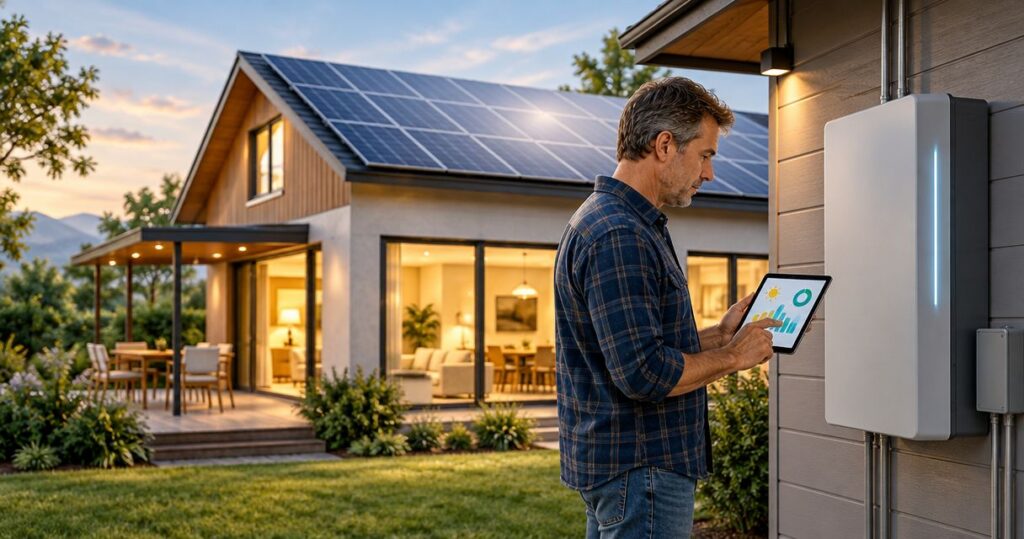
Yes—solar battery backup can recharge during a grid outage when the solar panels, battery, inverter and isolation equipment are configured to work without the utility grid. Sunlight must supply enough power to cover the home's active loads before surplus solar power can recharge the battery. A battery alone does not establish that capability, so your 2026 installation proposal should explicitly confirm solar charging during outages.
- Solar battery backup can recharge during outages when the system supports off-grid solar operation.
- Solar panels must cover active household loads before surplus generation can charge the battery.
- A depleted battery’s restart behavior depends on the installed equipment and configuration.
- Alphasolarsa fits San Antonio homeowners planning residential solar with battery backup.
Why this matters
Keeping your refrigerator running overnight and recharging the battery the next morning are different jobs. Your battery stores energy; your solar panels produce it. During an extended outage, both must work together under a system designed to operate independently of the utility.
This distinction matters when you are adding storage to an existing installation. An existing solar inverter does not automatically become outage-capable when a battery is installed. Before choosing equipment, review the questions involved in Powerwall installation with an existing solar system, then ask your installer to confirm compatibility for your actual equipment.
Buy an explained operating plan, not just a battery capacity figure. You need to know what stays powered, how solar charging works and what happens if stored energy runs out.
Can solar battery backup recharge during a grid outage?
Yes, provided the installation can isolate your home from the utility and keep compatible solar equipment operating on the home's backup electrical system. The battery system's controls coordinate solar generation, household consumption and charging while the grid is unavailable.
The distinction is easier to see by comparing configurations:
| Configuration | Best for | Outage behavior | Main limitation |
|---|---|---|---|
| Standard grid-tied solar without backup capability | Homeowners focused on daytime electricity generation | Normally shuts down when the utility fails | Sunlight alone does not provide household backup |
| Battery backup without connected solar generation | Homeowners who need stored energy for selected loads | Supplies supported circuits while stored energy remains | Cannot recharge from solar that is not connected to it |
| Solar with outage-capable battery backup | Homeowners who want storage and solar replenishment | Can power supported loads and recharge from available solar | Charging depends on sunlight, consumption and system controls |
These are configurations, not interchangeable promises. For a 2026 proposal, have the installer identify the specific operating mode rather than simply describing the installation as solar plus storage.
Solar without backup capability
Standard grid-connected solar equipment stops supplying power when the grid fails. This safety behavior prevents the solar installation from feeding an electrical network that utility crews expect to be de-energized.
The advantage is straightforward daytime generation during normal utility operation. The limitation is equally important: a roof producing electricity on a sunny day does not, by itself, keep your house powered during an outage.
Battery backup without solar charging
A battery can support connected circuits during an outage without having solar panels connected to its backup system. That configuration provides stored energy, but it does not create a new energy source when the battery runs low.
This suits homeowners seeking backup for selected loads without a solar installation. Its limitation is replenishment: once the grid is unavailable, charging requires another compatible source, if the installation supports one.
Solar paired with outage-capable battery backup
A properly configured solar-and-battery system can establish a local electrical supply after isolating from the utility. Compatible solar equipment can then produce power for supported household loads and battery charging.
This configuration fits homeowners who want the possibility of replenishing stored energy during a longer outage. It still has limits. Clouds, high household demand and equipment restrictions can leave little or no surplus for charging.
How does solar charging work while the grid is down?
The equipment manages the transition automatically when installed and configured for that function. Your role is to understand which loads it supports and how your electricity use affects the available energy.
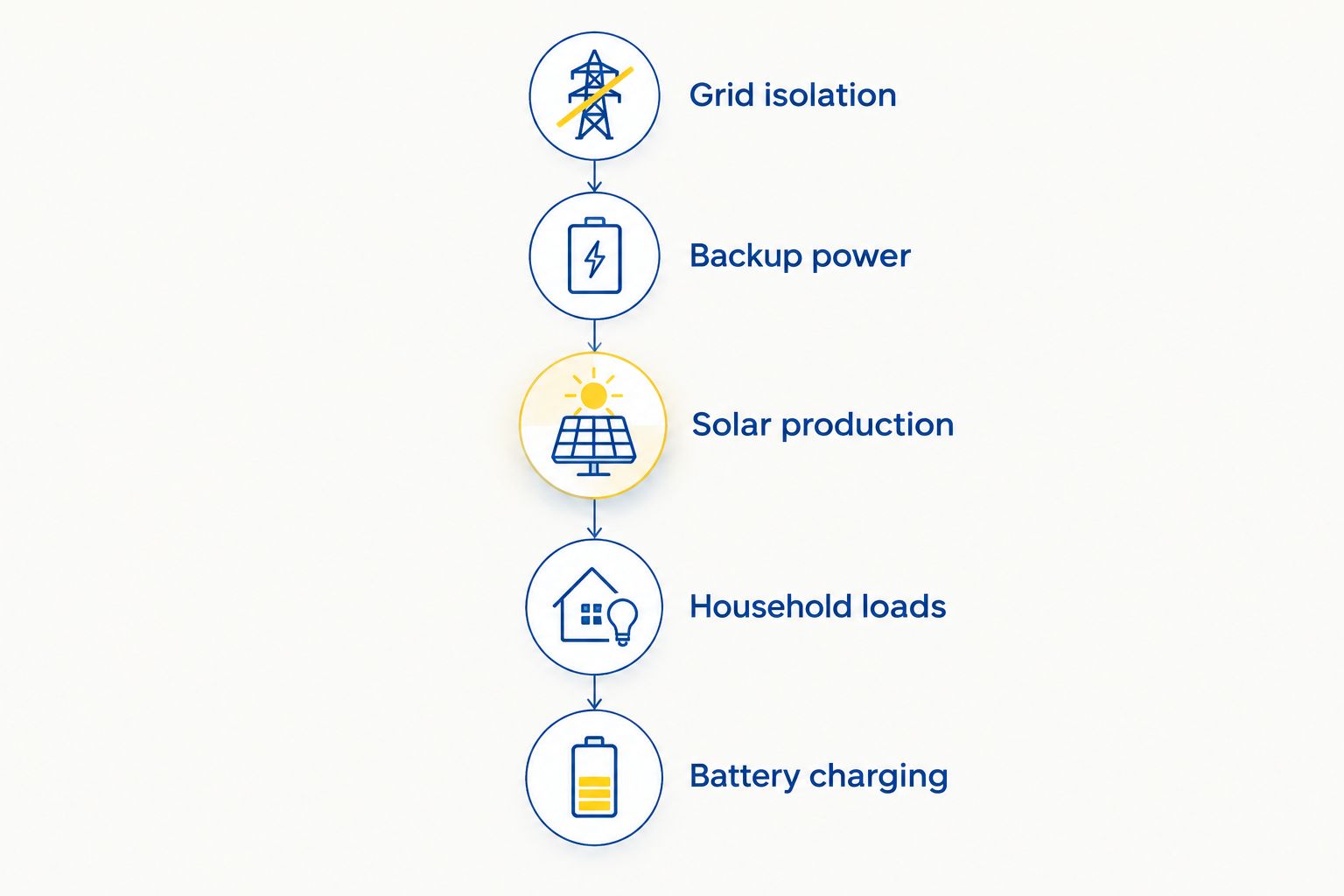
- Grid isolation. Approved equipment separates the backed-up electrical system from the utility connection.
- Backup power. The battery system supplies the electrical conditions required for supported circuits and compatible solar equipment to operate.
- Solar production. Available sunlight allows the panels to generate electricity within the system's operating limits.
- Household loads. Running appliances consume part or all of that generation.
- Battery charging. Solar generation remaining after household demand can charge the battery, subject to charging limits.
The steps explain why a battery does not necessarily charge just because the sun is out. If appliances consume all available solar output, no surplus remains. When consumption exceeds solar generation, the battery supplies the difference instead of gaining charge.
Why solar battery charging varies during an outage
Your 2026 backup plan should account for changing conditions rather than assume constant charging throughout daylight hours. These factors determine whether stored energy rises, holds steady or falls:
- Available sunlight. Clouds, shade and the time of day affect solar output. Daylight does not mean the panels are producing their rated power.
- Household demand. Air conditioning, electric cooking and other substantial loads leave less generation available for charging.
- Solar equipment compatibility. The inverter and controls must support solar operation within the isolated backup system.
- Battery charging limits. The battery and associated equipment limit how quickly incoming power can become stored energy.
- Battery state of charge. A nearly full battery accepts less additional energy; a deeply depleted system can face restart requirements.
- Backup circuit design. The circuits included in backup determine which household loads compete with charging during an outage.
These factors interact. Reducing a discretionary load can free solar power for charging, but it cannot overcome incompatible equipment or a lack of sunlight.
Will the battery recharge if the house is using electricity?
Yes—solar battery backup can recharge while household loads are running if solar production exceeds their combined demand. When production is lower than demand, the battery discharges to help supply those loads instead.
Think of charging as the remainder, not the first claim on every unit of solar generation. A refrigerator cycling on and off changes demand; adding air conditioning changes it again. That is why the backed-up circuit list matters as much as the storage capacity.
For San Antonio homeowners, cooling deserves a separate discussion. Read whether solar battery backup can run your central air conditioner before assuming that cooling and battery replenishment will happen together throughout an outage.
Ask your installer to explain the trade-off in plain language: which loads can operate together, and which should stay off while the battery recovers? Do not use a whole-home backup description as a substitute for that answer.
Can solar restart a completely depleted battery?
Solar restart after battery depletion depends on the equipment and its configuration. Some systems support recovery from solar under specified conditions; others require sufficient battery reserve, a supported restart procedure or restored utility power.
This capability is often called black start: starting an electrical system without an operating external supply. Do not assume it is included because a battery normally charges from solar when the grid is available.
For a 2026 purchase, ask for the manufacturer's documented behavior after low-energy shutdown. The explanation should distinguish an ordinary low-charge warning from a system that has stopped supplying backup power entirely.
Also ask what you must do, if anything. An automatic recovery process and a homeowner-operated restart procedure are not the same experience during an outage.
What should your installer confirm before you sign?
A useful proposal connects equipment choices to your household's priorities. Alphasolarsa offers residential solar and battery backup installation in San Antonio; use a consultation to discuss the actual loads you want supported rather than relying on a general promise of energy independence.
Ask for written answers to these questions:
- Will solar production continue after the installation disconnects from the utility?
- Which circuits remain powered, and which are excluded?
- Can solar power serve those circuits and charge the battery simultaneously?
- What limits solar charging while the home operates in backup mode?
- What happens after the battery reaches its low-energy shutdown point?
- Does the system support solar restart, and under what conditions?
- Which operating settings should the homeowner understand before an outage?
- Who handles troubleshooting after installation?
The most useful demonstration is the one that matches your installed system. Ask the installer to explain how you will recognize an outage, check stored energy and confirm whether solar is charging the battery.
A system design should also explain any gap between your requested loads and the proposed backup capability. That conversation belongs before installation, not during the first utility failure.
Discuss your home’s backup needs
Ask about solar charging, essential circuits and outage operation in a free consultation.
How should you compare battery capacity and charging power?
Battery capacity and charging power describe different things. Confusing them makes proposals harder to compare and encourages unrealistic expectations about recovery after an overnight outage.
- Kilowatt, or kW: a measure of power. 1 kilowatt equals 1,000 watts. Charging power describes the rate at which energy enters the battery.
- Kilowatt-hour, or kWh: a measure of energy. 1 kilowatt-hour equals the energy supplied at 1 kilowatt for 1 hour. Battery capacity describes stored energy, not charging speed.
A larger energy capacity does not automatically mean faster recharging. The solar array must produce the energy, household loads consume a share, and the battery must accept what remains within its charging limits.
When comparing proposals in 2026, keep those units separate. Ask for usable stored energy, supported output power and charging limits, then ask how those specifications relate to your chosen circuits. A single capacity number cannot answer all three questions.
FAQ
Can solar battery backup recharge during a power outage?
Yes, solar battery backup can recharge during an outage when the installation supports solar operation while isolated from the utility. Charging requires available solar generation beyond the power used by active household loads.
Will my solar panels work during an outage without a battery?
Standard grid-tied solar normally shuts down during a utility outage. Specialized backup-capable configurations differ, so confirm the capabilities of your actual installation rather than assuming panels alone provide backup.
Does my battery charge whenever the sun is shining?
No, sunlight does not guarantee battery charging. Household consumption, solar output, battery charge level and equipment limits determine whether energy enters the battery.
Can my battery recharge while my air conditioner is running?
Yes, if available solar production exceeds the air conditioner’s demand plus the home’s other active loads, and the equipment supports that operation. Otherwise, the battery can discharge even during daylight.
What happens if my solar battery runs empty overnight?
Restart behavior depends on the installed battery, inverter and controls. Ask whether the system can recover from solar after low-energy shutdown and whether homeowner action is required.
Does a bigger battery recharge faster during an outage?
No, greater battery capacity does not by itself increase charging speed. Solar output, household demand and the equipment’s charging power limits determine the recharge rate.
What should I ask a San Antonio solar installer about outage charging?
Ask the installer to confirm solar operation during outages, identify backed-up circuits and explain recovery after battery depletion. Request answers for the exact equipment and configuration in your proposal.
One last thing
A full battery can cause solar production to decrease during an outage. When household demand is low and the battery cannot accept more energy, the system must limit generation because it cannot export the surplus to the disconnected utility grid.
That behavior does not automatically indicate a fault. Ask Alphasolarsa to explain the expected operating states for your proposed installation so you can distinguish normal controls from a problem requiring support.
Related guides
- Solar panels in San Antonio: add a battery now or later
- Best home battery backup systems
- Tesla Powerwall: what an installed quote should include