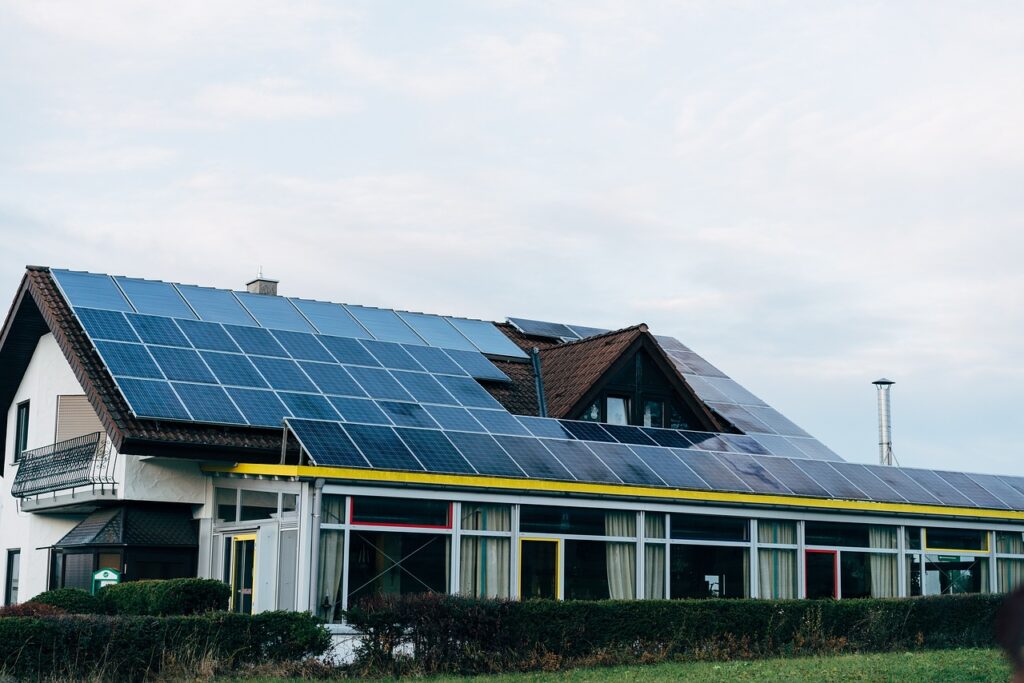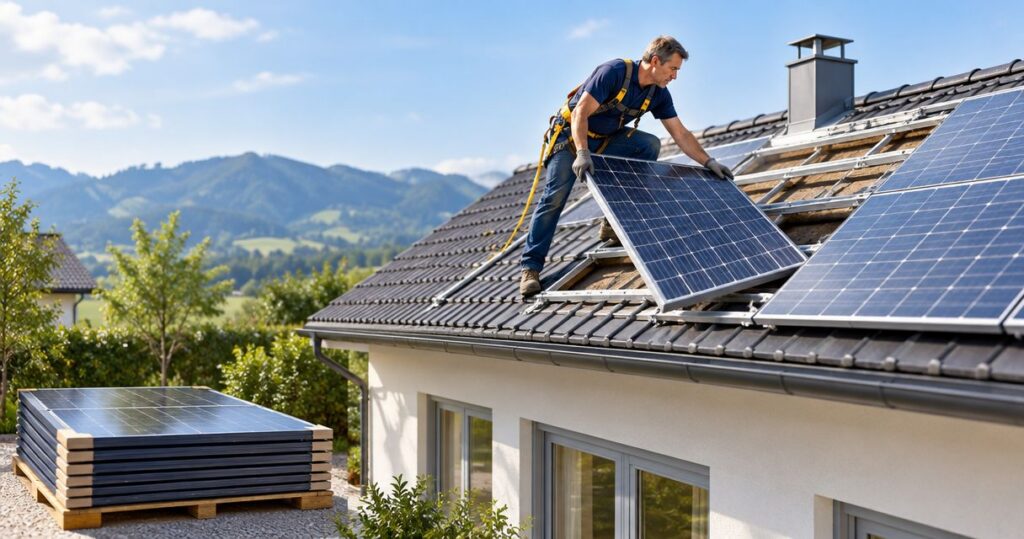
For solar panel removal and reinstallation in 2026, protect the panels with manufacturer-approved packaging, a dry and secure storage location, and a documented handoff between contractors. Have a qualified solar professional handle electrical disconnection and reconnection; switching off the inverter does not stop illuminated panels from producing electricity. Before roof work begins, agree on who moves the panels, where they stay, and who inspects them before reinstalling them.
- Safe solar panel removal and reinstallation requires protected storage, documented condition, and professional electrical handling.
- Follow the panel manufacturer’s instructions for orientation, packaging, stacking, and connector protection.
- Photograph panel labels and condition before removal, then check them again before reinstallation.
- Alpha Solar Solutions serves San Antonio homeowners considering residential solar and battery backup.
For San Antonio homeowners planning roof work, the storage arrangement belongs in the project scope—not in a last-minute conversation beside the driveway. Alpha Solar Solutions provides residential solar and battery backup services; ask about the scope of help available for your existing system before scheduling work.
Why this matters
A panel can look intact without being ready to reinstall. Rough handling can damage cells, frames, connectors, or the protective back surface. Some damage is visible; other problems require professional evaluation.
Storage also creates a gap between trades. The roofer needs a clear roof, the solar contractor needs protected equipment, and you need a record of what happened between removal and reconnection. Assigning responsibility before either crew arrives prevents that gap from becoming your problem.
How do you store panels during solar panel removal and reinstallation?
Use the panel manufacturer's handling and storage instructions as the starting point. The right orientation, support points, packaging, and stacking limits depend on the specific module; there is no universal arrangement that safely fits every panel.
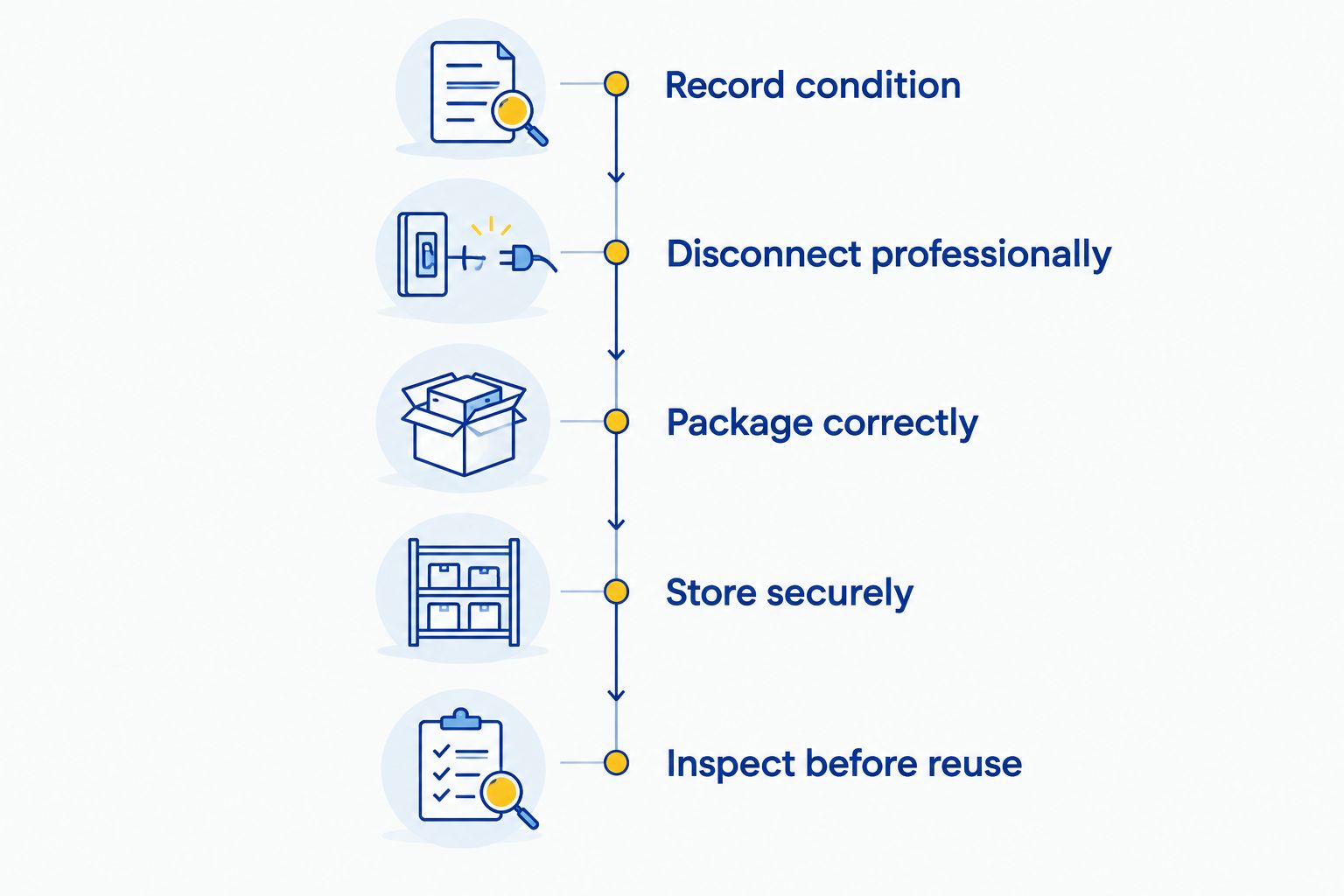
Follow this sequence with your contractor:
- Record condition. Photograph the installed array, accessible labels, existing damage, and relevant equipment before removal. Ask the contractor to record panel positions and electrical connections.
- Disconnect professionally. Have a qualified solar professional isolate the system and manage electrical work. Keep homeowners and roofing crews out of solar electrical handling.
- Package correctly. Use original shipping materials when suitable and intact, or packaging approved for the module. Protect corners, frames, glass, back surfaces, and connectors.
- Store securely. Choose a dry, access-controlled location away from roof debris, vehicle traffic, and other work. Follow the manufacturer's required storage orientation.
- Inspect before reuse. Compare the equipment with the removal record, evaluate damage, and complete the required checks before reconnecting the system.
The homeowner's role is coordination and documentation, not disconnecting cables or carrying panels off the roof. Ask the contractor to explain the plan in ordinary language and put the responsibilities in writing.
Which storage arrangement should you choose?
Best for most homeowners: a secure indoor space with suitable packaging and a clear handling plan. Indoor storage reduces exposure to weather and construction activity, but the room alone does not protect unsupported glass or unprotected connectors.
Use this comparison to discuss the arrangement with your contractor. Each option still needs to follow the module manufacturer's instructions.
| Storage arrangement | Best for | Main advantage | Main limitation |
|---|---|---|---|
| Suitable original packaging indoors | Projects with intact, appropriate packaging | Packaging intended for the module's transport or storage | Old, wet, or damaged packaging needs evaluation before reuse |
| Contractor-provided protective packaging indoors | Projects without usable original packaging | Protection can be planned around the specific equipment | Generic padding is not proof of suitable support |
| Temporary outdoor storage | Projects where outdoor storage is expressly permitted | Avoids relying on unavailable indoor space | Weather, security, drainage, and packaging need explicit controls |
Do not treat a panel's outdoor operating rating as permission to leave disconnected equipment uncovered. An installed array and a pile of removed modules are different conditions, particularly around loose connectors and exposed packaging.
Indoor storage: protect the space as well as the panels
Choose a location where people will not lean tools, ladders, lumber, or roofing materials against the equipment. Keep an access route clear so the panels do not need repeated moves whenever another trade needs something behind them.
Ask how the contractor will prevent tipping and unwanted contact. A garage can work only if the storage arrangement also accounts for vehicles, door movement, household traffic, and moisture. An empty corner is not a storage plan.
Outdoor storage: require an explicit plan
If outdoor storage is proposed, ask the contractor to identify the manufacturer's relevant requirements and explain the protective arrangement. The answer should cover weather exposure, ground conditions, stability, connector protection, and security.
A loose tarp does not establish that those requirements are met. If the contractor cannot explain the arrangement, choose another storage location before removal rather than improvising after the roof is clear.
Why storage requirements vary
The safest arrangement depends on the equipment and the job, not simply the available floor space. These factors change what your contractor needs to plan:
- Module instructions. Different panels have different requirements for support, handling, orientation, and stacking.
- Packaging condition. Damaged or moisture-affected materials need evaluation rather than automatic reuse.
- Storage location. Indoor and outdoor spaces present different exposure, access, and stability concerns.
- Construction activity. Roofing debris, tools, and foot traffic create hazards separate from weather.
- Storage duration. A delayed roof project requires continued protection and agreed inspections, not an open-ended unattended handoff.
- Existing condition. Cracked glass, bent frames, damaged cables, or other defects need separate evaluation before storage and reuse.
Avoid accepting a generic stacking limit or temperature range without the instructions for your module. A precise-looking number is not useful if it belongs to different equipment.
What belongs in your 2026 removal and storage agreement?
Your written scope should connect removal, storage, roof work, and reinstallation. Separate proposals are workable, but they need a clear handoff so responsibility does not disappear between contractors.
Ask for these details before approving the schedule:
- Equipment inventory: Panel identifiers, associated hardware, and the equipment being removed versus left in place.
- Condition record: Who takes photographs, where the records are kept, and how existing damage is identified.
- Storage address: The actual location, not simply a promise that panels will be stored safely.
- Handling responsibility: Who packages, transports, unloads, and moves equipment during the project.
- Damage process: Who receives a damage report and how repair or replacement decisions are handled.
- Delay plan: What happens if roofing takes longer than expected or the storage location becomes unsuitable.
- Reinstallation scope: Who checks roof readiness, reinstalls the array, reconnects equipment, and confirms operation.
Ask each contractor to clarify insurance and contractual responsibility directly. Do not assume the roofer's agreement covers solar equipment or that a removal proposal includes every part needed for reinstallation.
Can solar panels be stacked while they are stored?
Solar panels should be stacked only as the manufacturer's instructions permit. Do not assume that laying loose panels flat, glass against glass, is acceptable simply because the stack looks stable.
Ask what separates the modules, where the weight rests, and how the arrangement prevents sliding or tipping. If the answer depends on shipping packaging, confirm that the packaging is suitable for the panels and still serviceable.
The same caution applies to leaning panels against a wall. Orientation alone does not establish safe storage; support, restraint, and protection from accidental contact matter too.
Can you leave removed solar panels in the sun?
Removed solar panels can still produce electricity in sunlight. Storage must account for electrical safety as well as physical protection, even when the panels are no longer connected to the inverter.
Leave cable and connector handling to the solar professional. Keep children, pets, and other trades away from the storage area, and do not open connector protection or attempt to test loose panels yourself.
Ask the contractor how connectors will be kept protected from contamination and moisture. Household tape or an improvised covering is not a substitute for an appropriate protection method.
What should happen before reinstallation in 2026?
Reinstallation should begin with roof readiness and equipment checks, not simply putting the same panels back in the same places. The roof work can affect attachment locations, flashing details, and the suitability of existing mounting components.
Have the solar contractor address:
- Roof handoff: Confirm that the relevant roofing work is complete and attachment details are coordinated.
- Equipment condition: Compare panels, frames, cables, connectors, and mounting components with the removal record.
- Hardware suitability: Identify which components can be reused and which require replacement under the applicable instructions.
- Electrical checks: Complete the required inspection and testing before returning the system to service.
- Operating confirmation: Check inverter status and monitoring, and explain any remaining faults or follow-up work.
Ask whether permits, inspections, or utility coordination apply to your particular project. Requirements depend on the work being performed; removal and reinstallation should not be treated as automatically exempt.
The final handoff should confirm operation, not just appearance. Keep the completion record with your original installation documents so you can trace both the roof work and the solar work later.
Should you discuss battery backup during roof work?
If you are already considering backup power, discuss it during planning rather than after the array is reinstalled. Battery integration can affect the electrical design, equipment locations, and which household circuits receive backup power.
That does not mean you should automatically add a battery. Solar panel removal and reinstallation solves a different problem from outage protection, and combining projects makes sense only when the design and scope support your goals.
Alpha Solar Solutions is best suited to San Antonio homeowners considering residential solar with battery backup. Ask about a custom design, the local team's responsibilities, and support after installation; confirm separately whether removal and storage work falls within the proposed scope.
Discuss your solar plans
Ask about a free consultation for your home’s solar and battery backup goals.
Your 2026 homeowner handoff checklist
Before the first panel comes down, you should be able to explain the plan without guessing. Ask your contractors to resolve any unclear answer before work starts.
- You know the storage location and who controls access.
- You have a panel inventory and a condition record.
- You know who supplies packaging and handles transport.
- You understand how damage and project delays will be reported.
- You know who authorizes reinstallation after the roof work.
- You will receive confirmation that the system has returned to service.
Keep one shared record rather than scattered photographs and separate text-message threads. Include the agreed scope, equipment records, damage reports, and completion documents so every handoff remains traceable.
FAQ
What’s the safest way to store solar panels during roof replacement?
Store solar panels in suitable protective packaging in a secure location that meets the manufacturer’s instructions. Agree on handling, access, connector protection, and inspection before removal begins.
Can I remove and store my solar panels myself?
Have a qualified solar professional handle removal and electrical disconnection. Illuminated panels can still produce electricity, and rooftop handling adds fall and equipment-damage risks.
Can solar panels be stored flat in a garage?
Flat storage is appropriate only when the module manufacturer’s instructions permit the proposed support and stacking arrangement. A garage does not make unsupported or unsecured panels safe.
How long can solar panels stay in storage?
The acceptable storage period depends on the manufacturer’s requirements and the storage conditions. If the roof project is delayed, ask the contractor to confirm continued protection and inspection responsibilities.
Will my solar battery still work while the panels are removed?
Battery operation depends on the system design and the equipment disconnected for the work. Have the installer explain what remains operational, whether charging is available, and which backup functions are affected.
What should I check after solar panels are reinstalled?
Confirm that the contractor has completed the required inspections and electrical checks and has verified system operation. Review monitoring status and keep the completion record with your solar documents.
Does Alpha Solar Solutions offer solar and battery consultations?
Alpha Solar Solutions provides residential solar and battery backup services for San Antonio homeowners. Request a free consultation to discuss your goals, and confirm the available scope for any existing-system work.
One last thing
For a 2026 roof project, photograph the equipment labels as carefully as the glass. Labels connect each panel to its model, serial number, and handling instructions; clear records help you identify equipment if damage or a replacement question arises.
Do not sign off solely because the roof looks finished. Close the project when the solar contractor has completed the agreed checks, explained the system's status, and handed over the records.
Related guides
- Solar panels in San Antonio: add a battery now or later
- Can solar battery backup run your central air conditioner?
- Tesla Powerwall installation with an existing solar system
- Solar panel cleaning: what a service quote includes