
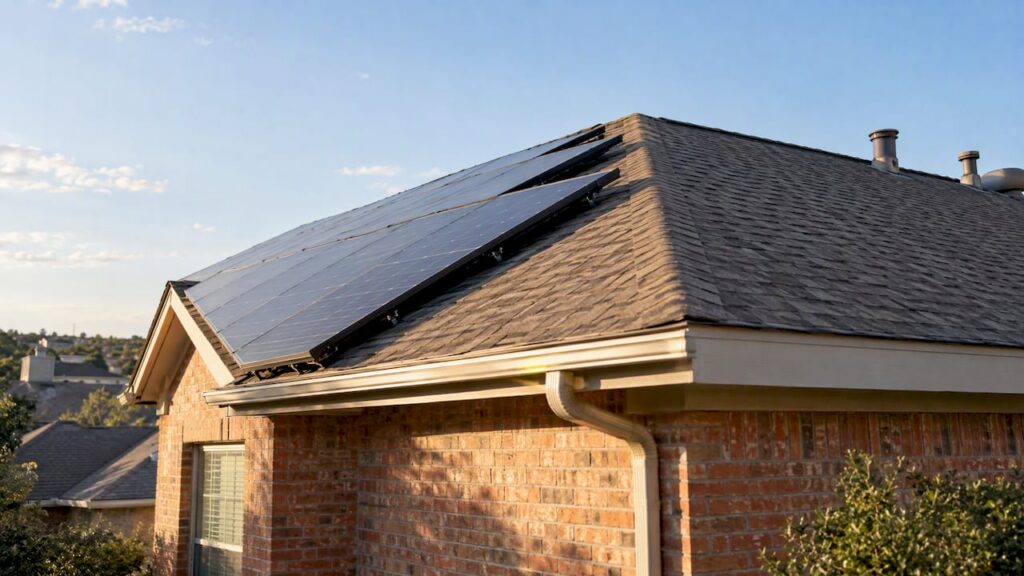
Aim your panels at true south (180°) with a tilt near 26°, and you give a San Antonio roof its best shot at strong annual output. Southwest and southeast faces are workable compromises, and a practical tilt range runs from about 15° to 40°. In most cases, shade and the amount of clear roof matter more than small tweaks to angle or direction.
TL;DR:
- Have an installer map shade in the morning, at noon, and late afternoon; photograph roof planes around 9 AM, noon, and 4 PM beforehand.
- Measure only unbroken roof space, account for vents and setbacks, and check roof age before installation because panels may outlast an aging roof.
- If afternoon cooling drives demand, a southwest layout shifts production later; daytime EV charging instead benefits from power produced while the car is plugged in.
- CPS Energy guidance favors systems facing south, accepts southeast and southwest, and references roughly 260 square feet of unobstructed space for installation.
- When roof planes lack clear space or face heavy shade, ground mounts allow tuned placement, but they cost more and require available land.
Table of Contents
- What does azimuth mean for your San Antonio roof?
- What tilt angle works best in San Antonio?
- Why do shading and usable area matter more than tweaks?
- When do seasonal adjustments, trackers and ground mounts make sense?
- What should you do before you call an installer?
- How does San Antonio weather affect orientation and yield?
- How do roof type and material change panel placement?
- What orientation mistakes do San Antonio homeowners make?
- How should orientation fit with a battery and EV charger?
- What local rules and HOA limits affect panel orientation?
- A local perspective on San Antonio roofs
- How we can help you get orientation right
- FAQ
- Sources
What does azimuth mean for your San Antonio roof?
Azimuth is simply the compass direction a roof plane faces, measured in degrees. Installers record it on every site visit, and you will see it on your design documents. Here is the quick reference:
- South is 180°, the ideal direction for annual energy in the Northern Hemisphere.
- East is 90° and west is 270°, which sit well off the ideal.
- Southeast and southwest fall between those marks and are the usual compromises when a south face is unavailable.
- North-facing planes are the weak spot. CPS Energy guidance recommends south-facing residential systems, accepts southwest and southeast, and does not support northern orientations for good efficiency.
The Department of Energy explains that modules in the Northern Hemisphere are pointed due south and tilted near the local latitude to collect the most energy over a year. That is the baseline, not a strict requirement.
Direction also shapes your day. A south face peaks around midday. Shift the array toward the southwest and the peak slides later into the afternoon, which can line up better with when your home is running air conditioning. A San Antonio rooftop study found that building azimuth is the main driver of the daily energy profile and of when peak output occurs.
So if your best roof plane faces southwest, you have not lost the game. You have traded a little annual energy for production that arrives later in the day. If you want to see how timing affects bills, our post on how installers match battery kW and kWh to demand peaks shows the logic.
What tilt angle works best in San Antonio?
The classic rule says to tilt your panels close to your local latitude. For a fixed system, the practical target depends on your site and roof. The goal is a tilt that serves the whole year, not just one season.
Federal guidance gives you room to work. The Department of Energy and FEMP note that a south-facing tilt between 15° and 40° in the continental U.S. produces strong results. The Homeowner’s Guide to Solar lands in the same place, saying panels perform best on south-facing roofs with a slope between 15 and 40 degrees.
Key range: a south-facing tilt of 15°–40° performs well across the continental U.S., according to DOE/FEMP guidance. That range is the recommended one.
Tilt involves trade-offs you can feel in the real world:
- Lower tilt reduces wind load on the mounting structure and suits a flush, low-profile look.
- Higher tilt helps shed hail and debris, but it raises wind loads, so the racking needs to be engineered for it.
- Your existing roof pitch often decides the matter. Most homes mount panels parallel to the roof, so the pitch becomes the tilt.
A 4:12 roof is a gentle slope of about 18°, and a 6:12 roof is about 27°. A 6:12 roof, in other words, has a slope within the range of angles shown in the RERH roof-pitch table. The RERH specification and checklist includes tables that map roof pitch to tilt angle, so you can find where your roof falls.
Why do shading and usable area matter more than tweaks?
Here is the part many homeowners get backward. A few degrees off ideal tilt costs you very little. A tree limb, chimney or neighboring roofline that shades the array for part of the day can cost you a lot. A LiDAR-based San Antonio study and professional assessments agree that shading is the largest hit to system performance, often outweighing small deviations in tilt or azimuth.

That is why we put the shading study ahead of the angle debate. Before you worry about small differences in tilt, confirm what the sun can actually reach on your roof.
Usable area is the second gate. CPS Energy provides installation guidelines for residential systems. Vents, skylights, dormers and setbacks all eat into the clear plane.
Run through these checks in order:
- Map shade across the day. Look at morning, noon and late afternoon, ideally with a LiDAR or on-site study.
- Measure clear plane area. Count only the unbroken roof surface where panels can sit.
- Check roof age. The Department of Energy advises weighing roof age and replacement timing before you install, since panels outlast an old roof.
- Confirm the structure. Steeper tilts add wind load, so mounts need engineering for local conditions.
Pro Tip: Photograph each roof plane at about 9 AM, noon and 4 PM before your installer visits, so you can spot shade patterns they should model.
When do seasonal adjustments, trackers and ground mounts make sense?
Most rooftop systems stay fixed, and that is a perfectly good choice. But if your array can change angle, its angle can be adjusted seasonally, while a fixed tilt offers a compromise throughout the year.
Adjustable mounts raise a fair question about effort. Someone has to change the angle a few times a year, and every moving part adds a maintenance task. For many homes the gain does not justify the chore.
Trackers are a different story, and they belong on the ground rather than the roof. The Department of Energy notes that ground-mounted systems can use one-axis or two-axis tracking to follow the sun and deliver more energy, at higher cost and with more maintenance.
A ground mount is worth a serious look in these cases:
- Your roof lacks clear area. When usable space is limited or heavily shaded, ground-mounted systems are a standard alternative that allows optimal tilt and orientation.
- Shade follows every roof plane. A clear spot in the yard can beat a compromised roof.
- You want a tuned angle. Ground racking lets you set the exact tilt and direction, and add tracking if the budget supports it.
If you have the land and a stubborn roof, a ground array may simply be the cleaner design.
What should you do before you call an installer?
Good quotes start with good prep. A little homework lets your installer model your site accurately instead of guessing.
Before the visit:
- Gather your recent electric bills so the design matches your real usage.
- Note your roof’s age and any planned replacement.
- Photograph every roof plane and each obstruction, such as trees, vents and chimneys.
- Estimate the clear area of each plane in square feet.
Then bring these questions:
- What azimuth and tilt will each array section use?
- Will you run a shading study, LiDAR or on-site?
- What annual kilowatt-hour production do you expect?
- Has a structural engineer verified the mounts for the chosen tilt?
- Who handles permitting?
You will also face a few decisions. Do you want maximum annual output, or production shifted toward your household’s peak hours? And is a ground mount or tracker worth the added cost for your lot? Having your answers ready makes the quote conversation much faster.
How does San Antonio weather affect orientation and yield?
San Antonio gets a lot of sun, but the weather is not a blank slate. Heat, dust, pollen, hail and strong storms all shape what a good design looks like, and they touch orientation in quieter ways than direction alone.
Start with heat. Panels lose some efficiency as they get hot, and a Texas summer roof gets very hot. Mounting with an air gap behind the modules helps them shed that heat, which is one more reason low-profile flush mounts are common here.
Then consider debris. Spring pollen and dust settle on panels and cut output until rain or cleaning clears them. A steeper tilt sheds debris a little more readily, while a flatter tilt lets it linger. We dug into this in our post on how spring pollen can outlast rain, and it is why we offer solar panel cleaning and maintenance for owners who want steady output.
Storms matter too. Hail favors a tilt that helps it slide off, but a steeper angle raises wind load. That is the same trade-off we covered in the tilt section, and it is why engineered racking matters more than chasing a perfect angle.
Finally, cloud cover and haze change the daily curve more than the annual total. A west-leaning array can catch strong late-day sun when afternoons stay clear. None of this overturns the south-facing, roughly 26° baseline. It simply explains why we favor sturdy mounting, a clean array and a clear view of the sky over fine-tuning degrees on paper.
How do roof type and material change panel placement?
Your roof’s shape and surface decide where panels can go, often before orientation enters the conversation. The best direction means little if the plane facing it cannot take the mounts.
A simple gable roof gives you two large planes, and one usually faces within range of south. Hip roofs split the surface into smaller sections, which can break up your clear area and make it harder to fit a system on a single plane. Flat roofs are the flexible option, since racks can set both tilt and direction, though they add structure and wind considerations.
Material matters as well:
- Composition shingle is the most common and generally the simplest to mount on.
- Standing seam metal often uses clamps that grip the seams without penetrating the roof, which is handy for owners who worry about leaks.
- Tile takes more care, because tiles must be lifted or replaced around each mount to keep the roof watertight.
Roof age is the quiet factor underneath all of it. The Department of Energy points homeowners toward weighing roof age and replacement timing before installing. If the roof needs replacing soon, do it first, or plan for removing and reinstalling the array later. Our team handles panel removal and reinstallation when that moment arrives.
The takeaway: pick the plane that balances direction, clear area and roof condition, not the one that wins on direction alone.
What orientation mistakes do San Antonio homeowners make?
Most mistakes come from chasing the wrong target. A few come up again and again.
Obsessing over the perfect angle. Homeowners sometimes reject a good roof because the pitch is a few degrees off the ideal tilt. Small deviations from latitude tilt usually trim annual output only slightly, while shade costs far more.
Ignoring shade until after signing. A tree that looks harmless in winter can shade the array all summer afternoon. Insist on a shading study before you commit, as the San Antonio LiDAR research supports.
Writing off southwest or southeast roofs. These are acceptable per CPS Energy guidance, and a southwest face can even push production toward your afternoon cooling load.
Choosing north-facing planes. This is the one orientation to avoid. North faces underperform, and CPS Energy does not support them for good efficiency.
Overlooking usable area. A roof can face the right way and still lack clear, unbroken space for the system you want.
Skipping the structural check. A steeper tilt raises wind load, so confirm the mounts are engineered for it.
Forgetting rebate rules. Orientation and unobstructed area can affect program eligibility, which we walk through in our guide to CPS rebate eligibility.
Avoid these common mistakes, and you will be ahead of many buyers.
How should orientation fit with a battery and EV charger?
If a battery or EV charger is in your plan, orientation becomes more than an annual-energy question. It becomes a question of when your power shows up.
With a battery, timing is flexible. Panels store midday energy for evening use, so a pure south array works well. A southwest lean can instead send more production into late afternoon, when household use climbs, and reduce how much the battery must carry. We compare the options in our post on adding a battery now or later, and our Battery Backup / Powerwall work starts from your actual usage.
Backup power adds a second goal. If keeping the lights and cooling on during an outage matters, you want production that holds up through the day, plus enough clear roof to size the system for the load you plan to protect.
EV charging shifts the picture again. Many owners plug in overnight, which leans on stored energy or the grid. If you charge during the day, a south-facing array meets that demand directly. Our EV charger installation can be planned alongside the array, so the panel layout, charger location and electrical capacity all fit together.
The simple rule: decide how you will use the energy before you finalize the direction. Whether you value total annual output or well-timed output should guide the final layout.
What local rules and HOA limits affect panel orientation?
Orientation decisions run into rules as well as physics. Two groups matter most in San Antonio: your utility and your homeowners association.
On the utility side, CPS Energy sets installation guidelines that favor south-facing systems, accept southwest and southeast, and discourage northern orientations. Its guidance also references roughly 260 square feet of unobstructed space. Those expectations tie into rebate programs, so read them before you finalize a layout. We cover the eligibility angle in our CPS rebate eligibility guide.
On the neighborhood side, HOAs can influence where panels go, especially on roof planes visible from the street. Rules vary by community, so we do not assume a standard answer. Check your covenants before design starts, and ask whether the HOA has requirements about placement, visibility or approval steps. If street-facing south planes are restricted, a compromise face or a ground mount behind the home may keep the project moving.
Permits are the third piece. Local permitting and utility interconnection both follow their own steps, and an orientation that looks fine on paper still needs sign-off. Our team handles the permitting, paperwork and rebate process as part of installation, so you are not left chasing forms.
If you run into a restriction, bring it up early. A good designer can often reach an acceptable layout, as long as the conflict surfaces before the plans are final.
A local perspective on San Antonio roofs
Across San Antonio roofs, the same pattern shows up: the angle is rarely the problem. Trees, rooflines and pitch quirks are. A few degrees off ideal almost never decides whether a system succeeds, but an afternoon shadow can. I would rather see a homeowner accept a southwest plane with a clean view of the sky than hold out for a perfect south face that sits under an oak. Good design and smart shading mitigation make small tilt and azimuth deviations manageable, so do not let a “perfect” number talk you out of a solid roof. Use the checklist above when you collect quotes, and ask a local installer for a real shading study.
— Anthony
How we can help you get orientation right
You have seen what drives a strong San Antonio system: direction, tilt, shade and clear area. We turn that into a design for your roof. Alpha Solar Solutions handles the full path, from first look to finished install, for homes and businesses in San Antonio and nearby areas.
Here is what we bring to your project:
- Site assessment and shading study so the layout starts from what the sun actually reaches.
- Engineered mounting built for local wind conditions and your chosen tilt.
- Permitting and rebate handling so you skip the paperwork.
- Full installation, with residential and commercial options.
- Related services such as battery backup and panel cleaning for complete system planning.
Residential solar installation is listed at 12,000 to 25,000 USD one-off, depending on the system. Request a quote or site assessment on our Residential Solar page and we will map your roof together.
FAQ
What direction should solar panels face in San Antonio?
True south is the best direction for annual energy. Southwest and southeast are acceptable compromises, per CPS Energy guidance, while north-facing planes generally underperform.
What is the best tilt angle for solar panels in San Antonio?
For a fixed system, a tilt of about 26° suits San Antonio’s latitude of roughly 29.4°. Federal guidance says a south-facing tilt of 15° to 40° works well across the continental U.S., so your roof pitch often sets the angle.
Does shading matter more than panel angle?
Usually, yes. A San Antonio LiDAR-based study found that shading is the largest impact on system performance, often outweighing small deviations in tilt or direction.
How much clear roof space do I need?
CPS Energy provides guidance on unobstructed space. If your roof falls short or is heavily shaded, a ground mount can be a good alternative.
Can I install panels on a west-facing roof?
Often you can. A west or southwest face shifts production later in the day, which can match afternoon cooling use, though it trades away some annual energy compared with south. Have your installer model it for your home.
Sources
- Solar Installation Guidelines
- LiDAR-Based Solar Mapping for Distributed Solar Plant Design and Grid Integration in San Antonio, Texas
- Solar Photovoltaic System Design Basics | Department of Energy