
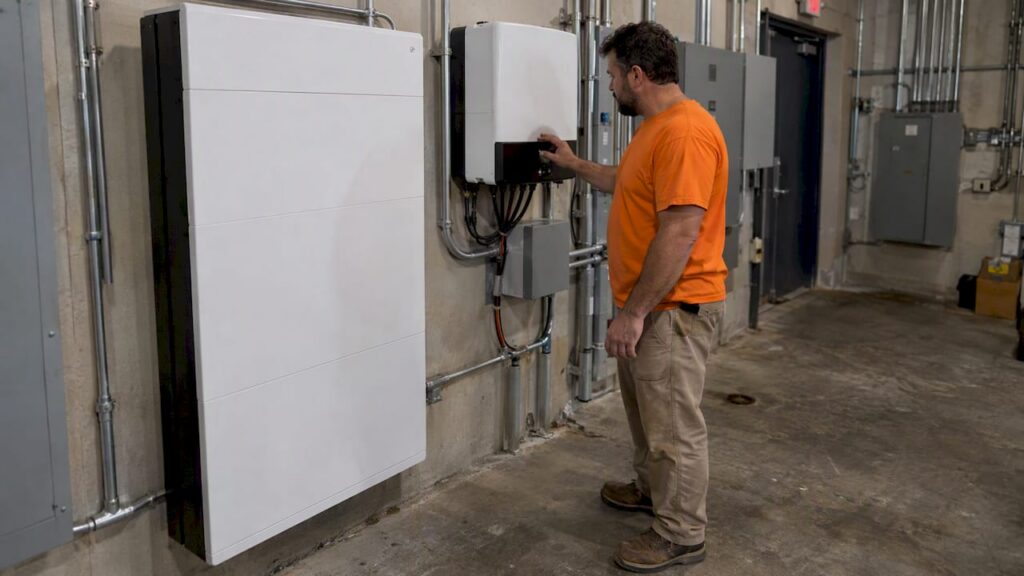
Solar-plus-battery systems can shave peak demand and lower your bill, but only when your tariff includes demand charges or steep time-of-use peaks and your load profile is predictable enough to target. The result depends on three things working together: a tariff where demand charges are financially material, a battery sized correctly in both kW and kWh, and a control system smart enough to act before the peak hits. We’ll walk through the mechanics, the sizing math, and real evidence below.
TL;DR:
- Check 12 months of utility bills for demand charges and recurring peak times; erratic spikes weaken the case for battery peak shaving.
- A 50 kW reduction against a 300 kW peak at a $15 per kW demand rate saves $750 monthly if it holds.
- Size the inverter in kilowatts for peak power and usable battery capacity in kilowatt hours for duration, including reserved charge before the event.
- A 2023 study found controls that use forecasts reduced simulated peak load by about 30%, while reactive systems can miss spikes entirely.
- Confirm utility tariffs, interconnection limits, and export settings before design; local rules can change whether battery discharge counts against billed demand.
Table of Contents
- What peak shaving means and why demand charges matter
- How solar and batteries actually shave a peak
- When peak shaving actually saves money
- Sizing and control: a step-by-step approach
- How we evaluate feasibility
- Keeping a peak-shaving battery healthy over time
- How utility rules and local policy shape your savings
- Who should move forward with a feasibility study
- Get a peak-shaving feasibility review
- FAQ
- Sources
What peak shaving means and why demand charges matter
Peak shaving means reducing the single highest kilowatt reading your meter records during a billing period, not your total energy use. Utilities that charge demand fees bill you for that one worst 15-minute window every month, sometimes at a rate that dwarfs your energy charge. Commercial, industrial, and some larger residential customers are the ones most likely to see a demand charge line item on their bill.
This differs from load shifting, where you move usage to cheaper time-of-use hours but don’t necessarily touch your peak kW. Peak shaving targets the spike itself: a battery discharges for those few minutes or hours when demand surges, flattening the curve your utility measures.
Here’s what separates the two approaches:
- Peak shaving reduces the highest recorded kW, directly cutting demand charges.
- Load shifting moves kWh consumption to lower-rate hours, cutting energy charges instead.
- A site can need one, the other, or both, depending on how its tariff is structured.
Say a facility’s measured peak is 300 kW and its demand charge is $15 per kW. Shaving 50 kW off that peak saves $750 that month, every month, as long as the shave holds.
How solar and batteries actually shave a peak
Three components do the work: your solar array, your battery, and the inverter and control logic that tie them together. The inverter’s kW rating sets how fast the system can push power out, while the battery’s usable kWh capacity sets how long it can sustain that push. Both numbers matter separately. A battery can have a large inverter rating but a small usable capacity, and it will shave a sharp, short peak well but run out quickly on a longer one.
During the day, solar generation often covers much of your load directly, and any surplus charges the battery. When a demand peak hits, whether from HVAC cycling, equipment startup, or EV charging, the battery discharges alongside solar to keep your grid draw under a target ceiling. Some of the battery’s capacity is typically held back as a reserve state of charge, so it’s never caught empty right before the highest spike of the month.
A workable system needs:
- Interval meter data or real-time metering so the control system knows your current draw.
- A predictive or rule-based energy management system (EMS) that discharges before the peak, not after it.
- Enough reserved capacity to cover the peak window without draining the battery to zero.
Interconnection agreements and inverter export settings also affect how a system behaves during a peak event, so these should be confirmed with your utility before finalizing a design.
Pro Tip: A battery without a predictive EMS often misses the peak entirely, since it reacts to demand instead of anticipating it.
When peak shaving actually saves money
Savings scale with how large your demand charges are, how often peaks occur, how predictable they are, and how much existing solar generation you already have to lean on. A site with one sharp, recurring peak each month is a far better candidate than one with erratic, unpredictable spikes.
A Department of Energy case study at Fort Carson projected about $525,000 in annual savings by shaving roughly 3,200 kW per month using smart battery demand-charge management, an example of how demand-charge-heavy tariffs can make peak shaving highly economical when the peaks are large and consistent.
Sites that tend to benefit most:
- Commercial and industrial facilities with steep per-kW demand charges.
- EV fast-charging locations, where short, intense charging spikes drive capacity costs.
- Some commercial properties with predictable daily load patterns, such as retail or office buildings with consistent HVAC cycles.
Before assuming you’re a candidate, check your last 12 months of bills for a demand charge line item, note how much your peak varies month to month, and see whether your peaks cluster around the same time of day.
Sizing and control: a step-by-step approach
Correct sizing starts with data, not guesswork. Here’s the sequence we use when evaluating a site:
- Pull historical interval meter data, ideally 12 to 24 months of 15-minute readings, and identify when peaks occur and how often.
- Choose a target shave in kW and a duration, then convert that into a kWh requirement by multiplying the target kW by how many hours the peak typically lasts.
- Confirm your inverter’s kW rating and the battery’s usable kWh, accounting for reserved state of charge and how quickly the battery can recharge between events.
Several common mistakes undermine peak shaving before it starts:
- Undersizing kWh capacity relative to how long the real peak actually lasts.
- Failing to aggregate multiple meters when a site has several services feeding one load.
- Ignoring reserved state of charge, leaving the battery empty right when it’s needed most.
- Installing a battery with no predictive control, which discharges reactively instead of ahead of the spike.
A 2023 MDPI study on PV-battery hybrid operation found that forecasting-driven control strategies reduced simulated peak load by about 30%, underscoring how much the control layer, not just battery size, drives results.
How we evaluate feasibility
When customers come to us asking whether peak shaving makes sense for their property, we start with a data-driven approach: a site assessment, a review of actual meter data, and a custom-designed PV and battery system sized to the real peak, not a generic template.
Our relevant services include:
- Residential and commercial solar panel installation with system design matched to load profile.
- Battery backup and integration for peak-shaving control.
- EV charger installation for properties where charging spikes drive demand costs.
- Ongoing monitoring so performance holds up after the system goes live.
We handle permitting, paperwork, and system design so you get a system sized for your actual peaks rather than a one-size-fits-all package.
Keeping a peak-shaving battery healthy over time
A battery used for peak shaving cycles differently than one used mainly for backup power. It charges and discharges daily, sometimes multiple times, which means usable capacity gradually declines over the years as the chemistry ages. Most lithium-based systems are designed to retain a large share of their original capacity after years of regular cycling, but the rate of decline depends on how deeply the battery discharges each cycle and how it’s managed thermally.
Keeping the reserved state of charge buffer intact matters here too. A battery that’s routinely pushed to near-zero during peak events will degrade faster than one that maintains a healthy floor. Good EMS software accounts for this by balancing how aggressively it discharges against long-term capacity loss.
Periodic monitoring catches problems early: a shifting peak window, a battery that’s no longer fully recharging between cycles, or an inverter running closer to its rated limit than it should. Routine checks of panel output also matter, since dirty or shaded panels reduce the daytime charging that feeds the battery before a peak event. Scheduling regular cleaning and maintenance keeps the solar side of the system contributing as much as it’s designed to, which in turn keeps the battery from doing more work than it should.
Warranty terms and expected cycle life vary by battery model, so it’s worth confirming those specifics with your installer before finalizing a system sized for frequent daily cycling.

How utility rules and local policy shape your savings
The value of peak shaving depends heavily on how your utility structures its rates and what rules govern exporting or discharging power back to the grid. A utility with high per-kW demand charges and strict time-of-use peaks creates far more financial upside than one with flat energy rates and no demand component at all. Before sizing a system, we look closely at the actual tariff a site is on, since two buildings on different rate schedules from the same utility can see very different payback periods.
Interconnection rules also matter. Some utilities require specific metering or communication equipment before allowing battery discharge to count against demand, and agreements can include limits on how fast a system can ramp up or down. These details affect both the technical design and the financial model, so confirming them early avoids surprises later in the project.
Local incentive programs, rebates, and net metering structures change periodically and vary by utility and region, so current specifics should always be verified directly with your utility or a licensed installer rather than assumed from general information. Inverter manufacturers, including GoodWe’s documentation on time-of-use and peak-shave modes, note that local grid rules directly affect which operating mode is appropriate for a given site.

Who should move forward with a feasibility study
If your last several bills show a steady demand charge and a peak that repeats around the same time each day, you’re a strong candidate for a closer look. If your peaks are scattered and unpredictable, start by pulling your interval data before committing to anything. Either way, a short feasibility review beats guessing.
— Anthony
Get a peak-shaving feasibility review
If your bill shows a demand charge that keeps creeping higher, we can walk you through what a custom-sized PV and battery system would look like for your specific peaks. We design residential and commercial systems around actual meter data, not a generic package, and handle the engineering, permitting, and installation from start to finish.

A feasibility evaluation with us typically includes a review of your billing history, an on-site assessment, and a proposed system sized in both kW and kWh to match your real peak windows. Whether you’re exploring residential solar installation, a commercial system, or EV charger integration for a high-demand charging site, reach out to Alpha Solar Solutions to request a quote and see what a properly sized system could save you.
FAQ
What is solar battery peak shaving?
Solar battery peak shaving is the practice of using a battery, often charged by solar, to reduce the highest kilowatt demand your meter records during a billing period. It targets the demand charge portion of your bill rather than total energy use, discharging during short, high-demand windows to flatten your peak.
What is the 33% rule in solar panels?
Definitions of this term vary across the industry, and we don’t have a verified, standard source defining a “33% rule” specific to solar panel design or peak shaving. If you’ve encountered this term from a specific source, it’s worth asking a licensed installer to clarify how it applies to your situation.
Why are people getting rid of solar panels?
Reasons vary widely by homeowner and are often tied to individual circumstances like moving, roof repairs, or dissatisfaction with a prior installation rather than a single common cause. A properly sized, well-maintained system with routine cleaning and upkeep is generally built to perform reliably for decades.
What is the GoodWe peak shaving mode and how does it work?
GoodWe inverters include operating modes, described in their user manuals, that charge the battery during low-demand valley hours and discharge it during peak demand windows. The exact behavior depends on local grid rules and how the inverter’s time-of-use settings are configured for your site.
How do I know if my property is a good candidate for peak shaving?
Check your utility bills for a demand charge line item and see whether your peak kW repeats at a similar time each day. Sites with steep, predictable demand charges, like many commercial, industrial, and EV-charging properties, tend to see the clearest returns.