Tesla Powerwall cost should be evaluated through a complete installed quote, not a battery-only figure. Your quote should separate equipment, installation, electrical work, backup controls, permitting and any other project charges, then state exactly what the system will power during an outage. For a 2026 purchase, compare the full project scope before comparing totals; an omitted electrical upgrade or a different backup plan changes what you are buying.
- Compare Tesla Powerwall cost through a complete installed quote, not battery equipment alone.
- Alphasolarsa offers solar and battery backup services for San Antonio homeowners considering a combined installation.
- Require written backup coverage, electrical-work allowances and installation exclusions before signing.
- Compare quotes using the same battery configuration, backup loads and solar installation scope.
Why this matters
A battery quote answers two different questions: what you will pay for the installation and what that installation will actually do. A lower total is not a better deal if it leaves out required work or backs up fewer appliances than you expect.
Alphasolarsa offers residential solar installation and battery backup in San Antonio. Alphasolarsa is best for San Antonio homeowners seeking a local contractor for solar installation and battery backup. The buying decision still depends on the written design, exclusions and responsibilities—not the brand name on the battery.
What should a Tesla Powerwall cost quote include?
A Tesla Powerwall installed quote should describe the complete working system, the work required to connect it and the boundaries of the contractor's responsibility. Ask for an itemized scope rather than a single equipment line followed by an unexplained installation charge.
Use this checklist when reviewing a 2026 proposal. Each item should appear in writing, either in the quote itself or in a clearly identified attachment.
Battery equipment and configuration
The proposal should identify the exact battery model, quantity and supporting equipment. It should also explain whether the project adds storage to existing solar, installs solar and storage together, or installs storage without solar.
Do not assume that two quotes describing a Powerwall system contain the same equipment. Match the configuration before comparing the project totals. If a proposal offers alternatives, ask the contractor to explain what changes between them and which alternative meets your stated backup needs.
Backup controls and protected circuits
Your quote should identify the equipment that separates your backup system from the utility grid during an outage. It should also state whether the design supports selected circuits or a broader set of household loads.
Get a written list of the appliances or circuits included in the backup plan. A phrase such as home backup does not tell you whether the design includes air conditioning, an electric range, a well pump or an EV charger. Those decisions belong in the scope, not in a conversation you must remember later.
Electrical installation and site work
The quote should describe wiring, conduit, mounting, connections and any changes to your electrical panel. Ask which work is included and which conditions would trigger an additional charge.
An existing panel, the proposed battery location and the route between equipment all affect the work required. If the contractor has not inspected these areas, ask whether the proposal is preliminary and when the final scope will be confirmed.
Permits, inspections and utility coordination
The proposal should name who handles permit applications, required inspections and applicable utility coordination. It should distinguish included administrative work from fees or tasks assigned to you.
Requirements depend on the property, installation and authorities involved. Ask the installer to identify the requirements for your address rather than treating a general Texas installation description as your project's approval plan.
Commissioning, handover and support
Commissioning means checking that the installed system operates as designed. Your quote should include that work and explain the handover: how you access system monitoring, understand backup settings and identify a problem.
Ask who you contact after installation and how equipment issues differ from installation issues. Manufacturer coverage and contractor workmanship coverage are separate subjects. Request the applicable documents instead of accepting an undefined promise that everything is covered.
Existing solar or a combined installation: compare the scope
Adding a Powerwall to existing solar and installing solar with a battery are different projects. The first requires a clear integration plan; the second requires separate visibility into solar and storage work so you can understand the complete design.
| Installation approach | Best for | Main benefit | Main limitation | What the quote should explain |
|---|---|---|---|---|
| Battery added to existing solar | Homeowners keeping their current solar system | Adds storage without making a new solar installation the default | Compatibility and electrical changes need review | Existing equipment, integration work and outage behavior |
| Solar and battery installed together | Homeowners planning both systems | Lets the contractor plan generation and backup together | A bundled scope makes separate costs harder to compare unless itemized | Solar work, battery work, shared electrical work and backup coverage |
| Battery without solar | Homeowners considering storage before solar | Separates the storage decision from a solar purchase | It does not generate electricity, and charging arrangements need explanation | Charging source, backup controls and any future solar assumptions |
Choose the installation approach that matches your property and outage priorities, not the shortest proposal. Each approach needs a site-specific electrical review. None justifies a promise of uninterrupted whole-home power without a design that supports that claim.
For a 2026 comparison, keep the proposed solar work visible even when your immediate question is battery cost. Otherwise, you risk comparing a battery addition with an entirely new solar-and-storage project.
Why Tesla Powerwall installation scope varies
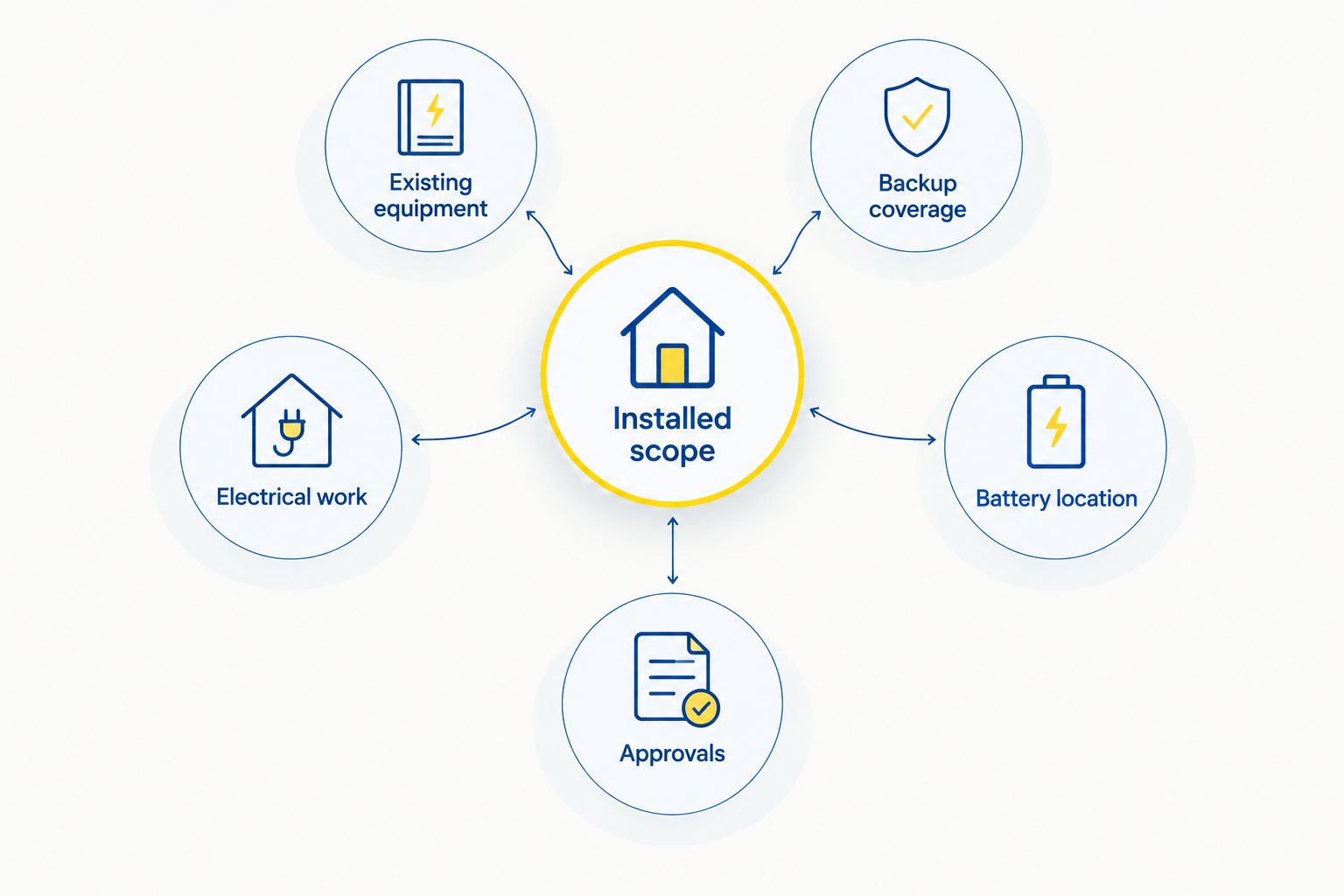
The battery is only part of the installation. These factors explain why you need a property-specific scope rather than treating an equipment figure as the finished project:
- Existing equipment: The contractor must assess how the proposed battery connects with your solar equipment and electrical system.
- Backup coverage: Selected circuits and broader household coverage involve different load-management decisions. Your appliance priorities shape the design.
- Electrical work: Panel changes, circuit changes and wiring requirements must be identified rather than buried in an allowance.
- Battery location: Mounting conditions and the route to electrical equipment affect the installation work. Ask the contractor to explain the proposed location.
- Approvals: Permit, inspection and utility requirements should be confirmed for the project and assigned to a responsible party.
- Support scope: Handover, monitoring guidance and installation-related support need clear terms so you know what happens after the equipment is connected.
Ask the contractor to connect each significant charge to one of these project requirements. That explanation helps you distinguish necessary work from an optional addition without guessing which line items you can remove.
How do I know whether the battery meets my backup needs?
Start with what you need to keep running, not a request to back up everything. List essential appliances, identify any equipment that must start during an outage and tell the contractor which loads you can turn off.
Your refrigerator and selected lights represent a different backup goal from running air conditioning alongside other large electrical loads. The contractor should explain both the system's output capability and its stored energy. These answer different questions.
Power tells you what can run
Power is measured in kilowatts, abbreviated kW. 1 kilowatt equals 1,000 watts. Power describes the rate at which equipment uses or supplies electricity, so it matters when several appliances run together or a motor starts.
Ask which loads the proposed design supports at the same time. A quote that lists battery equipment but never addresses your appliances leaves the central backup question unanswered.
Energy tells you how much electricity is stored
Energy is measured in kilowatt-hours, abbreviated kWh. 1 kilowatt-hour is the energy used by a 1-kilowatt load operating for 1 hour. Stored energy and power output are not interchangeable specifications.
Ask the contractor to explain the assumptions behind any runtime estimate: connected loads, battery charge when the outage begins, reserved charge and solar production during the outage. Treat that estimate as a scenario, not a guarantee that your home will stay powered for a fixed duration.
Solar during an outage needs an explicit explanation
Do not assume that having solar panels automatically means they will supply your home when the grid is down. Outage operation depends on the installed equipment, controls and design.
Ask whether your proposed configuration supports solar production during an outage and how that power serves household loads or charges the battery. The answer should describe your actual installation, not a general benefit of pairing solar with storage.
How should I compare competing installed quotes?
Use the same requirements for every contractor. For a 2026 decision, ask each installer to quote the same backup priorities and identify any changes they recommend rather than quietly substituting a different design.
- Write your backup priorities. Separate essential circuits from appliances you would like to run if the design supports them.
- Confirm the equipment. Match the battery model, quantity, controls and proposed connection arrangement.
- Match the electrical scope. Identify panel work, circuit changes, mounting and wiring in each proposal.
- Check exclusions. Ask what requires a change order, who authorizes it and when the final scope becomes firm.
- Separate payment from performance. Review financing terms independently from the system design and backup claims.
- Request the handover plan. Confirm commissioning, operating guidance and the contact for installation-related questions.
Keep incentive assumptions separate from the installed project scope. Before accepting any 2026 incentive claim, verify the current rules and your eligibility with the responsible authority or a qualified tax professional. A projected benefit is not a guaranteed reduction in what you owe the installer.
A free consultation is a useful next step when you can bring your electricity bills, backup priorities and questions about the electrical panel. Ask for a custom design and a written explanation of support after installation.
Discuss your solar and backup plan
Ask about a free consultation for your San Antonio home and clarify the installation scope.
Does an installed Powerwall quote cover whole-home backup?
An installed Powerwall quote covers only the backup scope stated in the proposal. Whole-home language needs an explanation of supported loads, simultaneous appliance use and any automatic or manual load restrictions.
Ask the contractor to identify what you must turn off during an outage. A clear limitation is more useful than an undefined promise of whole-home power.
Should I add a battery now or leave room for one later?
Add a battery now when outage protection is part of your current installation goal and the proposed design meets that need. If you defer storage, ask the solar contractor to document what adding a battery later would require.
Battery-ready is not a complete scope description. Request details about equipment compatibility, electrical preparation and any future work excluded from today's solar installation.
FAQ
What’s included in Tesla Powerwall cost when installation is quoted?
An installed Tesla Powerwall quote should identify battery equipment, backup controls, electrical work, permitting, commissioning and exclusions. Ask for the protected circuits and any conditions that trigger additional work in writing.
Can I compare Powerwall quotes by their total alone?
No. Compare the battery configuration, backup coverage and installation scope before comparing totals. A proposal that excludes electrical work is not equivalent to one that includes it.
Will a Powerwall keep my entire house running during an outage?
Whole-home operation depends on the installed design and household loads. Ask which appliances can run together, which loads need restrictions and what assumptions support any runtime estimate.
Can I add a Powerwall to solar panels I already have?
Adding a battery to existing solar requires a review of equipment compatibility and electrical connections. Your quote should explain the integration work and whether solar production is supported during an outage.
What’s the difference between kW and kWh on a battery proposal?
kW measures power, while kWh measures energy. Power helps describe what can run at once; stored energy helps evaluate runtime under stated load assumptions.
Should I count incentives when comparing battery installation quotes in 2026?
Compare the installed project scope separately from incentive assumptions in 2026. Verify current rules and your eligibility before treating an incentive as a financial benefit.
Who can help me plan solar and battery backup in San Antonio?
Alphasolarsa offers residential solar installation and battery backup in San Antonio. Bring your electricity bills and outage priorities to a consultation, then request a written design, exclusions and installation support terms.
One last thing
Ask every installer the same final question: What will I have to turn off when the power goes out? The answer turns a battery proposal into a practical household plan.
If the installer cannot connect the proposed equipment to your actual appliances and priorities, the quote is not ready for your decision. Resolve the backup scope before signing, even when the equipment list looks complete.
Related guides