
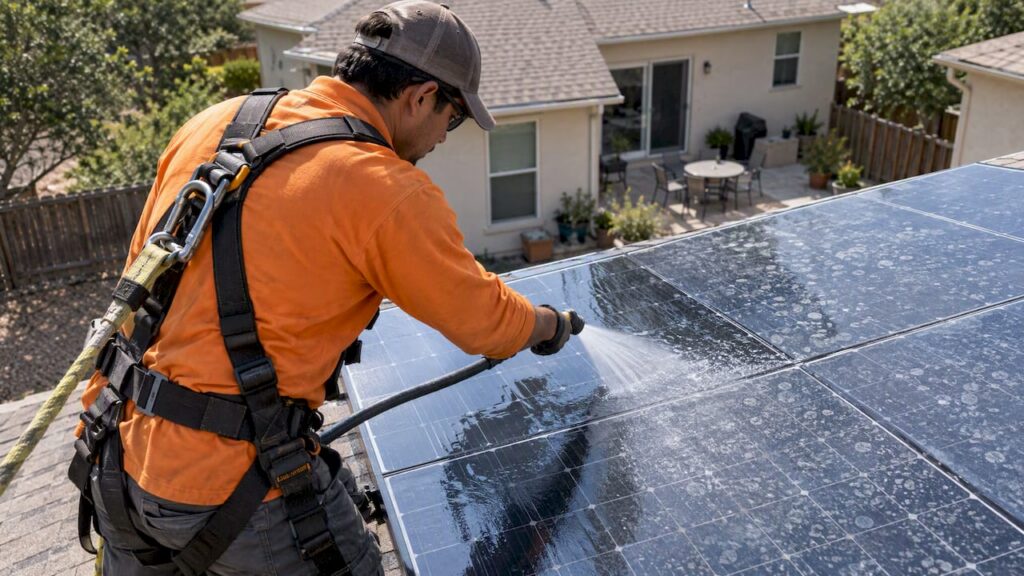
Most hard water spots on solar panels can be removed safely, and the first move should always be non-contact: a gentle hose rinse followed by a distilled or deionized final rinse. If the mineral film has hardened into a bonded layer, dilute acid cleaners applied with care can usually lift it. When spots resist that treatment or the roof access feels risky, calling a professional protects both your safety and your warranty.
TL;DR:
- For mild spots, rinse cool panels at low pressure early or late, wash gently with mild soap, then finish with distilled or deionized water.
- For cemented scale, test dilute citric acid or vinegar on a corner, apply briefly with a soft sponge, rinse thoroughly, and stop after one attempt.
- Avoid pressure washers, stiff brushes, abrasive pads, and unapproved cleaners, which can damage seals or coatings; follow the panel manufacturer’s care instructions first.
- Clean once or twice a year as a baseline, increasing frequency for dusty, coastal, or farmland sites where deposits build faster.
- Hire a professional when roof access is steep or high, deposits remain after one cautious treatment, or the glass coating shows haze or damage.
Table of Contents
- Why Hard Water Spots Form on Solar Panels
- Can You Remove Hard Water Spots Without Damaging the Panels?
- How to Remove Mild Hard Water Spots Step by Step
- Removing Stubborn, Cemented Mineral Deposits Safely
- Preventing Hard Water Spots Before They Start
- When to Call in a Professional Cleaning Service
- What Installers Prioritize When It Comes to Panel Cleaning
- Let Us Handle the Hard Water Spots for You
- FAQ
- Sources
Why Hard Water Spots Form on Solar Panels
Hard water carries dissolved calcium and magnesium. When a few drops linger on warm glass and evaporate, those minerals stay behind as a chalky white film. One rinse rarely causes a problem. The trouble builds over weeks and months, as dew settles overnight and the sun bakes it dry again the next day.
That repeated wet-and-dry cycle does more than leave a film. NREL field research found that daily dew and heat cycles can bond dust and mineral particles directly to the glass, a process called cementation. Once deposits cement, rain alone will not wash them away. What starts as a light haze turns into a crust that needs active cleaning.
Where you live changes how fast this happens:
- Coastal homes pick up salt spray that reacts with hard water minerals and speeds up buildup.
- Properties near farmland collect dust, pollen, and organic residue that cement faster in humid air.
- Dry, dusty regions see heavier mineral concentration in each evaporation cycle, even with less total rainfall.
Can You Remove Hard Water Spots Without Damaging the Panels?
Yes, in most cases, as long as you start gentle and work your way up only if needed. The safest first step is a non-contact rinse: a standard garden hose on a low-pressure setting, applied to cool panels, early morning or evening. Follow it with a distilled or deionized water rinse, since tap water left to air-dry is what causes the spots in the first place.
What to avoid matters just as much as what to try:
- Skip pressure washers. The force can drive water under seals or strip the anti-reflective coating that keeps your panels efficient.
- Skip stiff brushes or abrasive pads, which leave micro-scratches that scatter sunlight instead of letting it through.
- Skip unknown household chemicals. Industry coupon studies warn that harsh or abrasive contact cleaning accelerates coating loss over repeated cleanings.
Your panel manufacturer’s care instructions take priority over any general advice, including ours. If your documentation specifies particular tools or cleaners, follow that guidance first and treat non-contact rinsing as your default method whenever the manual allows it.
How to Remove Mild Hard Water Spots Step by Step
Before anything else, check your safety setup. If your panels sit on a steep or high roof, this is a job for a professional with fall protection, not a weekend project. If you do have safe, low-slope access, switch off your system according to your inverter manual before you start; our guide on backup power and shutdown steps covers what that process generally involves.
Gather your supplies: distilled or deionized water, a low-sudsing mild dish soap, a soft microfiber mop or sponge on a telescopic pole, a squeegee, a bucket, and a garden hose with a low-pressure nozzle.
- Work early morning or evening when panels are cool, never in direct midday sun.
- Rinse the whole array first with low-pressure water to loosen loose dust and softer deposits.
- Mix a small amount of mild dish soap into a bucket of water and wipe gently with the microfiber mop, using light pressure only.
- Rinse thoroughly again with low-pressure water to clear away all soap residue.
- Finish with a distilled or deionized water rinse, which leaves no new mineral film behind as it dries.
- Squeegee or let the panels air-dry fully before reconnecting the system.
Test this whole sequence on one corner first. If the glass comes back clear with no cloudy residue, continue across the rest of the array. If a hazy film remains after drying, you are likely dealing with cemented deposits that need a stronger approach.
Removing Stubborn, Cemented Mineral Deposits Safely
When a non-contact rinse and a mild soap wash leave spots behind, you are dealing with mineral film that has cemented to the glass. A low-concentration citric acid solution or diluted white vinegar can dissolve that film without resorting to anything harsh. Homeowners researching general techniques for removing mineral spots from glass will recognize the same principle used on car windshields and marine glass: a weak acid, applied briefly, breaks the mineral bond chemically instead of relying on scrubbing.
Keep the process conservative:
- Mix a dilute solution, just a few percent acid to water, rather than reaching for anything concentrated.
- Apply it sparingly, or as a light paste on a sponge, rather than pouring it directly onto the glass.
- Let it sit for a short dwell time only, then agitate gently with a soft sponge, no aggressive back-and-forth scrubbing.
- Rinse immediately and thoroughly with low-pressure water, then finish with a distilled or deionized final rinse.
Pro Tip: Test any acid solution on a small, inconspicuous corner first and wait to see how the glass responds before treating the full panel.
If the deposit is still visible after one careful attempt, stop there. Repeating the process aggressively raises the risk of surface abrasion, and a second pass rarely succeeds where the first one failed. At that point, a professional assessment can confirm whether the glass coating is intact and whether the remaining film needs a different method entirely.

Preventing Hard Water Spots Before They Start
The easiest hard water spot to deal with is the one that never forms. A few consistent habits go a long way.
- Finish every clean with distilled or deionized water whenever possible. If you only have tap water on hand, squeegee the panels dry immediately instead of letting them air-dry, since standing tap water is what leaves the mineral film behind.
- Set a baseline cleaning schedule of once or twice a year, following O&M guidance from SOMAH, and increase the frequency if you live somewhere dusty, coastal, or near farmland.
- Trim back overhanging branches and clear roof drains nearby, since dripping sap, leaves, and standing debris all speed up staining.
- Stick to manufacturer-approved cleaners only. The Department of Energy’s guidance on PV corrosion points to routine maintenance with the right products as a key factor in avoiding long-term component damage.
When to Call in a Professional Cleaning Service
Some situations call for a professional rather than a ladder and a garden hose.
- Your roof is steep, high, or otherwise unsafe to access without fall protection equipment.
- Mineral scale resists a careful, conservative DIY attempt and you see no improvement after one pass.
- You notice any visible damage, haze, or discoloration on the glass coating itself.
- You would rather have the work backed by insurance and a warranty-aware process than risk it yourself.
A good cleaning provider will use a deionized final rinse, soft-contact techniques, proper fall protection, and before-and-after production checks so you can see the measurable difference. Before hiring anyone, ask directly: do you finish with DI water, are your technicians trained on module warranty requirements, and can you detach and reattach panels safely if the cleaning or an inspection calls for it? Our overview of solar panel insurance considerations is worth a look if you want to understand how a cleaning mishap could intersect with your coverage.
What Installers Prioritize When It Comes to Panel Cleaning

From an installer’s perspective, the goal is never to clean as often as possible. It is to clean only when soiling actually costs you meaningful production, and to do it in a way that protects the coating underneath. That means favoring a deionized final rinse, tailoring frequency to your actual site conditions, and treating aggressive contact cleaning as a last resort rather than a routine.
The trade-off is straightforward once you see it: a small efficiency gain from frequent scrubbing rarely outweighs the wear it puts on the glass over years of service. Field playbooks, like the ones we rely on for local rebate and maintenance work in San Antonio, favor scheduled checks and targeted cleaning over blanket frequent washing.
— Anthony
Let Us Handle the Hard Water Spots for You
Scrubbing mineral deposits off a rooftop array is not how most homeowners want to spend a Saturday, and we would rather you not risk your panels or your warranty finding out the hard way which chemicals are safe. Our Solar Panel Cleaning & Maintenance service uses warranty-aware methods with deionized final-rinse finishing, so stubborn hard water spots come off without putting your anti-reflective coating at risk.

If your panels need to come down for roof work or a deeper inspection, our Solar Panel Removal & Reinstallation team handles that safely as well, with the same careful standards. Reach out for an on-site assessment, ask us about before-and-after production checks, and we will give you a straight answer on what your panels actually need.
FAQ
What is the 33% rule in solar panels?
This term is not a standard industry rule and definitions vary depending on the source. If you have seen it referenced somewhere specific, it is best treated as that source’s own shorthand rather than a recognized technical standard.
Why is it hard to sell a house with solar panels?
Difficulty usually comes down to financing arrangements, like an outstanding loan or lease that a buyer has to take over, rather than the panels themselves. A clear maintenance history and documented cleaning, like warranty-aware service, can help ease a buyer’s concerns during a sale.
Why are people getting rid of solar panels?
Reasons vary by homeowner and often relate to aging equipment, a move, or a desire to upgrade to newer technology rather than any inherent flaw in solar ownership. Panels that are properly maintained, including regular cleaning, typically continue performing well for many years.
What takes out hard water spots?
A gentle rinse followed by a distilled or deionized water final rinse removes fresh mineral film in most cases. For spots that have cemented onto the glass, a dilute citric acid or vinegar solution with a short dwell time, applied carefully and rinsed thoroughly, is the safest next step before calling a professional.
Sources
- Scientists studying solar try solving a dusty problem
- Managing and mitigating solar PV corrosion | Department of Energy
- Solar PV System Operation and Maintenance (SOMAH)
- Anti-soiling coatings of PV modules for different climates (IEA-PVPS)