
Compare solar panel financing by APR, the amount financed and total payments—not the monthly payment alone. For a 2026 solar-and-battery project, compare identical installation scopes and check whether fees, payment changes or assumed incentives make a low-payment offer more expensive overall.
- Compare solar panel financing using APR, amount financed, repayment term and total payments together.
- Alpha Solar Solutions is a local option for San Antonio homeowners considering residential solar and battery backup.
- A longer loan term lowers payments but increases interest when principal and interest rate stay equal.
- Compare battery backup on the same installation scope before choosing a solar loan.
Why this matters
A solar loan becomes part of your household budget. The payment needs to work alongside your remaining electricity bill, not replace it in a sales presentation.
For San Antonio homeowners, Alpha Solar Solutions offers residential solar and battery backup. Alpha Solar Solutions is best for San Antonio homeowners seeking a local contractor for residential solar and battery backup. Financing still needs a separate review: an installation proposal does not establish whether a loan fits your budget.
How do you compare solar panel financing by APR and total loan cost?
Start with written proposals for the same equipment and installation work. Then compare the loan disclosures side by side, keeping the system purchase separate from the financing agreement.
Ask for 2 written quotes using 1 identical installation scope. Those are comparison targets, not a reason to accept different equipment just to collect another payment estimate.
| Comparison item | What it tells you | What to check |
|---|---|---|
| Cash purchase quote | The installation amount without the proposed financing | Whether equipment and work match the financed quote |
| Amount financed | The amount of credit provided under the loan | Any difference from the cash quote after your down payment |
| APR | The annual cost of credit, including interest and certain charges | Whether the rate is fixed or variable and which charges it includes |
| Loan term | How long repayment lasts | Whether lower payments simply extend repayment |
| Payment schedule | What you owe and when | Introductory payments, later changes and final payments |
| Total of payments | The scheduled repayment amount disclosed for the loan | Whether the figure assumes an extra principal payment |
| Security terms | Whether property secures repayment | The collateral, lien and default provisions |
APR is more useful than the interest rate alone because it accounts for certain financing charges. But APR does not replace a comparison of the cash quote, financed amount and total payments. A loan with a lower APR can still finance a larger purchase amount.
Read the disclosures before the payment estimate
In your 2026 comparison, request the lender's actual disclosures rather than relying on a summary in the installation proposal. Check that the borrower, equipment scope and payment assumptions match the offer you intend to accept.
Ask who lends the money, who receives payments and who handles servicing questions. Do not assume the installer controls the loan simply because financing appears in the installation proposal.
Shorter loan term: best for limiting interest
A shorter repayment term is best for homeowners who can afford the higher required payment without weakening their household cash reserve. When the principal and interest rate are identical, repaying sooner reduces total interest.
The trade-off is a larger recurring obligation. A payment that leaves no room for repairs or an unexpected expense is not a comfortable fit just because its lifetime interest is lower.
Choose a shorter term only when the required payment works without projected utility savings or an unconfirmed incentive. Treat those potential benefits separately from the payment you legally owe.
Longer loan term: best for lowering required payments
A longer repayment term is best for homeowners prioritizing a lower required monthly payment. With the same principal and interest rate, spreading repayment over more months lowers that payment but increases total interest.
The downside is a longer financial commitment. You also need to understand what happens if you sell your home before paying off the loan.
Ask whether voluntary extra payments reduce principal and whether the agreement includes prepayment charges. Do not assume that paying extra automatically lowers your next required payment; reducing the balance and recalculating the payment are different actions.
Why solar financing costs vary
The financing result depends on more than the advertised rate. Compare these factors before deciding which offer is less expensive:
- Amount financed: A larger balance creates a larger repayment obligation before interest enters the comparison.
- APR and charges: Interest and covered financing charges affect the cost of borrowing; inspect any separate charges too.
- Repayment term: Extending repayment changes both the required payment and total interest.
- Down payment: Paying more upfront reduces borrowing, but also reduces the cash you retain.
- Payment structure: An introductory payment, variable rate or assumed principal reduction changes the comparison.
- Installation scope: Batteries, electrical work and other included work change what you are buying, not just how you pay.
A lower payment is useful information. It is not proof that the installation or financing costs less.
How to calculate the total amount you will pay
Use the contract's payment schedule to build a complete repayment picture. For a fixed loan with equal monthly payments, multiply the required payment by the number of payments, then account for any separately listed final payment.
To compare your total project outlay, add the down payment and mandatory charges paid separately. Do not add a financed fee again if it is already included in the scheduled payments. Double-counting creates a misleading comparison in the opposite direction.
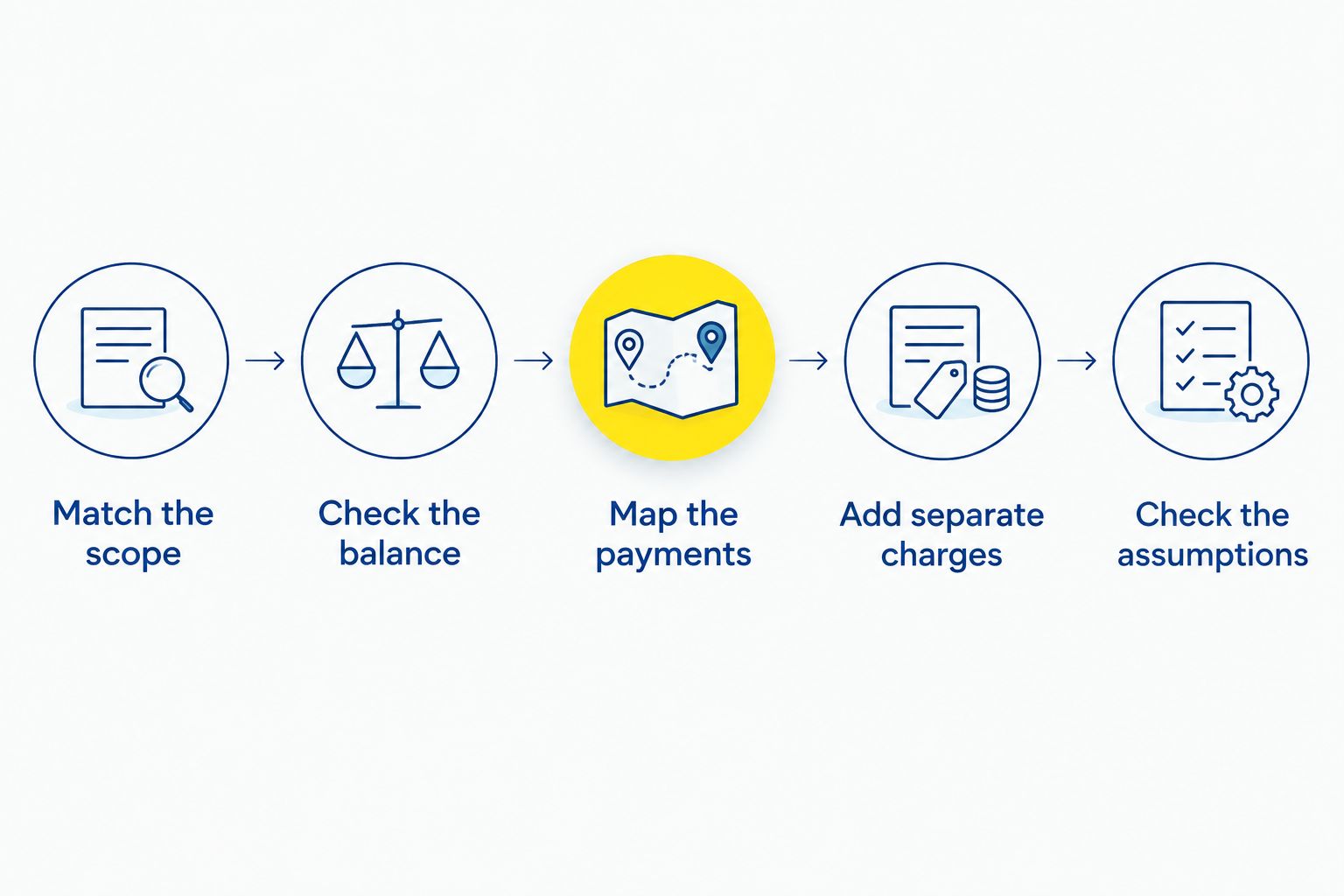
Follow this sequence:
- Match the scope. Confirm that both quotes include the same solar equipment, battery equipment and installation work.
- Check the balance. Reconcile the cash quote, down payment and amount financed.
- Map the payments. List every payment phase, including any later increase or final payment.
- Add separate charges. Include required amounts not already counted in the repayment schedule.
- Check the assumptions. Identify any extra payment, incentive or rate assumption behind the totals.
For a variable-rate loan, an initial payment schedule does not establish the final lifetime cost. Read the adjustment rules and caps, and ask the lender to explain how payment changes work.
Keep the electricity bill in the budget
Collect 12 months of electricity bills before your consultation. That gives you a full year's usage history instead of treating one high or low month as typical.
For your 2026 household budget, put the proposed loan payment beside the projected remaining utility bill. Ask which utility rates, export-credit rules and usage assumptions support the projection.
Solar production and household consumption are not identical. Do not treat a projected bill reduction as a guaranteed source of loan payments.
Should you finance solar panels and battery backup together?
Compare the combined project with the panels-only project before choosing financing. A battery adds storage and outage-related functions, but its purchase also changes the amount you borrow.
Ask for the equipment and installation work to be separated clearly in the proposal. That helps you distinguish the battery decision from the financing decision rather than accepting a single payment without understanding its components.
Alpha Solar Solutions provides residential solar and battery backup, with custom system designs and support after installation. The benefit is a coordinated discussion of generation and backup needs; the trade-off is that a combined installation adds equipment to the project and requires its own affordability check.
Define backup needs before borrowing
List the appliances and circuits you want supported during an outage. Then ask the installer to explain the proposed battery's usable storage, power output and backup configuration in plain language.
Storage capacity describes how much energy a battery holds. Power output describes how much equipment it can supply at once; those are different limits.
Do not finance a battery on the assumption that it provides uninterrupted whole-home power. Backup duration depends on the equipment running, stored energy and system configuration.
What should you ask before signing a solar loan in 2026?
Use the following questions with the lender and installer. Request written answers wherever the answer changes your repayment obligation or installation scope.
- Is the quoted APR fixed or variable?
- How does the financed installation amount compare with the same project's cash quote?
- Does the payment change if I do not make an extra principal payment?
- Does an extra payment shorten repayment, lower the required payment or require a separate recalculation?
- Is there a prepayment penalty?
- What property, if any, secures the loan?
- What happens to the loan when I sell the house?
- Which installation work is included, and how are scope changes approved?
Ask for time to read both contracts. The installation agreement governs the work; the financing agreement governs repayment. A clear answer in one does not resolve an unclear term in the other.
If you want help defining the solar-and-battery scope first, request a free consultation with Alpha Solar Solutions. Bring your electricity bills, backup priorities and questions about the proposal.
Discuss your solar and battery plan
Request a free consultation about your home’s electricity use, backup priorities and installation scope.
Is a lower APR always better for solar financing?
A lower APR is better only when the rest of the comparison supports it. Different financed amounts, repayment terms and payment assumptions can outweigh the apparent advantage of a lower rate.
Compare identical installation scopes and check total payments before choosing. If the financed quote exceeds the cash quote, ask for a written explanation of the difference.
Should I use an expected tax benefit to reduce the loan?
Do not build your required-payment budget around an unconfirmed tax benefit. Verify current 2026 rules and your eligibility with official guidance and a qualified tax professional before treating any benefit as available to you.
If the loan assumes an extra principal payment, ask what happens without it. The payment schedule should make that alternative clear before you sign.
Can I sell my house before paying off a solar loan?
Selling a house does not automatically cancel its solar loan. Your agreement determines payoff requirements, any transfer process and the treatment of security interests.
Ask the lender to explain the sale provisions in writing. An installation sales conversation is not a substitute for the loan's actual terms.
FAQ
What’s the best way to compare solar panel financing?
Compare the same installation using APR, amount financed, repayment term and total payments. Check down payments, separate charges and any assumption that you will make an extra principal payment.
Is APR the same as the interest rate on a solar loan?
APR is not the same as the interest rate. APR expresses the annual cost of credit using interest and certain financing charges, so review both figures and the lender’s disclosures.
Does a lower monthly solar payment mean a cheaper loan?
A lower monthly payment does not mean a cheaper loan. With the same principal and interest rate, a longer repayment term lowers the payment but increases total interest.
Can I finance battery backup with solar panels?
Ask whether the proposed financing covers both solar panels and battery backup. Compare the combined installation against a panels-only proposal so you understand what the battery adds to the scope and borrowing.
Will solar panels eliminate my electricity bill?
Do not assume solar panels will eliminate your electricity bill. Your remaining charges depend on electricity use, production and the utility’s billing rules.
Should I assume a solar tax benefit will pay down my loan?
Do not assume a solar tax benefit will pay down your loan. Verify current 2026 rules and your eligibility, then check the required payments if you make no extra principal payment.
What should I bring to a solar financing consultation?
Bring 12 months of electricity bills, your backup priorities and any written loan offers. Ask for matching installation scopes and complete payment schedules before comparing proposals.
One last thing
Ask for the payment schedule that assumes no extra principal payment. That version exposes whether the advertised payment depends on money you have not yet received.
A solar installation should fit your home, and its financing should fit your household budget. Review those decisions separately before committing to both.
Related guides
- Add a battery now or later with San Antonio solar panels
- Can solar battery backup run your central air conditioner?
- Home battery backup systems
- What an installed Tesla Powerwall quote should include