
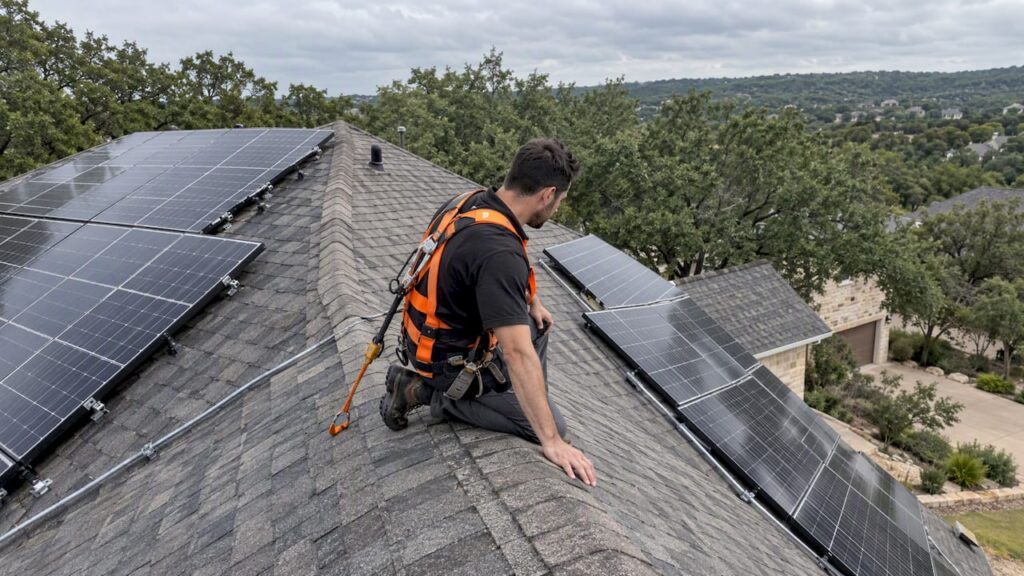
South-facing panels produce the most annual energy, while west-facing panels often deliver more late-afternoon value in Texas, depending on your rate plan and battery situation. West arrays typically give up some yearly output but shift power toward the hours when air conditioners run hardest. The right call for your roof comes from a quick per-face model and a look at your bill.
TL;DR:
- West arrays produce 10% to 20% less annually, but a single summer study in Austin found 49% more output from 3 PM to 7 PM.
- South usually wins under flat rate credits, while west can pay off when time of use plans reward afternoon power or export credits are low.
- Compare south and west both with and without storage if you may add a battery later, since storage reduces the value of west’s timing advantage.
- Use PVWatts with identical system size, tilt, and shading, then compare hourly output with actual buy and export rates, not annual production alone.
Table of Contents
- How much energy do you give up facing west?
- Why does your Texas rate plan change the winner?
- Do batteries change the orientation choice?
- How do you model your own roof?
- What should you ask installers for in a quote?
- Where we land on south, west and mixed designs
- Get a free south vs west comparison for your home
- FAQ
- Sources
How much energy do you give up facing west?
In Texas, south-facing panels generate the highest total annual output. West-facing panels typically produce 10–20% less than a south-facing system of the same size, though they generate more power in the late afternoon. Other practitioner guidance lands in a similar place: east and west faces usually lose 10–15%, while southeast and southwest faces lose far less.

That gap is not a fixed number for every address. City-level PVWatts examples for San Antonio and Austin show west near 90% of south, and the exact percentage shifts with tilt, shading and local weather. Even cloud patterns play a small role: research on morning versus afternoon cloudiness finds it can nudge the best azimuth a few degrees off due south.
Here is what the loss means in dollars. Say your south-facing array would produce 10,000 kWh a year (an illustrative figure, not a market average). Texas residential rates averaged about 16.4¢/kWh in May 2026, so a 1,000 to 2,000 kWh difference in production is worth roughly $164 to $328 a year at that rate, if every kWh were valued at the full retail price.
But not every kWh is worth the same, and that is where west-facing panels earn their keep. The most cited Texas evidence comes from a Pecan Street Research Institute study in Austin.
Pecan Street found west-facing arrays produced 49% more electricity than south-facing arrays of the same size during the 3:00 PM to 7:00 PM summer peak window.
That is the stretch of the day when Texas homes lean hardest on cooling. Here is what else the study reported:
- West-facing systems cut peak grid demand by 65%, compared with 54% for south-facing systems in the sample.
- About 84% of west-array generation in the peak window was used inside the home, offsetting cooling loads without exporting to the grid.
- The results came from a small Austin sample over a single summer, so treat them as a strong signal for timing value, not a guarantee for your roof.
The same group’s summary report on summer peak demand reached the same conclusion: west arrays do the most when afternoon power is the expensive power. The sample is small, but the pattern fits how Texas homes actually use electricity.
Why does your Texas rate plan change the winner?
Texas has no statewide net metering. Most of the state sits in the deregulated ERCOT market, where you choose a Retail Electric Provider that sets export and buyback terms. Municipal utilities such as Austin Energy and CPS Energy run their own programs with their own rules. In AEP Texas territory, for instance, the wires company handles interconnection while buyback depends on the retail provider you pick.
That structure is why two neighbors can reach opposite orientation decisions. Austin Energy’s Value of Solar program paid around 9.9¢/kWh in 2026, well below the typical retail rate. When exported power is credited at a low rate, the kWh you use inside your own home during the afternoon are worth more than the ones you send out.
Here is how it generally plays out:
- Flat rate or full retail credit: every kWh is worth the same, so south usually wins because it makes more of them. Analysts of the Austin data frame it the same way: south usually wins on flat rates, while west can win on bill value where afternoon pricing is steep.
- Time-of-use plan with expensive late afternoons: west timing can be worth more, because its extra output lands in the costly hours.
- Low export credit: timing matters more, since the energy you use directly beats the energy you sell back cheaply.
Installers who work these designs daily say the same thing: rate structure should drive the orientation decision, with time-of-use plans favoring west and flat rates favoring south.
A simple break-even rule helps. If a west array produces about 86% of what a south array would, each of its kWh needs to be worth roughly 16% more to match your bill savings. If your plan pays a clear premium for afternoon power, that bar is reachable. If it doesn’t, south pulls ahead.
Pro Tip: Pull up your latest bill and your plan’s fact sheet before you talk to any installer. Look for peak-hour definitions, any difference between the price you pay and the price you are credited for exports, and whether your REP or municipal utility offers a buyback at all.
If you live in San Antonio, municipal programs add another layer. Our guide to CPS rebate eligibility walks through the local paperwork we handle for homeowners.
Do batteries change the orientation choice?
They often do, and usually in south’s favor. A south-facing array produces a tall midday peak. Paired with storage, that midday energy charges the battery efficiently and then serves your evening loads. Practitioners note that south-facing arrays are generally stronger when paired with batteries because the larger midday peak charges the battery more reliably across seasons.

The logic is simple. A west array’s main selling point is timing: it makes power when you need it. A battery gives you that timing for any array, because it moves midday energy into the evening. Once you have storage, the extra total kWh from a south face matter more than when the panels produce them.
Timing still matters in a few cases:
- If you have no battery today, the Pecan Street finding that about 84% of west-array peak output was used in-home shows why west can pay off where export credits are low.
- If a battery is likely in a year or two, model both scenarios now, since the best orientation for a no-battery home may not be the best one for the same home later.
- If your battery is sized mainly for backup rather than daily cycling, your array still needs to cover afternoon cooling on its own most days.
Sizing is its own question. Our posts on how installers match kW and kWh to shave demand peaks and on whether battery backup can run a central air conditioner explain what a battery can realistically carry through a Texas summer evening.
How do you model your own roof?
You don’t have to guess. The National Renewable Energy Laboratory’s PVWatts calculator is free, and you can run it yourself or ask your installer to run it. Here is the workflow:
- Gather your roof azimuth, tilt, shading notes and a planned system size. Use true south, not magnetic south, when you measure.
- Run PVWatts for your address with a south azimuth of 180° and again with a west azimuth of 270°, keeping tilt and system size identical. Record annual kWh and the hourly production profile for each run.
- Compare the two profiles against your REP plan or municipal program. Multiply afternoon production by your peak rate and midday production by your off-peak or export rate to estimate a yearly bill impact.
- Repeat step 3 with a battery scenario, assuming midday energy shifts into the evening.
- Compare the bill-offset results, not just the kWh totals, before you choose a face.
Keep in mind that tilt matters as much as direction. Fixed arrays often land near their best yearly output with a tilt of roughly latitude minus 10 to 15 degrees, and 15–40° is a common range for the continental US.
Pro Tip: Ask for the hourly production file as a spreadsheet. A single annual number hides the afternoon behavior that decides this whole question.
What should you ask installers for in a quote?
Orientation decisions go wrong when a quote shows one big annual number and nothing else. Ask each installer to put the following in writing:
- Per-face kWh per year, so you can see south and west results side by side.
- An hourly production profile for each face, ideally as a spreadsheet.
- A shading study and the tilt angle used in the model.
- The degradation assumption behind the long-term estimate.
- The export credit assumed, and where it came from: your REP’s current terms or your municipal program’s rate card.
- A bill-impact scenario using your actual plan terms, plus a second scenario that includes a proposed battery.
- Confirmation that the installer handles interconnection and permitting, and documents the export-credit assumptions in the contract paperwork.
If two quotes disagree, the difference usually hides in the export-credit assumption or the shading numbers. Ask each installer to explain theirs. One small maintenance point belongs on the list too: dust and pollen can trim output, which is why we cover spring pollen on San Antonio panels. If you’re comparing cleaning options, supplier resources such as SaraWest’s PV panel cleaner concentrate show what professional-grade products look like.
Where we land on south, west and mixed designs
Our stance is simple: model both, then let your rate plan, shading and storage plans decide. We don’t start from a favorite direction. For many San Antonio homeowners, a south-first design paired with a battery wins on value and resilience, and in some homes a mix of south and west faces captures the best of both. Either way, we compare south and west azimuths, along with battery scenarios, in every quote.
We also review your REP buyback terms, handle permits, and pair the battery so the value in the model shows up on your actual bill. A design is only as good as the paperwork behind it.
— Anthony
Get a free south vs west comparison for your home
If you’d rather not run the numbers alone, we’ll do it with you. We build an address-specific production comparison for your roof and a bill-impact estimate for your plan, so you see what each face is worth before you commit.
What you get with us:
- A south vs west production comparison for your address.
- A bill-impact estimate built on your REP plan or municipal program terms.
- Battery pairing scenarios, so you see how storage shifts the answer.
- Permits and interconnection handled by our team, with support after installation.
Our residential solar installation typically runs $12,000 to $25,000, depending on system size and design. Book a production comparison and we’ll show you the numbers for your roof.
FAQ
What direction should my solar panels be facing?
In the Northern Hemisphere, true south gives the highest yearly output. If your usage skews toward evenings, a slight turn toward the southwest can help, and small deviations from south often cost only a few percent. Use true south, not magnetic south, when you measure your roof.
Is Texas good for solar panels?
Yes. Texas gets strong sun, and its afternoon cooling demand lines up well with solar production. Your savings depend on your retail provider’s buyback terms, since the state has no statewide net metering, so check your plan before you sign.
Is west-facing solar worth it in Texas?
It can be. West-facing panels give up some annual output but produce more in the afternoon, and the Austin study found 49% more output in the 3 to 7 PM window. That timing pays off most on time-of-use plans or plans with low export credits.
Does a battery make south-facing panels the better choice?
Often, yes. A battery stores midday energy for the evening, so timing matters less and total production matters more. Run both a battery and a no-battery scenario to see which face wins on your bill.
Sources
- South vs West-Facing Solar Panels: Output & Savings (2026) | GreenEnergyCalc
- GreenTech Media: Are Solar Panels Facing the Wrong Direction? – Pecan Street Inc.