
When you sell a home with solar panel financing, the debt does not automatically pass to the buyer: you must arrange a payoff or an approved transfer under your contract. A solar lease or power purchase agreement follows a different process because another company owns the equipment, and the buyer’s agreement alone does not replace the provider’s approval. Before listing your home in 2026, confirm ownership, transfer requirements and any recorded financing documents with your provider and title company.
- Solar panel financing stays your responsibility unless the lender approves a transfer or receives payment.
- A solar lease or power purchase agreement needs its own review before a home sale.
- Ask the title company about financing filings before negotiating the buyer’s responsibilities.
- Alpha Solar Solutions serves San Antonio homeowners considering solar installation and battery backup; discuss future resale before signing.
Why this matters
Selling the house and settling the solar agreement are separate tasks. Your purchase contract needs to address both, rather than assuming the panels and their payment obligations move together.
For a San Antonio homeowner choosing financing in 2026, the exit terms deserve attention alongside the monthly payment. Start with solar panel financing: compare APR and total loan cost, then ask what happens if you sell before the loan ends.
A buyer needs to understand what they will own, what payments remain and which approvals are still outstanding. Clear paperwork helps everyone negotiate the same transaction instead of discovering different expectations during closing.
Solar panel financing: what happens when you sell your home?
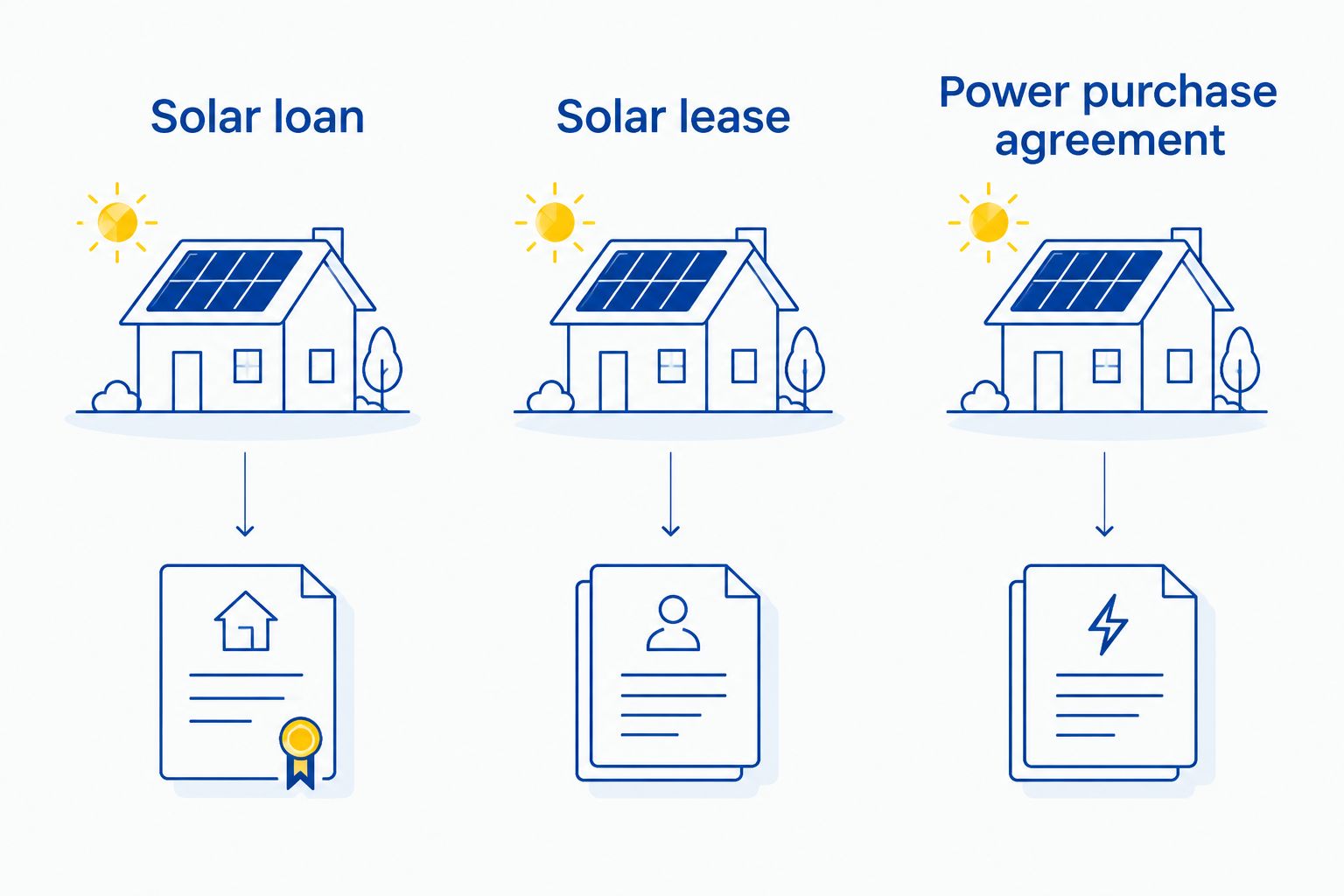
Your solar agreement determines the available paths. First establish whether you own the equipment with borrowed money or use equipment owned by a solar provider.
| Arrangement | Who owns the equipment? | What needs to happen at sale? | Best for | Main limitation |
|---|---|---|---|---|
| Solar loan | Usually the homeowner; verify the agreement | Arrange payoff or a lender-approved assumption if permitted | Sellers who want to transfer owned equipment with clear documentation | The buyer cannot simply take over payments without approval |
| Solar lease | Usually the leasing company | Follow the provider’s transfer or contractual buyout process | Sellers with a buyer willing and eligible to accept the lease | Transfer terms and provider approval control the process |
| Power purchase agreement | Usually the provider | Follow the agreement’s transfer or buyout provisions | Sellers whose buyer accepts the electricity-purchase arrangement | Payments concern generated electricity, not repayment of an equipment loan |
| Owned outright | The homeowner | Document ownership and specify included equipment | Sellers transferring equipment without an outstanding solar agreement | Warranty, condition and equipment records still need review |
These are common structures, not a substitute for reading your agreement. A battery, roof work or other improvements can have separate financing even when everything was installed together.
Start with these steps
- Find the signed agreement. Use the contract, amendments and current account statement—not the original sales presentation.
- Request sale instructions. Ask the lender or provider for its payoff and transfer procedures in writing.
- Send documents to the title company. Include any security agreement, filing information and separate battery agreement.
- Agree on responsibilities. State who handles payment, applications, approvals and required documents in the purchase contract.
- Confirm completion before closing. A submitted transfer request is not an approved transfer, and a payoff estimate is not proof of payment.
Keep your real estate agent informed throughout. Your agent coordinates the transaction, but the lender or provider decides whether its agreement can transfer.
Solar loan: payoff or approved assumption
With a solar loan, selling the home does not by itself cancel your debt. Ask whether the loan requires repayment at sale, permits assumption by a qualified buyer or allows another arrangement.
Payoff provides a clear route when the contract requires it or the buyer will not assume the debt. Request an official payoff statement with its expiration date and payment instructions. An account balance is not necessarily the amount needed to settle the loan on the closing date.
If closing proceeds will fund the payoff, have the title company confirm how it will handle payment and any required releases. Compare your expected proceeds after the mortgage, selling expenses and solar payoff; do not assume the sale leaves enough to cover every obligation.
An assumption keeps an existing loan in place with an approved replacement borrower, where the lender permits it. That option preserves cash at closing, but it adds an approval process and depends on the buyer accepting the terms.
Before agreeing to an assumption, ask for written confirmation that you will be released from the obligation. A buyer’s promise to make payments is not the same as the lender releasing you.
Solar lease: follow the provider’s transfer terms
A solar lease generally gives you use of equipment owned by the leasing company. You therefore cannot promise the buyer ownership of those panels simply because they are attached to your roof.
Ask the provider for its home-sale package before you list. That package should explain the steps required under your agreement, including buyer review, signatures and any contractual alternatives to transfer.
A transfer lets a willing buyer continue the existing arrangement, subject to approval. Its limitation is equally clear: the buyer must evaluate an ongoing contract rather than receive owned equipment without that obligation.
If the buyer declines the lease, review the agreement’s purchase, termination or other sale provisions with the provider. Do not promise a buyout or equipment removal until the contract confirms that option. Have your agent address the agreed outcome in the purchase contract.
Power purchase agreement: transfer the electricity contract
Under a power purchase agreement, commonly called a PPA, you generally buy electricity generated by provider-owned equipment. That differs from borrowing money to purchase the panels.
A prospective buyer needs the full agreement, including payment terms, remaining obligations and any scheduled changes. Giving the buyer only a recent bill leaves out the contract they are being asked to accept.
The advantage of an approved transfer is continuity under the existing agreement. The trade-off is that the buyer must accept its remaining terms, and the provider must complete its required process.
For a 2026 sale, request current transfer instructions rather than relying on what a salesperson described when the system was installed. If the agreement offers an alternative to transfer, get the provider’s written explanation before building that alternative into negotiations.
Why the sale process varies
The equipment on the roof does not tell you enough about the paperwork underneath it. These factors determine what your transaction needs:
- Ownership structure. A loan, lease and PPA create different rights and obligations. Identify the signed agreement before discussing transfer.
- Transfer provisions. The contract determines whether assumption, assignment or a buyout is available and what approval requires.
- Recorded documents. A security interest or financing filing needs review by the title company, even when it concerns equipment rather than the real estate itself.
- Buyer financing. The buyer’s mortgage lender must evaluate the proposed transaction under its own requirements. Share the solar documents early.
- Separate equipment agreements. A battery or related improvement can carry an obligation separate from the panels. Check every relevant account.
- Closing readiness. Payoff statements, approval letters and release documents must match the agreed transaction. Unfinished paperwork is not a completed resolution.
Avoid treating every solar filing as a mortgage lien. A UCC financing statement can concern a security interest in equipment; fixture filings and real-property liens raise different questions. Ask the title company to identify what is recorded and what action the sale requires.
What should you give the buyer before accepting an offer?
Give the buyer enough information to evaluate both the equipment and any continuing obligation. A clear document package is more useful than a general claim that solar lowers bills.
For your 2026 listing file, gather:
- The signed solar agreement and amendments.
- The latest statement and the provider’s sale instructions.
- An equipment list covering panels, inverter and battery, if installed.
- Available installation, permit and inspection records.
- Warranty documents and their transfer conditions.
- Available production records and utility bills, clearly identified by date.
- Monitoring access instructions and the process for changing account ownership.
Historical production is evidence of past performance, not a guarantee of the buyer’s future bill. Household usage, weather, utility rates and equipment condition affect the result.
Explain battery backup separately. Identify which circuits the system supports and provide the available operating documents; do not describe the home as having uninterrupted whole-home power unless the actual design and operating limits support that statement.
Will solar panels increase your sale proceeds?
Do not assume a higher sale amount will cover your remaining solar balance. Equipment ownership, condition, documentation and the buyer’s appraisal process are distinct from what you still owe.
Ask your real estate agent to evaluate relevant local comparable sales. Give the appraiser accurate system information through the transaction’s normal process, and keep projected electricity savings separate from an asserted property value.
A useful negotiation compares complete outcomes: your net proceeds after an agreed payoff versus the terms of a permitted transfer. There is no reliable shortcut in which the loan balance automatically becomes added home value.
How do you choose financing if you expect to move?
Choose solar panel financing with an exit you understand, not just a payment you can manage. Ask the lender to point to the contract language covering a home sale before you sign.
Bring these questions to a 2026 financing discussion:
- Does selling the property trigger repayment?
- Can a buyer assume the loan, and who approves that request?
- What written document releases the original borrower?
- What security interest or filing accompanies the financing?
- Are the panels and battery covered by the same agreement?
- Which warranty and support arrangements continue after ownership changes?
Keep equipment design and financing approval separate. The installer explains the system; the lender explains the debt; your title company explains closing requirements.
Alpha Solar Solutions is best for San Antonio homeowners seeking local solar installation with battery backup. Its local team, custom system designs and support after installation belong in the equipment discussion, while your lender remains the source for binding financing terms.
For a new installation, a free consultation with Alpha Solar Solutions can start with your electricity use, outage priorities and plans to move. Ask for a design that explains the equipment and backup scope without assuming guaranteed savings or incentive eligibility.
Discuss your solar and battery plans
Ask Alpha Solar Solutions about a custom system and explain any plans to sell your home.
FAQ
Can I sell my house if I still owe money on solar panels?
Yes, but the sale must address the outstanding solar obligation under your agreement. Arrange a payoff or a permitted, approved transfer, and have the title company confirm the closing requirements.
Does the buyer have to take over my solar loan?
No, a buyer does not automatically take over your solar loan. An assumption requires agreement from the buyer and approval from the lender where the contract permits it.
Can I pay off solar panel financing with my home sale proceeds?
A payoff from sale proceeds is an option when the transaction provides enough funds and the closing arrangements support it. Give the title company an official payoff statement and confirm any required release process.
What happens if a buyer refuses my solar lease?
Review the lease’s contractual alternatives with the provider before promising a solution. A purchase, termination or other arrangement is available only if the agreement permits it and its requirements are met.
Is a solar UCC filing the same as a mortgage lien?
No, a UCC filing is not automatically the same as a mortgage lien. Ask the title company what the specific filing covers and whether a release, amendment or other action is required for your sale.
Does the battery transfer with the solar panels when I sell?
Check the battery’s ownership, financing and warranty documents separately. Include the battery explicitly in the sale agreement and confirm whether its accounts or obligations require a separate transfer.
Can I promise the buyer the same electricity bill I have?
No, your electricity bill does not guarantee the buyer’s future bill. Share dated production and utility records, and explain that usage, weather, rates and system condition affect the outcome.
One last thing
A completed financial transfer does not automatically give the buyer access to system monitoring. Before your 2026 closing, confirm who changes the monitoring account, where the equipment documents will go and how the buyer requests service.
Hand over the system’s operating information with the house keys. The buyer needs to understand the solar equipment and battery controls, not just know that the final financing document was signed.
Related guides
- Solar panels in San Antonio: add a battery now or later
- Can solar battery backup run your central air conditioner?
- Solar installation in San Antonio: handling HOA approval