
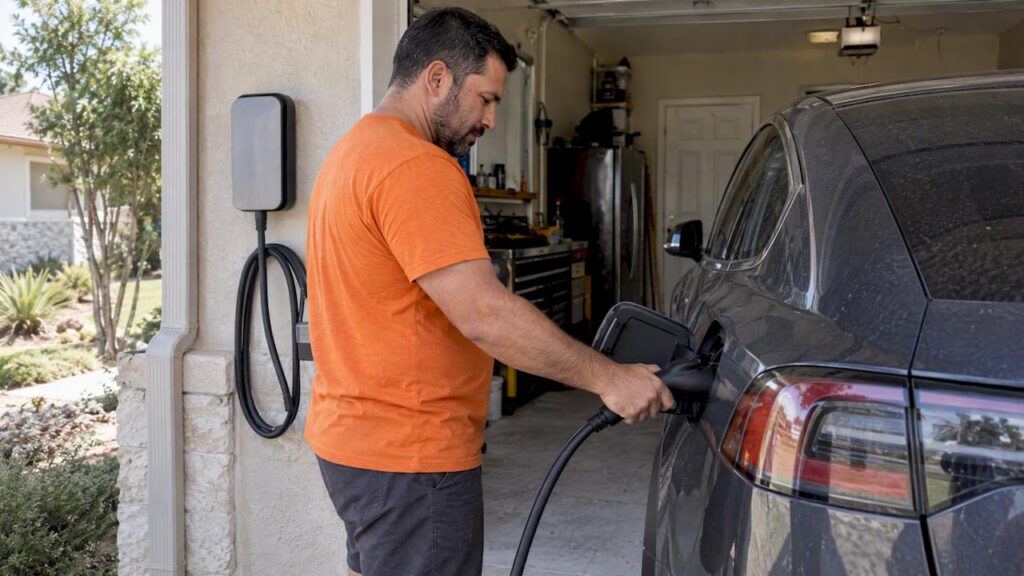
An outdoor-rated EV charger is built to survive rain, dust, humidity and temperature swings, so you can mount it on an exterior wall, a carport post or a pedestal. An indoor charger is only designed for a dry, sheltered spot like a closed garage. If there is any chance water, sprinklers or blowing dust will reach the unit, buy the outdoor-rated one. It also works fine inside a garage, so it is the safer default for most San Antonio homes.
Below, we explain what the ratings mean, where each type belongs, why Texas sun matters even with a weatherproof unit, and what to check before you buy.
TL;DR
- Outdoor-rated chargers work indoors too. Indoor-only chargers should never go outside. When in doubt, choose the outdoor-rated unit.
- Look for the rating on the label, not the marketing. NEMA 3R or 4 (or an IP rating such as IP54 to IP65) tells you what the enclosure was tested against.
- The charger is only half of a weatherproof install. Conduit, fittings and wiring must also be rated for wet locations.
- San Antonio sun is a real factor. Shade extends the life of plastics and electronics, even on a rated unit.
- Permit and inspection are required in San Antonio for an EV charger circuit, whether it is inside or outside.
Table of Contents
- What “outdoor rated” actually means
- Indoor chargers: where they are fine and where they are not
- Outdoor-rated chargers: where they earn their keep
- Side-by-side comparison
- The charger is only part of a weatherproof install
- Why San Antonio heat changes the conversation
- Charging speed does not depend on indoor or outdoor
- Permits and inspection in San Antonio
- A quick decision guide
- Our perspective
- Get the install done right
- FAQ
- Sources
What “outdoor rated” actually means
A charger label that says “outdoor rated” is shorthand for a specific test result. Two rating systems show up on EV chargers, and they measure similar things in different ways.
NEMA ratings
NEMA ratings come from the National Electrical Manufacturers Association and describe an enclosure in real-world service. The ones you will see most often:
- NEMA 1: indoor use only. Protects against casual contact with the unit and falling dirt. It is not meant for rain.
- NEMA 3R: outdoor use. Handles rain, sleet and snow, and stays undamaged by external ice. It is not designed for hose-directed water.
- NEMA 4: outdoor use. Adds protection against windblown dust and water sprayed from a hose.
- NEMA 4X: everything in NEMA 4, plus corrosion resistance, which matters near the coast or in salty, chemical-heavy air.
In plain terms: a NEMA 3R or NEMA 4 charger is what most homeowners want on an exterior wall.
IP ratings
IP stands for ingress protection. It is a two-digit code. The first digit covers solid objects like dust, the second covers water. A higher number means better protection. For example, IP54 is dust-protected and shrugs off splashing water, while IP65 is fully dust-tight and handles water jets. Both are outdoor-capable. Some manufacturers publish IP ratings, others publish NEMA, and many publish both.

For a concrete example, one widely installed Level 2 wall unit is rated IP55 in its US installation manual, which tells installers not to add caulk, sealant or adhesive because the supplied screws already carry sealing washers. That detail matters: a rated charger is a tested system, and extra DIY sealing can work against it.
What the rating does not tell you
Neither scale says much about ultraviolet (UV) exposure. A unit can be perfectly watertight and still have its plastic housing chalk, crack or fade after years of strong sun. We come back to this in the San Antonio section below.
Indoor chargers: where they are fine and where they are not
Indoor chargers are built for a controlled environment: a closed, dry garage with a stable temperature. They are usually a bit cheaper, and that is their main appeal.
They make sense when all of the following are true:
- The charger will be mounted inside an enclosed garage.
- Nothing in the space will spray or splash it: no pressure washer, no sprinkler overspray, no open door facing the weather.
- You are certain you will never move the charger outside later.
They are a poor choice when:
- Your garage door stays open for long stretches, so rain and dust blow in.
- The wall is shared with a damp utility area or a washing area.
- You may move to a carport, driveway or side wall down the road. An indoor-only unit would need to be replaced.
The price gap between an indoor-only unit and an outdoor-rated one is usually small compared with the cost of the electrical work. That is why we rarely see a reason to choose an indoor-only charger at all.
Outdoor-rated chargers: where they earn their keep
You need an outdoor-rated charger whenever any part of it will sit outside the conditioned envelope of the home. Common San Antonio scenarios:
- Driveway or side-of-house parking with the charger on an exterior wall.
- Carports, which are open to wind-driven rain and dust.
- Detached garages or workshops where the door is often open or the building is not sealed.
- Shared or commercial lots where the charger sits on a post or pedestal.
The U.S. Department of Energy’s Alternative Fuels Data Center notes that home charging equipment is safe outdoors when it is explicitly rated for that environment, and that the installation must follow local codes and the National Electrical Code (NEC). In practice that means choosing certified equipment, then having it installed with wet-location wiring methods and ground-fault protection.
Side-by-side comparison
| Factor | Indoor-only charger | Outdoor-rated charger |
|---|---|---|
| Typical rating | NEMA 1 or low IP | NEMA 3R, 4 or 4X; IP54 and up |
| Where it can mount | Closed, dry garage | Garage, exterior wall, carport, pedestal |
| Rain, dust, sprinkler spray | Not designed for it | Designed for it |
| Upfront price | Often slightly lower | Often slightly higher |
| Flexibility if you move it later | Low | High |
| Works inside a garage | Yes | Yes |
| Best for | Sealed garage, never relocated | Almost everyone else |
The charger is only part of a weatherproof install
Homeowners often compare chargers and forget the rest of the circuit. A weather-rated charger on an installation with the wrong parts is still a weak installation.
Here is what has to be right outside:
- Conduit and fittings. Wall-mounted units need watertight fittings where the supply wiring enters the wirebox. The manufacturer’s own installation manual calls for watertight fittings on outdoor installs. Indoor-grade fittings are a common way moisture gets in.
- Wire sizing. The NEC requires the circuit and breaker to be sized at 125% of the charger’s continuous output, a point the Alternative Fuels Data Center lays out for home charging. A 40-amp charger, for example, needs a 50-amp breaker.
- Ground-fault protection. Certified chargers include a built-in personnel protection system that detects ground faults and cuts power to reduce shock risk. UL Solutions explains these systems and why certified equipment matters most in wet or outdoor conditions. Look for a listing mark such as UL on the charger.
- Mounting height and cable management. Mount where the cable reaches your charge port without dragging across a walkway. The Department of Energy’s site-planning guidance stresses accessibility and cord management to prevent tripping hazards. If you want another take on laying out a charging spot, this German-language guide to charging infrastructure planning covers cable placement and weather protection for e-bike charging, and many of the layout ideas carry over.
- No extra sealant. Follow the manual. More caulk is not more protection.
Why San Antonio heat changes the conversation
Water gets the attention, but in South Texas the sun does more slow damage. Federal best-practice guidance for charging installations points out that structural shade or a canopy protects equipment from direct solar radiation, which can wear down plastics and sensitive electronics over time, even when the unit carries a weather rating.
What that means for your wall:
- Pick the shadiest practical mounting spot. A north- or east-facing wall beats a west-facing one that bakes all afternoon.
- Add a roof overhang, carport roof or small canopy if the spot is exposed.
- Keep the charger off the hottest surfaces, such as a wall with no shade that reflects heat all day.
- Consider the garage anyway. Even though an outdoor-rated unit can live outside, an enclosed garage often keeps it cooler. If you have a garage space, the best setup is often an outdoor-rated charger mounted inside it.
That last point answers the keyword question neatly. Indoor versus outdoor is not always a choice between two chargers. Often it is a choice of location, and the outdoor-rated unit is the one that gives you both options.
Charging speed does not depend on indoor or outdoor
A common mix-up: people assume outdoor chargers are faster or slower. They are not. Speed comes from the charging level and the circuit.
- Level 1 uses a standard 120-volt outlet and adds roughly 2 to 5 miles of range per hour, which suits vehicles parked for seven hours or more.
- Level 2 uses a 240-volt circuit and typically adds 10 to 33 miles of range per hour, depending on your vehicle and the charger’s power output.
Is Level 1 bad for your battery? Not according to the guidance we reviewed: it is a gentle, standard way to charge. Level 2 is preferred at home mainly for convenience, because it refills a daily commute’s worth of range well within an overnight window.
If you plug a Level 1 cord into an outdoor outlet, treat that as a separate safety question. The outlet and cord need to be rated and protected for wet locations, and a dedicated Level 2 circuit is usually the better long-term answer.
Permits and inspection in San Antonio
The location of the charger does not change the paperwork. The City of San Antonio adopted the 2024 International Code Council codes on January 30, 2025, and those codes incorporate the NEC. For an EV charger, that means an electrical permit from the city’s Development Services Department before work starts, and an inspection once the installation is complete.
This is one more reason to hire a licensed electrical contractor rather than treat a charger as a weekend project. We walk through the steps in our EV charger permit checklist for San Antonio homeowners.
If your home is in an HOA, check the rules about exterior fixtures before you pick a wall. Our guide to handling HOA approval for solar applies in the same way to exterior charger placement.

A quick decision guide
Work through these questions in order:
- Will the charger ever be outside the closed garage envelope? If yes, outdoor-rated, no exceptions.
- Is the garage truly sealed, and will it stay that way? If you are unsure, outdoor-rated.
- Do you want flexibility to move it later? Outdoor-rated.
- Is the spot in direct sun? Add shade, or choose a shadier wall.
- Is a certified listing mark on the label? If not, skip it.
- Is the circuit sized at 125% of the charger’s continuous load, with wet-location fittings? Ask your installer to confirm.
Our perspective
We install EV chargers across San Antonio and within about 50 miles of the city, and the most common mistake we see is not a bad charger. It is a good charger paired with the wrong plan around it: a wall that gets full afternoon sun, fittings that are not meant for wet locations, or a placement the homeowner regrets once the cord has to cross a walkway.
Our advice is simple. Buy the outdoor-rated unit even if you plan to mount it in the garage. The flexibility is worth it, and you will not have to redo anything if your parking situation changes. Then spend your attention on the installation: shade, conduit, circuit sizing, permit and inspection.
Because we also design solar and battery systems, we like to look at the whole picture. If you have solar panels or are planning them, the charger can be placed and sized with your system in mind, so overnight or daytime charging fits your energy plan rather than fighting it.
— Anthony
Get the install done right
If you want a charger on your driveway wall, in your garage or under your carport, our team can help you choose the right unit, place it, and handle the work to code. See our EV charger installation service or contact us through our site to talk through your setup. We serve San Antonio and the surrounding area within a 50-mile radius.
FAQ
Can an EV charger be installed outside?
Yes, as long as the charger is explicitly rated for outdoor use and the installation follows the NEC and local code. That includes wet-location wiring methods, watertight fittings and ground-fault protection. In San Antonio you also need an electrical permit and an inspection.
Can I use an outdoor-rated charger inside my garage?
Yes. An outdoor-rated charger is built to a tougher standard, so it works anywhere an indoor unit would. It is also the more flexible choice if you later move it or the garage door is open often.
Is an IP rating or a NEMA rating better?
Neither is better; they are different scales. NEMA 3R and 4 and IP54 to IP65 are all reasonable for a home charger. Match the rating to your exposure: a covered carport needs less than a bare wall facing the weather, and a coastal or chemical-heavy site may call for NEMA 4X.
Does outdoor charging slow down or damage my car’s battery?
No. Weather does not change how your car manages its battery. Level 1 and Level 2 charging are both standard AC charging, and the vehicle controls the charge profile. The sun and heat affect the charger hardware over time, which is why shade helps.
Do I need a permit for an outdoor EV charger in San Antonio?
Yes. The city requires an electrical permit from the Development Services Department before installation and an inspection afterward. A licensed electrical contractor will normally handle both for you.
Sources
- Alternative Fuels Data Center: Charging Electric Vehicles at Home
- Wall connector installation manual, steps 2, 3 and 4 (US)
- Wall connector installation manual (watertight fittings)
- UL Solutions: EV service equipment personnel protection systems
- Physical site security for charging stations (AFDC)
- Best practices for EVSE installations (AFDC)
- Electric Vehicle Charging for Multifamily Housing (U.S. Department of Energy)
- Alternative Fuels Data Center: Vehicle Search
- Codes & Ordinances, City of San Antonio