

TL;DR:
- Accurate 12-month utility data is essential for designing an effective Texas solar system.
- Tailored sizing and utility rate analysis maximize savings and prevent system underperformance.
- Adding batteries enhances resilience and can improve long-term return despite higher upfront costs.
Texas electricity bills have a way of creeping higher every summer, leaving homeowners guessing how much they actually spend year to year. If you’ve wondered whether solar can genuinely cut your costs or if the numbers are too complicated to trust, you’re not alone. This guide walks you through a clear, step-by-step workflow to model your savings, size your system correctly, add battery backup if it makes sense, and verify that your investment is performing. Every step is grounded in real data and local Texas conditions, so you can move forward with confidence instead of guesswork.
Table of Contents
- What you need before starting: Building your solar energy profile
- Step-by-step: Calculating your potential solar energy savings
- Optimizing your system: Batteries, backup, and the Texas grid
- Validating your savings: Monitoring, troubleshooting, and continuous improvement
- Why a custom workflow beats cookie-cutter solar solutions in Texas
- Ready to save? Start your solar journey with expert support
- Frequently asked questions
Key Takeaways
| Point | Details |
|---|---|
| Start with 12 months of data | Gathering a full year of utility bills is essential for accurate solar savings calculations in Texas. |
| Customize your system size | Match your solar system to your peak energy needs, especially high summer AC use, to avoid undersizing. |
| Leverage batteries for resilience | Adding batteries can boost energy independence and take advantage of buyback programs while qualifying for tax credits. |
| Monitor and adjust savings | Ongoing monitoring and troubleshooting ensure your solar investment delivers the expected utility cost reduction. |
What you need before starting: Building your solar energy profile
With your intent to boost energy savings, your first step is to gather the right data to design your unique solar solution. Skipping this step is the single biggest reason homeowners end up with a system that underperforms or takes longer than expected to pay off.
Start with your electricity bills
Accurate modeling needs 12 months of electric bill data to account for time-of-use rates, peak AC usage, and variable Texas climate conditions. One summer month alone won’t show you the full picture. You need to see how your usage shifts from a mild March to a brutal August.
Here’s what to pull from each bill:
- Kilowatt hours (kWh) used — this is your actual energy consumption, not just the dollar amount
- Your utility rate per kWh — this changes by season and sometimes by time of day
- Any demand charges or tiered pricing — common with larger Texas homes
- Billing credits or buyback payments — relevant if you already have partial solar or if your utility offers a net metering program
Assess your roof and available space

Beyond bills, you need a basic roof assessment. Note the direction your roof faces (south-facing is ideal in Texas), the age of the roof, and whether any trees or structures cast shade during peak sun hours. A roof that needs replacement in three years should be addressed before installation.
Use this quick-reference table to organize your data before modeling:
| Data point | Where to find it | Why it matters |
|---|---|---|
| Monthly kWh usage | Your utility bill | Sizes the system correctly |
| Rate per kWh | Utility bill or provider website | Calculates dollar savings |
| Time-of-use schedule | Utility website | Identifies peak cost windows |
| Roof orientation and age | Home inspection report | Affects panel output and placement |
| Buyback or export rate | Utility or Texas solar guide | Impacts payback period |
For a broader overview of what documents and approvals you’ll need, the solar installation checklist from Mianro Solar covers permit requirements and utility interconnection steps.
Pro Tip: Document your time-of-use rates separately for summer and winter. In Texas, the gap between peak and off-peak rates can be significant, and a system sized only for average usage may miss the most expensive hours.
Step-by-step: Calculating your potential solar energy savings
Once you’ve gathered your energy data, it’s time to begin calculating how much you can actually save. This is where many homeowners either oversimplify or overthink the process. A structured approach keeps it accurate.
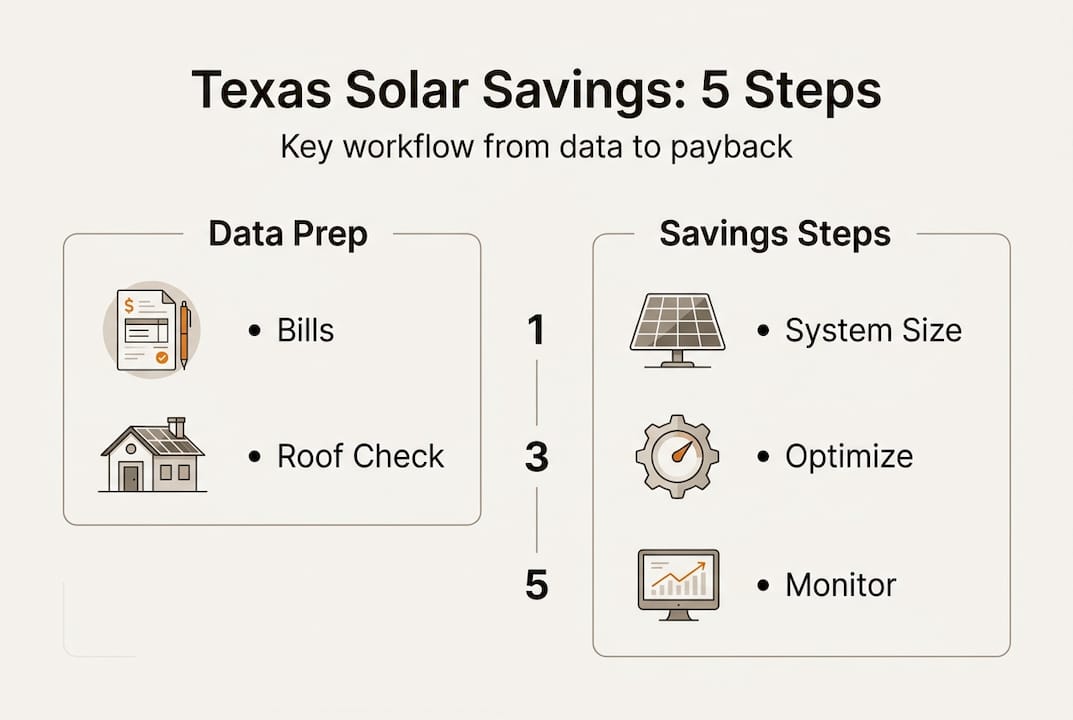
The calculation workflow
- Input your 12-month usage history into a modeling tool. This establishes your baseline consumption in kWh.
- Estimate your system size in kilowatts (kW). A general rule is that 1 kW of solar produces roughly 1,400 to 1,500 kWh per year in Texas, though your roof angle and local shading will affect this.
- Apply the federal Investment Tax Credit (ITC). In 2026, the ITC allows you to deduct 30% of your total system cost from your federal taxes. This significantly reduces your net upfront cost.
- Project your utility savings by multiplying your expected annual production by your current rate per kWh.
- Calculate your payback period by dividing your net system cost (after ITC) by your annual savings.
Solar payback analysis factors in upfront costs, ITC credits, historical usage, and projected utility savings. Missing any one of these inputs skews the result.
Modeling tool comparison
| Tool type | Best for | Accuracy level | Cost |
|---|---|---|---|
| Online calculators | Quick estimates | Moderate | Free |
| Professional energy audit | Custom system design | High | Paid |
| Spreadsheet templates | DIY detailed modeling | High (if done right) | Free |
Caution: If your bills show a spike every July and August, don’t model based on your annual average alone. Ignoring seasonal spikes leads to undersized systems that leave your highest-cost months uncovered.
For a deeper look at how the solar panels savings process works from design to payback, we break it down with Texas-specific numbers. You can also revisit the homeowner savings calculation section of our Texas guide for additional context.
Pro Tip: Always size your system to your peak AC demand, not your average monthly usage. Texas summers are the reason most homeowners go solar, and your system should be built to handle them.
For installation steps and solar system design steps that align with your savings model, reviewing permit and grid connection requirements early prevents delays.
Optimizing your system: Batteries, backup, and the Texas grid
With your basic system and savings calculated, optimizing your workflow for energy independence and outage protection is the next step. Texas’s grid has a documented history of instability, and many homeowners are choosing to add battery storage for reasons beyond just saving money.
Grid-tied vs. backup battery systems
A grid-tied system without storage sends excess power back to the grid and draws from it at night. It’s the lower-cost option and works well if your utility offers fair buyback rates. A battery backup system stores your excess solar energy at home, giving you power during outages and letting you avoid drawing from the grid during peak-rate hours.
Batteries provide resilience during outages and support buyback strategies, but they do add to upfront costs. The good news is that batteries are ITC eligible when paired with a solar system, which softens that cost considerably.
Key benefits of adding battery storage:
- Outage protection — keeps critical appliances running when the grid goes down
- Peak shaving — draws stored energy during high-rate hours instead of paying premium grid prices
- Buyback optimization — exports stored power during peak buyback windows for maximum credit
- Energy independence — reduces reliance on a grid that has shown vulnerability during extreme weather
For a detailed breakdown of how solar battery storage affects your overall system cost and savings, we cover the numbers in full. You can also explore long-term solar savings tips and how to maximize solar ROI once your system is running.
For a closer look at how batteries impact payback, Hello Solar’s analysis shows that the payback period can extend by two to four years with storage, but the added resilience often justifies the investment for Texas homeowners.
Pro Tip: Before adding a battery, model your buyback plan using your utility’s actual export rate, not a generic estimate. Some Texas utilities offer strong export rates that make storage less financially necessary, while others offer very little, making storage the smarter choice.
Validating your savings: Monitoring, troubleshooting, and continuous improvement
Having optimized your system, make sure your savings are real and persistent through monitoring and fine-tuning. Installation is not the finish line. It’s the starting point for a long-term energy ownership strategy.
How to monitor your system
Most modern inverters (the device that converts solar energy into usable electricity) come with a companion app that shows real-time production, daily totals, and historical trends. Check it monthly and compare your actual output to your original projections.
Troubleshooting steps if savings lag:
- Check your monitoring app for any error alerts or production drops that weren’t there before.
- Compare season-over-season — a drop in October compared to the previous October is a red flag worth investigating.
- Inspect for shade changes — new tree growth or a neighbor’s addition can reduce output significantly.
- Check for panel soiling — dust and pollen buildup in Texas can reduce output by 5% to 15%.
- Consult a professional if output has dropped more than 10% without an obvious cause.
Regular monitoring, tracking seasonal changes, and system cleaning can boost long-term ROI and prevent underperformance from going unnoticed for months.
Texas savings benchmarks
| System size | Avg. annual production (TX) | Expected annual savings | Typical payback range |
|---|---|---|---|
| 6 kW | 8,400 to 9,000 kWh | $1,100 to $1,400 | 7 to 9 years |
| 8 kW | 11,200 to 12,000 kWh | $1,450 to $1,850 | 7 to 9 years |
| 10 kW | 14,000 to 15,000 kWh | $1,800 to $2,300 | 7 to 10 years |
If your actual savings are consistently below projections, revisit your original system sizing assumptions and check whether your utility rate has changed. Rate increases actually improve your ROI going forward, but they can also signal that your system needs to be expanded.
For practical guidance on improving solar panel ROI and understanding your solar energy savings over time, we cover the most common adjustments homeowners make after year one. System performance benchmarks from Mianro Solar can also help you compare your output against Texas norms.
Why a custom workflow beats cookie-cutter solar solutions in Texas
Now that we’ve examined the workflow, here’s why a personalized strategy is not just preferred — it’s essential for real savings.
Generic online calculators are built for national averages. Texas is not average. The state has its own deregulated energy market, extreme seasonal swings, and grid policies that change more frequently than most states. A calculator that doesn’t account for your specific utility’s buyback rate or your zip code’s peak sun hours will produce numbers that look good on screen but don’t hold up on your actual bill.
We’ve seen homeowners come to us after using a popular national tool that suggested a 6 kW system would cover their needs. When we modeled their actual 12-month usage, including three months of 2,000-plus kWh summers, the right size was closer to 9 kW. That gap represents thousands of dollars in missed savings over the system’s lifetime.
A personalized approach prevents costly under-sizing and leverages incentives that generic modeling often misses. Local policy changes, utility rate structures, and your home’s unique load profile all feed into a model that only works when it’s built around your data.
The workflow steps in this article are designed to be revisited. As your usage changes, as rates shift, or as you add an EV charger or a battery, your savings model should be updated. Think of it as a living document, not a one-time calculation. For homeowners considering custom solar battery planning, starting with accurate data makes every downstream decision sharper.
Ready to save? Start your solar journey with expert support
If you’re ready for measurable savings and peace of mind, your next step is just a click away.

At Alpha Solar Solutions, we design every system around your actual usage data, your roof, and your local utility rates. No generic estimates. No surprises. Our team handles everything from custom system design to installation, and we stay with you after the panels are up to make sure your savings hold. Explore our residential solar installation options to see what a tailored system looks like for your home. You can also revisit our Texas solar savings guide for more detail on incentives and planning. And when your panels need attention, our panel cleaning services keep your output where it should be.
Frequently asked questions
How many months of utility data should I use for solar modeling?
You should use 12 months of electric bills to model your solar savings accurately, accounting for Texas’s seasonal variations in AC usage and utility rates.
Do batteries qualify for solar tax credits in Texas?
Yes, batteries are ITC eligible when paired with a solar system, allowing you to deduct 30% of the battery cost from your federal taxes in 2026.
How can I tell if my solar system is underperforming?
Regularly compare your current utility bills and monitor your system’s app output. Monitoring seasonal changes helps you catch drops in production before they cost you months of savings.
What is the biggest mistake when designing a solar system for Texas?
Undersizing the system by not matching it to peak AC usage is the most common and costly error, leaving your highest-cost summer months uncovered.
Recommended
- Solar energy guide: Texas homeowner savings in 2026
- Texas solar savings: your complete guide for long-term success
- Solar Solutions Archives – Alpha Solar Solutions, LLC
- Solar Panels Archives – Alpha Solar Solutions, LLC
- Master Solar Energy Consumption Optimization for Homes
- Navigate the Texas energy choice workflow in 5 steps