

TL;DR:
- Accurately sizing your solar system requires your home’s energy usage and local sunlight data.
- Use formulas and tools like PVWatts to determine the optimal system size tailored to your home.
- Consult local experts to verify feasibility, address shading, roof conditions, and future energy needs.
Electricity bills in San Antonio keep climbing, and many homeowners are turning to solar to take back control. But one question stops most people before they even get started: how big does my solar system actually need to be? Too small and you’re still paying the utility company. Too large and you’ve spent money you didn’t need to. Getting the size right is the single most important step toward real savings, and this guide walks you through every part of that process, from reading your energy bills to confirming your final system size with a local expert.
Table of Contents
- Gather your home’s energy usage and understand local sunlight
- Calculate your optimal solar system size
- Adjust for your roof, home factors, and future needs
- Confirm feasibility and verify with solar experts
- A smarter approach to solar sizing in San Antonio
- Get local expertise for your solar project
- Frequently asked questions
Key Takeaways
| Point | Details |
|---|---|
| Start with your kWh | Add up your past year’s energy use for an accurate solar baseline. |
| Customize for San Antonio sun | Peak sun hours and roof tilt dramatically affect the right system size. |
| Use expert-verified calculations | Double-check numbers with a local professional installer before buying. |
| Plan for the future | Consider EVs and other future needs when sizing your solar investment. |
Gather your home’s energy usage and understand local sunlight
Now that you understand why sizing is so important, start by gathering the essential data unique to your home and location. This is the foundation of everything that follows, and the good news is that most of what you need is already available to you.
Start by pulling your electric bills from the past 12 months. You’re looking for the kilowatt-hour (kWh) number on each bill. A kilowatt-hour is simply the unit your utility uses to measure how much electricity you consumed. Add all 12 monthly figures together to get your annual usage. Most San Antonio homes use between 12,000 and 18,000 kWh per year, though homes with pools or older HVAC systems can run higher.
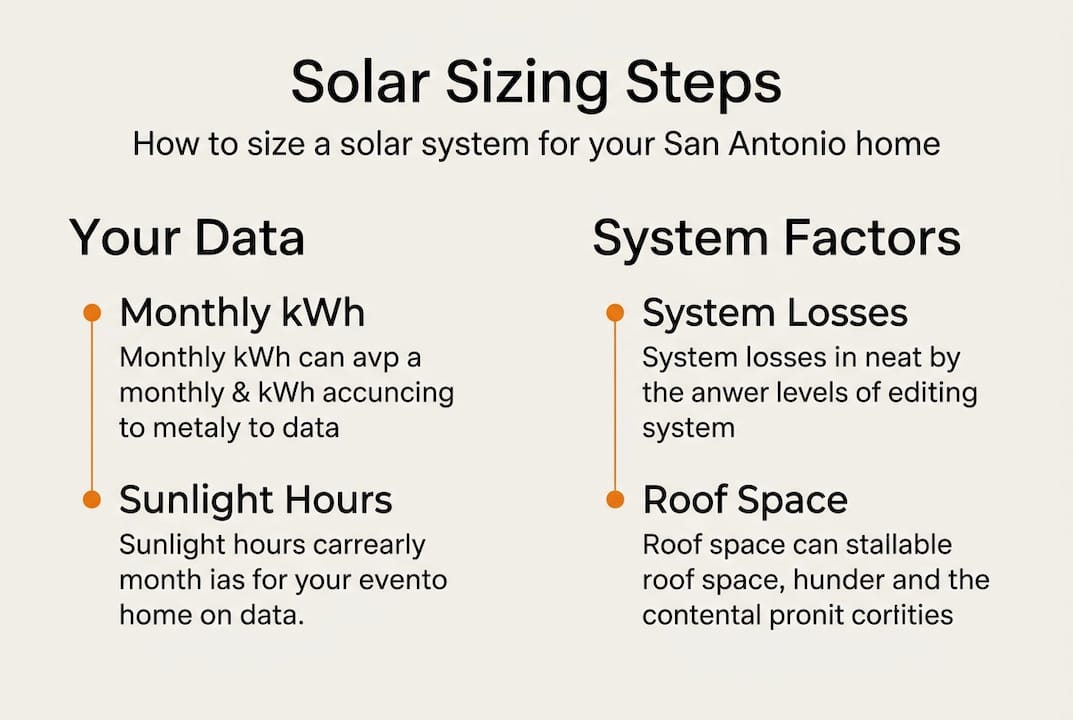
Next, consider how much sunlight your roof actually receives. San Antonio is one of the sunniest cities in Texas, and peak sun hours average 5.2 to 5.5 per day, which is excellent for solar production. Peak sun hours measure the intensity of sunlight, not just the hours of daylight. This number is critical because it directly affects how much energy your panels will generate each day.
Several factors can reduce the effective sun hours your system captures:
- Roof shading from trees, chimneys, or neighboring buildings
- Roof tilt angle (flat roofs produce less than optimally tilted ones)
- Panel orientation (south-facing is best; east or west reduces output slightly)
- Seasonal weather patterns (San Antonio’s summer storms can affect short-term production)
Here’s a quick look at how monthly usage translates into estimated system size:
| Monthly avg kWh | Annual kWh | Estimated system size |
|---|---|---|
| 900 kWh | 10,800 kWh | ~5 kW |
| 1,100 kWh | 13,200 kWh | ~6 kW |
| 1,400 kWh | 16,800 kWh | ~8 kW |
| 1,700 kWh | 20,400 kWh | ~10 kW |
Understanding the solar power benefits specific to San Antonio will also help you appreciate why accurate data collection pays off in the long run.
Pro Tip: Log into your CPS Energy online account to see your average monthly consumption over the last year. This is faster and more accurate than digging through paper bills, and it often shows usage patterns that help you plan better.
Once you have your annual kWh and a clear picture of your local sunlight, you have everything you need to move to the calculation step. If you want a deeper look at solar panel basics before continuing, that’s a great place to build your confidence.
Calculate your optimal solar system size
With your data in hand, you’re ready to crunch the numbers and see what system size truly fits your energy profile. The formula is simpler than it looks.
Here’s the step-by-step process:
- Find your annual kWh usage. Use the 12-month total from your bills.
- Divide by 365 to get your average daily usage in kWh.
- Divide by your peak sun hours (use 5.2 to 5.5 for San Antonio).
- Divide by 0.86 to account for system losses like heat, wiring, and inverter inefficiency.
- The result is your recommended system size in kilowatts (kW).
The system size formula is: annual kWh divided by (365 times sun hours times 0.86 performance ratio). In San Antonio, 1 kW of solar capacity produces roughly 1,600 to 1,900 kWh per year.
Let’s run a real example. Say your home uses 13,200 kWh per year:
- 13,200 divided by 365 = 36.2 kWh per day
- 36.2 divided by 5.3 sun hours = 6.8
- 6.8 divided by 0.86 = ~7.9 kW system
A 6 kW system is the most common starting point for mid-size San Antonio homes. It typically covers the energy needs of a 3-bedroom home with central air conditioning, a refrigerator, washer, dryer, and standard lighting.
Here’s a comparison to help you match your usage to a system size:
| Annual kWh usage | Recommended system size | Est. panels (400W each) |
|---|---|---|
| 9,000 kWh | ~5.5 kW | ~14 panels |
| 12,000 kWh | ~7 kW | ~18 panels |
| 15,000 kWh | ~8.5 kW | ~22 panels |
| 18,000 kWh | ~10 kW | ~25 panels |
The 0.86 performance ratio accounts for real-world losses. Every system loses some efficiency due to heat (panels get hot in San Antonio summers), DC to AC conversion through the inverter, and minor wiring resistance. Ignoring this factor leads to undersized systems that fall short of your goals.
You can also run your specific address through the NREL PVWatts calculator to get a localized production estimate. It factors in your exact zip code, roof tilt, and orientation. Reviewing solar installation costs alongside your sizing math helps you understand the full financial picture, and checking available solar tax credits can significantly reduce your out-of-pocket investment in 2026.
Adjust for your roof, home factors, and future needs
After your basic system size is set, you need to account for real-world variables that could affect performance. Numbers on paper don’t always match what’s on your roof.
Roof orientation has a big impact. A south-facing tilt near 29° is ideal for San Antonio, which sits at roughly 29° north latitude. That angle maximizes year-round sun exposure. East or west-facing roofs still work well but typically produce 10 to 15 percent less energy annually.
Any significant shading or incorrect tilt can reduce solar output by up to 20%, which means a system that looked right on paper may consistently underperform in practice.
Before finalizing your system size, check these factors on your actual roof:
- Tilt angle: Is your roof pitch close to 20 to 30 degrees?
- Shading: Are there trees or structures that cast shadows between 9 a.m. and 3 p.m.?
- Roof age: A roof older than 10 to 15 years may need replacement before installation.
- Available space: Do you have enough unobstructed square footage for the number of panels you need?
- Local utility policies: Does CPS Energy allow net metering for your system size?
Space constraints are real. A 10 kW system needs roughly 600 to 700 square feet of usable roof space. If your roof can only fit 400 square feet of panels, your maximum system size is capped regardless of your energy needs.
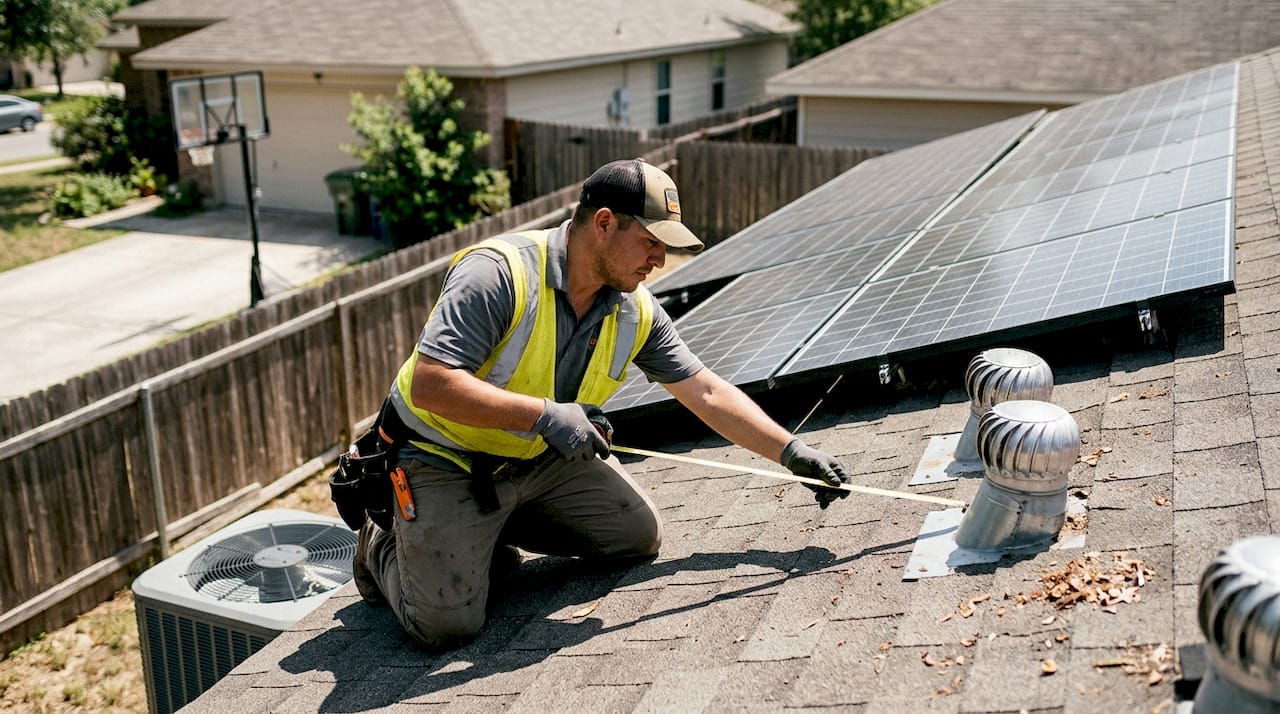
Thinking about the future matters just as much. If you plan to add an electric vehicle, a pool, or upgrade to an all-electric home, your energy needs will grow. To maximize solar ROI over the long term, size your system with those additions in mind now rather than paying for a second installation later.
Pro Tip: Add 10 to 15 percent extra capacity to your calculated system size if you expect to increase your electricity use within the next three to five years. The marginal cost of a few extra panels during initial installation is far lower than a separate upgrade project.
Keeping your panels clean also protects long-term output. Dust and debris in San Antonio’s dry summers can reduce production noticeably, so reviewing solar panel maintenance practices is worth your time once your system is installed.
Confirm feasibility and verify with solar experts
Once you’ve adjusted for home specifics, it’s time for the crucial step of checking feasibility and validating with pros. Your math may be solid, but a professional site assessment catches things no calculator can.
Here’s a clear process to follow before making any final decisions:
- Review your roof space using satellite imagery tools like Google Maps or your installer’s design software.
- Calculate your system size using the formula above and cross-check with the NREL PVWatts tool.
- Check your electrical panel to confirm it can support a solar system. Older 100-amp panels may need an upgrade.
- Consult a certified local installer who can assess shading, structural integrity, and local permit requirements.
- Decide based on a complete proposal that includes production estimates, costs, incentives, and payback period.
Online tools plus a site visit from a trusted installer work together to verify your calculations against real conditions. Neither alone is enough.
A local installer will also review your utility interconnection requirements. CPS Energy has specific rules about how solar systems connect to the grid, and a professional ensures your system qualifies for net metering credits and avoids costly compliance issues.
Don’t overlook incentives. The federal solar tax credit covers 30 percent of your total system cost in 2026. Some financing options also allow you to start saving immediately with no money down. Exploring renewable energy options with a local expert helps you understand every available benefit before you sign anything.
Pro Tip: Never finalize a solar purchase based on an online quote alone. A professional walkthrough of your home takes less than an hour and can save you thousands by catching sizing errors, shading issues, or panel placement problems before installation day.
A smarter approach to solar sizing in San Antonio
Here’s something most solar guides won’t tell you: the biggest sizing mistakes we see don’t come from homeowners doing bad math. They come from homeowners trusting generic online calculators that have no idea what your specific roof looks like, how your household actually uses energy, or what CPS Energy’s current policies are.
Free sizing tools built for a national audience average out variables that genuinely matter in San Antonio. Your roof pitch, your neighborhood’s tree coverage, your summer cooling load — these details shift your ideal system size more than most people expect.
We’ve also seen homeowners accept oversized proposals from installers who benefit from selling more panels. Bigger is not always better. An oversized system costs more upfront and may not qualify for the best utility incentives.
The solar system benefits you actually experience depend entirely on whether your system was sized for your real home, not a statistical average. A measured, local-data approach is the only way to get there. Fast decisions rarely produce optimal long-term value in solar.
Get local expertise for your solar project
For a worry-free, optimized solar investment, work with trusted local professionals who focus on your unique energy goals.
At Alpha Solar Solutions, we design every system specifically for your San Antonio home. That means reviewing your actual energy usage, assessing your roof in person, and building a system that fits your life today and your plans for tomorrow.

Our residential solar experts handle everything from permits and utility interconnection to installation and ongoing support. We also offer solar panel cleaning to keep your system producing at its best year after year. Ready to see exactly what size system your home needs? Contact us today for a free, no-obligation consultation.
Frequently asked questions
How do I calculate my home’s annual kWh usage for solar sizing?
Add up the kWh shown on your electric bills for the past 12 months. That total is your annual kWh usage, which is the starting point for every solar sizing calculation.
Is a south-facing roof necessary for solar panels in San Antonio?
South-facing is ideal and maximizes annual production, but east or west-facing roofs still perform well with slight adjustments to system size and panel placement.
What is the typical size for a Texas home’s solar system?
Most Texas homes need a 6 to 8 kW system, but your actual size depends on your energy usage and roof space. In San Antonio, 1 kW generates roughly 1,600 to 1,900 kWh per year.
Should I oversize my solar system for future electric vehicles or appliances?
Yes. If you plan to increase energy demand with an EV, heat pump, or pool, adding extra capacity now is far more cost-effective than expanding your system later.