

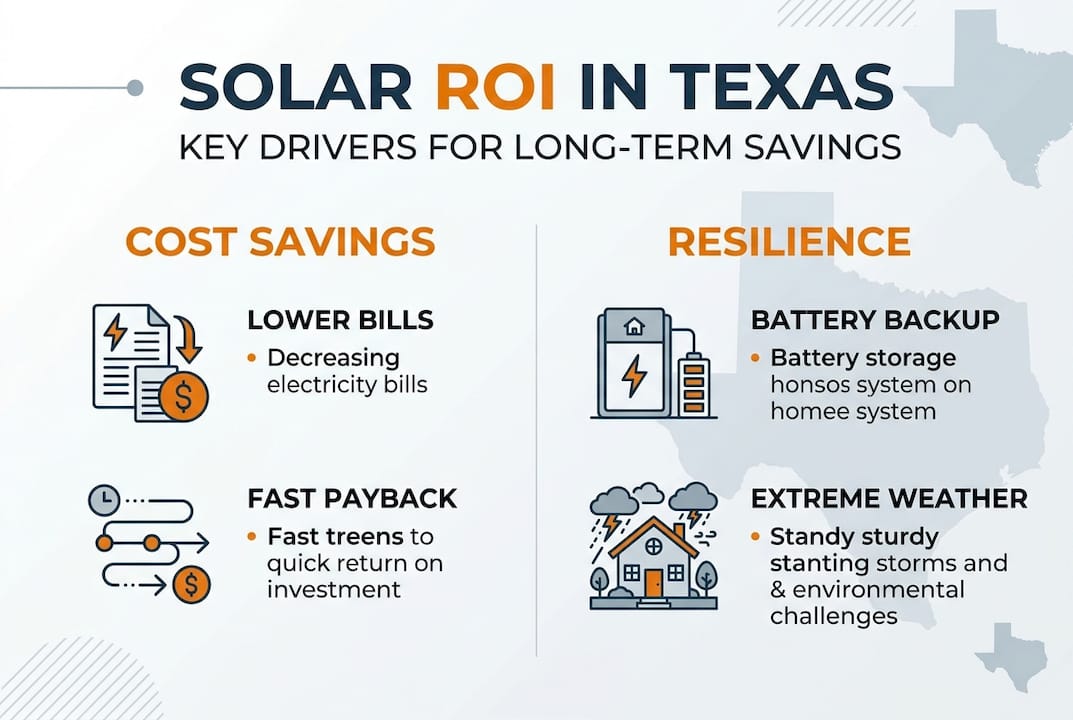
Texas homeowners are paying some of the highest electricity bills in the country, and those rates keep creeping higher every year. If you’ve been told solar is too expensive or too unreliable for Texas, that story is outdated. Between the federal tax credit, permanent property tax exemptions, and the growing role of battery storage, the real question isn’t whether solar saves money. It’s how much, and how fast. This guide walks you through actual costs, incentives, battery value, EV integration, and real-world ROI scenarios so you can make a confident, informed decision.
Table of Contents
- Understanding solar savings in Texas
- Batteries, backup, and extreme weather: maximizing reliability
- Sizing, installation choices, and EV integration
- Real-world ROI scenarios and edge cases
- Make your solar savings real with expert support
- Frequently asked questions
Key Takeaways
| Point | Details |
|---|---|
| Texas-specific incentives | Texas homeowners benefit from federal ITC and permanent property tax exemption for solar projects. |
| Battery storage impact | Adding batteries boosts reliability, enables bill savings, and protects against outages for fast ROI. |
| Customized solar solutions | Sizing, installing, and integrating EV charging with solar maximizes savings and future-proofs your energy. |
| ROI varies by scenario | High-usage, long-term homeowners see best ROI, while renters and low-usage homes should review utility and incentive details. |
Understanding solar savings in Texas
Let’s start with the numbers that actually matter to your wallet. Solar panel costs in Texas average $2.50 to $3.50 per watt before incentives. On a typical 10-kilowatt system, that’s $25,000 to $35,000 before the federal Investment Tax Credit (ITC) reduces your tax bill by 30%. That credit alone saves you $7,500 to $10,500 on a mid-range system. Texas also offers a permanent property tax exemption for the added home value from solar, which means your property taxes won’t go up just because you installed panels.
A common misconception is that solar only makes sense for wealthy homeowners. That’s not accurate. Financing options, including solar loans, make ownership accessible without a large upfront payment. The SEIA recommends cash or loan ownership over leases for maximum long-term savings, and they advise getting multiple bids and verifying all incentives before signing anything.
Here’s a quick look at how costs and savings compare for a typical Texas home:
| System size | Estimated cost (before ITC) | After 30% ITC | Est. annual savings |
|---|---|---|---|
| 8 kW | $20,000–$28,000 | $14,000–$19,600 | $1,400–$1,800 |
| 10 kW | $25,000–$35,000 | $17,500–$24,500 | $1,700–$2,200 |
| 12 kW | $30,000–$42,000 | $21,000–$29,400 | $2,000–$2,600 |
Your actual savings depend on your monthly usage, your utility’s rates, and how long you stay in the home. Homes using 1,400 kilowatt-hours (kWh) or more per month see the strongest ROI. Check out current solar panel pricing and solar ROI tips to sharpen your projections before getting quotes.
Key insight: Solar ROI isn’t just about panel cost. It’s about your usage, your utility’s rate structure, and how long you own the home. The longer you stay, the better the return.
Now that you know why solar can pay off, let’s break down how the numbers stack up for Texas homeowners when you add battery storage.

Batteries, backup, and extreme weather: maximizing reliability
Texas learned a hard lesson in February 2021 when Winter Storm Uri knocked out power for millions of homes for days. Grid-tied solar systems without batteries shut off automatically during outages, leaving homeowners in the dark even with panels on their roofs. That’s why batteries are now considered essential for Texas homeowners who want real energy security.
Adding battery storage does increase your upfront investment. Battery systems add $10,000 to $20,000 to a solar project, but they unlock three major benefits:
- Backup power during ERCOT outages and rolling blackouts
- Self-consumption of solar energy at night instead of buying from the grid
- Virtual power plant (VPP) earnings where utilities pay you to discharge stored energy during peak demand
If your utility charges peak rates of $0.30 per kWh or higher, battery payback can happen in as little as four years. The typical payback range is four to seven years when you factor in peak rate savings and backup value. Understanding battery longevity helps you plan for replacement cycles and long-term budgeting.
Here’s how a solar-only system compares to a solar-plus-battery setup:
| Feature | Solar only | Solar + battery |
|---|---|---|
| Outage protection | None | Yes, hours to days |
| Night-time savings | Limited | High (self-consumption) |
| Peak rate protection | Partial | Full |
| VPP participation | No | Yes |
| Upfront cost | Lower | Higher |
| Long-term ROI | Good | Better |
Pro Tip: Avoid grid-tied-only solar if outage protection matters to you. A battery-backed system keeps your lights, refrigerator, and medical devices running when the grid goes down.
Batteries also protect you from rising energy costs by reducing how much power you pull from the grid during expensive peak hours. That’s a benefit that compounds every year as utility rates increase.
With cost and incentives understood, you need to know how batteries fundamentally alter the reliability and value equation.
Sizing, installation choices, and EV integration
After establishing how batteries add value, it’s time to plan your ideal system setup and future-proof your power needs. Getting the size right is the single most important step. A system that’s too small won’t offset enough of your bill. One that’s too large wastes money on panels you don’t need.
The SEIA recommends sizing your system to cover 80 to 100 percent of your annual electricity use. Here’s how to approach the planning process:
- Pull your last 12 months of electricity bills and calculate your average monthly kWh usage.
- Add 20 to 30 percent if you plan to add an EV charger or increase usage.
- Choose microinverters or power optimizers if your roof has shading from trees or chimneys. These devices let each panel work independently, so one shaded panel doesn’t drag down your whole system.
- Pair your system with a battery sized for at least one full night of essential loads.
- Get a minimum of three bids from licensed installers and verify that each quote includes all applicable incentives.
EV charging integration is one of the smartest moves a Texas homeowner can make right now. Charging your car at home from solar power instead of the grid can save $1,000 to $1,500 per year in fuel and electricity costs. It also increases your total energy offset, which improves your overall ROI. Our solar installation services include EV charger installation designed to work seamlessly with your solar and battery setup.
Pro Tip: Always get multiple bids and ask each installer to confirm which incentives they’ll apply. Some installers miss local utility rebates that can save you hundreds more.
Before committing, review the pros and cons of solar energy for your specific home type and usage pattern. Not every roof or situation is ideal, and knowing the full picture helps you make the right call.
Real-world ROI scenarios and edge cases
Now, let’s look at real-world scenarios and edge cases to help you decide if solar truly fits your situation.
| Homeowner type | Monthly usage | Est. payback | Notes |
|---|---|---|---|
| High-usage family | 1,800 kWh | 6–8 years | Best ROI, strong incentive value |
| Average household | 1,100 kWh | 9–12 years | Good ROI if staying 12+ years |
| Low-usage home | 600 kWh | 13–16 years | Marginal; consider smaller system |
| Solar + battery | 1,400+ kWh | 4–7 years | Best overall value with peak rates |
High-usage homes above 1,400 kWh per month consistently show the strongest return on investment. If your home uses less than 800 kWh monthly, solar may still make sense, but the payback period stretches out and the financial case becomes less clear.
Texas does not have statewide net metering. That means the credit you receive for sending excess solar power back to the grid depends entirely on your utility. CPS Energy, Oncor, and other providers each have their own buyback rates, and some are quite low. This is a critical factor when comparing solar versus utility costs in your area.
Here are a few edge cases worth knowing:
- Renters cannot claim the federal ITC and generally cannot install panels. If you’re renting, community solar programs may be an option.
- Short-term homeowners who plan to move within 10 to 12 years may not fully recoup their investment, though solar does increase resale value.
- Grid-tied solar without a battery shuts off automatically during outages, which surprises many new solar owners.
- Low-usage households should consider a smaller, targeted system rather than a full offset installation.
Key insight: Solar is excellent for sunny, high-rate homes with long ownership timelines. For short stays or low usage, the math requires closer scrutiny.
Visit our solar advice blog for deeper dives into specific scenarios, utility comparisons, and updated incentive information as 2026 programs evolve.
Make your solar savings real with expert support
Reading about solar savings is one thing. Seeing them show up on your monthly bill is another. The difference between a system that performs and one that underdelivers almost always comes down to proper sizing, verified incentives, and quality installation.

At Alpha Solar Solutions, we design residential solar installations built specifically for Texas homes, including battery backup, EV charger integration, and ongoing support. We also offer solar panel cleaning services to keep your system producing at peak efficiency year after year. Dirty panels can lose 15 to 25 percent of their output, so maintenance matters more than most homeowners realize. Ready to see what your home qualifies for? Get your free energy saving quote and let’s build a system that works for your budget, your usage, and your long-term goals.
Frequently asked questions
How long does it take to break even on a solar and battery system in Texas?
Most homeowners reach break-even in 4 to 7 years with a solar and battery system, especially when peak utility rates exceed $0.30 per kWh and the 30% federal ITC is applied.
Are batteries necessary for solar power in Texas?
Batteries are strongly recommended for Texas homeowners because grid-tied solar shuts off during outages, leaving you without power even on a sunny day. After the 2021 winter storm, backup capability became a priority for most families.
What incentives are available for Texas homeowners installing solar?
The federal ITC covers 30% of total project costs and Texas provides a permanent property tax exemption so your home’s increased value from solar won’t raise your tax bill.
How does EV charging change the economics of solar power?
Adding an EV charger increases your total energy offset and can save $1,000 to $1,500 annually in fuel costs. Sizing your system for 80 to 100% offset while accounting for EV charging needs maximizes your long-term return.
Is net metering available everywhere in Texas?
Texas has no statewide net metering policy, so the credit you receive for excess solar power depends on your specific utility provider and their current buyback rate.