Commercial solar installation for business tenants is the addition of solar power to leased premises with the aim of reducing purchased electricity without creating obligations that outlast the tenancy. Your decision depends on more than roof space: the lease, landlord’s approval, electricity account and responsibility for the equipment must all fit together.
- Commercial solar installation on leased premises starts with written landlord approval, meter checks and a clear exit agreement.
- Alpha Solar Solutions serves San Antonio businesses seeking commercial solar installation and battery backup.
- Compare tenant-owned, landlord-owned and third-party-owned systems before choosing equipment.
- Solar panels alone do not provide outage protection; backup requires compatible equipment and a defined load plan.
Why commercial solar installation matters for business tenants
A tenant can pay the electricity bill without controlling the roof. That split makes commercial solar installation a property agreement as well as an electrical project: the party funding the system does not necessarily control how long it stays in place.
For a 2026 project, settle those responsibilities before comparing panel counts. A system that suits your electricity use still needs a workable agreement covering access, repairs, insurance and departure.
Alpha Solar Solutions is best for San Antonio businesses seeking a local contractor for commercial solar installation and battery backup. Start a conversation with Alpha Solar Solutions once you can explain who controls the premises and who pays the electricity account. A consultation can help define the technical scope; it does not replace the landlord’s permission or legal review of the lease.
The practical advantage is control over part of your electricity supply. The constraint is that you are improving someone else’s property. Treat both sides of that decision equally.
How to plan solar for leased business premises
1. Confirm your right to install equipment
Read the lease yourself first. Find the provisions covering alterations, roof access, electrical work, insurance and reinstatement, then ask the landlord to identify the approval process in writing. Do not treat permission to occupy the building as permission to install solar.
A verbal agreement leaves important questions unanswered. Your written agreement should identify the proposed equipment, its location and the people allowed to access it. Have a qualified legal adviser review the terms before you commit to installation.
Best for tenants at the feasibility stage: establish permission before paying for a detailed design. Keep the approval tied to the actual project rather than a general expression of support.
- Identify who can authorize roof and electrical alterations.
- Confirm whether your lease includes any roof rights.
- Document access for installation, inspection and maintenance.
- Ask who approves penetrations and cable routes.
- Record insurance and reinstatement responsibilities.
2. Match the electricity meter to your business
Check your electricity bill against the meter serving your space. Establish whether you have a dedicated account, share a building supply or reimburse the landlord through a service charge. That arrangement determines how solar production would reach your business and how any benefit would be allocated.
A roof above your unit does not prove that a solar connection can serve your account. In a multi-tenant building, the proposed connection point and billing arrangement need particular attention.
Best for businesses sharing a property: resolve metering before comparing system sizes. Ask the contractor and electricity provider to confirm the proposed arrangement rather than assuming the building’s existing setup will work unchanged.
- Locate the meter associated with your bill.
- Identify the account holder and billing responsibility.
- Check whether common areas use a separate supply.
- Ask how exported electricity would be treated.
- Document how benefits would be allocated between occupants.
3. Build a baseline from your actual electricity use
Collect 12 months of electricity bills and any available interval data, which records usage across shorter periods. Start with a spreadsheet showing consumption, operating hours, seasonal closures and planned equipment changes. Annual consumption alone does not show whether your business uses electricity when panels generate it.
For your 2026 assessment, distinguish current demand from future plans. An additional refrigeration unit, extended opening hours or an EV charger belongs in a separate scenario, not silently inside the baseline.
Alpha Solar Solutions can discuss a custom system design against that information. The benefit of a contractor-led assessment is a coordinated proposal; the limitation is that its assumptions still need your review.
- Gather 12 months of bills for the relevant account.
- Request interval data where available.
- Separate weekday, weekend and overnight operations.
- List planned changes to major electrical equipment.
- Flag demand charges or other bill components for explanation.
4. Resolve roof condition and installation access
Ask the landlord for available roof records before arranging a site assessment. Establish whether repairs or replacement are planned, then have the appropriate professionals assess structural suitability and the proposed installation method. A tenant should not assume responsibility for an existing roof problem without understanding the agreement.
Map the physical access as carefully as the panel layout. Installers need a safe route to the roof and electrical equipment, while future maintenance needs access that remains practical during business operations.
Best for premises with uncertain roof history: settle roof responsibilities before selecting equipment. A design should account for the building you occupy, not just the clear space visible from the ground.
- Request roof condition and maintenance records.
- Identify planned roof work with the landlord.
- Arrange structural and electrical assessments as required.
- Agree installation access and business disruption arrangements.
- Define responsibility for roof-related repairs and equipment removal.
5. Choose ownership and agree the exit terms
Write down who will own the panels, inverter, battery and associated equipment. Then compare 3 scenarios: you stay until the lease ends, you renew, or you leave early. These are planning scenarios, not predictions; each needs a clear allocation of responsibility.
Ownership affects who arranges maintenance, handles equipment faults and decides whether a system stays when your tenancy ends. A landlord-funded project can reduce your direct equipment responsibilities, but it still needs a clear agreement about how your business receives the electricity benefit.
For a 2026 proposal, ask your legal and financial advisers to review the ownership structure before signing. Do not assume a future tenant or building buyer will accept the same terms.
- Name the owner of each major system component.
- Assign maintenance, insurance and repair obligations.
- Define what happens at normal lease expiry.
- Address early departure and business sale separately.
- Specify transfer, removal and reinstatement procedures.
6. Separate bill reduction from outage protection
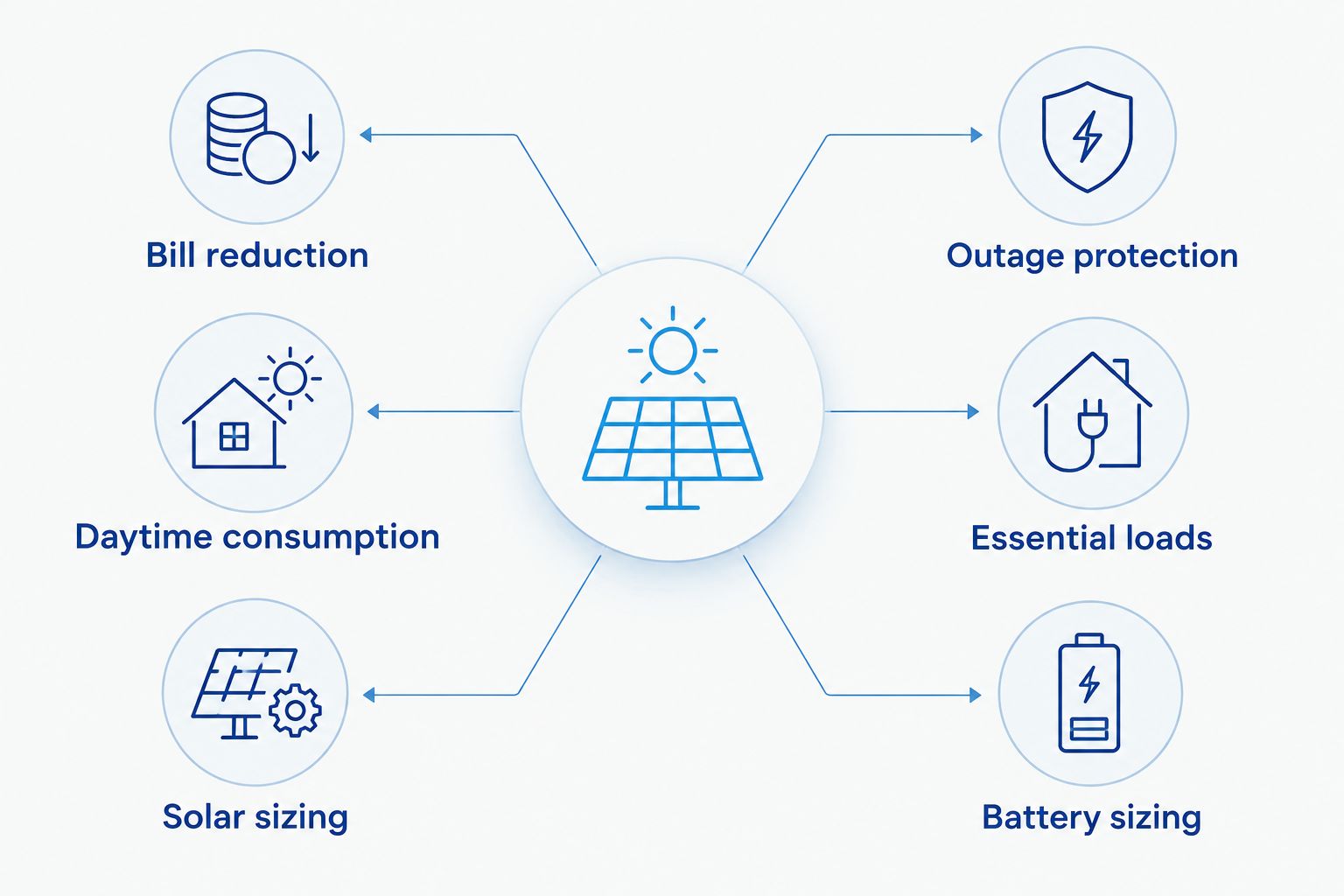
Answer 2 separate sizing questions: how much electricity should solar offset, and which circuits must remain powered during an outage? A conventional grid-connected solar system shuts down during a grid outage unless it has equipment designed to support isolated backup operation.
Battery capacity describes stored energy; output power describes what the battery can run at once. Both matter. A battery selected around overnight consumption is not automatically suitable for starting a large motor or supporting every business circuit.
Best for businesses concerned about outages: define essential loads before choosing a battery. Alpha Solar Solutions offers commercial solar and battery backup, but the proposal must specify the supported equipment and operating limits rather than imply uninterrupted whole-premises power.
- List essential loads separately from optional loads.
- Record running demand and startup requirements.
- Identify circuits that need backup operation.
- Ask how solar recharging works during an outage.
- Request the assumptions behind any runtime estimate.
7. Request a proposal that exposes the assumptions
Create a written brief using your approved roof area, electricity records, lease conditions and backup priorities. Give the same brief to each contractor so you can compare scope rather than isolated equipment totals.
Your 2026 proposal should distinguish modeled electricity production from guaranteed outcomes. Ask how shading, consumption timing, electricity rates and export treatment affect the estimate. Any incentive discussion needs current verification for the relevant owner and project; do not treat eligibility as automatic.
Best for tenants ready to proceed: choose a documented scope with clear responsibilities. A lower headline commitment does not resolve an omitted roof repair, electrical upgrade or end-of-lease obligation.
- Request the proposed layout and connection approach.
- Ask which approvals and applications are included.
- Identify exclusions and potential additional work.
- Review production and financial assumptions separately.
- Confirm monitoring, maintenance and after-installation support.
- Record who handles faults and communication with the landlord.
Compare ownership options for leased premises
Ownership should follow your lease position and operating needs, not a preference for a particular panel. These options describe structures to evaluate; they are not a statement that every structure is offered by your contractor or landlord.
| Option | Best for | Main advantage | Key limitation |
|---|---|---|---|
| Tenant-owned solar | Tenants with documented installation rights and a stable occupancy plan | Direct ownership of the equipment | The tenant must address maintenance, departure and reinstatement obligations |
| Landlord-owned solar | Buildings where the owner wants a permanent installation | Ownership stays with the property owner | The tenant needs a clear agreement about electricity charges and benefits |
| Third-party-owned solar | Businesses evaluating an energy-service agreement instead of equipment ownership | Equipment ownership and some service duties can sit with another party | Contract duration, transfer terms and landlord consent still require review |
| Defer installation | Tenants with unresolved roof rights, metering or relocation plans | Avoids committing before basic permissions are settled | Does not provide on-site solar generation or solar-backed outage protection |
Do not choose tenant ownership just because you pay the electricity bill. The best fit is the structure that assigns responsibilities clearly throughout installation, operation and departure.
Compare the full agreement, including maintenance and termination terms. Equipment ownership alone does not tell you who receives the financial benefit or who carries the operational burden.
Common mistakes business tenants make
Treating landlord approval as a complete agreement
Approval to install is not the same as agreement on maintenance access, insurance or removal. Document those responsibilities before work starts. Otherwise, the unresolved questions remain attached to equipment already installed on the building.
Sizing panels against the whole building’s consumption
Your business needs a proposal tied to the supply and billing arrangement that actually serves it. A building-wide consumption figure is not a substitute for your account data, particularly where multiple tenants or common areas share the property.
Comparing equipment without comparing lease obligations
A panel and battery list does not explain what happens if you relocate. Review equipment performance alongside the tenancy agreement. Ask who owns the system at departure and who pays for any agreed removal or reinstatement work.
Assuming a battery supports every business load
Backup capability depends on the electrical design, supported circuits, stored energy and output limits. Identify essential equipment by name. Ask the contractor to explain what happens when several supported loads run or start together.
Counting an incentive before confirming eligibility
Do not use an assumed tax benefit to make an otherwise unsuitable project look acceptable. Confirm current rules, ownership requirements and applicable project conditions with a qualified tax adviser before including an incentive in your decision.
FAQ
Can I install commercial solar panels on a building I lease?
Commercial solar installation on leased premises requires the necessary property rights, landlord consent and project approvals. Review your lease first, then document installation, maintenance and departure responsibilities before committing.
Who should own solar panels on rented business premises?
The owner should be the party whose responsibilities and occupancy plans fit the written agreement. Compare tenant, landlord and third-party ownership against maintenance duties, electricity benefits and end-of-lease terms.
What happens to the solar system when my business moves?
The lease and solar agreement should specify whether the system stays, transfers or is removed. Resolve early departure separately from normal lease expiry, including responsibility for reinstatement.
Will commercial solar keep my business running during an outage?
Solar panels alone do not provide backup during a grid outage. Outage operation requires compatible backup equipment and a design that identifies supported circuits, power limits and stored-energy requirements.
Is solar worthwhile if my business shares an electricity meter?
A shared meter requires a clear connection and billing arrangement before you can evaluate the benefit to your business. Establish who holds the account and how solar generation would affect the charges allocated to each occupant.
What should I bring to a commercial solar consultation?
Bring your lease, landlord correspondence, 12 months of electricity bills and any interval data. Include operating hours, planned equipment changes and a list of essential loads if you want battery backup.
Should a tenant wait until the lease is renewed before installing solar?
Settle the expected occupancy period and departure terms before committing to solar. If renewal is unresolved, compare the project under both renewal and departure scenarios rather than assuming your business will stay.
One last thing
Ask the landlord a simple question before discussing panel layouts: what happens if the roof needs work after installation? The answer connects access, removal, storage, reinstallation and responsibility for disruption—issues an electricity estimate does not settle.
For a 2026 project, bring that answer and your electricity records to a free consultation with Alpha Solar Solutions. The next useful step is a defined scope, not a promise of savings before the premises have been assessed.
Related guides
These guides cover supporting solar and battery decisions. Apply their general questions to your commercial proposal rather than treating a residential example as a business-system specification.
- Solar panels in San Antonio: add a battery now or later
- Solar panel financing: compare APR and total loan cost
- Can solar battery backup run your central air conditioner?
- Powerwall installation with an existing solar system