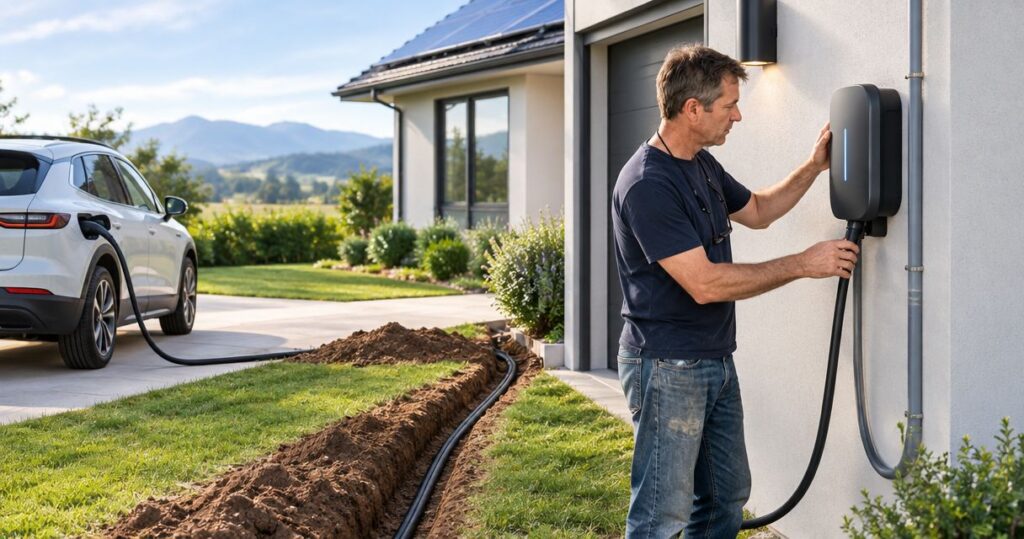
EV charger installation cost depends on the electrical route, available panel capacity and work needed to reach your parking space—not just the charger itself. Long cable runs add wiring and installation work, while trenching can add excavation, underground protection and surface restoration; compare those items separately in your 2026 quote.
- EV charger installation cost depends on cable routing, panel capacity and restoration—not cable length alone.
- Compare trenching with an accessible aboveground route before approving excavation.
- Alpha Solar Solutions serves San Antonio homeowners who need EV charger installation.
- Ask for an itemized scope covering electrical work, permits, trenching and surface repairs.
Why this matters
A charger location that looks convenient from your driveway can be difficult to reach from your electrical panel. The route must account for walls, pavement, existing utilities and the condition of the electrical equipment supplying it.
For San Antonio homeowners considering Alpha Solar Solutions, the useful starting point is a site-specific scope rather than a headline installation figure. Choose the parking location and confirm the electrical route before comparing proposals. Otherwise, you can end up comparing different jobs under the same installation label.
How do long cable runs and trenching affect EV charger installation cost?
Long cable runs require more conductor and raceway, along with the labor needed to install and secure them. Trenching adds a separate construction task: opening the ground, protecting the underground electrical route, backfilling and addressing the disturbed surface.
The shortest route is not automatically the simplest. A direct path beneath a driveway involves different work from a longer accessible route around the garage wall.
Use this comparison to discuss routing options before the installer finalizes your 2026 proposal:
| Routing option | Best for | Main advantage | Main limitation |
|---|---|---|---|
| Accessible garage route | Parking near the electrical panel | Keeps much of the work accessible | Walls, doors and storage can obstruct the path |
| Exterior wall route | Reaching parking along the house | Can avoid disturbing the ground | Requires suitable outdoor materials and visible conduit |
| Underground route | Detached parking or routes without suitable wall access | Carries the circuit beneath the surface | Requires excavation or another underground installation method, plus restoration |
These are routing options, not promises that every property supports each one. Ask your installer to identify the preferred route and explain why the alternatives were rejected.
What should the installation scope separate?
A useful proposal distinguishes electrical work from construction and finishing work. Look for clear descriptions of:
- Circuit installation: Conductors, protective raceway, breaker and charger connection.
- Panel work: Any changes needed to support the charging load.
- Ground work: Excavation method, utility coordination and backfilling.
- Restoration: Responsibility for concrete, pavers, landscaping and other disturbed surfaces.
- Approvals: Required permits, inspections and utility coordination where applicable.
Ask whether the charger itself is included or supplied by you. That simple distinction prevents a hardware-only offer from being mistaken for a complete installation.
Accessible garage routes: confirm the actual cable path
Best for: homeowners whose regular parking space is close to an accessible electrical panel. An accessible route can keep the work concentrated inside or along the garage, without opening a yard or driveway.
Measure the installation path, not the straight-line distance between the panel and charger. Wiring may need to go around door openings, cross overhead or follow accessible structural spaces before reaching the mounting point.
The limitation is that nearby does not mean uncomplicated. A finished wall, crowded equipment area or unsuitable mounting location can still require additional work.
Before accepting this route, park your vehicle where you normally leave it. Check whether the charging cable reaches the vehicle inlet without crossing a walking path or blocking a door, and leave room for normal garage use.
Exterior wall routes: weigh access against appearance
Best for: homeowners with parking beside the house and a practical wall-mounted path. Exterior conduit can provide a route without trenching, depending on the building layout and installation requirements.
Ask where the conduit will run, how it will pass through the wall and how penetrations will be sealed. Outdoor equipment and wiring methods must suit their exposure, including wet conditions where applicable.
The advantage is avoiding ground disturbance. The trade-off is visible equipment and a route that may be longer than the direct path across the yard.
For a 2026 exterior installation, request a marked-up photo or drawing showing the proposed path. That lets you resolve placement concerns before work begins rather than after conduit is attached to the house.
Underground routes: define trenching and restoration separately
Best for: homeowners charging at detached parking areas or locations without a suitable aboveground route. An underground circuit can reach a charger away from the house, but excavation is only part of the work.
The installer must select a wiring method and burial arrangement that meet the applicable requirements. There is no single trench-depth instruction that fits every installation; the requirements depend on the wiring method and site conditions.
Before excavation, arrange the required utility-location process. In Texas, contact Texas 811 before digging, and ask how privately owned lines—such as irrigation wiring or lines to an outbuilding—will be identified.
A utility mark is not permission to dig without precautions. Confirm who handles excavation, how conflicts will be addressed and when the route must remain open for inspection.
Restoration deserves its own written scope. Backfilling a trench does not, by itself, describe how a lawn, driveway or paved path will be returned to use.
Why EV charger installation cost varies
The same charger can require very different installation work at different homes. These factors explain the scope differences you should resolve before signing:
- Route length: More distance requires more wiring and raceway; long runs also require attention to voltage drop.
- Electrical capacity: An available breaker position does not establish that the home can support the additional charging load.
- Ground conditions: Existing utilities, roots, rock and restricted access affect how an underground route can be installed.
- Surface restoration: Crossing lawn, pavers or concrete creates different repair tasks.
- Charging demand: The chosen charging output affects circuit design and the load added to the home.
- Future equipment: Planned solar, battery backup or other electrical additions should be discussed before the design is finalized.
None of these factors justifies an unexplained allowance. Ask the installer to connect each proposed item to a condition at your property.
How do you compare installation quotes fairly?
Use the same parking location, charging objective and restoration expectations for every proposal. A quote for a different route or lower charging output is not a like-for-like comparison.
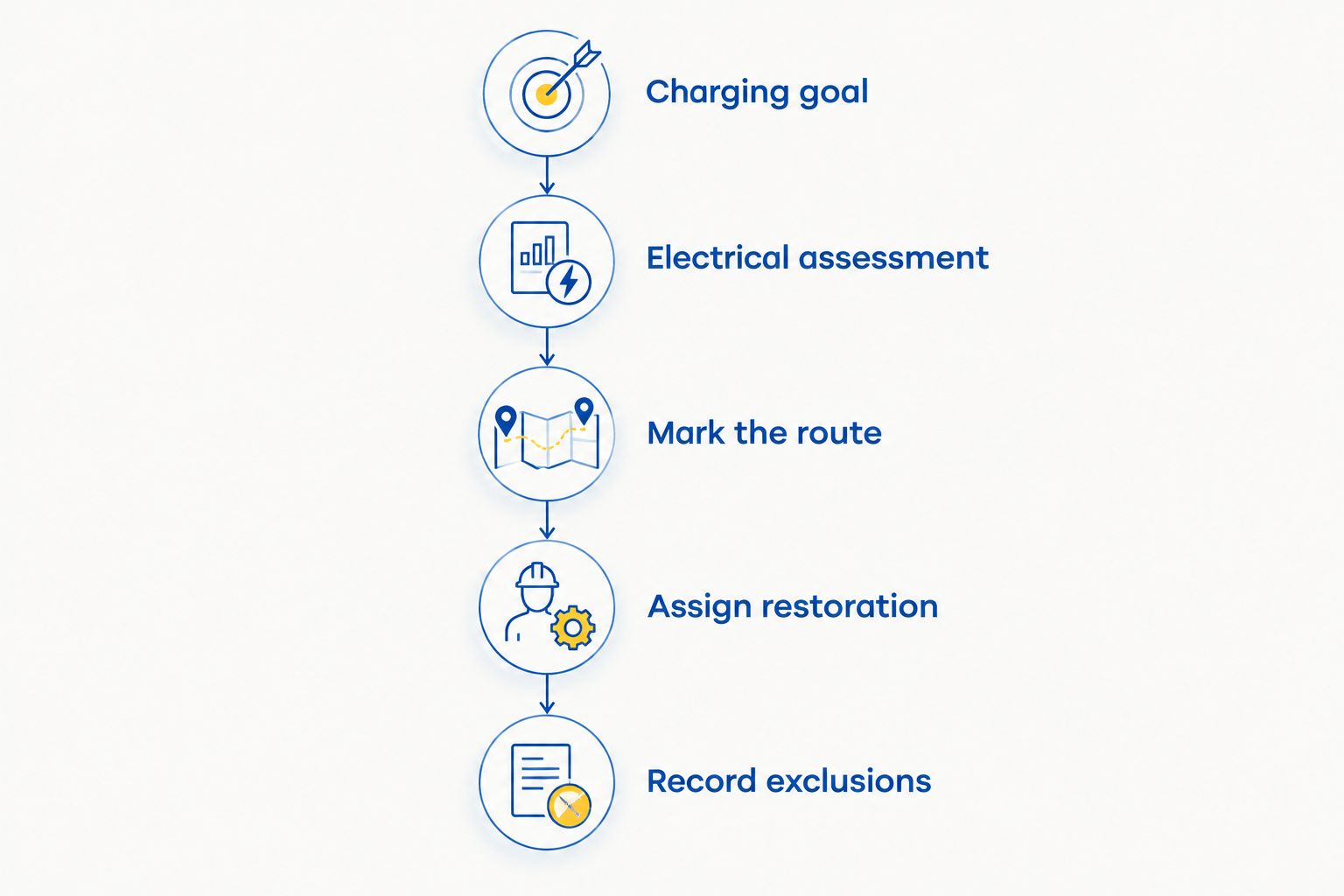
Start with the charging goal
Tell the installer where the vehicle parks, when you normally charge and whether you expect another EV. The goal is a suitable charging setup—not automatically the highest output the equipment offers.
Confirm the electrical assessment
Ask how the existing household load was evaluated. Air conditioning, cooking equipment, water heating and other large loads matter when assessing the addition of EV charging.
Mark the route
Have the proposed route shown on a photo or site sketch. Identify wall penetrations, underground sections and any pavement crossings before approving the scope.
Assign restoration
Get written responsibility for backfill, surface repairs and disposal of excavated material. Identify work left to you or another contractor before scheduling installation.
Record exclusions
Ask what happens if excavation reveals an obstruction or the electrical assessment identifies additional work. Your 2026 agreement should explain how changes receive approval before that work proceeds.
A clear route and responsibility list make proposals easier to compare. Keep both with the final installation documents.
Does a long cable run mean you need a panel upgrade?
A long cable run does not, by itself, establish that you need a panel upgrade. Cable design and available electrical capacity are related parts of the project, but they answer different questions.
For residential charging, Level 1 typically uses 120 volts, while Level 2 commonly uses 240 volts. The charging equipment's output and the home's existing electrical load help determine what the supply circuit needs to support.
For example, a conventional circuit supplying 32 amps of continuous charging requires a 40-amp circuit under the standard continuous-load sizing rule. That example explains circuit sizing; it is not a recommendation for your home or a substitute for an electrical assessment.
Ask whether suitable load management can address capacity constraints before treating a service upgrade as the only path. Compatibility and approval still need to be established for the proposed installation.
Is moving the charger better than trenching?
Moving the charger is worth comparing when it avoids difficult excavation without making daily charging inconvenient. The decision should account for both installation scope and how you use the parking space.
A location closer to the panel can reduce the wiring route. It loses that advantage if you must park awkwardly, stretch the charging cable across a walkway or leave it exposed to vehicle traffic.
Test the proposed location with your vehicle present. Check the inlet position, door clearance and cable storage before choosing the mounting point.
Do not plan around a general-purpose extension cord. Follow the charging equipment manufacturer's instructions and have the permanent connection designed for the location.
Should you plan EV charging with solar and battery backup?
Plan the electrical design together if you are considering EV charging, solar and battery backup. Shared planning helps identify panel-space needs, equipment locations and which loads belong on any backed-up circuits.
Solar generation does not automatically mean your vehicle charges directly from solar at every moment. Charging time, household demand and the system's design determine how generation and consumption overlap.
An EV charger also should not be assumed to remain powered during an outage. Backup operation depends on the battery system, available output, stored energy and the loads included in the backup design.
For a 2026 consultation with Alpha Solar Solutions, bring your charging needs and outage priorities to the same discussion. Ask what happens to EV charging when grid power fails, rather than accepting a general statement that the home has battery backup.
When is it time to request a consultation?
Request a site assessment when the route crosses pavement, reaches detached parking or raises questions about electrical capacity. These conditions need a property-specific design before the installation scope is dependable.
Alpha Solar Solutions serves San Antonio homeowners who need EV charger installation. A free consultation is a practical next step if you also want to discuss residential solar or battery backup; ask for a custom design that separates charging needs from outage-protection goals.
Bring photos of the panel, parking area and possible route, along with your vehicle and charger details if already selected. Ask who provides support after installation and which documents you will receive at completion.
Discuss your charging setup
Ask about a free consultation for EV charging, solar and battery backup at your San Antonio home.
FAQ
What makes EV charger installation cost increase on a long run?
A long run adds wiring, raceway and installation work, and the design must address voltage drop. Excavation, access restrictions and surface repairs add separate tasks when the route goes underground.
Does my EV charger installation always need trenching?
No, EV charger installation does not always need trenching. An accessible garage or exterior wall route can avoid excavation when it meets the site’s electrical and physical requirements.
Can I dig the trench myself before the electrician arrives?
Agree on the trench requirements and division of work with the installer before digging. Complete the required utility-location process, address private utilities and confirm inspection requirements before excavation begins.
Who repairs my driveway after charger installation?
Driveway repair belongs to whichever party your agreement assigns it to. Ask whether the scope includes cutting, backfilling and finished restoration rather than assuming electrical installation includes all repairs.
Do I need the fastest home charger available?
You need charging output that suits your vehicle, parking routine and available electrical capacity. Higher output changes the electrical demand and is not automatically the right design for your home.
Will a home battery keep my EV charger running during an outage?
A home battery does not automatically keep an EV charger running during an outage. The charger must be included in a suitable backup design, with enough available output and stored energy for the intended use.
One last thing
Choose the charger location with the vehicle parked—not with the garage empty. The electrical route matters, but so does reaching the vehicle inlet without creating an obstacle every evening.
Before approving your 2026 installation, ask for a final walkthrough covering the cable path, mounting position, restoration scope and charging settings. Those decisions turn a broad installation proposal into a job you can understand and approve.
Related guides
- Solar panels in San Antonio: add a battery now or later?
- Can solar battery backup run your central air conditioner?
- Powerwall installation with an existing solar system
- What an installed Powerwall quote should include