

TL;DR:
- Many San Antonio homeowners are experiencing rising electricity costs and seeking solar solutions to reduce bills. Preparation involves gathering utility bills, roof details, and questions to ensure an effective consultation. A thorough site assessment, energy analysis, and tailored system design help optimize long-term savings and reliability.
Your CPS Energy bill probably hasn’t dropped on its own recently. If anything, it’s done the opposite. Many San Antonio homeowners are watching their electricity costs creep higher every season and are seriously ready to make a change, but they’re not sure where to start. Solar sounds great in theory, but the actual process of getting a system installed feels unclear. What happens at a consultation? What do you need to bring? How do you know the proposal is right for your home? This guide walks you through each step so you go into your solar consultation prepared, confident, and ready to make a smart decision.
Table of Contents
- What to prepare before your home solar consultation
- Step-by-step breakdown of the home solar consultation process
- How solar recommendations are tailored for your home
- What to expect after your consultation
- Why a thorough consultation means a better solar outcome
- Ready to schedule your home solar consultation?
- Frequently asked questions
Key Takeaways
| Point | Details |
|---|---|
| Be prepared | Having your energy information ready makes your consultation smoother and more accurate. |
| Step-by-step clarity | Knowing the consultation process helps you ask better questions and avoid surprises. |
| Customized recommendations | The best results come from a solar plan tailored to your home and energy needs. |
| Local expertise matters | San Antonio-specific guidance ensures your solar setup is truly effective. |
| Follow up for success | Review your proposal carefully after the consultation and clarify any questions before moving forward. |
What to prepare before your home solar consultation
Once you’re motivated to lower your energy costs and know the value of going solar, the next step is being ready for your first consultation. Showing up organized saves time and helps your solar advisor give you a more accurate and useful recommendation from the start.
The most important thing you can bring is your energy history. That means your utility bills, ideally covering the last 12 months. These bills show your monthly usage in kilowatt hours (kWh), which is the unit used to measure how much electricity your home consumes. Without this data, any system recommendation is just a rough guess. With it, your advisor can size a system that actually matches your real usage patterns, including summer peaks when your AC runs nonstop.
Here’s a quick preparation checklist organized by category:
| Category | What to gather |
|---|---|
| Energy | 12 months of utility bills, average monthly kWh usage, notes on recent high-usage months |
| Home and site | Roof age, HOA rules (if applicable), recent renovations, shading from trees or structures |
| Goals and questions | Target savings percentage, interest in battery backup or EV charging, budget range |
| Documentation | Property records if needed, photos of your roof and electrical panel |
Beyond documents, it helps to know what you want to ask. Many homeowners walk in without questions and walk out unsure whether they got the right information. Jot down your priorities before the meeting. As part of the residential solar installation process, your advisor should cover financing, incentives, and long-term warranty details, but only if you ask.
Questions worth preparing:
- What federal or state incentives apply to my system?
- How long will my payback period be?
- What happens to my production on cloudy days?
- Is my roof suitable without repairs first?
- What’s included in the warranty for panels, inverters, and labor?
The home solar energy process for San Antonio homes typically begins well before installation. Your preparation directly affects how useful your consultation becomes.
Pro Tip: Scan your utility bills and save them as PDFs in a single folder on your phone or email. That way you can pull them up instantly during the consultation without shuffling through paper. If your utility provider has an online portal, you can often download your full usage history in one file.
Understanding the solar energy savings workflow ahead of time also gives you a better foundation for comparing proposals later.
Step-by-step breakdown of the home solar consultation process
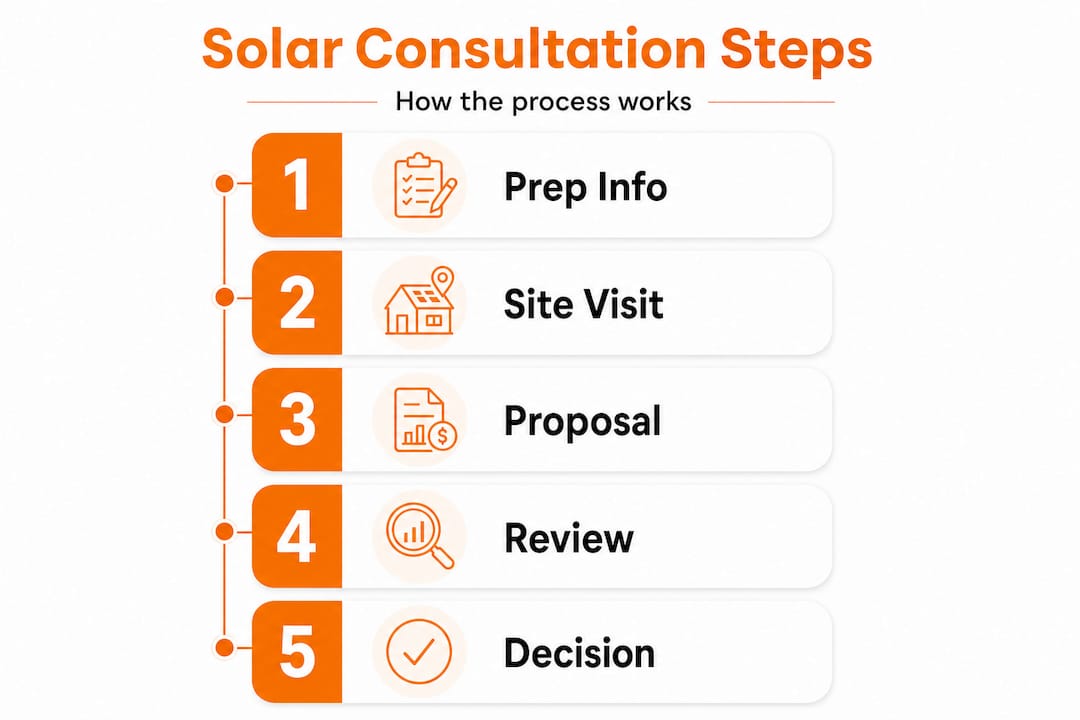
Now that you’re prepared, let’s break down what actually happens during your consultation. Knowing the stages removes the guesswork and lets you focus on getting the best possible outcome for your home.
-
Initial contact and scheduling. You reach out by phone, form, or online booking. You’ll share basic details about your home and energy use. This helps the advisor prepare before arriving at your door or joining a virtual call.
-
Site assessment. The advisor evaluates your roof, including its age, condition, orientation (which direction it faces), and pitch (the angle of the slope). They also note shading from trees, chimneys, or nearby structures. All of this affects how much sunlight your panels will capture.
-
Energy analysis. Using your utility bills, the advisor calculates your average daily and monthly usage. This determines how large your system needs to be to offset your consumption. A system sized too small won’t save you much. One sized too large means you’re paying for capacity you don’t need.
-
Goal discussion. This is where you talk about what matters most to you. Do you want to completely eliminate your bill? Are you interested in customized solar recommendations that include a battery backup so your home stays powered during outages? Do you drive an electric vehicle and want to charge it using solar energy? These conversations shape the entire system design.
-
System presentation. Your advisor walks you through the recommended equipment, including panel type, inverter model (the inverter converts solar energy into usable electricity for your home), and any battery or EV charger options. They’ll explain what each component does in plain terms.
-
Comparison of add-on options. Many homeowners want to know how battery backup and EV charging compare as add-ons. Here’s a quick breakdown:
| Feature | Battery backup | EV charger integration |
|---|---|---|
| Primary benefit | Keeps power on during outages | Charges your electric vehicle using solar energy |
| Best for | Homeowners worried about grid reliability | EV drivers looking to reduce fuel and charging costs |
| Impact on system size | May require larger panel array | Adds load, may require additional panels |
| Upfront cost | Higher | Moderate |
| Long-term savings | High, especially with time-of-use rates | Significant for EV owners |
- Final proposal and Q&A. The advisor presents a written proposal covering system specs, total cost, estimated production, projected savings, and financing options. This is your chance to ask every question on your list.
Important: One of the most common mistakes homeowners make is not asking about available rebates, tax credits, or incentives during this step. The federal solar tax credit (also called the Investment Tax Credit) currently allows you to deduct 30% of your system cost from your federal taxes. Ask your advisor to walk through every incentive that applies to your situation.
Solar system sizing is one of the most critical factors discussed during this stage, and getting it right from the start prevents costly adjustments later.
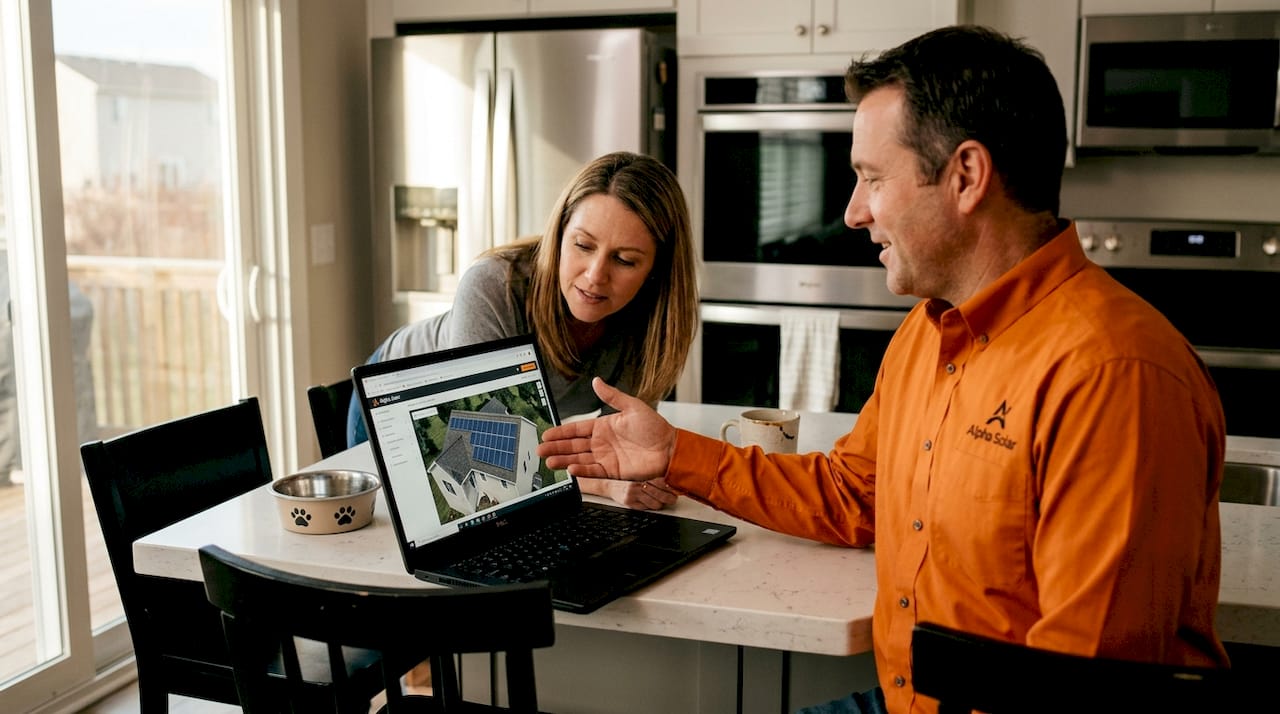
Pro Tip: Before you sign anything, ask your advisor to show you a visual mock-up of where the panels will be placed on your roof. This helps you see the actual layout and confirm that shading issues have been accounted for in the design.
How solar recommendations are tailored for your home
With a clear understanding of the consultation steps, it’s important to see how your inputs directly shape your solar solution. No two homes in San Antonio are exactly the same, and the best solar systems reflect that.
Your energy usage history is the starting point. An advisor looks at how much electricity you use each month and identifies patterns. If your bills spike from June through September because of air conditioning, your system should be sized to handle that summer demand, not just your average annual usage.
Roof characteristics play a major role as well. South-facing roofs in San Antonio capture the most sunlight throughout the year. East or west-facing roofs can still work well, but the production estimates will differ. Roofs with significant shading from oak trees or two-story neighbors require panel placement adjustments or the use of microinverters, which are small devices attached to each panel individually to maximize output even when some panels are partially shaded.
The solar panel components chosen for your system, from the panels themselves to the inverter type, are selected based on your specific site conditions and energy goals. Here are the factors that have the highest impact on your final recommendation:
- Average monthly kWh usage: Drives the total number of panels needed
- Roof size, orientation, and tilt: Determines how many panels can physically fit and at what efficiency
- Shade analysis: Affects whether microinverters or string inverters are better for your setup
- Desired energy offset: 80% offset vs. 100% offset requires different system sizes
- Battery backup requirements: Adds capacity and storage needs to the design
- EV charging load: Increases daily energy demand, which scales up the system
Stat callout: San Antonio homeowners with properly sized solar systems typically offset 80 to 100% of their annual electricity usage, with many seeing their monthly CPS Energy bill drop to the minimum service charge only.
If you add battery backup, your system needs to be large enough to charge the batteries and still power your home. If you add an EV charger, the advisor factors in your average daily mileage to estimate charging energy needs. Both additions are worth discussing during your consultation because they influence design from the ground up.
San Antonio also has specific local regulations and utility rules around net metering (the system that lets you sell excess solar energy back to the grid for credits). Checking net metering factors that apply to CPS Energy customers is something your consultant should walk you through in detail.
What to expect after your consultation
Finally, here’s what to do after your consultation so you can make an informed decision and start saving as soon as possible.
After the meeting, you’ll have a written proposal in hand or in your inbox. Take time to review it carefully. Don’t feel rushed to sign immediately. A reputable company won’t pressure you. Here’s a step-by-step approach for what to do next:
-
Read the full proposal. Check the system size (measured in kilowatts, or kW), the number of panels, the estimated annual production (in kWh), and the projected savings over 10, 20, and 25 years.
-
Verify the incentive calculations. Confirm that the federal 30% tax credit has been applied correctly to your total system cost. Ask whether any local CPS Energy rebates or state programs are included.
-
Check the warranty terms. Most quality solar panels carry a 25-year production warranty. Inverters typically have 10 to 12 years. Ask what the labor warranty covers.
-
Review financing options. Whether you’re paying cash, using a solar loan, or doing a lease, understand the total cost of ownership. Loans with low interest rates and no prepayment penalties tend to give the best long-term value.
-
Ask about HOA and permit requirements. If you live in a neighborhood with a homeowners association, you may need approval before installation. Your installer should handle permit applications with the city, but it’s good to know the timeline.
-
Get references. Ask for contact information from a few previous customers in San Antonio. A quick conversation with someone who has been through the process gives you real-world insight that no brochure can provide.
Warning: Do not skip reviewing local code requirements. San Antonio has specific electrical and building codes that affect how solar systems are installed. Missing a code requirement can delay your installation or require costly rework. Always confirm your installer pulls the proper permits.
Understanding net metering credits and how they appear on your CPS Energy bill is also worth asking about post-consultation, especially if you expect to generate more energy than you use during certain months.
The solar panel system components in your proposal should be clearly listed with model numbers so you can independently verify that you’re getting quality equipment.
Pro Tip: Ask your installer for examples of recent installations on similar home types in San Antonio. Seeing real results from homes with comparable roof styles or energy needs gives you confidence that the proposal is realistic.
Why a thorough consultation means a better solar outcome
Here’s a perspective worth sitting with: the consultation is not a sales call. Or at least, it shouldn’t be. We’ve seen what happens when homeowners rush through the process because a company offered a fast quote and a pressure-packed close. The systems get installed quickly, but the results don’t match the promises. The system is undersized. The battery was never discussed. The roof shading wasn’t accounted for.
The questions you ask up front decide 80% of your long-term satisfaction with solar. That’s not an exaggeration. A system designed with the wrong assumptions performs poorly for 25 years. A system designed around your actual usage, roof conditions, and goals performs well from day one.
San Antonio homes present specific challenges that only someone with local knowledge will catch. Flat tile roofs, common in certain neighborhoods, require different mounting hardware. Municipal rules about panel setbacks from roof edges affect how many panels can actually fit. Summer heat affects panel efficiency in ways that need to be factored into production estimates.
A consultant who truly advocates for you will bring these things up without being asked. They’ll flag a roof that needs repairs before installation so you don’t end up removing panels later. They’ll walk you through the solar savings workflow insights for your specific scenario, not a generic example.
Our honest take: take your time with the consultation. Bring your questions. Push back if something doesn’t make sense. The best solar outcome starts with the most honest, thorough conversation.
Ready to schedule your home solar consultation?
If this guide has helped you see what the process looks like and feel more confident about moving forward, the next step is simple: book your consultation with Alpha Solar Solutions.
We work with San Antonio homeowners through every step of the process, from your first question to a fully installed, permitted, and producing solar system. Our team specializes in residential solar installation designed around your actual energy needs, not a one-size-fits-all package. We also offer home EV charging solutions and battery backup protection so you can build the system that makes the most sense for your lifestyle. Local experience, honest guidance, and step-by-step support are what we bring to every consultation.
Frequently asked questions
How long does the typical home solar consultation take?
Most consultations last 30 to 60 minutes, depending on the size of your home and how many questions you have. Virtual consultations can sometimes move faster, while in-person site assessments may take a bit longer.
What documents or information should I have ready?
Bring your last 12 months of utility bills, any notes on recent home improvements, and a clear sense of your main energy goals. The home solar energy process moves much faster when your usage history is already organized and accessible.
Can I add battery backup or an EV charger to my system?
Yes, and both options are best discussed during the consultation so they can be built into the original system design rather than added on later. Customized solar system designs account for battery and EV charging loads from the very beginning.
How do I know if my home is a good fit for solar power?
Your advisor will evaluate your roof orientation, shading, condition, and energy usage during the site assessment. Most San Antonio homes are excellent candidates, and your solar panel system components evaluation will confirm the specifics for your property.
What questions should I ask during my solar consultation?
Ask about projected savings, the federal 30% tax credit, warranty details for panels and inverters, battery backup options, and ongoing maintenance needs. The more specific your questions, the more useful your proposal will be.