
TL;DR:
- San Antonio’s high sun exposure makes it an ideal location for home solar energy.
- Installing solar involves assessment, permits, installation, inspection, and grid interconnection steps.
- Tax incentives and net metering can significantly reduce costs and boost long-term savings.
If your CPS Energy bill keeps climbing every summer, you’re not imagining it. San Antonio homeowners face some of the fastest-rising electricity costs in Texas, and that financial pressure is pushing more families to take a serious look at solar. The good news is that San Antonio also enjoys over 220 sunny days per year, making it one of the best places in the country to generate your own power. This guide walks you through every step of the home solar energy process, from evaluating your roof to calculating your payback, so you can make a confident, informed decision.
Table of Contents
- Understanding your home’s solar potential in San Antonio
- Step-by-step: The home solar installation process
- Costs, incentives, and payback for San Antonio solar
- Verifying system performance and maximizing long-term value
- Our perspective: What most first-time solar adopters miss in San Antonio
- Get started with San Antonio’s trusted solar experts
- Frequently asked questions
Key Takeaways
| Point | Details |
|---|---|
| San Antonio’s solar advantage | Over 220 sunny days and state incentives make solar a smart investment for local homeowners. |
| Step-by-step process | A typical solar project involves assessment, permitting, installation, and grid connection. |
| Strong savings and quick payback | Average annual savings exceed $2,000, with most systems breaking even in 6-8 years. |
| Maintenance is simple | Routine cleaning and weather checks help maximize system output and longevity. |
Understanding your home’s solar potential in San Antonio
San Antonio’s climate is genuinely one of the strongest arguments for going solar. The city averages 5+ peak sun hours daily and over 220 sunny days annually. That means your panels have more time to produce electricity compared to most other U.S. cities. More sun hours translate directly into more savings on your monthly bill.
But your city’s sun exposure is only part of the picture. Your individual home matters just as much. Before anything else, a qualified installer will evaluate these key factors:
- Roof orientation: South-facing roofs capture the most sunlight in the Northern Hemisphere. Southwest-facing works well too, especially for afternoon production.
- Shade issues: Trees, chimneys, or neighboring buildings that cast shade can significantly reduce output. Even partial shading on one panel can affect the whole string.
- Roof age and condition: If your roof is older than 10 to 15 years, it may need replacement before panels go on. Installing solar on a worn roof means costly removal later.
- Available square footage: More usable roof space allows for a larger system and bigger savings.
Here’s a quick look at common system sizes and what they mean for a San Antonio home:
| System size | Estimated annual output | Best suited for |
|---|---|---|
| 6 kW | 8,400 to 9,000 kWh | Average 1,500 to 2,000 sq ft home |
| 8 kW | 11,200 to 12,000 kWh | Larger homes or higher usage |
| 10 kW | 14,000 to 15,000 kWh | High-usage homes or EV owners |
For panel selection, we strongly recommend monocrystalline panels, which are made from a single silicon crystal and offer higher efficiency in limited space. They perform better in heat, which matters a lot during San Antonio summers. You should also ask about hail-resilient modules, which are rated to withstand impact from large hailstones without cracking. In a city where spring hailstorms are a real risk, this is not optional.
Pro Tip: Ask your installer about the San Antonio solar benefits specific to your neighborhood, including local shading maps and utility rate structures that affect your system design.
Step-by-step: The home solar installation process
Once you know your home is a good fit, here’s how the step-by-step process unfolds. It’s more straightforward than most homeowners expect.
- Free site assessment: Your installer visits your home, reviews your past utility bills, and uses satellite imagery to map your roof. This shapes the system design.
- System design and proposal: You receive a custom layout showing panel placement, estimated production, and projected savings. Review this carefully.
- Permits and HOA approval: Your installer handles local building permits with the City of San Antonio and, if needed, HOA design review. This is where delays most often occur, so starting early helps.
- Equipment ordering: Panels, inverters, and mounting hardware are ordered. Lead times vary but typically run one to three weeks.
- Installation day: A crew mounts the racking system, installs panels, runs conduit, and connects the inverter. Most residential installs are completed in one to two days.
- City inspection: A city inspector verifies the system meets electrical and structural codes. Your installer schedules this on your behalf.
- CPS Energy interconnection: CPS Energy approves your grid connection and installs a bi-directional meter, which measures both what you consume and what you send back.
- System activation: Once approved, your system goes live and starts generating power immediately.
A key concept to understand is net metering. PV cells convert sunlight to direct current (DC) electricity, your inverter converts that to usable alternating current (AC), and net metering allows you to earn credits for any excess power you send back to the grid. CPS Energy applies those credits to your next bill.
Owning your system outright means you capture the full value of every kilowatt-hour your panels produce. Leasing keeps upfront costs low, but you give up tax credits and long-term savings.
| Model | Upfront cost | Federal tax credit | Long-term ROI |
|---|---|---|---|
| Ownership | Higher | Yes, 30% ITC | Highest |
| Lease or PPA | Low or none | No | Lower |
For a deeper look at wiring and system configuration, our solar system setup guide covers the technical side in plain language. You can also review San Antonio solar costs before your first consultation.
Pro Tip: Schedule your permit submission during off-peak months (fall or winter) to avoid the spring and summer backlog at the City of San Antonio permitting office.
Costs, incentives, and payback for San Antonio solar
After understanding the installation steps, it’s crucial to look at the numbers to plan your investment.
The average cost for San Antonio solar runs $2.80 to $3.10 per watt, with typical annual savings of $2,000 to $2,500 and a payback period of 6 to 8 years. For a standard 8 kW system, that puts your gross cost between $22,400 and $24,800 before any incentives.

Here’s where the incentives dramatically change the math:
| Incentive | Savings |
|---|---|
| Federal Investment Tax Credit (30% ITC) | $6,720 to $7,440 on an 8 kW system |
| Texas property tax exemption | Saves hundreds per year in added home value taxes |
| Texas sales tax exemption | Removes 8.25% sales tax on equipment |
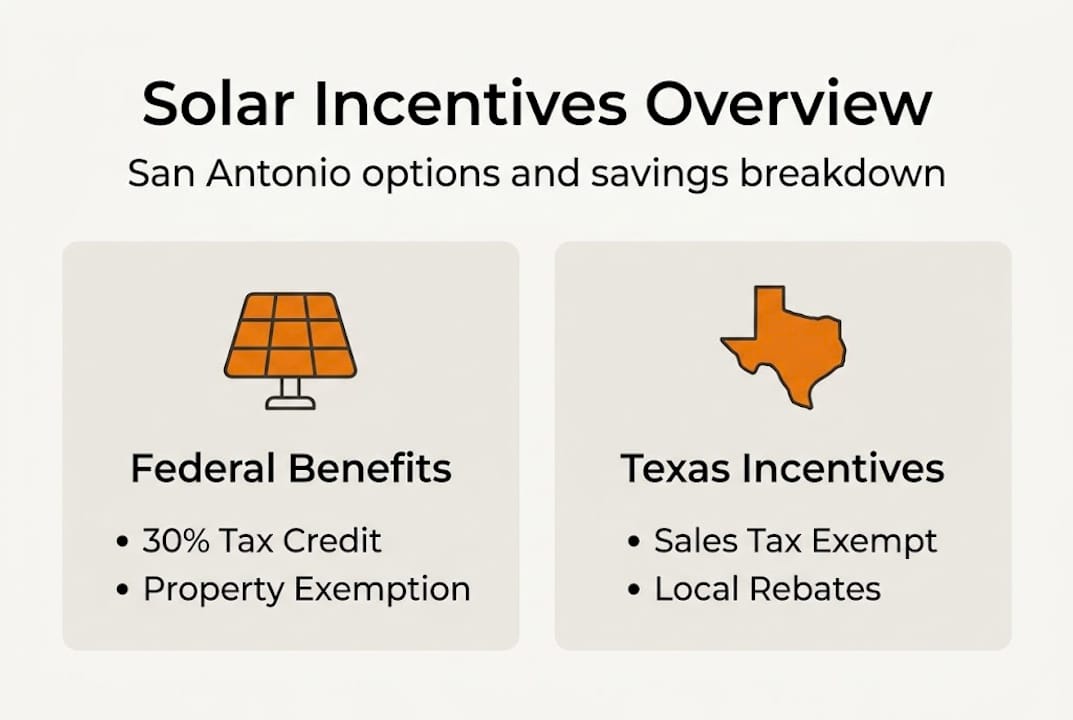
Texas offers a 100% property tax exemption and a sales tax exemption on solar equipment purchases, which are two meaningful breaks that lower your net cost significantly.
Key financial points to know:
- Federal ITC in 2026: The 30% credit applies to total installed cost, including panels, inverters, labor, and battery storage. It reduces your federal tax bill dollar for dollar.
- Net metering credits: CPS Energy credits excess generation at the full retail rate during on-peak hours and at a lower rate off-peak. Timing your appliance use matters.
- 25-year savings: Over the life of your system, total savings typically land between $40,000 and $90,000, depending on usage, system size, and future rate increases.
For a full breakdown of available tax credit options, we’ve published a detailed resource on our site. You can also explore specific energy savings strategies that work well for San Antonio’s rate structure, or review a complete breakdown of solar cost details for 2025 and 2026 pricing trends.
The bottom line: After the federal tax credit and Texas exemptions, most homeowners reduce their net cost by 35% to 40% before a single watt is generated.
Verifying system performance and maximizing long-term value
Once your system is operational, ongoing attention ensures you get the most from your investment. Solar panels are low-maintenance, not no-maintenance. There’s a real difference.
Here’s what to monitor and manage on a regular basis:
- Use your monitoring app daily at first: Most modern inverters come with a smartphone app that shows real-time and historical production. Track it against your estimated output from the proposal. If there’s a consistent shortfall, flag it early.
- Watch your utility bill monthly: Your net metering credits should reduce your bill noticeably. If they don’t shift within the first full billing cycle, something may need inspection.
- Schedule panel cleaning twice a year: San Antonio’s dry summers mean dust, pollen, and debris build up on panels and reduce output. Clean panels can improve efficiency by 10% to 25%. Check out our solar cleaning tips for the right technique.
- Inspect after every major storm: Hail and high winds can shift panels or crack cells without visible exterior damage. A quick visual check after severe weather is smart practice.
Pro Tip: After hailstorms, schedule a professional inspection rather than just a visual scan. RETC-tested hail-resilient modules reduce your storm damage risk, but impact assessment still matters for warranty and insurance purposes.
Looking ahead, your system’s value can grow over time with strategic upgrades:
- Battery storage: Adding a backup battery lets you store excess solar energy for nighttime use or grid outages. This is especially useful given Texas’s grid reliability history.
- EV charger installation: If you own or plan to buy an electric vehicle, a home EV charger pairs perfectly with solar, letting you fuel your car with power you generate yourself.
- Panel replacement or expansion: If your usage grows or panel efficiency declines after 20 years, expanding or upgrading your system is straightforward.
Explore the full range of solar ownership benefits to understand how each upgrade fits your long-term energy plan.
Our perspective: What most first-time solar adopters miss in San Antonio
National solar guides give you a solid foundation, but they often skip the details that matter most in Texas. Here’s what we see firsthand.
First, hail is not a footnote here. San Antonio sits in a hail-prone corridor, and many homeowners don’t ask about panel impact ratings until after storm season. Choose modules with documented hail resistance ratings before installation, not after.
Second, grid connection delays through CPS Energy can add four to six weeks to your timeline. Budget for that. Don’t plan financially around a specific activation date.
Third, the fine print on leases and PPAs (power purchase agreements) often surprises homeowners. Leasing avoids upfront costs but doesn’t deliver the tax credits or the full long-term return on investment that ownership does. In a market with as many strong incentives as Texas, that trade-off rarely makes sense.
Finally, routine cleaning is consistently under-budgeted. In San Antonio’s climate, dirty panels are a real drag on performance. Plan for it. Review all the variables when evaluating your solar investment costs so nothing catches you off guard.
Get started with San Antonio’s trusted solar experts
Ready to move from curiosity to a real plan? Alpha Solar Solutions works with San Antonio homeowners at every stage of the solar journey, from your very first question to ongoing system support.
Our team designs residential solar installation systems built around your home’s actual usage, roof layout, and financial goals. We also handle panel cleaning, battery storage, EV charger installation, and detach-and-reattachment services. No guesswork, no one-size-fits-all packages. Schedule your free solar savings quote today and find out exactly what solar can do for your home and your monthly bill.
Frequently asked questions
How long does the home solar installation process take in San Antonio?
Most installations are completed within 6 to 10 weeks, covering site assessment through grid connection. Permitting and CPS Energy interconnection are the steps most likely to affect your timeline.
What kind of maintenance do home solar panels require in Texas?
Panels need periodic cleaning and visual checks after severe weather. Panel cleaning and hail checks are especially important in Texas, where dust accumulation and hailstorms are seasonal realities.
Are there property or sales tax increases after installing solar in Texas?
No. Texas provides full exemptions for both property tax increases from added home value and sales tax on solar equipment purchases, so your tax burden doesn’t grow when you go solar.
How much can homeowners save with solar in San Antonio?
Typical annual savings reach $2,000 to $2,500, with 25-year totals ranging from $40,000 to over $90,000 depending on system size and future rate changes.