
TL;DR:
- Proper placement of solar panels significantly impacts their energy production in San Antonio, where optimal orientation and tilt maximize sunlight capture. Factors such as roof shading, obstructions, and seasonal shadows influence panel efficiency, making site assessment essential for best results. Tailoring panel direction to household energy use and utility rates can further enhance savings beyond maximum annual output.
You installed solar panels to cut your electricity bills, but what if the placement is quietly working against you? Many San Antonio homeowners discover months or even years later that their system is producing far less energy than it should, simply because of how or where the panels were positioned on the roof. The good news is that proper placement can make a meaningful difference in what your system produces every single day. This guide walks you through everything you need to know to assess your current setup, fix what is not working, and get the most out of every hour of Texas sunshine.
Table of Contents
- Why solar panel placement matters in San Antonio
- What you need before you start
- Step-by-step: How to optimize your solar panel placement
- How to verify and maintain optimal performance
- Our unique take on solar placement: It’s not just about sunlight
- Connect with San Antonio’s solar optimization experts
- Frequently asked questions
Key Takeaways
| Point | Details |
|---|---|
| South-facing isn’t always best | Tailor panel orientation to your home’s usage and rate plan for maximum savings. |
| Preparation is critical | Assess all obstacles, shadows, and energy patterns before installation. |
| Optimize with local conditions | San Antonio’s sun patterns and roof designs require tailored placement strategies. |
| Maintenance ensures stability | Regular cleaning and shadow checks keep your system efficient for decades. |
Why solar panel placement matters in San Antonio
San Antonio sits at roughly 29.4 degrees north latitude, which means the city enjoys abundant sunshine year-round. But sunshine alone does not guarantee great solar production. The direction your roof faces, the angle of your panels, and even the shadow from a nearby oak tree can all chip away at your system’s output in ways that are easy to miss.
Orientation is everything. Research confirms that facing panels due south maximizes total annual solar energy collection in the Northern Hemisphere. That is because a south-facing surface receives the most consistent sunlight throughout the day, from morning to late afternoon. If your panels face east, west, or north, you are likely leaving real production on the table.
Beyond orientation, tilt angle also plays a significant role. A panel lying flat collects less energy than one angled toward the sun. For San Antonio, a tilt between 20 and 30 degrees tends to perform well for annual production, though adjusting for seasonal peaks is also worth considering.
Common placement challenges San Antonio homeowners face include:
- Complex rooflines with multiple angles, dormers, or intersecting slopes that force panels into less-than-ideal positions
- Mature tree canopy that casts shadows in the morning or late afternoon, especially on south or southwest-facing roof sections
- Chimney and HVAC equipment that create hard shadows across panel rows at certain times of day
- Seasonal shadow shifts, where a tree that does not shade panels in winter blocks significant sunlight by June
- Limited usable roof area due to skylights, vents, or steep pitches that reduce where panels can go
City-level solar planning increasingly relies on GIS-based rooftop assessments, which account for tilt, orientation, shadowing, and even temperature effects to identify which rooftops offer the strongest solar potential. This same thinking applies at your individual home level.
Understanding your roof’s specific strengths and weaknesses is the first step toward making smarter decisions. You can find guidance on how to maximize ROI tips and see how best panel types for San Antonio factor into overall system performance.
📊 Stat callout: Homes with panels facing due south produce measurably more annual energy than comparable systems facing east or west, with some studies estimating 10 to 25 percent higher output depending on the tilt and latitude.
Now that you know why optimizing placement is critical, let’s see what you’ll need to get started.
What you need before you start
Before you can improve anything, you need a clear picture of what you are working with. A quick but thorough site assessment will save you a lot of guesswork and help any solar professional give you more accurate advice.
Here is a basic checklist to get your assessment started:
- Safe roof access or a way to observe the roof from the ground or with a camera
- Compass or azimuth app on your smartphone to check which direction each roof section faces
- Angle measurement app (many free options exist) to estimate your roof pitch
- Camera or drone (optional but very useful) to photograph panel layout and spot obstructions
- Your utility bills for the past 12 months to understand your energy use by season
- Household energy schedule, meaning when you run the dishwasher, AC, EV charger, and other big loads
Site factors to note:
- Roof size and usable area after accounting for vents, skylights, and setback requirements
- Existing panel positions and whether they leave any high-potential roof sections unused
- Obstructions within 100 feet, including trees, neighboring structures, chimneys, and satellite dishes
- Roof condition, since panels added to a roof that needs replacement in five years create extra cost later
| Site factor | Why it matters | How to assess it |
|---|---|---|
| Roof orientation | Determines daily sun exposure | Use a compass app from the rooftop |
| Roof tilt | Affects angle of sunlight contact | Use a pitch gauge or angle app |
| Shading sources | Can cut output by 10 to 40 percent | Observe shadows at midday and 3 PM |
| Usable area | Limits how many panels fit | Measure after removing obstacles |
| Energy use timing | Guides orientation choice | Review utility bill hourly data |
GIS-based assessments used by city planners evaluate all of these factors together, including roof usability, tilt, shadowing, temperature, and energy return on investment. You can apply the same logic to your own home by gathering each of these data points before making any changes.
Pro Tip: Take sunlight measurements at multiple times throughout the day, ideally at 9 AM, noon, and 3 PM, and repeat this across different seasons if possible. Shadows move more than most homeowners expect between summer and winter in San Antonio.
Keeping your panels in good condition throughout this process matters too. Check out these solar panel cleaning best practices and solar panel maintenance tips to make sure dirty panels are not masking a placement issue.
With your tools and site conditions ready, it’s time to jump into the practical steps to optimize placement.
Step-by-step: How to optimize your solar panel placement
Now comes the part where assessment turns into action. Follow these steps in order to work through your placement systematically.
-
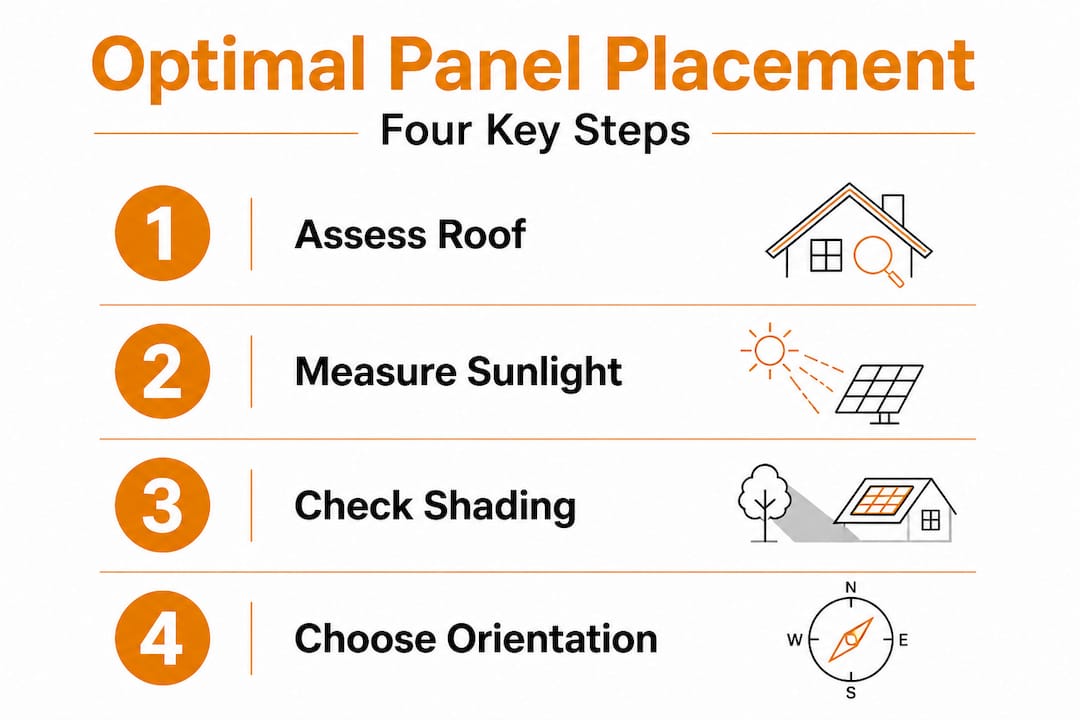
Determine your roof’s azimuth. Azimuth is simply the compass direction your roof faces, measured in degrees. South is 180 degrees. Pull out your compass app and stand at the center of each roof section to get a reading. Write down the azimuth for every section where panels currently sit or could potentially go.
-
Prioritize south-facing sections. South-facing panels capture the most sunlight across all hours of the day. If your current panels are on a north-facing slope or a heavily shaded east-facing section, this is likely your biggest problem. Repositioning even a portion of your array to a better-oriented section can produce noticeable gains.
-
Match tilt to your latitude and goals. For San Antonio at roughly 29 degrees latitude, a tilt between 20 and 30 degrees works well for annual production. A steeper tilt, around 35 to 40 degrees, can improve winter production when the sun sits lower in the sky. If your utility charges more during summer afternoons, you may actually want a shallower tilt to capture more of those intense midday hours.
-
Map your shadow patterns carefully. Walk around your home at different times of day and mark where shadows fall on your roof. Use a shadow analysis app or ask your installer to run a solar pathfinder analysis. Even a shadow covering just one row of cells can reduce an entire panel’s output significantly, depending on how your system is wired.
-
Trim or remove obstructions where possible. If a tree branch is shading a quarter of your array for three hours every afternoon, removing it could recover thousands of kilowatt-hours (kWh) over the life of your system. Work with an arborist if needed and get neighbor permission if the tree is on a shared property line.
-
Consider splitting your array. If your roof has sections facing different directions, placing smaller arrays on multiple sections can sometimes outperform one large array crowded onto a single slope. This is especially true if your east and west sections are large and unshaded.
Research confirms that shifting panels from due south to southwest or southeast changes the production curve without drastically reducing total annual output. Depending on your rate plan and when you use the most electricity, that shift could actually save you more money.
| Orientation | Peak production time | Best for | Annual yield vs. south |
|---|---|---|---|
| South (180°) | Midday | Maximum annual output | 100% (baseline) |
| Southwest (210°) | Early to mid afternoon | TOU (time-of-use) rate plans | 93 to 97% |
| Southeast (150°) | Late morning | Morning-heavy usage schedules | 90 to 95% |
| East/West split | Morning and late afternoon | Flat rate plans, even production | 85 to 92% combined |
| North-facing | Minimal | Not recommended as primary | 60 to 70% |
Pro Tip: If your utility uses time-of-use (TOU) pricing, where electricity costs more in the late afternoon, a southwest-facing system that produces more from 2 PM to 6 PM can lower your bill more than a south-facing system that peaks at noon when rates are lower. Talk to us about matching your panel direction to your actual rate plan for the best financial outcome. You can also explore more ways to maximize solar ROI on your system.
After optimizing setup, it’s helpful to know how to verify your results and avoid common pitfalls.
How to verify and maintain optimal performance
Getting your placement right is a one-time win. Keeping your panels performing at that level is an ongoing practice. Here is how to stay on top of it.
Monitor production regularly. Your inverter, which is the device that converts solar energy into usable electricity, likely has a monitoring app or display. Check it weekly and compare today’s output to the same day last month or last year. A sudden drop usually means something changed, whether that is a dirty panel, a new shadow, or a system issue.
Watch for these performance warning signs:
- Production drops by 15 percent or more compared to historical averages
- One panel or string consistently underperforms the rest
- Output falls sharply after a windstorm or heavy pollen season
- A neighbor builds an addition or plants a fast-growing tree
Clean your panels on a regular schedule. In San Antonio, pollen season can coat panels with a thick yellow film that noticeably reduces output. Dust, bird droppings, and general grime also accumulate and block sunlight. Most homeowners benefit from cleaning two to four times per year, with an extra cleaning after major storms. You can find detailed guidance in our clean solar panels guide.
“Shadowing and orientation variables are among the most critical long-term factors for rooftop solar performance. Neglecting either one over time leads to predictable and preventable production losses.”
Adapt as your home changes. Your energy use will shift over time. Adding an electric vehicle, upgrading your HVAC system, or working from home full time all change when and how much electricity you consume. Revisit your panel orientation strategy every few years to make sure it still aligns with your usage patterns. You should also review how to handle weather events by reading about winter panel prep in Texas.
Watch tree growth. Trees grow. A sapling that posed no shading risk when your panels were installed could become a significant problem five years later. Do a shadow check every spring and fall to catch changes early.
With an optimized and well-maintained system, it’s time to consider the real-world impact of these strategies.
Our unique take on solar placement: It’s not just about sunlight
Here is something most solar guides will not tell you. South-facing panels are not automatically the best choice for every San Antonio homeowner. They are the best choice for maximum annual production. That is a different thing from maximum annual savings.
Consider this: if your utility’s peak pricing period runs from 3 PM to 7 PM, a south-facing system that generates most of its power between 10 AM and 2 PM might actually be producing energy you do not need, while you pay full price for afternoon power from the grid. A southwest-facing or west-facing array would shift production into that costly window and reduce what you owe on your bill, even if total annual kilowatt-hours are slightly lower.
We have seen this play out with real San Antonio homeowners. Families who adjusted their array orientation based on their CPS Energy rate plan and household schedule ended up with better financial returns than neighbors who simply went with the default “face it south” approach. The numbers do not lie.
The same logic applies to battery storage. If you add a home battery system, your production timing matters even less because you can store midday energy and use it in the evening. That flexibility can actually make a south-facing orientation more valuable again because it charges the battery faster during peak sun hours.
The point is: there is no universal answer. Your placement strategy should match your energy habits, your utility rate structure, and your long-term plans for the home. That is exactly why we always assess each homeowner’s situation individually before recommending any changes.
Connect with San Antonio’s solar optimization experts
Your solar system should be working as hard as possible for your household, every single day. Whether you are starting fresh or looking to improve what you already have, Alpha Solar Solutions offers the local expertise and hands-on service to make that happen.
We provide residential solar installation designed around your specific roof, energy use patterns, and financial goals. Our team also offers professional solar panel cleaning to keep your system producing at full capacity year-round. And if you want to take your energy independence further, our battery storage analysis can show you exactly how backup power fits into your setup. Reach out today and let us help you turn good solar potential into real, measurable savings.
Frequently asked questions
What is the ideal direction for solar panels in San Antonio?
South-facing is typically best for maximum annual energy, since facing due south captures the most total sunlight over the year. However, a slight southwest orientation may produce better financial results if your utility charges peak rates in the late afternoon.
How much does shading impact panel output?
Even partial shading can significantly reduce energy production, and shadowing variables are among the most critical long-term factors affecting rooftop solar performance. In some wiring configurations, shade on one panel reduces output across an entire string of panels.
Can I install panels on multiple roof sections?
Yes, splitting panels across several roof areas can sometimes outperform a single array, especially if shading or orientation varies across your roofline. Microinverters or DC optimizers make multi-section setups more effective by allowing each panel to operate independently.
How do I measure if my panels are performing optimally?
Compare your current production data to your installer’s original estimates and watch for sudden drops in your monitoring app. A consistent shortfall of 15 percent or more compared to projections is a clear signal to investigate placement, shading, or cleanliness.
Is professional cleaning necessary for solar panels?
Periodic professional cleaning ensures maximum light absorption and efficiency, which matters most during San Antonio’s heavy pollen seasons and after summer storms. Dirty panels can lose 5 to 20 percent of their output depending on how much debris has accumulated.