
TL;DR:
- Post-installation solar care in San Antonio involves regular cleaning, monitoring, and timely inspections to maintain system efficiency amid local dust and pollen. Keeping detailed records, scheduling routine checks, and understanding component lifespans ensure homeowners maximize long-term savings and system performance. Proactive maintenance and professional support prevent costly surprises and preserve warranty validity over the system’s lifespan.
Getting solar panels installed is the exciting part. What happens after is what actually determines whether your system pays off. Post-installation solar best practices are what separate homeowners who see strong, consistent savings year after year from those who quietly lose performance without ever knowing why. San Antonio’s heat, dust, and seasonal pollen create real maintenance demands that a generic guide won’t cover. This article gives you the specific steps, schedules, and warning signs you need to protect your investment and keep your system running at peak output for decades.
Table of Contents
- Key takeaways
- What to gather before your first maintenance check
- Cleaning and inspection schedule for San Antonio
- Reading monitoring data and spotting problems early
- Long-term upkeep, component lifespan, and warranty management
- My honest take on post-installation care
- Ready to protect your San Antonio solar investment?
- FAQ
Key takeaways
| Point | Details |
|---|---|
| Clean on a schedule | Clean panels 2 to 4 times per year using deionized water and a soft brush, adjusted for San Antonio’s dust and pollen levels. |
| Monitor production monthly | A drop of 15 to 20% from a panel or string signals a problem that needs attention before it compounds. |
| Know your inverter’s lifespan | String inverters typically need replacement every 10 to 15 years; budget for this well in advance. |
| Keep all warranty documentation | Tracking upkeep records protects your claims and supports resale value if you ever sell your home. |
| Shift loads to peak hours | Running major appliances between 11 AM and 3 PM maximizes how much solar energy your home actually uses. |
What to gather before your first maintenance check
Good solar care starts before you touch a single panel. Having the right materials and information on hand makes every inspection faster, safer, and more effective.
Tools and materials you need:
- A soft-bristle brush or panel-specific cleaning kit
- Deionized or distilled water (tap water leaves mineral deposits that reduce light transmission)
- Non-abrasive microfiber cloths
- Non-slip footwear and gloves for rooftop work
- A ladder rated for your roof height, with a spotter present
- A harness system if your roof pitch is steep
Beyond physical tools, you need your system documentation. Request a detailed string map from your installer if you do not already have one. This document shows exactly which panels connect to which inverter. Without it, troubleshooting a single underperforming panel becomes a guessing game.
You also need your monitoring app credentials, inverter manual, and all warranty paperwork organized in one place. San Antonio’s climate adds a specific layer of preparation. Dust, pollen, and heat stress affect how often your panels need attention, so understanding your local environment helps you build a realistic schedule rather than following generic national advice.
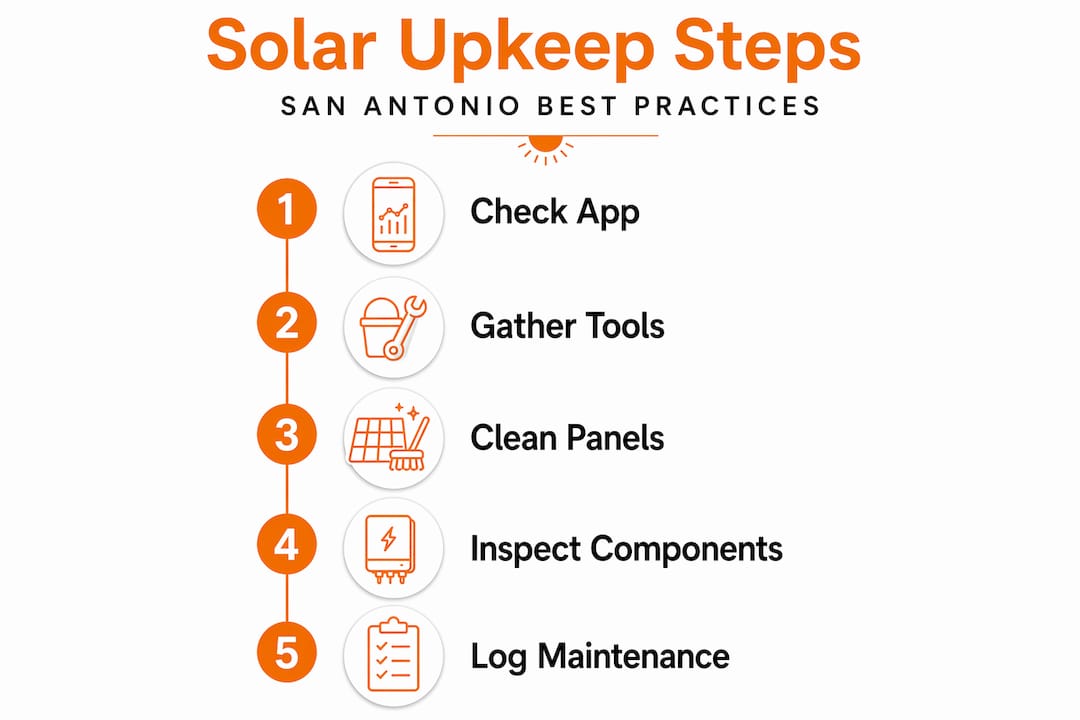
Pro Tip: Check your monitoring app before any physical inspection. If production numbers look normal, a visual check is likely enough. If something looks off in the data, you will know to inspect more closely before climbing up.
Finally, know what you are not qualified to touch. Wiring, junction boxes, and inverter internals are off-limits for homeowner maintenance. Electrical components require a licensed technician. Reviewing your homeowner safety guide before starting is time well spent.

Cleaning and inspection schedule for San Antonio
San Antonio is not the Pacific Northwest. Rain does not wash your panels consistently, and the spring pollen season combined with summer dust can coat your array faster than most homeowners expect. A cleaning schedule designed for this city looks different from a national average.
Here is a practical routine built for local conditions:
-
Conduct a visual inspection twice per year. Walk the perimeter of your home or use binoculars to check for visible debris, cracked glass, bird droppings, and shading from tree growth. Do this in early spring before pollen peaks and again in early fall.
-
Clean panels two to four times per year. The recommended cleaning approach uses early morning or late evening hours when panels are cool. Never clean hot panels with cold water. The thermal shock can cause microcracks that damage cells and void your warranty.
-
Use only soft brushes and deionized water. High-pressure washers and abrasive materials are off the table. They scratch the anti-reflective coating on panel glass, permanently reducing efficiency.
-
Inspect inverter ventilation monthly. Your inverter is typically mounted in a garage or utility space. Check that its vents are clear of dust buildup and that no error lights are active. A blocked vent causes heat-related shutdowns on hot San Antonio afternoons.
-
Check mounting hardware annually. Look for rust, loose bolts, or any signs that brackets have shifted. High wind events, which San Antonio gets periodically, can stress mounts over time.
-
Manage vegetation around your roofline. Trees and shrubs grow. A branch that cast no shadow two years ago may now block panels for several hours daily. Trim proactively and check shading patterns at noon in both summer and winter.
Pro Tip: After a major storm or a particularly heavy pollen week, do a quick app check. If production is down more than expected for the conditions, schedule a cleaning within the next few days rather than waiting for your regular cycle.
Recognizing when your panels need cleaning before the scheduled date is a skill worth developing. Visible film, streaking after rain, or a gradual production decline between cleanings are all signs to act sooner.
Reading monitoring data and spotting problems early
Your monitoring system is the most underused tool most homeowners have. Logging in once a month takes five minutes and can catch a problem that would otherwise cost you hundreds of dollars in lost production before anyone notices.
Here is what to watch for:
- A single panel producing 15 to 20% less than its neighbors is a clear signal. This level of output drop points to shading, a dirty panel, a faulty microinverter, or a loose connection. It needs a professional look.
- Inverter error codes should never be dismissed. Weekly inverter checks for error codes allow early detection before a minor fault becomes a full system shutdown.
- Whole-system production declining gradually over months without seasonal explanation could indicate panel degradation faster than normal, or a string-level fault that is easy to miss without careful month-over-month comparison.
- Production that stops entirely is obvious but worth stating: check the inverter first. Many shutdowns are caused by a tripped breaker or a grid voltage issue, not panel failure.
Some fixes are homeowner-friendly. If a panel is dirty, clean it. If a tree branch is casting new shade, trim it. If the inverter display shows a simple error like “grid frequency out of range,” your utility may be experiencing fluctuation and the system will often restart automatically.
Anything involving wiring, connections inside the inverter, or a microinverter swap requires a licensed technician. Attempting electrical repairs yourself risks injury, voids warranties, and can create fire hazards. When in doubt, call a professional.
Long-term upkeep, component lifespan, and warranty management
Solar is a long-term asset. Understanding how your components age helps you plan financially and make smarter decisions about repairs versus replacements.
| Component | Expected Lifespan | Notes |
|---|---|---|
| Solar panels | 25 to 30+ years | Degrade at 0.5% to 1% annually; premium N-type panels as low as 0.25% |
| String inverters | 10 to 15 years | Most common failure point; budget for replacement |
| Microinverters | 25 years | Longer rated lifespan; better for long-term reliability |
| Mounting hardware | 25+ years | Inspect annually for rust or stress damage |
| Monitoring equipment | Varies | Software updates may be needed; check with installer |
Panel degradation is gradual and expected. Systems maintained correctly can perform well beyond their 25-year warranty period. What catches most homeowners off guard is the inverter. String inverters require replacement around the 10 to 15-year mark, while microinverters are rated to last as long as the panels themselves.
Warranty management is where many homeowners drop the ball. Keep every service record, every cleaning log, and every repair receipt. Warranty claims for panel defects are much easier to process when you can show documented maintenance history. Some manufacturers will deny claims if they suspect neglect, even when the defect is genuinely their fault.
Schedule a professional inspection every three to five years beyond your own routine checks. Rain-based cleaning plus professional inspection every few years is often enough for well-maintained systems, but having an expert eye on wiring condition, insulation integrity, and inverter health pays dividends in system lifespan.
One more practice that significantly boosts your return: load shifting. Running your dishwasher, washer, dryer, and EV charger between 11 AM and 3 PM means you are using power your panels are actively generating rather than drawing from the grid. This one habit can meaningfully improve your monthly savings without any hardware changes. You can explore strategies to maximize ROI in more detail if you want to go deeper on consumption timing.
My honest take on post-installation care
I have worked with hundreds of San Antonio homeowners on their solar systems, and the pattern I see most often is not broken equipment. It is neglect followed by surprise.
Homeowners go through installation, feel great, watch the savings come in for a year or two, and then gradually stop checking the monitoring app. Life gets busy. The system keeps running, mostly. But “mostly” is where money quietly disappears. I’ve seen systems running at 70% of their designed output for over a year because a microinverter failed and nobody noticed until we ran a full inspection.
The other thing I want to address directly: proper commissioning matters more than most homeowners realize. Getting Permission to Operate from your utility is not the same as confirming your system was installed correctly. A proper commissioning includes verifying torque values, checking insulation resistance, and confirming every panel is producing as designed. If your installer skipped those steps, you may have started with a system running below its potential.
My advice is simple. Set a calendar reminder to check your monitoring app on the first of every month. Schedule one professional inspection in year three or four. Clean your panels before the San Antonio summer heat hits in full. These three habits prevent the majority of problems I see in the field.
Proactive homeowners consistently get more out of their solar investment than passive ones. Not because their panels are better, but because they catch small problems before they become expensive ones.
— Anthony
Ready to protect your San Antonio solar investment?
At Alphasolarsa, we work with San Antonio homeowners every day to keep their systems clean, inspected, and producing at their best. Whether your panels need a professional cleaning after a dusty season or your system is due for a full inspection, our team handles it with the care your investment deserves.
Our solar panel cleaning services are designed specifically for San Antonio’s climate, with proper techniques that protect your warranty and restore output quickly. If you are thinking about adding battery storage or an EV charger to your existing system, we can assess compatibility and handle the full installation. And if you are still evaluating solar or ready to upgrade, our residential solar services give you a custom-designed system built to last. Reach out to Alphasolarsa today and let us make sure your system is working as hard as you need it to.
FAQ
How often should San Antonio homeowners clean solar panels?
Cleaning two to four times per year is the standard recommendation, adjusted based on local debris levels. San Antonio’s spring pollen and summer dust typically push that frequency toward the higher end.
What are the signs of a solar panel problem I should watch for?
A single panel or string producing 15 to 20% less than others, recurring inverter error codes, or a gradual unexplained drop in monthly production are the main red flags that warrant a professional inspection.
How long do solar inverters last compared to panels?
Panels typically last 25 to 30 years, while string inverters need replacement around the 10 to 15-year mark. Microinverters are rated to last about 25 years, making them a stronger long-term choice.
Can I clean my solar panels myself?
Yes, with the right tools and timing. Use deionized water and a soft brush during early morning or evening hours when panels are cool. Never use a pressure washer, and always prioritize roof safety.
Does maintenance affect my solar warranty?
Yes, significantly. Keeping service records and following manufacturer-approved cleaning and inspection guidelines protects your ability to make valid warranty claims if equipment defects arise.