

TL;DR:
- Solar energy produced 90–95% fewer lifecycle emissions than fossil fuels, making it a cleaner option.
- Since 2010, solar costs have dropped 41%, with 91% of new projects in 2024 being cheaper than fossil fuel alternatives.
Solar energy has already passed a milestone most people missed. In 2025, solar generation grew 30% year over year and played a central role in pushing fossil fuel electricity generation into reverse for the first time ever. The solar vs fossil fuels debate is no longer hypothetical. It’s playing out in real time, on electric bills, in policy chambers, and on rooftops across the country. This article breaks down the real differences in emissions, costs, reliability, and long-term outlook so you can make smarter decisions about your energy future.
Table of Contents
- Key Takeaways
- Solar vs fossil fuels: the environmental truth
- The real cost comparison
- Reliability, storage, and grid realities
- Energy security and geopolitical stakes
- Future outlook for solar and fossil fuels
- My honest take on the solar vs fossil fuels conversation
- Ready to take control of your energy costs?
- FAQ
Key Takeaways
| Point | Details |
|---|---|
| Solar emissions are far lower | Solar produces 90–95% fewer lifecycle carbon emissions than fossil fuels across its usable life. |
| Solar costs now beat fossil fuels | In 2024, 91% of new renewable projects were cheaper than the least expensive new fossil fuel option. |
| Battery storage closes the reliability gap | Maturing battery systems are reducing solar’s intermittency concerns and improving grid stability. |
| Fossil fuels create price vulnerability | Fuel costs make up 60–70% of fossil fuel energy pricing, exposing consumers to commodity swings. |
| Solar adoption strengthens energy security | Countries deploying solar reduce their exposure to volatile fuel imports and geopolitical supply risks. |
Solar vs fossil fuels: the environmental truth
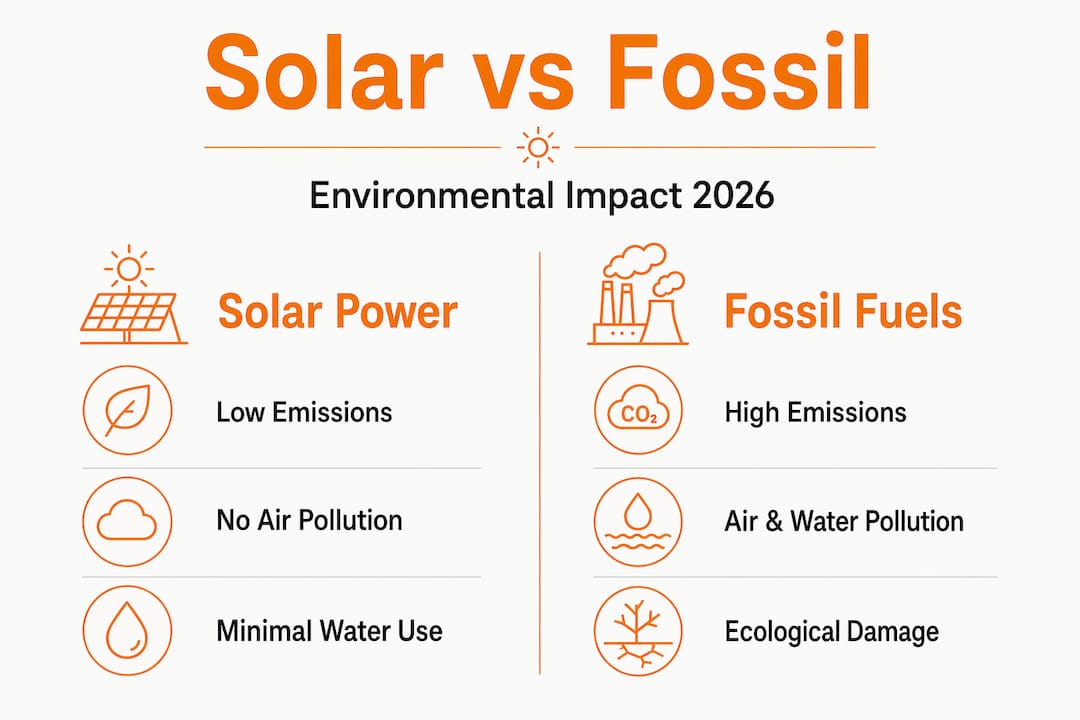
The emissions gap between solar and fossil fuels is not a close race. Solar produces 90–95% fewer lifecycle carbon emissions than fossil fuels, according to National Renewable Energy Laboratory research. Coal emits roughly 23 times more carbon per unit of electricity generated. Natural gas comes in at about 11 times more. These numbers account for the full lifecycle of a solar panel, including mining, manufacturing, shipping, installation, and eventual disposal.
One of the most persistent myths is that solar panels create significant pollution during manufacturing and never really “pay back” their carbon debt. The reality is that a typical solar panel pays back its manufacturing emissions within two to four years of operation. Most panels last 25 to 30 years. That means you get more than two decades of near-zero emission energy generation from a single panel.
| Energy source | Lifecycle CO₂ (grams per kWh) | Emission factor vs solar |
|---|---|---|
| Solar PV | 20–50 | Baseline |
| Natural gas | 400–490 | ~11x higher |
| Coal | 820–1,050 | ~23x higher |
| Wind | 7–15 | Lower than solar |
Beyond carbon, fossil fuels carry additional environmental costs that rarely appear on an energy bill. Coal mining disrupts land on a massive scale. Natural gas extraction through fracking risks groundwater contamination. Oil spills cause ecosystem damage that lasts decades. Solar panels, by comparison, require land but do not pollute the soil or water beneath them during operation.
Pro Tip: If you want a local picture of how solar compares to grid electricity from fossil fuels in your area, check out this detailed look at solar’s environmental impact for San Antonio homeowners.
The real cost comparison
Solar energy has a straightforward cost structure. High upfront capital, zero fuel cost, and predictable pricing for the life of the system. Fossil fuel energy works the opposite way. Lower capital costs to build a gas plant, but ongoing exposure to commodity prices that can spike without warning. Fuel costs represent 60–70% of the total cost of fossil fuel electricity. That means every time oil markets tighten or a pipeline gets disrupted, your electricity rate feels it.
The cost of solar has shifted dramatically at a global level. Since 2010, solar PV costs have dropped so far that solar is now 41% cheaper than the cheapest new fossil fuel power options in many markets. In 2024 alone, 91% of new renewable power projects came in below the cost of the least expensive new fossil fuel plant built anywhere in the world. That is not a small margin. That is a structural shift.
Here is how the two models compare practically for someone making an energy decision today:
- Solar: Higher upfront system cost, but electricity from that system is free once installed. No fuel to buy. No commodity exposure. Predictable savings over 20 to 25 years.
- Fossil fuel grid power: Lower initial barrier to access, but rates are tied to natural gas and coal prices. When those prices rise, your bill rises with them.
- Price stability: Solar’s levelized cost is highly stable because there is no fuel component. Fossil fuel costs fluctuate as markets move.
- Long-term value: A homeowner who installs solar today locks in their energy price for decades, protecting against future rate increases.
This is exactly why the renewable energy comparison increasingly favors solar for both households and large energy buyers. The cost of solar energy is front-loaded but predictable. Fossil fuels are cheaper to start but unpredictable over time, and that unpredictability carries real financial risk.
Reliability, storage, and grid realities
The most common objection to solar is that the sun does not always shine. That is true. But framing solar as unreliable because it is intermittent misses how modern energy systems actually work.
Battery storage technology has matured significantly. Countries with higher renewable shares experienced lower electricity price shocks during the fossil fuel market disruptions of recent years, partly because battery storage buffered the gaps. That is a direct, measurable benefit of energy storage working alongside solar generation.

Pro Tip: Pairing a solar system with a battery backup is one of the most effective ways to get consistent, reliable power at home. A battery stores excess solar energy during the day and releases it at night or during outages, so you are rarely dependent on the grid.
The grid itself is also evolving. Most energy experts agree that high solar penetration still needs a complement of dispatchable sources, including natural gas, nuclear, and hydropower, to maintain stability. That is not a knock against solar. It is a description of how hybrid energy systems work, and those hybrid systems are where the grid is heading.
One genuinely interesting development in this space is the technology being developed to convert renewable electricity into methane using captured CO₂. Researchers have developed reactors that produce renewable methane that can be stored and transported using existing natural gas infrastructure. This means the fossil fuel grid’s delivery system could eventually carry renewable energy. The two energy types are not necessarily as separate as they appear today. Companies like XFuel are already exploring solar integration with diesel systems to smooth this kind of hybrid transition.
Energy security and geopolitical stakes
Energy policy is not just about electricity rates. It is about national sovereignty. Any country that imports oil, coal, or natural gas is financially exposed to wherever those commodities are produced and whoever controls the supply chain.
Here is why solar and other fossil fuel alternatives change the equation for policymakers:
- Reduced import dependency. Deploying solar reduces exposure to volatile commodity imports, which directly strengthens energy sovereignty for any country that has historically spent significant GDP on fuel imports.
- Price shock insulation. Countries with higher solar and renewable capacity are less affected when global fossil fuel prices spike due to conflict, sanctions, or cartel decisions.
- Domestic job creation. Solar installation, manufacturing, and maintenance create local employment that stays within the economy, unlike fuel payments that leave the country.
- Transition costs are real. Moving away from fossil fuels requires new grid infrastructure, storage capacity, and workforce retraining. These costs are not trivial, but they are one-time capital investments rather than recurring operational expenses.
For individual homeowners, this translates directly. When you install solar, you are not just cutting your electricity bill. You are protecting yourself from rising energy costs tied to fuel markets you have zero control over.
Future outlook for solar and fossil fuels
The trajectory is clear and backed by data. BloombergNEF forecasts solar will overtake fossil fuels as the dominant electricity source by 2035. Renewable energy already meets over 33% of global electricity, and solar is the fastest growing piece of that share.
| Metric | 2025 status | 2035 projection |
|---|---|---|
| Solar share of global electricity | ~15–18% | Projected majority source |
| Solar annual growth rate | 30% year over year | Continued rapid expansion |
| New renewable vs fossil fuel cost | 91% of renewables cheaper | Gap expected to widen further |
| Battery storage capacity | Rapidly scaling | Grid-scale deployment mainstream |
A few things to watch as you evaluate energy decisions in the next several years:
- Storage scaling is the critical variable. The faster battery costs fall, the faster solar can reliably replace fossil fuel generation without needing dispatchable backup.
- Grid infrastructure investment is lagging. In many regions, transmission grids were not built for distributed solar generation, and upgrading them is a major bottleneck.
- Fossil fuel demand is still rising overall. Despite clean energy growth, sectors like AI data centers and industrial processes are driving total energy demand higher, which means fossil fuels are not disappearing overnight.
- The residential opportunity is now. For homeowners, the economics of solar are already favorable. Waiting does not improve the math much, and utility rates continue to climb.
My honest take on the solar vs fossil fuels conversation
I have watched the energy economics shift faster than almost anyone predicted five years ago. The number I keep coming back to is this: a decade ago, solar was roughly five times more expensive than fossil fuel power. Today, it is cheaper in most markets. That kind of cost curve does not reverse.
What I find frustrating is how often the conversation about solar intermittency is used to dismiss solar entirely, while the very real risks of fossil fuel dependency get downplayed. A gas price spike that doubles your electricity bill is a reliability problem too. It just does not get framed that way.
The honest reality is that neither side of this debate is perfectly clean or perfectly reliable. Solar has intermittency. Fossil fuels have price volatility, geopolitical exposure, and long-term environmental consequences that are growing harder to ignore. The question for a homeowner or a policymaker is not which source is perfect. It is which combination of sources gives you the best long-term outcome at the lowest total cost.
In my experience, the homeowners who invest in solar now, paired with good battery storage, end up better positioned than those who wait for a perfect grid solution. You do not need to solve the whole energy transition to benefit from it. You just need to make a smart decision for your own situation.
— Anthony
Ready to take control of your energy costs?
At Alphasolarsa, we help homeowners and businesses in San Antonio move away from utility rate increases and toward predictable, long-term energy ownership. Whether you are interested in residential solar installation for your home or exploring commercial solar solutions for your business, our team designs systems built for your specific energy profile and goals.

We also handle battery storage, EV charger installation, and panel maintenance so your system keeps performing at its best. If you are ready to stop paying for fuel price swings you cannot control, reach out to Alphasolarsa for a no-pressure consultation. We will show you exactly what solar looks like for your property and your budget.
FAQ
Is solar really cleaner than fossil fuels over its full lifetime?
Yes. Solar produces 90–95% fewer lifecycle emissions than coal or natural gas, and a typical panel pays back its manufacturing carbon within two to four years while lasting 25 to 30 years.
Is solar cheaper than natural gas and coal now?
In most markets, yes. Since 2010, solar costs have dropped so much that it is now 41% cheaper than fossil fuels in new power plant comparisons, and 91% of new renewable projects undercut the cheapest new fossil fuel option in 2024.
Can solar power handle demand when the sun is not shining?
Not on its own, but battery storage systems and hybrid grids close the gap significantly. Countries with higher solar shares have actually seen lower electricity price shocks during energy disruptions because storage buffers the shortfall.
When will solar overtake fossil fuels as the main electricity source?
BloombergNEF projects solar will overtake fossil fuels as the dominant electricity source globally by 2035, driven by rapid capacity expansion and continued cost declines.
How does going solar protect you from fossil fuel price volatility?
Solar locks in your energy cost at installation with no ongoing fuel expenses. Because fuel costs drive 60–70% of fossil fuel electricity pricing, solar owners are insulated from commodity market swings that regularly push utility rates higher.