

TL;DR:
- Community solar allows renters and homeowners with shaded or unsuitable roofs to benefit from shared off-site solar farms without installing panels. Subscribers receive bill credits based on their designated share’s energy production, often saving 5 to 15% on electricity costs with no upfront investment. Eligibility depends on state legislation, with many programs emphasizing accessibility for low-to-moderate income households and community benefits like local job creation.
Most people assume going solar means putting panels on your roof. If you rent, have a shaded roof, or simply can’t afford a full installation, that assumption can feel like a dead end. Community solar explained simply: it’s a shared solar model that lets you benefit from a solar farm in your area without owning or installing a single panel. You subscribe to a portion of that farm’s output, and the energy credits show up directly on your utility bill. It’s one of the most accessible paths to clean energy available today, and far more people qualify than realize it.
Table of Contents
- Key takeaways
- What community solar is and how it actually works
- Who benefits most from community solar
- Benefits and trade-offs worth knowing
- How to sign up for a community solar program
- State programs and the legal framework behind them
- My honest take on community solar
- See what solar options are available to you
- FAQ
Key takeaways
| Point | Details |
|---|---|
| No panels required | You subscribe to a share of an off-site solar farm and receive bill credits, not rooftop hardware. |
| Open to renters and owners | Anyone on the utility grid can participate, including renters and those with shaded or unsuitable roofs. |
| Typical savings of 5 to 15% | Subscription fees are structured to cost less than your equivalent utility rate, producing real monthly savings. |
| No upfront cost | Most programs have zero installation fees and offer flexible, short-term contract options. |
| Availability varies by state | Not every state has enabling legislation, so checking local program availability is your first step. |
What community solar is and how it actually works
Community solar is any solar project or purchasing program within a region that benefits multiple customers at once. Instead of one household owning one rooftop system, dozens or hundreds of subscribers share the output of a single, larger solar installation, typically located on open land or commercial rooftops nearby.
Here’s how the process flows from sun to savings:
- A solar developer builds a community solar farm and connects it to the local utility grid.
- You subscribe to a specific share of that farm’s capacity, usually measured in kilowatts (kW) or as a percentage of the farm’s total output.
- The farm generates electricity and feeds it into the grid.
- Your utility tracks how much energy your share produced each month and applies that as a bill credit to your account.
- You pay the community solar provider a monthly subscription fee, which is typically set below what you’d otherwise pay your utility for the same amount of electricity.
The utility company plays a central role here. It acts as the middleman, receiving power from the solar farm, applying credits to subscriber accounts, and processing payments between subscribers and providers. You don’t deal with the physical infrastructure at all.
There are two main subscription structures you’ll encounter. A fixed monthly payment plan locks in your fee based on an agreed share of output. A variable plan adjusts with actual production, meaning your credit and fee may shift slightly month to month. Both can save you money, but fixed plans are easier to budget around.
Pro Tip: When comparing community solar subscriptions, ask providers for a sample bill showing exactly how the credit appears. If a provider can’t show you that, keep looking.
Who benefits most from community solar
This is where community solar really stands apart. Rooftop solar isn’t viable for a significant portion of households. Renters can’t install panels on property they don’t own. Homeowners with north-facing roofs, heavy tree cover, or structurally compromised roofs face similar barriers. And the upfront cost of a full residential system, even with financing, puts it out of reach for many lower-income families.
Community solar solves all of these problems at once. The groups who benefit most include:
- Renters who want to participate in clean energy but have no control over their building’s roof
- Homeowners with shaded or unsuitable roofs who can’t generate enough solar power locally to justify installation
- Low-to-moderate income households who can’t absorb the upfront costs of a private solar system
- People who move frequently, since many community solar subscriptions are transferable or come with simple exit options
- Small businesses and nonprofits that want predictable energy costs without capital investment
State-level community solar programs frequently reserve a portion of capacity specifically for low-to-moderate income subscribers, sometimes at a deeper discount. Maryland’s program, for example, includes provisions designed to promote energy equity by making sure lower-income households aren’t left out of the clean energy transition.
Beyond individual savings, the broader community benefits are real. Community solar contributes to local job creation during construction and maintenance phases. It builds community wealth by keeping energy dollars circulating locally rather than flowing to distant fossil fuel suppliers. And it distributes energy generation more widely, which strengthens the grid.
“Community solar is one of the most practical tools we have for making clean energy genuinely accessible. It’s not just for homeowners or those who can afford a major installation. It’s for everyone on the grid.”
Benefits and trade-offs worth knowing
Community solar carries real advantages, but going in with clear expectations sets you up for a better experience. Here’s a balanced look at what you get and what you should watch for.
| Factor | Community solar | Standard utility electricity |
|---|---|---|
| Monthly cost | Subscription fee (typically 5 to 15% less) | Standard utility rate |
| Upfront cost | None | None |
| Environmental impact | Clean solar energy credited to your account | Mix of grid sources |
| Ownership | No panel ownership | No panel ownership |
| Federal tax credits | Not available to subscribers | Not applicable |
| Availability | Varies by state | Available everywhere |
| Contract flexibility | Often month-to-month or short-term | N/A |
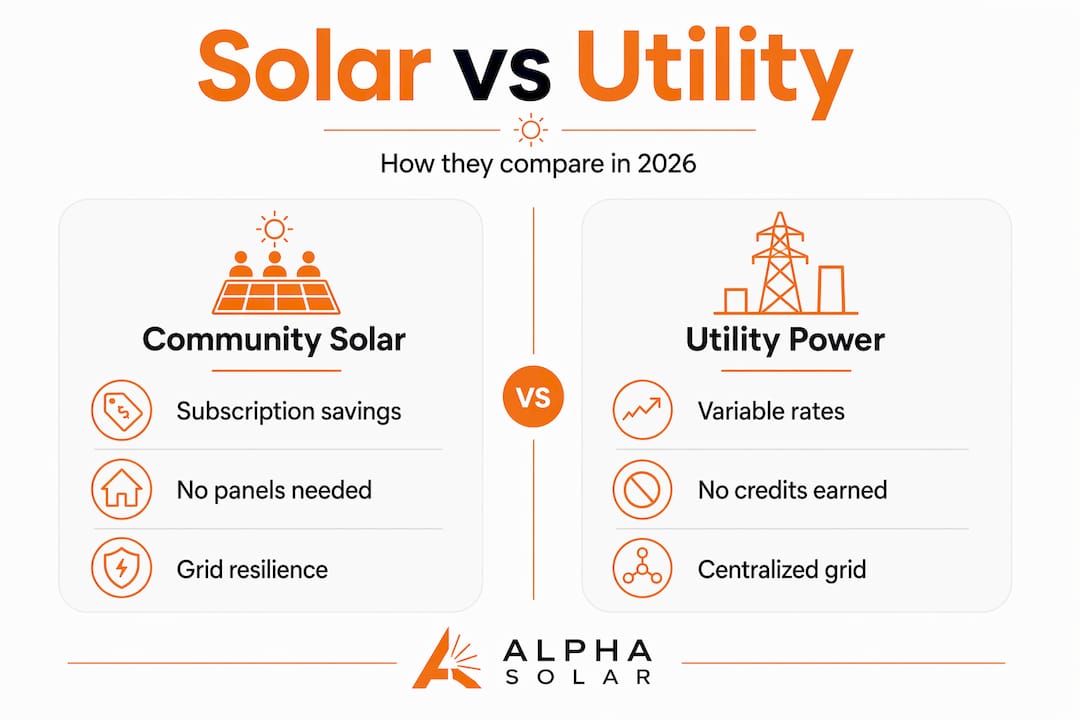
Subscribers typically save 5 to 15% on the electricity costs covered by their subscribed share. That’s real money over time, especially as utility rates continue to rise.

One important limitation: community solar subscribers don’t receive federal tax credits. Developers claim commercial credits on the project side, but those savings don’t pass through as a tax incentive to you directly. Your savings come from the subscription fee being lower than your standard utility rate. Understanding this distinction keeps your expectations grounded.
Most subscriptions carry no upfront cost and many are available month-to-month, which makes them far less risky than a long-term rooftop installation contract. That flexibility is a genuine advantage. You can often exit without major penalties if your situation changes, though this varies by provider.
Community solar also adds a layer of grid resilience by distributing generation across more locations. Concentrated power sources create single points of failure. A community solar farm, especially one paired with battery storage, helps smooth out supply disruptions and supports a more stable grid for everyone in the area.
Pro Tip: Always read the full contract before signing. Pay specific attention to the exit clause, any fees for early termination, and how credits are calculated if the farm underproduces. These three details determine your actual financial outcome.
How to sign up for a community solar program
Participating in community solar is a straightforward process once you know what to look for. Here’s how to move from interested to enrolled.
-
Check availability in your state. Start with your utility company’s website or call their customer service line. Many utilities maintain a list of approved community solar providers in your area. National databases like the Department of Energy’s community solar resources are also a practical starting point.
-
Compare available projects. Look at subscription fee structures, contract lengths, and the discount rate compared to your utility’s standard rate. Some providers offer longer contracts with a higher guaranteed discount; others keep things month-to-month with a modest savings rate.
-
Verify your eligibility. Most programs require that you’re a customer of the utility serving the project’s location. Some programs have waitlists due to high demand, so signing up early matters.
-
Review the contract carefully. Before you commit, confirm how credits are applied to your bill, what happens if you move, and what exit fees (if any) apply. Consumer protections like clear contract disclosures are a standard feature of mature programs, but terms still vary.
-
Enroll and monitor your first bills. Once you’re subscribed, your utility will begin applying credits each billing cycle. Track your credits on each bill to confirm they’re appearing correctly. If something looks off, contact your provider or utility right away.
The whole process typically takes a few weeks between enrollment and your first credited bill. Some providers send a welcome packet explaining exactly what to look for on your statement. If yours doesn’t, ask for one.
Pro Tip: Screenshot or save your first three bills after enrolling. Having a clear record of how credits are applied makes it much easier to resolve any billing discrepancies quickly.
State programs and the legal framework behind them
Community solar isn’t available everywhere. Whether you can participate depends heavily on whether your state has passed enabling legislation that allows utilities to support shared solar projects and bill credit programs.
States with mature, well-established programs include New York, Illinois, Minnesota, Maryland, and Massachusetts. These states have clear rules about contract disclosures and billing standards, which creates a safer environment for subscribers.
Other states are still developing their frameworks, with programs in early rollout phases. And some states, like Pennsylvania, currently lack the legal framework that makes community solar possible at all, meaning residents there have no path to subscribe regardless of interest.
| State | Program status | Notable feature |
|---|---|---|
| New York | Mature | Income-based tiers and strong subscriber protections |
| Illinois | Mature | Dedicated capacity for low-income households |
| Maryland | Mature | Clear disclosure requirements and consumer protections |
| Minnesota | Mature | One of the oldest programs in the country |
| Pennsylvania | No enabling legislation | Community solar not currently available |
Checking solar regulations in your state before exploring programs saves time and sets realistic expectations. If your state doesn’t have a program yet, it’s worth contacting your state representative to show support for enabling legislation. These policy decisions respond to constituent demand.
My honest take on community solar
I’ve worked with a lot of homeowners and renters who were genuinely surprised to learn community solar was even an option. The most common misconception I run into is that solar is always a big capital commitment. People assume it means signing a 20-year lease or spending tens of thousands of dollars. Community solar rewrites that story entirely.
What I’ve learned from real conversations with subscribers is that the billing credit system confuses people at first. They expect a separate check or a dramatically different bill. Instead, the credit quietly offsets what they owe each month. Once people understand that, they appreciate how simple the mechanism actually is.
My one consistent piece of advice: read the contract before you sign anything. I’ve seen subscribers end up in multi-year agreements with early termination fees that wiped out their savings. The programs are legitimate and the savings are real, but not every provider operates with the same level of transparency. Stick with providers that clearly explain the solar incentives involved and give you a sample bill upfront.
Community solar isn’t a perfect replacement for owning your own system. If you own your home and your roof is suitable, a dedicated residential installation usually offers better long-term value. But for the large share of people who can’t take that path right now, community solar is a genuinely good option. Don’t let the complexity of the concept stop you from exploring what’s available in your area.
— Anthony
See what solar options are available to you
At Alphasolarsa, we help homeowners and community members throughout the San Antonio area understand every solar option available to them. Whether you’re exploring community solar programs or ready to move forward with a dedicated residential solar system on your own property, our team walks you through the numbers honestly. We also support businesses looking at commercial solar installation and offer services like EV charger installation and solar panel cleaning to keep your energy setup running at its best. Reach out to Alphasolarsa today and get a clear, no-pressure conversation about what solar can actually do for your situation.
FAQ
What is community solar in simple terms?
Community solar is a shared solar program where subscribers receive electricity bill credits based on their portion of a solar farm’s output. You don’t need to own or install panels to participate.
How does community solar work with my utility bill?
Your utility applies a credit each month reflecting the energy your subscribed share generated. That credit reduces your total bill, and you pay a separate, typically lower monthly fee to the solar provider.
Who qualifies for community solar programs?
Anyone who is a customer of the utility serving the project’s location can typically qualify, including renters and homeowners. Some programs reserve capacity for low-to-moderate income households at additional discounts.
Do community solar subscribers get any tax credits?
No. Subscribers do not receive federal tax credits directly. The financial benefit comes from subscription savings versus the standard utility rate, typically 5 to 15% on your subscribed energy portion.
How do I find community solar programs near me?
Start with your utility company’s website or customer service line to find approved local providers. You can also check your state’s public utilities commission website, which often lists available community solar projects and eligibility details.