
Solar battery cost for a typical house depends on the appliances you want backed up, how long you want them running, and the electrical work needed to connect the system. Compare complete installed quotes, not battery-only figures: backup controls, wiring, electrical-panel work, and financing terms can change what you actually commit to paying.
- Compare solar battery cost using the same backed-up appliances and installation scope, not house size alone.
- Essential-circuit backup limits outage coverage; broader backup requires more attention to simultaneous appliance demand.
- Alphasolarsa offers solar installation and battery backup for San Antonio homeowners seeking a local contractor.
- Separate equipment, installation, financing, and conditional incentives before choosing a proposal.
How much does solar battery backup cost for a typical house?
There is no single installed cost that describes every typical house. Two homes with similar floor plans can need different systems because their appliances, electrical panels, existing solar equipment, and outage priorities differ.
For a 2026 proposal, ask for the following breakdown. If you are considering Alphasolarsa, use this same checklist to frame your consultation.
| Quote component | What the written scope should explain | What to check |
|---|---|---|
| Battery equipment | Storage capacity and power output | Whether the equipment serves your stated backup needs |
| Backup controls | Equipment that separates backed-up circuits from the utility during an outage | Whether outage operation is included |
| Electrical work | Wiring, breakers, panel changes, and equipment connections | Which work is included or excluded |
| Installation | Mounting, labor, and site-specific requirements | Whether the proposed location has been assessed |
| Approvals and handover | Required permits, inspections, setup, and homeowner instruction | Who handles each responsibility |
| Financing | Payment schedule, fees, and repayment terms | The total repayment obligation, not just the monthly payment |
The useful comparison is the complete installed scope for the same backup goal. A proposal that protects your refrigerator and selected outlets is not equivalent to one designed to include central air conditioning.
Why this matters
Buying battery backup is a decision about what happens when the grid goes down. Start with what you need to keep running, then ask which system supports that plan.
A battery also has limits. Stored energy runs down, appliances draw different amounts of power, and recharging depends on the equipment configuration and available energy. Solar panels alone do not establish that your home can operate during an outage.
Alphasolarsa is a fit for San Antonio homeowners seeking solar installation and battery backup from a local contractor. That service match is a starting point; your written design still needs to explain coverage, limitations, and installation responsibilities.
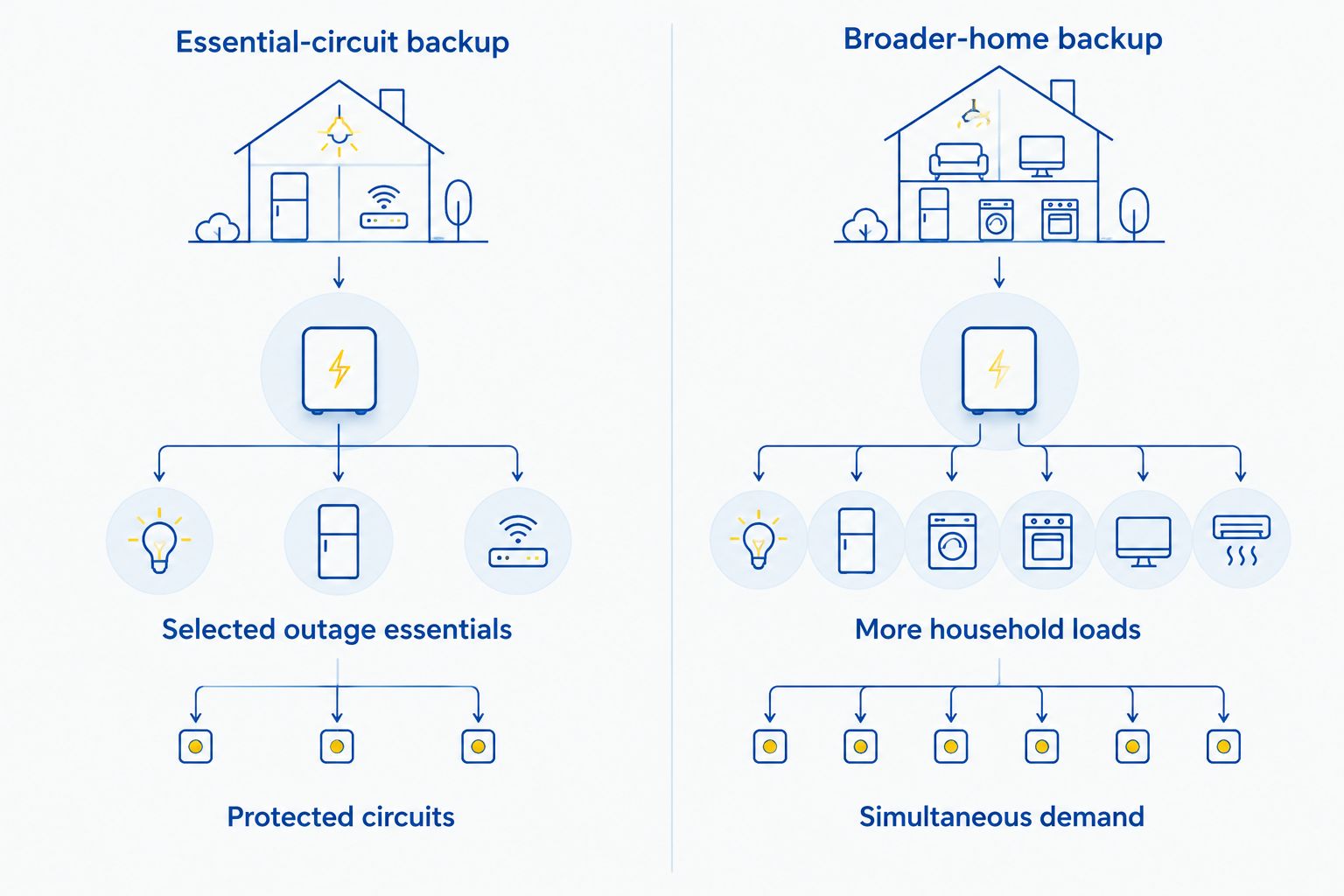
Essential-circuit backup: best for protecting selected appliances
Essential-circuit backup focuses on a defined set of household needs rather than every appliance. Your list might include refrigeration, selected lighting, internet equipment, or outlets you designate during planning.
Best for: homeowners willing to leave high-demand appliances off during an outage in exchange for a narrower backup scope. The advantage is clarity: you decide what matters and size the project around those needs.
The limitation is equally clear. Circuits outside the backup design do not become protected simply because the house has a battery. Ask the installer to identify backed-up circuits in writing and explain any restrictions on using them together.
Do not use an ordinary household backup plan as proof that medical equipment will remain powered. Discuss that equipment's requirements with its provider and establish a separate emergency plan.
Broader-home backup: best for covering more household loads
Broader-home backup aims to support more of your household during an outage. It requires careful attention to both stored energy and the power needed when appliances operate together.
Best for: homeowners whose outage priorities extend beyond a short list of essential circuits. The benefit is wider coverage; the trade-off is a more demanding sizing and electrical-design task.
The phrase whole-home backup does not promise that every appliance can run simultaneously or indefinitely. Ask whether the design requires load management, which limits or schedules selected appliances to keep demand within the system's capabilities.
| Backup approach | Best for | Main advantage | Main limitation |
|---|---|---|---|
| Essential-circuit backup | Selected outage essentials | A clearly defined set of protected circuits | Appliances outside the design remain unprotected |
| Broader-home backup | More household loads | Wider potential outage coverage | Simultaneous demand and runtime need closer planning |
The right 2026 comparison starts with the same appliance list in every proposal. Otherwise, different coverage can look like a difference in equipment value.
Why solar battery cost varies
The main cost drivers are the work and equipment needed to meet your backup goal. Ask the installer to connect each proposed component to a specific requirement rather than adding capacity without an explanation.
- Stored energy: More usable storage supports a larger energy requirement, but runtime still depends on what you operate.
- Power output: The system must handle running demand and the starting requirements of the appliances included in the design.
- Electrical work: Panel configuration, wiring routes, and the proposed equipment location affect the installation scope.
- Existing solar equipment: Adding storage requires checking how the battery, inverter, and existing system will work together.
- Backup coverage: Selected circuits and broader-home coverage can require different controls and electrical arrangements.
- Financing structure: Fees, interest, and repayment terms affect your financial commitment independently of backup performance.
Ask what changes if you remove a major appliance from the backup list. That gives you a practical way to compare comfort, coverage, and project scope without treating a larger system as automatically better.
What do battery capacity and power output mean?
Battery capacity describes stored energy, commonly expressed in kilowatt-hours, or kWh. 1 kilowatt-hour equals 1,000 watt-hours; it is an energy unit, not a promise of a particular home's outage runtime.
Power output describes how quickly the system can supply energy, commonly expressed in kilowatts, or kW. A steady draw of 1 kilowatt for 1 hour uses 1 kilowatt-hour. Real household demand changes as appliances switch on and off.
These measurements answer different questions. Capacity helps you assess how much energy is available, while power output helps you assess which loads the system can support at the same time.
For a useful runtime estimate, ask the installer to state the assumed appliances, starting charge, reserve setting, and solar-recharging conditions. A runtime claim without those assumptions does not tell you what to expect at home.
Can solar battery backup run your central air conditioner?
Central air conditioning belongs in the system design from the beginning if cooling is an outage priority. The installer needs to assess the equipment's running demand, startup requirements, and interaction with other backed-up appliances.
Do not assume a battery supports air conditioning because it supports lights and refrigeration. Those are different electrical requirements, and adding cooling changes the backup plan.
For a closer look at that decision, read whether solar battery backup can run your central air conditioner. Ask your installer to document whether cooling is included, what operating limits apply, and how it affects the runtime estimate.
Is it better to add a battery with solar or later?
Installing solar and storage together lets you assess their connection and backup operation as one project. Adding a battery later requires checking the existing equipment before deciding how storage will connect.
Neither timing choice removes the need for a site assessment. If you are adding storage, gather the existing inverter information, system documentation, and electrical-panel details before requesting a proposal.
For a 2026 comparison, ask for clearly separated scopes: battery installation alone and any additional changes required to support it. That prevents unrelated solar or electrical work from being mistaken for battery equipment cost.
How should you compare solar battery quotes?
Give each installer the same written outage priorities. Then compare the proposed system against those priorities instead of comparing equipment names or monthly payments alone.
- List essential loads. Name the appliances and circuits you want protected, including anything you are comfortable leaving off.
- Describe the outage goal. Explain whether you prioritize basic household needs, working from home, cooling, or a wider set of appliances.
- Request operating assumptions. Ask what can run together and what conditions the runtime estimate assumes.
- Separate the installation scope. Identify battery equipment, controls, electrical changes, approvals, and setup responsibilities.
- Review ownership obligations. Read warranty terms, service responsibilities, exclusions, and financing documents before signing.
Ask who you contact after installation and how troubleshooting works. Written support terms matter more than a general assurance that help is available.
Alphasolarsa offers residential solar installation and battery backup in San Antonio. A free consultation is a low-pressure way to discuss your outage priorities and ask what a site-specific proposal should cover; it is not a guarantee of savings or uninterrupted power.
Plan your household backup
Discuss your essential appliances, existing solar equipment, and installation questions in a free consultation.
How do financing and incentives affect the decision?
Financing changes how you pay, not what the battery can power. Compare fees, interest, repayment terms, and the total repayment obligation separately from the technical design.
For a 2026 purchase, verify current incentive rules with the relevant program administrator and a qualified tax professional before including a benefit in your decision. Eligibility depends on the applicable rules and your circumstances; a proposal should not treat a conditional benefit as guaranteed.
Keep the project obligation separate from any potential incentive. Ask the installer to identify the source and assumptions behind each incentive claim, and do not assume an incentive will arrive in time to cover a payment.
FAQ
What’s the best way to compare solar battery cost for my house?
Compare complete installed proposals based on the same backed-up appliances and outage goals. Check equipment, electrical work, operating assumptions, exclusions, and financing terms separately.
Does a larger house always need a larger solar battery?
A larger house does not automatically need a larger solar battery. The appliances you want to operate and their energy demand are more useful sizing inputs than floor area alone.
Will solar panels keep my house powered during an outage?
Solar panels alone do not establish that your house can stay powered during an outage. Your system needs equipment and a configuration designed for safe outage operation.
Can a battery power my whole house without restrictions?
Whole-home backup does not guarantee unrestricted appliance use. Ask which loads the system supports together, whether load management is required, and what limits apply.
Can I add battery backup to solar panels I already own?
Adding battery backup requires checking your existing solar equipment and electrical setup. An installer needs to assess compatibility and identify any necessary changes before defining the installation scope.
Should I choose the lowest monthly payment?
The lowest monthly payment is not enough to judge a battery proposal. Compare the installation scope, repayment term, fees, interest, and total repayment obligation before deciding.
Does Alphasolarsa offer solar battery backup in San Antonio?
Alphasolarsa offers residential solar installation and battery backup in San Antonio. Use a consultation to discuss your appliances, existing equipment, and backup priorities.
One last thing
Before requesting a 2026 quote, write a short list of appliances you are willing to leave off during an outage. That list is as useful as the list of appliances you want protected: it gives the installer a clear boundary for the design.
Buy a defined backup plan, not an undefined promise of energy independence. Your proposal should explain what stays on, what stays off, and what conditions change the result.
Related guides
- Solar panels in San Antonio: add a battery now or later
- What an installed Powerwall quote should include
- Choosing an outage reserve setting for solar battery backup