

TL;DR:
- Reducing energy bills involves behavior changes, tariff management, and home upgrades that work together.
- Smart consumption data and simple adjustments can significantly cut costs without major investments, especially for short-term savings.
Energy bill reduction is the process of combining practical behavior changes, tariff management, and home efficiency upgrades to lower your monthly utility costs. Most homeowners overpay not because energy is expensive, but because they have not yet matched their habits, billing plan, and home systems to work together. The good news is that savings are available at every budget level. From adjusting your thermostat to installing solar panels, the strategies in this guide move from free and immediate to longer-term investments that pay off for years.
What is energy bill reduction, and where do you start?
Energy bill reduction, known in the industry as residential energy efficiency management, covers every decision that affects how much electricity and gas your home consumes and how much you pay per unit. The starting point is understanding your bill. A typical utility bill has two main charges: a unit rate (the cost per kilowatt-hour of energy you use) and a standing charge (a fixed daily fee just for being connected to the grid). Cutting energy expenses means attacking both sides of that equation.
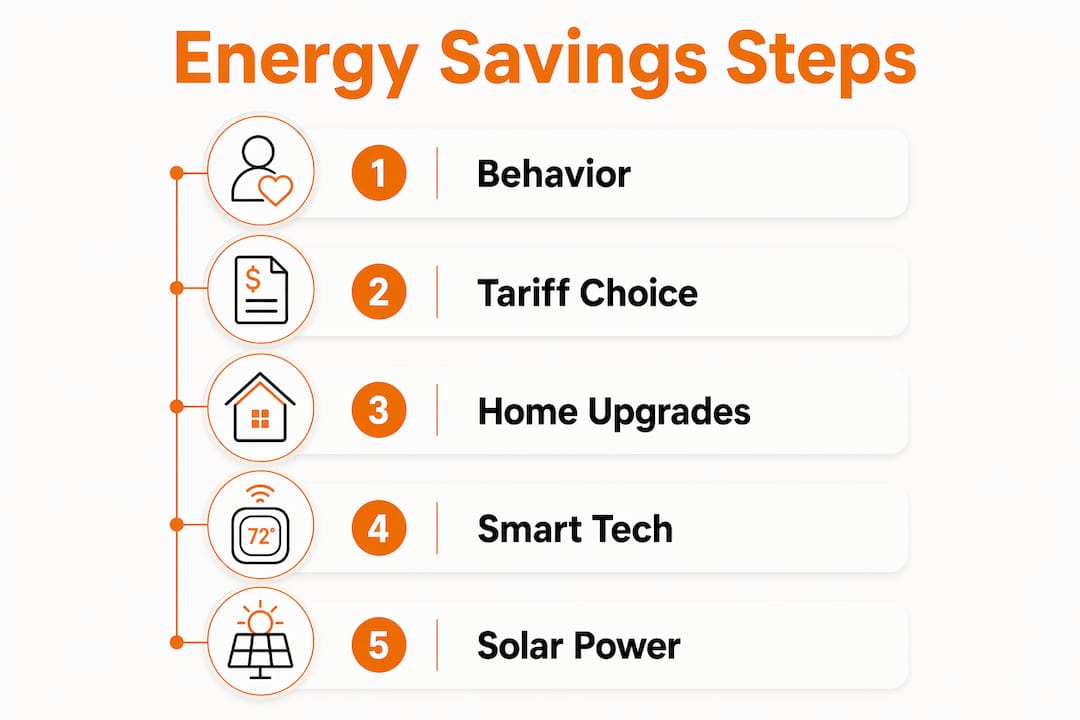
The fastest wins come from behavior. The medium-term wins come from tariff selection. The long-term wins come from physical upgrades to your home. Each layer builds on the last. Homeowners who treat these three levers as separate problems miss the compounding effect of addressing all three together.
What are the best no-cost behavior changes to lower your energy bills?
Behavior changes are the highest-return moves available because they cost nothing and take effect immediately. Turning down your thermostat by 1°C can reduce annual heating costs by about 10%. That single adjustment, made once, saves money every day of the heating season without any loss of comfort most people can actually feel.
Here are the most effective habits to build right now:
- Unplug devices at the wall. Standby power from idle devices adds up to a meaningful expense each year. Televisions, game consoles, and phone chargers all draw power even when you think they are off.
- Wash clothes at 30°C and run full loads. Washing at lower temperatures uses significantly less energy with no meaningful difference in cleaning performance for everyday laundry.
- Air dry dishes and clothes. Skipping the heated dry cycle on your dishwasher and hanging clothes instead of using a dryer removes two of the biggest energy draws in a typical home.
- Use bathroom exhaust fans properly. Failing to run exhaust fans during and after showers forces your air conditioning system to work harder to remove humidity, raising energy use significantly.
- Set timers on high-use appliances. Scheduling your water heater, pool pump, or electric vehicle charger to run during off-peak hours reduces both consumption and cost.
Pro Tip: Use your smart meter’s hourly data to find “vampire loads,” which are devices that consume power around the clock. Check the app at midnight when you think everything is off. Any reading above a baseline suggests something is drawing power it should not be.
How do energy tariffs and payment methods affect your bill?
Your tariff is the pricing structure your utility or energy supplier uses to charge you. Choosing the wrong one can cost you hundreds of dollars a year even if your actual consumption stays the same.
The two main types are fixed tariffs and variable tariffs. A fixed tariff locks your unit rate for a set period, typically 12 or 24 months. A variable tariff moves with market prices. Fixed tariffs cap your unit rate but often include exit fees and standing charges that affect your real savings. Variable tariffs give you flexibility but expose you to price spikes.
| Tariff type | Best for | Watch out for |
|---|---|---|
| Fixed rate | Homeowners who want predictable bills | Exit fees if you switch early |
| Variable rate | Homeowners who monitor markets actively | Price increases during peak seasons |
| Time-of-use | Homeowners with smart meters and flexible schedules | Higher peak rates if habits do not shift |
How you pay also matters. Paying monthly by direct debit is roughly $175–$180 cheaper annually than paying quarterly. Suppliers price quarterly billing higher because it creates cash flow risk for them. Monthly direct debit removes that risk and passes the savings to you.
Standing charges deserve more attention than most homeowners give them. Standing charges can disproportionately impact low-usage homes, meaning a household that uses very little energy can still face a high bill simply from the daily connection fee. If your consumption is low, prioritize tariffs with minimal standing charges over those advertising low unit rates.
Pro Tip: Before switching to a fixed deal, check the exit fee in the contract. If the fee is higher than your projected savings over the remaining contract period, staying put is the better financial move.
What home upgrades offer the highest long-term energy savings?
Physical upgrades to your home deliver savings that compound over decades. They also increase property value, which means you benefit twice: lower bills now and a higher sale price later.

Windows and insulation
Replacing old windows with energy-efficient models can cut utility bills by 25–30%. Modern double or triple-pane windows with low-emissivity coatings dramatically reduce heat transfer in both summer and winter. The savings are especially significant in climates with extreme temperatures, like San Antonio summers.
Upgrading loft and cavity wall insulation reduces heat loss by up to 35%. Insulation is often the single highest-return upgrade available to homeowners because it works passively, every hour of every day, with zero ongoing cost.
Heating and cooling systems
Heating system maintenance improves efficiency and can reduce energy consumption by 10–20%. Leaky ducts, clogged filters, and worn components all force your HVAC system to run longer to achieve the same result. An annual tune-up costs far less than the energy wasted by a neglected system.
| Upgrade | Typical upfront cost | Long-term savings |
|---|---|---|
| Loft insulation | Low to moderate | Up to 35% heat loss reduction |
| Energy-efficient windows | Moderate to high | 25–30% utility bill reduction |
| HVAC maintenance | Low (annual) | 10–20% efficiency improvement |
| Solar panel system | High | Replaces grid electricity costs long term |
Pro Tip: Schedule your HVAC tune-up in early spring before cooling season begins. Technicians are less busy, appointments are easier to get, and you catch problems before they become expensive failures in July.
For homeowners ready to go further, solar power tips for 2026 show how pairing solar panels with battery storage removes your dependence on grid pricing entirely.
How can smart home technology help you control energy use?
Technology does not automatically lower your bills. It gives you the information and control to lower them yourself. The distinction matters because many homeowners install smart devices and then do nothing differently.
Smart meters alone do not reduce bills. Their value lies in the consumption data they provide. When you can see exactly how much energy your home uses hour by hour, you can identify the specific appliances and habits driving your costs up. That data is what makes change possible.
Here is how to use technology effectively:
- Smart thermostats like Nest or Ecobee learn your schedule and adjust temperatures automatically. They prevent the common mistake of heating or cooling an empty house.
- Smart plugs with energy monitoring show you the exact wattage of any device. Plug in your old refrigerator or space heater and you will quickly see whether replacement makes financial sense.
- Hourly consumption tracking through your smart meter app identifies high-use periods. Shifting laundry, dishwashing, or EV charging to off-peak hours can reduce your bill without changing how much energy you use overall.
- Automated timers on water heaters and pool pumps remove the need to remember. Set them once and the savings happen automatically.
The homeowners who get the most from technology are the ones who spend 10 minutes a week reviewing their usage data. That habit alone consistently reveals savings that no amount of passive monitoring delivers.
Key takeaways
Reducing your energy bill requires combining behavior changes, smart tariff selection, and targeted home upgrades. No single strategy delivers full results on its own.
| Point | Details |
|---|---|
| Start with behavior | Lowering your thermostat 1°C cuts heating costs by about 10% with no investment required. |
| Review your tariff | Monthly direct debit saves roughly $175–$180 per year compared to quarterly billing. |
| Insulate before upgrading appliances | Insulation reduces heat loss by up to 35% and delivers passive savings every day. |
| Use smart meter data actively | Hourly consumption data reveals vampire loads and high-use periods you can shift or eliminate. |
| Plan upgrades by payback period | Windows, insulation, and solar each deliver different timelines. Match the upgrade to how long you plan to stay. |
What I have learned after years of watching homeowners cut their bills
The most common mistake I see is homeowners skipping straight to tariff shopping. They spend hours comparing unit rates, switch suppliers, save a small amount, and then feel like they have done everything possible. They have not. The surest savings come from reducing energy usage, not from hunting for the cheapest tariff. A cheaper tariff on a wasteful home is still a high bill.
My honest recommendation is to work in order. Fix the behavior first. It costs nothing and delivers results within the first billing cycle. Then look at your tariff with fresh eyes, because your lower consumption may now qualify you for a different rate structure. Only after those two steps are in place does it make sense to evaluate physical upgrades, because now you know your actual baseline.
The other thing I tell homeowners is to be realistic about timelines. Insulation and windows pay back over years, not months. Solar panels pay back over a longer horizon but then generate free electricity for decades. The homeowners who get frustrated are the ones who expected a two-year payback on a 15-year asset. Plan your upgrades to match how long you intend to stay in the home. If you are staying 10 or more years, solar is almost always the right long-term answer. If you are staying two years, start with behavior and tariffs and leave the big investments for the next owner to benefit from.
— Anthony
How Alphasolarsa helps San Antonio homeowners take the next step
Behavior changes and tariff reviews get you started. At some point, the biggest remaining lever is the energy your home generates itself.
Alphasolarsa designs and installs custom residential solar panel systems for San Antonio homeowners who are ready to replace rising utility bills with predictable, long-term energy ownership. Our team also handles home EV charger installation, solar panel cleaning, and panel removal and reinstallation. Every system is sized to your actual consumption, not a generic estimate. If you want to know exactly how much a solar system would reduce your bill, contact Alphasolarsa for a no-pressure consultation and a custom quote built around your home.
FAQ
What is the fastest way to reduce my energy bill?
Lowering your thermostat by 1°C is the fastest single change, cutting heating costs by about 10% with no upfront cost. Unplugging standby devices adds further savings immediately.
Does a smart meter automatically lower my energy bill?
Smart meters do not lower bills on their own. They provide hourly consumption data that helps you identify wasteful usage and shift high-demand tasks to off-peak hours.
Is a fixed or variable energy tariff better for saving money?
Fixed tariffs offer predictable costs and protect against price spikes, but exit fees can offset savings if you switch early. Variable tariffs suit homeowners who actively monitor market prices.
How much can insulation save on my energy bills?
Loft and cavity wall insulation can reduce heat loss by up to 35%, making it one of the highest-return physical upgrades available to homeowners.
When does solar make financial sense for a homeowner?
Solar makes the strongest financial case for homeowners planning to stay in their home for 10 or more years. A custom-sized system from a provider like Alphasolarsa replaces a large portion of grid electricity costs and delivers savings for decades. You can also check energy-saving strategies for 2026 to see how solar fits alongside other bill-reduction methods.