

TL;DR:
- Comparing solar quotes requires evaluating system size, equipment quality, and long-term costs. Homeowners should verify all proposals include key details like warranties, production estimates, and itemized costs for accurate comparison. Running your own production estimate helps identify inflated claims, ensuring you choose the best long-term value.
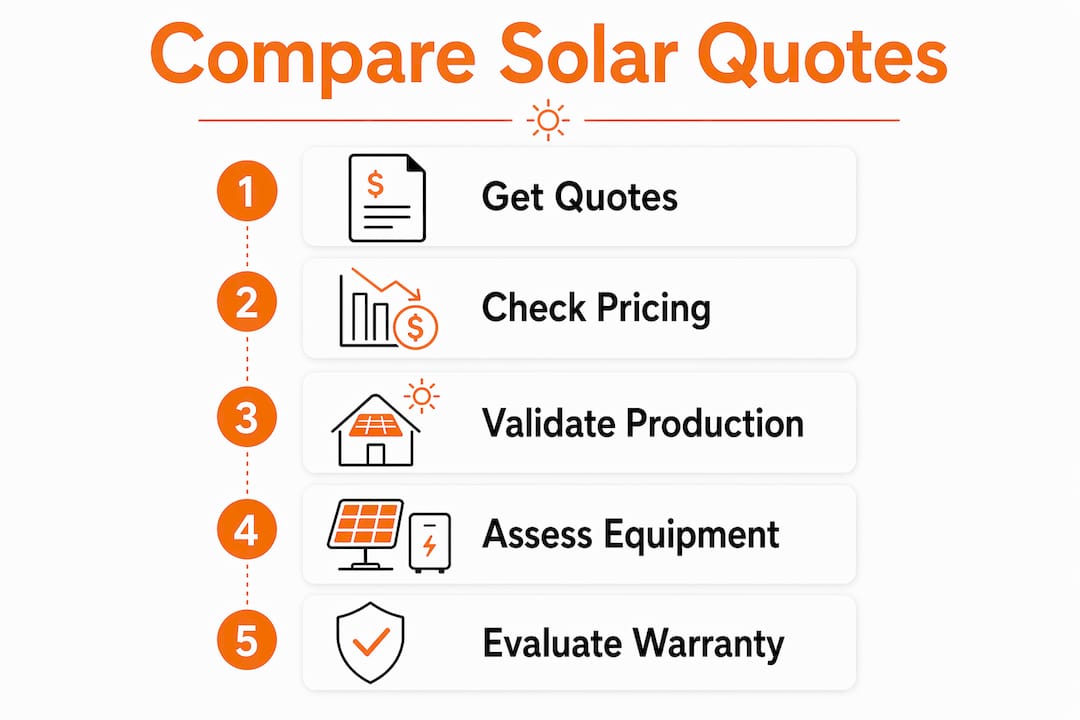
Comparing solar quotes means evaluating each proposal’s cost per watt, system size, equipment quality, production estimates, and warranty terms to identify the best long-term value for your home. Most San Antonio homeowners focus only on the total price. That single number hides critical differences in panel quality, installer reliability, and realistic energy savings. A solar installation is a long-term investment, and the cheapest bid is rarely the best value. This guide gives you a clear, step-by-step solar quote comparison framework so you can make a confident, informed decision.
How to compare solar quotes: what each proposal must include
Before you can compare anything, every quote you receive must contain the same core information. Without these details, you are comparing apples to oranges.
A complete solar proposal includes:
- System size in kilowatts (kW DC) and the total number of panels
- Panel make, model, and wattage (for example, a 400W panel from a named manufacturer)
- Inverter type and brand: string inverter, microinverter (such as Enphase), or power optimizer (such as SolarEdge)
- Equipment warranties: panel product warranty, inverter warranty, and workmanship warranty
- Estimated annual energy production in kilowatt-hours (kWh), with clear modeling assumptions
- Gross price and net price after any applicable incentives are applied
- Full cost breakdown: equipment, installation labor, permits, and any additional fees
- Installation timeline and the installer’s license and certification details
Getting at least 3 quotes is the standard recommendation for any homeowner. Three proposals give you enough data to spot outliers in pricing, system design, and production estimates. If one quote looks dramatically different from the others, that difference tells you something important.
Pro Tip: Ask each installer to provide their quote in writing with every line item separated. A single lump-sum price is a red flag that costs are being bundled to hide markups.
How do you normalize pricing across different solar quotes?
Solar proposals rarely show the same system size or price structure. To compare them fairly, you need one universal metric: cost per watt ($/W).
The calculation is straightforward:
- Find the total installed price before any incentives or financing adjustments.
- Find the system size in watts (convert kilowatts to watts by multiplying by 1,000; a 10 kW system equals 10,000 watts).
- Divide the total price by the system wattage. A $30,000 system at 10,000 watts equals $3.00/W.
As of 2026, competitive $/W ranges are $2.50–$3.50/W for solar-only systems and $3.50–$5.00/W for solar-plus-battery systems. A quote well above these ranges needs a clear explanation. A quote well below them deserves even more scrutiny.
- Separate cash price from financed price. A financed price more than 5–10% higher than the cash price often signals hidden dealer fees built into the loan. Those fees can add thousands of dollars to your total cost without appearing as a separate line item.
- Account for additional costs like electrical panel upgrades, trenching, or permit fees. These are legitimate costs, but they must appear in the quote. If they show up later, that installer is not being transparent with you.
Pro Tip: Always ask for both the cash price and the financed price in writing. If the financed price is significantly higher, ask the installer to itemize the dealer or origination fee separately.
How do you validate production estimates in a solar proposal?
Annual energy production estimates determine how much you save. Inflated estimates make a system look more financially attractive than it actually is.
The most reliable benchmark tool is NREL’s PVWatts calculator, a free online tool from the National Renewable Energy Laboratory. You enter your address, system size, and panel tilt to get a realistic production estimate. If a proposal’s annual production figure exceeds PVWatts by more than 10%, ask the installer for written justification.
Watch for these specific issues in production modeling:
- Shading is ignored. Trees, chimneys, and neighboring structures reduce output. A quote that does not mention shading analysis is using idealized assumptions.
- Roof orientation is not specified. South-facing roofs in San Antonio produce the most energy. East or west-facing panels produce noticeably less.
- System losses are not disclosed. Wiring losses, inverter efficiency, and panel degradation all reduce real-world output. A realistic model accounts for these.
- Electricity rate escalation is too aggressive. Salespeople often inflate savings by assuming your utility rates will rise faster than they likely will. A conservative and honest escalation rate is around 3% per year.
Many installers use optimistic assumptions that ignore shading or real system losses. Transparent assumptions matter far more than a polished presentation.
Pro Tip: Request the specific modeling assumptions in writing: shading factor, system losses percentage, panel degradation rate, and the utility rate escalation used. Any installer confident in their numbers will provide this without hesitation.
How do equipment quality, warranties, and installer reputation compare?
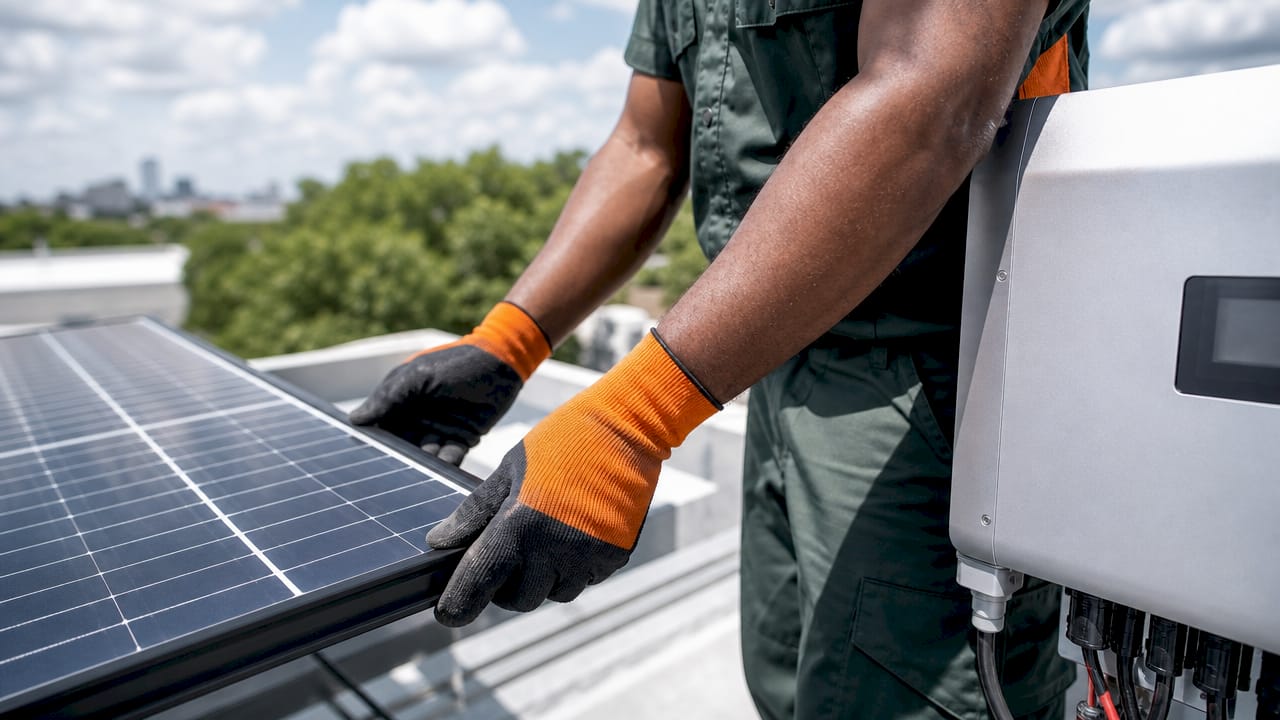
Price and production numbers only tell part of the story. The equipment on your roof and the company standing behind it determine whether your system performs well for 25 years.
Panel and inverter quality
Not all solar panels degrade at the same rate. A panel with a lower degradation rate retains more of its original output over time, which means more energy and more savings over the life of the system. Do not rely on generic labels like “Tier 1” to judge quality. Instead, look at the specific degradation rate stated in the manufacturer’s warranty and the length of the product warranty itself.
A quality solar system includes approximately 25 years of product warranty coverage for panels and at least 10 years for inverters. A workmanship warranty from the installer should cover at least 5 years, though 10 years is a stronger standard.
Monitoring: module-level vs. system-level
Microinverters and power optimizers (like those from Enphase or SolarEdge) provide module-level monitoring. This means you can see exactly how each individual panel is performing. String inverters provide system-level monitoring only, which makes it harder to detect a single underperforming panel.
| Feature | Module-level monitoring | System-level monitoring |
|---|---|---|
| Detects single panel issues | Yes | No |
| Inverter type | Microinverter or power optimizer | String inverter |
| Typical cost | Higher | Lower |
| Best for | Complex roofs, shading | Simple south-facing roofs |
Installer credentials
Check that your installer holds a valid Texas electrical contractor license and carries liability insurance. Look for NABCEP (North American Board of Certified Energy Practitioners) certification as an additional quality signal. Read recent Google and BBB reviews specifically for the San Antonio area. Years in business matters too. A company that has been operating locally for several years has a track record you can verify.
What are the red flags when comparing solar quotes?
Some warning signs in a solar proposal are easy to miss if you do not know what to look for.
- Payback period under 4 years. A realistic payback for a well-designed San Antonio system is typically longer. Unrealistically short payback claims usually rest on inflated production or aggressive rate escalation assumptions.
- No workmanship warranty, or one shorter than 5 years. This signals the installer is not confident in their own work.
- No itemized cost breakdown. A single total price with no line items makes it impossible to verify what you are paying for.
- Unusually low total price. The cheapest quote often hides risks like inferior equipment, missing services, or a contractor who will not be around if something goes wrong.
- Large gap between cash and financed price. A spread greater than 5–10% almost always means hidden dealer fees are built into the loan amount.
A solar proposal is only as trustworthy as the assumptions behind it. If an installer cannot or will not explain their production modeling in plain language, that is your answer.
Homeowners frequently select the cheapest bid rather than the one with the greatest long-term value. The result is often higher costs down the road through equipment failures, poor production, or an installer who has gone out of business before the warranty expires.
Key takeaways
Comparing solar quotes effectively requires evaluating cost per watt, production assumptions, equipment warranties, and installer credentials, not just the total price.
| Point | Details |
|---|---|
| Use cost per watt | Divide total installed price by system wattage to compare bids on equal footing. |
| Verify production estimates | Cross-check annual output claims against NREL’s PVWatts calculator for your San Antonio address. |
| Check all warranty terms | Panels should carry ~25 years product warranty; inverters at least 10 years; workmanship at least 5 years. |
| Watch for hidden fees | Ask for both cash and financed prices; a gap over 5–10% signals undisclosed dealer fees. |
| Get at least 3 quotes | Multiple proposals reveal pricing outliers and give you leverage to ask better questions. |
What I have learned from watching San Antonio homeowners compare quotes
After working with homeowners across San Antonio, the pattern I see most often is this: someone receives three quotes, picks the lowest one, and calls it a day. I understand the logic. Solar is a big purchase and saving money upfront feels like the right move. But the lowest bid is almost never the lowest cost over 25 years.
The regional market here has real variation in installer quality. San Antonio has a mix of large national companies and smaller local contractors. The national companies often have polished proposals and aggressive sales tactics. The local contractors sometimes have rougher-looking quotes but better workmanship and faster response times when something needs attention years later. Neither category is automatically better. You have to dig into the details.
The single most useful thing I tell homeowners is to run their own PVWatts estimate before they meet with any installer. When you already know what a realistic production number looks like for your roof, you can immediately spot when a proposal is inflating it. That one step changes the entire dynamic of the conversation.
I also recommend reading our homeowner’s guide to choosing a solar installer before you start collecting quotes. Understanding what to look for in an installer makes the quote comparison process much cleaner. Patience is the other factor. The homeowners who get the best outcomes are the ones who take two or three weeks to gather real information rather than signing on the first visit.
— Anthony
Alphasolarsa makes solar quote comparison straightforward
Sorting through multiple solar proposals takes time, and the details matter. Alphasolarsa provides San Antonio homeowners with detailed, transparent quotes that break down every cost, production assumption, and warranty term in plain language.
Every Alphasolarsa proposal includes a full system design, itemized pricing, and honest production modeling based on your actual roof conditions. No inflated estimates. No hidden fees. If you are ready to see what a clear, trustworthy quote looks like, request a no-obligation consultation through our residential solar installation page. You can use it as your benchmark when comparing other proposals, or simply let us earn your business on the merits.
FAQ
How many solar quotes should I get before deciding?
Get at least 3 quotes before making a decision. Multiple proposals reveal pricing outliers and give you a realistic range for system size, cost, and production.
What is a good cost per watt for solar in 2026?
A competitive cost per watt in 2026 is $2.50–$3.50/W for solar-only systems and $3.50–$5.00/W for solar-plus-battery systems. Quotes outside these ranges need a clear explanation.
How do I know if a production estimate is realistic?
Run the system details through NREL’s free PVWatts calculator using your San Antonio address. If the installer’s estimate exceeds PVWatts by more than 10%, ask for written documentation of their modeling assumptions.
What warranties should a solar quote include?
A complete solar quote should include a panel product warranty of approximately 25 years, an inverter warranty of at least 10 years, and a workmanship warranty from the installer of at least 5 years.
Why is the financed price higher than the cash price?
Lenders charge dealer or origination fees that get rolled into the loan amount. A financed price more than 5–10% above the cash price means those fees are significant. Always ask the installer to itemize them separately before signing.