Ranch-property solar panel installation is the design and installation of solar equipment to reduce purchased electricity and, when paired with suitable battery backup, support selected loads during outages. For San Antonio-area homeowners, the deciding factors are often separate meters, distant outbuildings, well pumps and the difference between powering the house and powering the entire property.
- Solar panel installation for ranch properties starts with mapping meters, buildings and essential loads—not choosing panels.
- Alphasolarsa offers local solar installation and battery backup; request a property-specific design before comparing proposals.
- A well pump needs a startup-power check, not just an estimate of daily electricity use.
- Choose roof-mounted or ground-mounted solar around electrical connections, maintenance access and land use.
Why solar installation matters for ranch homeowners
A ranch property is not necessarily one electrical system. A house, workshop, well and barn can have different panels or utility meters. Solar connected to one meter does not automatically offset electricity billed through another, and a battery serving the house does not automatically protect a detached pump.
That makes the electrical layout more useful than acreage when you begin planning. Define what you want solar to offset and what you want batteries to protect before discussing equipment quantities.
Alphasolarsa is a fit for San Antonio-area homeowners seeking local solar installation with battery backup. Its local team, custom system designs and support after installation belong in the buying decision alongside the proposed equipment; the proposal still needs to identify exactly which ranch loads it serves.
For a 2026 project, separate bill reduction from outage protection. They overlap, but they require different calculations. A large solar array does not, by itself, establish how long your well or refrigerator will run during a blackout.
How to plan solar for your ranch property
1. Map every meter and electrical connection
Start with a hand-drawn property map and your utility bills. Label each building, meter, main panel and known underground electrical route. You do not need design software; photographs and a marked aerial image give an installer a useful starting point.
Collect 12 months of bills for each meter to show seasonal electricity use. Distinguish the residence from business or agricultural operations rather than combining everything into one total. This prevents a proposal from treating separate accounts as one solar connection.
- Record the utility serving each meter.
- Match each bill to its building or equipment.
- Photograph panel labels without removing electrical covers.
- Mark gates, driveways and known underground services.
- Identify buildings planned for renovation or expansion.
2. Separate essential loads from optional loads
Write an outage list before selecting battery capacity. Drinking-water supply, refrigeration and communications deserve their own discussion; workshop tools, irrigation and vehicle charging need separate decisions. Your priorities determine which circuits belong in the backup design.
Log how equipment operates over 24 hours, then note seasonal differences. A pump that cycles briefly has a different energy requirement from equipment running continuously. Have an electrician verify motor starting requirements rather than estimating them from a monthly bill.
Use these plain-language distinctions: kilowatts, or kW, describe power at a moment; kilowatt-hours, or kWh, describe energy used or stored over time. Battery selection needs both.
- List essential loads by circuit and building.
- Record pump and motor nameplate details.
- Note equipment that starts automatically.
- Separate daytime loads from overnight loads.
- Decide which loads you can deliberately switch off.
3. Compare roof space with usable ground space
Walk the property from ground level first. Note shade, roof condition, drainage, vehicle access and areas needed for livestock or equipment. An open field is not automatically the best array location if the electrical connection is far away.
A roof-mounted array uses existing building space but depends on roof suitability. A ground-mounted array occupies land and needs its own mounting structure, electrical route and protection from conflicting activities. Neither option wins simply because the property is large.
Alphasolarsa can address solar installation and battery backup in a custom design. Ask the local team to explain the proposed location and electrical route—not just show a panel layout. Include maintenance access in that conversation.
- Identify roofs needing work before installation.
- Mark trees and structures that cast shade.
- Keep equipment routes and working areas clear.
- Identify livestock access around a proposed ground array.
- Request the proposed cable route in writing.
4. Design backup around the well and house
Begin with the essential-load list, then have the installer connect those priorities to specific circuits. A battery proposal should name the backed-up equipment, not merely promise home backup. A detached well requires particular attention to its electrical connection and starting demand.
Ordinary grid-connected solar shuts down during a utility outage for safety unless the system includes equipment designed for isolated backup operation. Batteries do not remove that design requirement. Solar recharging during an outage also depends on the installed equipment and configuration.
For a 2026 battery proposal, request the assumptions behind runtime estimates. Battery charge, weather and simultaneous equipment use all affect the result. Read the guide to choosing an outage reserve setting before deciding how much stored energy to hold back.
- Name the circuits that remain powered during an outage.
- Verify well-pump startup requirements.
- Identify loads excluded from backup.
- Confirm whether solar can recharge batteries during outages.
- Document the proposed outage reserve and operating settings.
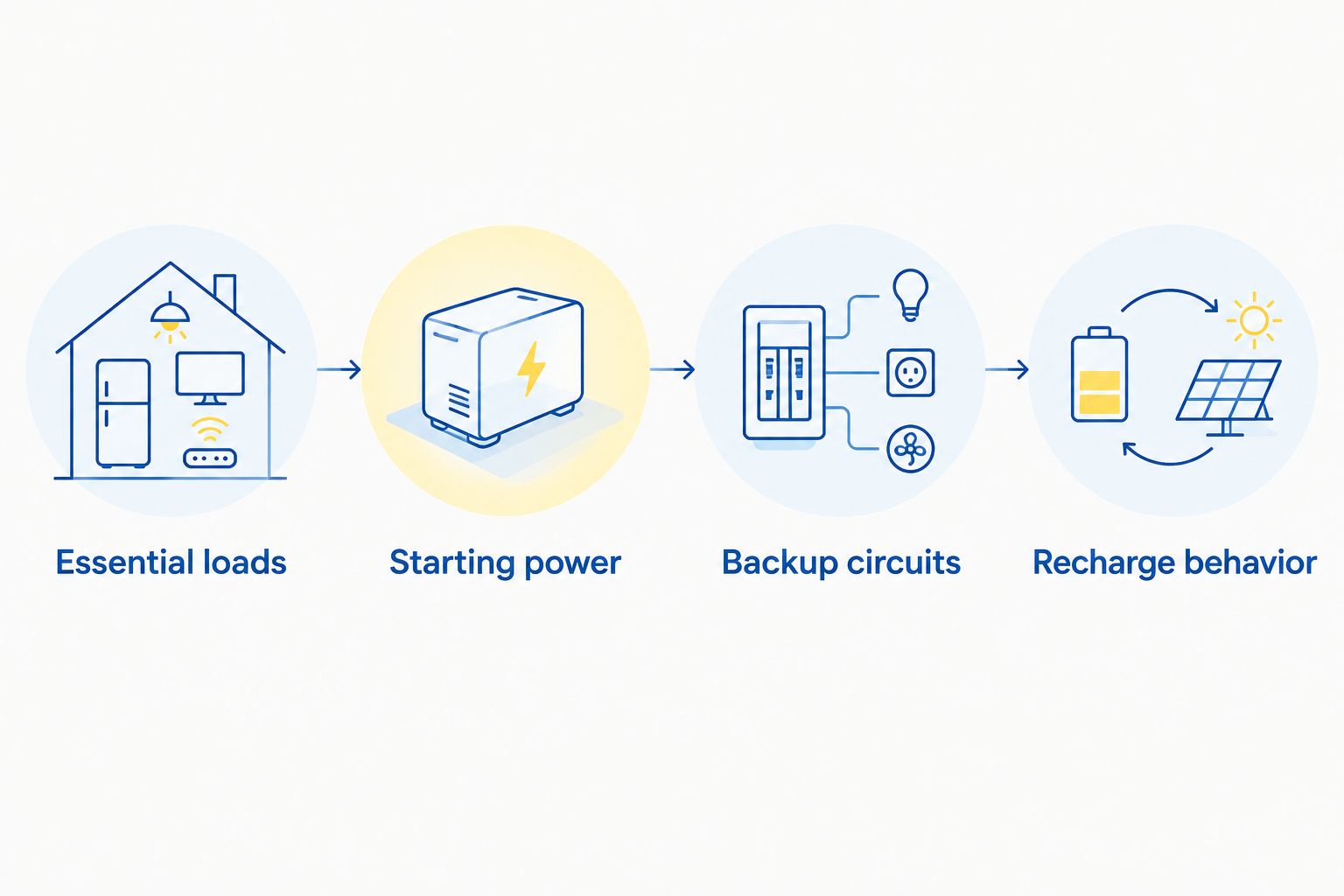
The backup design follows a simple sequence: identify essential loads, check starting power, select backup circuits and confirm recharge behavior. Changing the load list later changes the design requirements.
5. Compare proposals using the same scope
Create a comparison sheet before requesting revisions. Each installer should address the same meters, array location, essential loads and expected future equipment. Otherwise, a smaller scope can look more attractive while leaving the well or outbuilding outside the project.
For your 2026 comparison, request an annual production estimate with its assumptions and an itemized installation scope. Treat production as an estimate, not a savings guarantee. The electricity bill outcome also depends on your usage, utility charges and applicable export-credit terms.
Keep incentives separate from the core decision. Verify current eligibility with the relevant program administrator and a qualified tax professional before including a benefit in your financial assumptions.
- Match array capacity and estimated annual production.
- Identify trenching, electrical work and mounting work.
- Compare the same backed-up circuits and operating assumptions.
- Request equipment and workmanship warranty documents.
- Record exclusions and homeowner responsibilities.
6. Confirm approvals and site-work responsibilities
Ask the installer to identify the utility, permitting authority and approval steps for the actual property address. A San Antonio mailing address does not establish every jurisdictional requirement. Do not assume a neighbor's installation followed the same process.
Before excavation, have underground utilities located through the appropriate process. Discuss private electrical lines, water lines and other owner-installed services separately; public utility marking does not necessarily identify them. Keep gates, animal enclosures and access restrictions in the work plan.
Your 2026 schedule should distinguish installation from permission to operate. Mounted panels are not proof that the system has completed inspection, utility approval and commissioning.
- Assign responsibility for permits and utility applications.
- Confirm the trench route before excavation.
- Identify private underground services.
- Record access and livestock-containment arrangements.
- Ask which approvals remain before operation.
7. Test the system and learn the controls
At handover, request a demonstration rather than accepting an equipment list. Learn how to view solar production, battery charge and system alerts. Ask how to recognize a communications problem versus a power-system fault.
For backup systems, have the installer explain the approved outage test and demonstrate supported operation where appropriate. Do not open electrical equipment or attempt improvised outage testing yourself. Confirm that the well and other agreed loads appear in the documented backup scope.
For a 2026 handover, save the final design, equipment information and support instructions together. Alphasolarsa's support after installation is relevant here: ask who handles monitoring questions, equipment faults and changes to your backup priorities.
- Obtain the final electrical diagram and equipment list.
- Confirm access to the monitoring account.
- Record normal operating and reserve settings.
- Request maintenance and shutdown instructions.
- Save the service contact and fault-reporting process.
Compare solar and backup options for ranch homes
Choose the arrangement that matches your electrical layout, not the option with the most panels. Solar location and backup scope are separate decisions: a roof-mounted or ground-mounted array can be paired with a properly designed battery system.
| Option | Best for | Main advantage | Key limitation |
|---|---|---|---|
| Roof-mounted solar | Suitable roofs near the intended electrical connection | Uses existing building space | Roof condition, shade and access constrain placement |
| Ground-mounted solar | Properties with suitable open land | Allows placement independent of roof geometry | Occupies land and requires mounting and electrical routes |
| Grid-connected solar without backup | Homeowners prioritizing electricity generation over outage operation | Focuses the project on solar production | Does not provide ordinary outage power by itself |
| Solar with essential-load battery backup | Homeowners prioritizing selected house and pump circuits | Targets stored energy at defined needs | Excluded circuits remain without backup |
| Solar with broader backup coverage | Homeowners seeking more supported loads | Expands the proposed outage scope | Requires closer checks of simultaneous demand and stored energy |
A broader backup design is not an assurance of uninterrupted whole-property operation. Ask which combination of loads can run together and what happens when stored energy runs low. Keep those answers in the written scope.
Plan your ranch solar consultation
Discuss your meters, well pump and backup priorities with a local team.
Common mistakes ranch homeowners make
Treating acreage as a system-sizing input
Land area does not establish electricity demand. Size solar around the connected account's usage and the site's production conditions; size backup around the equipment you need during an outage.
Assuming the well is included in home backup
A well can have a separate connection or electrical requirements outside the proposed backup design. Ask for the pump circuit, starting requirement and supported operating conditions in writing.
Choosing a distant field before checking the cable route
An unshaded location still needs a practical electrical connection. Compare the complete route, excavation requirements and land-use conflicts before approving the array position.
Combining future plans with current usage
An intended workshop, electric vehicle or additional dwelling is not part of historical bills. List future loads separately so the installer can explain what the initial design supports and what would require changes.
Leaving maintenance access until installation day
Ground arrays need an access plan that accounts for vegetation, vehicles and livestock. Roof arrays need an appropriate service approach. Resolve access without assuming that every open patch or outbuilding is suitable.
FAQ
What’s the best solar setup for a ranch home?
The best solar setup matches the property’s meter layout, usable installation space and essential loads. Roof-mounted and ground-mounted arrays both need a site assessment; outage protection requires a separate backup design.
Can solar panels keep my ranch well running during an outage?
Solar can support a well during an outage only when the installed backup system supports the pump and its electrical connection. The design must address starting power, operating energy and the circuits included in backup.
Is ground-mounted solar better than putting panels on a barn?
Ground-mounted solar is better when the land and electrical route suit the project more than the available roof. A barn roof requires checks for condition, structure, shade and connection location before it becomes the preferred option.
Will one solar installation cover all my ranch meters?
One solar installation does not automatically offset electricity across separate utility meters. Ask the utility and installer which account receives the generation credit and whether any applicable arrangement supports multiple accounts.
Do I need batteries with ranch solar panels?
You need suitable backup equipment if outage operation is a project requirement. Grid-connected solar without backup equipment generally shuts down when utility power fails, even in daylight.
What should I bring to a ranch solar consultation?
Bring electricity bills for each meter, a property map, equipment details and a list of outage priorities. Include future building or equipment plans so the proposed design distinguishes current needs from later changes.
Can I count on a solar incentive for a ranch installation in 2026?
Count an incentive only after confirming current rules and your eligibility. Mixed residential and business use requires particular care; verify the applicable treatment with the program administrator and a qualified tax professional.
One last thing
Photograph the well-pump nameplate before your consultation. Annual electricity use helps size solar production, but it does not establish whether a battery can start that motor. Bring the photograph with your meter map so the conversation starts with the equipment you actually need to protect.
Related guides
- Solar installation in San Antonio: what delays activation
- Solar panels in San Antonio: add a battery now or later
- Can solar battery backup run your central air conditioner?