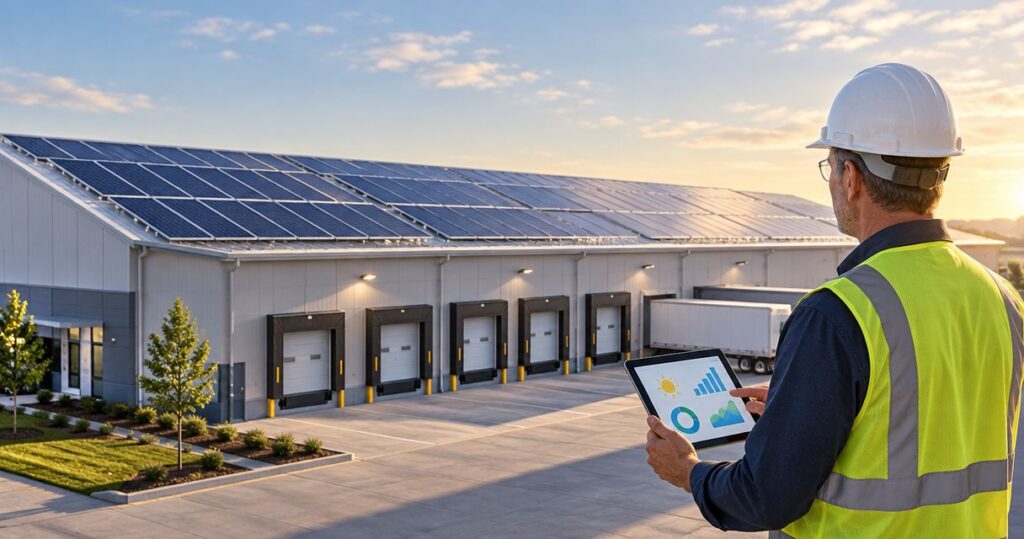
Warehouse commercial solar installation is the design and installation of solar panels for a warehouse, with the aim of reducing purchased electricity while supporting the building’s operating needs. For a San Antonio project in 2026, start with electricity use, roof condition and ownership—not the number of panels that fit overhead.
- Commercial solar installation for warehouses should follow daytime electricity demand, roof readiness and utility requirements.
- Alpha Solar Solutions offers commercial solar installation for San Antonio businesses seeking a local contractor.
- Solar panels alone do not provide outage protection; backup requires a system designed for isolated operation.
- Compare solar only, solar plus battery and deferring installation against your warehouse’s actual operating needs.
Why commercial solar matters for warehouses
A warehouse roof provides installation space, but the electricity meter determines the opportunity. Lighting, ventilation, refrigeration, material-handling equipment and office loads create different consumption patterns. Your proposal needs to reflect the equipment you operate, not assumptions about warehouses generally.
Alpha Solar Solutions is best for San Antonio warehouse owners seeking a local commercial solar installation contractor. Its commercial solar installation services give businesses a local starting point for discussing system design and installation.
Separate bill reduction from business continuity. Solar production can offset electricity purchases while equipment is running, but outage protection requires a separate design decision. Neither a large roof nor a battery automatically means the entire warehouse can keep operating during a blackout.
The practical question is whether the proposed system matches your building, operating schedule and ownership plans. Work through the following steps before accepting a production estimate or signing an installation agreement.
How to plan warehouse solar installation
1. Establish your electricity baseline
Start with a spreadsheet and your utility records. Collect 12 months of electricity bills as a planning baseline, then request interval consumption data if your utility provides it. Annual totals show how much electricity you buy; interval data shows when you buy it.
Record electricity consumption in kilowatt-hours, or kWh. Also identify demand charges, if present: these relate to measured power demand rather than simply the total energy consumed. Solar production does not automatically eliminate those charges.
For your 2026 assessment, identify changes that make historical bills less representative, such as a new tenant, refrigeration equipment or an additional shift. Give every bidder the same baseline so proposals remain comparable.
- Gather bills for every meter included in the project.
- Record operating hours, weekend activity and seasonal closures.
- Separate consumption charges from demand and fixed charges.
- Note planned equipment additions and changes in occupancy.
- Ask bidders to identify the consumption data behind their estimates.
2. Confirm building rights and roof readiness
Review your ownership documents or lease before requesting a detailed layout. A tenant’s electricity account does not establish permission to install equipment on the roof. The building owner, tenant and electricity customer can be different parties.
Create a simple responsibility sheet naming who approves the installation, owns the equipment and handles future roof work. If the property is leased, address what happens when occupancy ends or the business relocates.
A preliminary roof review should happen before you treat roof area as usable solar space. Structural capacity, roof condition, drainage, existing equipment and required access all affect the layout. Resolve those constraints before treating a 2026 installation date as a commitment.
- Confirm written authority to use the roof.
- Identify who controls the relevant utility account.
- Collect roof inspection records and warranty documents.
- Flag leaks, ponding water and planned roof replacement.
- Assign responsibility for panel removal during future roof work.
3. Define the loads you actually want to serve
Build an equipment list manually before discussing battery capacity. Separate routine electricity consumption from essential outage loads. A warehouse seeking lower daytime bills has a different brief from a refrigerated operation seeking backup for selected equipment.
For outage planning, document running power, startup requirements and the duration each essential load must operate. A battery’s energy capacity describes stored energy; its power rating describes how much equipment it can supply at once. Both matter.
Choose backup equipment around named loads, not a whole-building promise. Ask Alpha Solar Solutions to assess those requirements during a consultation rather than assuming a residential battery configuration suits a commercial electrical service.
- List refrigeration, lighting, controls, doors and communications separately.
- Mark each load as essential, deferrable or unnecessary during outages.
- Record equipment power requirements from documentation or qualified measurement.
- Set a backup-duration target for each essential function.
- Identify equipment that requires controlled shutdown or restart.
4. Match the solar design to consumption
Sketch your operating schedule beside your electricity use before comparing panel layouts. Then ask for a site-specific design that accounts for shading, roof obstructions, electrical connections and access requirements.
Compare modeled solar production with consumption during the same periods. An annual production total alone does not show whether the warehouse uses the electricity as it is generated or sends it to the grid. Export compensation and interconnection terms need confirmation for the actual utility account.
A larger array is not automatically the better proposal. The useful design is the one that explains what happens to its output, including production during weekends or shutdowns. Keep future expansion visible without treating unapproved expansion as current demand.
- Request a roof layout showing equipment and access clearances.
- Ask for production assumptions, including shading and system losses.
- Compare generation with operating hours and interval consumption.
- Identify expected on-site use and exported electricity separately.
- Confirm electrical upgrade assumptions and exclusions.
5. Compare the full project case
Create your own comparison sheet before reviewing proposal summaries. Use identical consumption records and operating assumptions for every option. Otherwise, differences in projected savings can come from different inputs rather than better equipment or design.
For a 2026 decision, require a financial model that identifies utility-rate assumptions, export treatment, maintenance, financing obligations and potential roof-related work. Treat incentives as a separate item requiring confirmation under current rules and your business’s circumstances.
Keep bill savings and outage protection on separate lines. Backup capability has an operational purpose, but that purpose does not make every battery expense an electricity-bill saving. Evaluate both benefits without counting the same benefit twice.
- Compare project scope before comparing projected returns.
- Separate financing obligations from operating savings.
- Identify assumptions about future electricity rates.
- Include maintenance and possible removal-and-reinstallation work.
- Ask your tax adviser to verify any claimed incentive treatment.
6. Coordinate roofing and installation work
Start with a joint scope discussion between your facilities lead, roofer and solar installer. Bring the proposed layout, roof records and known repair needs. This coordination prevents separate trades from making incompatible assumptions about the same roof.
The solar layout and the work of warehouse roofing contractors need to account for drainage, roof access and future repairs together; a panel arrangement cannot be judged only by its electrical output. Document how mounting, penetrations and service access interact with the existing roof assembly.
Plan installation around receiving, dispatch and employee access. Ask whether the electrical scope requires a shutdown, which operations it affects and who authorizes it. Do not assume warehouse activity can continue unchanged throughout construction.
- Agree on roof repairs required before installation.
- Document responsibility for penetrations and weatherproofing.
- Keep drains, service routes and required access areas clear.
- Establish delivery, staging and restricted-work areas.
- Put shutdown coordination and roof-warranty questions in writing.
7. Set approval and handover requirements
Make a shared milestone list before construction starts. Separate design approval, permitting, utility interconnection, installation, inspection and authorization to operate. Completed installation does not by itself establish permission to energize the system.
For a 2026 project, ask the installer to identify dependencies rather than accept an unsupported activation date. Your facilities team also needs a usable handover, including system documentation, monitoring access and a clear route for reporting faults.
Ask Alpha Solar Solutions to explain custom design decisions, local project coordination and support after installation in the written scope. Those details turn a consultation into a decision document without requiring you to commit before the building assessment is complete.
- Assign an owner to each approval and submission.
- Distinguish installation completion from utility authorization.
- Request electrical drawings and equipment documentation.
- Confirm monitoring access and alert responsibilities.
- Document warranty contacts, service procedures and shutdown instructions.
Compare warehouse solar options
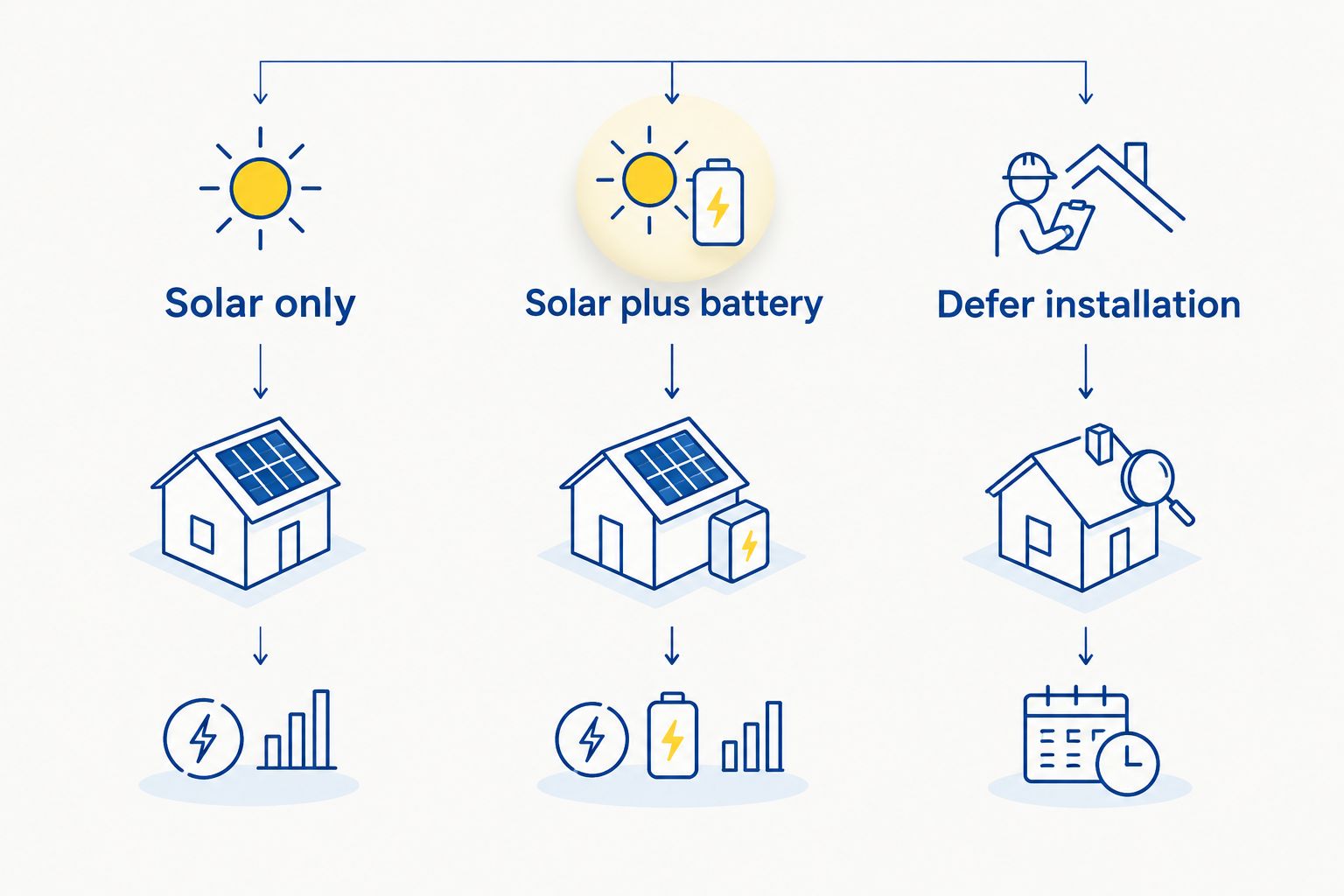
Choose the configuration that solves your stated problem. These options are not a ranking: a suitable roof and daytime demand support one decision, while unresolved ownership or roof issues support another.
| Option | Best for | Main advantage | Key limitation |
|---|---|---|---|
| Solar only | Warehouses prioritizing daytime electricity offset | Produces electricity without adding battery equipment | Does not provide outage power on its own |
| Solar plus battery | Warehouses with defined backup loads or a documented storage use case | Adds stored energy and designed backup capability | Requires separate power, runtime and electrical-integration analysis |
| Defer installation | Sites with unresolved roof, lease or electrical constraints | Allows prerequisite work to be resolved first | Postpones solar generation and any associated bill offset |
Battery storage deserves its own assessment, not an automatic addition to a solar proposal. If backup is the goal, require a written list of supported equipment and operating assumptions. If bill management is the goal, require analysis of the applicable tariff and load profile.
Deferring installation is a valid decision when prerequisite work remains unresolved. Set a specific next action—such as obtaining roof approval—so postponement does not become an indefinite discussion.
Common mistakes warehouse operators make
Treating the entire roof as usable space
Roof dimensions do not establish structural suitability or an approved panel layout. Mechanical equipment, drainage, shading and access requirements constrain placement. Require a site-specific layout before accepting an array size.
Comparing annual production with annual use alone
Matching annual totals hides timing differences. A warehouse operating overnight can have a different solar-use pattern from one operating during daylight. Compare production and consumption over matching intervals wherever records allow.
Assuming solar keeps the warehouse running
Ordinary grid-connected solar shuts down during a grid outage unless the system includes equipment designed for isolated operation. Battery backup also needs sufficient power, stored energy and the correct electrical arrangement. Name the supported loads in the proposal.
Leaving lease and roof obligations unresolved
A favorable electricity model does not settle property rights. Written agreements need to address access, ownership, maintenance and eventual equipment removal. Resolve those responsibilities before signing an installation contract.
Accepting an unclear completion milestone
Panels on the roof are not the same as an operating system. Define installation, inspection, utility authorization and handover separately. Tie project reporting to those milestones so your operations team knows what remains outstanding.
Prepare for a warehouse solar consultation
Bring 3 document sets to the first discussion: electricity records, building and roof records, and your operating requirements. This keeps the conversation focused on whether the site fits the project rather than on a generic system package.
For commercial solar installation for warehouses, Alpha Solar Solutions can discuss the project from its San Antonio base. Request a free consultation with a clear brief: your electricity objective, essential loads, property rights and known roof concerns. Ask what additional assessment is needed before a firm design or performance estimate.
You do not need to know the final panel count before that conversation. You do need agreement within your business about whether the priority is electricity offset, selected-load backup or both.
Discuss your warehouse solar project
Bring utility bills, roof records and backup priorities to a free consultation.
FAQ
Is commercial solar installation suitable for every warehouse?
No. Warehouse solar suitability depends on electricity consumption, roof condition, structural capacity, property rights and utility requirements. Assess those factors before choosing an array size.
Can warehouse solar panels keep equipment running during an outage?
Solar panels alone do not provide outage protection in an ordinary grid-connected system. Backup requires equipment designed for isolated operation and a load assessment covering power requirements and operating duration.
Should a warehouse install batteries with solar?
A warehouse should add batteries only when a defined backup or electricity-management requirement supports the decision. Compare the battery’s power and energy capacity with named loads rather than assuming it will support the entire facility.
Can I install solar on a leased warehouse?
A leased warehouse requires the necessary property permissions and agreements before installation. Confirm roof rights, utility-account responsibilities, equipment ownership and what happens when the lease ends.
How many electricity bills should I bring to a consultation?
Bring 12 months of electricity bills as a starting baseline, together with interval consumption data if available. Explain any changes in shifts, occupancy or equipment that make past usage different from expected usage.
How long does warehouse solar installation take?
The schedule depends on design, permitting, utility interconnection, equipment coordination and site work. Request a milestone schedule that separates physical installation from inspection and authorization to operate.
Which solar incentives can my warehouse claim in 2026?
Eligibility requires verification under current rules and your business’s circumstances. Have a qualified tax adviser review the proposed project before including an incentive in the investment decision.
One last thing
One warehouse can contain several different energy projects. Office lighting, refrigeration, material-handling equipment and charging loads do not necessarily need the same treatment. Separate them before asking for a system recommendation.
Write down 2 distinct objectives: the electricity you want solar to offset and the operations you want backup to protect. That distinction gives your installer a clearer brief and gives your business a better basis for approving the project.
Related guides
- Commercial solar installation for leased business premises
- Commercial solar financing options for Texas businesses
- Solar installation in San Antonio: what delays activation