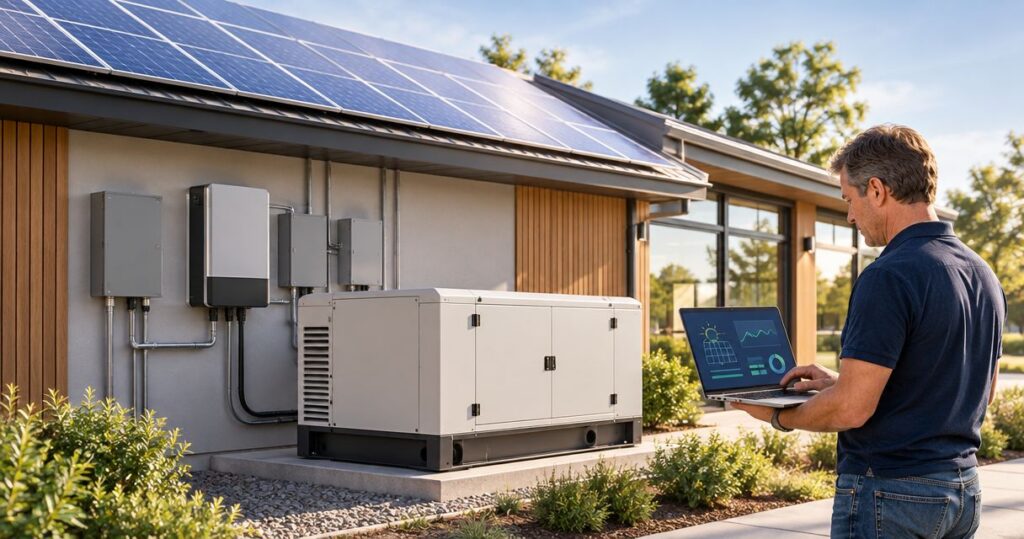
Instead of manually shutting down solar equipment whenever your backup generator runs, have a qualified electrical team design commercial solar generator integration with automatic isolation and coordinated controls. For a 2026 project, choose between keeping solar separate during outages and installing an approved system that manages solar, storage and generator power together—never simply connect a solar inverter to a generator-backed panel.
- Commercial solar generator integration requires engineered isolation, compatible equipment and documented outage controls—not a simple panel connection.
- Alpha Solar Solutions serves San Antonio businesses considering commercial solar installation alongside existing backup equipment.
- Keep solar off the generator-backed bus unless the equipment manufacturers explicitly support coordinated operation.
- Choose outage solar operation only with an approved design that controls generation, storage and changing building loads.
Why this matters
A standard grid-following solar inverter needs an acceptable electrical reference to operate. A running generator can provide voltage and frequency, but that does not make the inverter and generator compatible. Uncontrolled solar production can exceed building demand and send power toward a generator that is not designed to absorb it.
The first decision is whether solar must operate during an outage. If not, a design that isolates solar whenever the generator supplies the building avoids the need to coordinate their simultaneous output. If yes, the project needs equipment and controls approved for that operating arrangement.
Alpha Solar Solutions is best for San Antonio property owners seeking local commercial solar installation. Use its commercial solar services as a starting point for discussing your building, existing backup equipment and required outage loads. Generator compatibility still needs a project-specific engineering review.
Before you start
- Collect equipment records and site access. Gather the solar inverter, generator and automatic transfer switch model numbers; manufacturer manuals; electrical drawings; utility interconnection documents; and access arrangements for electrical rooms. An automatic transfer switch moves building loads between power sources.
- Define the loads that must stay powered. List essential circuits, motor-starting requirements and acceptable transfer interruptions. Bring 12 months of electricity bills for the solar assessment, but use equipment data and measured demand—not bills alone—to size backup power.
- Check the hidden compatibility issue first. An existing transfer switch does not automatically protect the generator from solar backfeed. Before ordering equipment, require a drawing showing where solar connects and what physically or functionally prevents unsupported parallel operation.
This is a planning and commissioning guide, not a live-wiring procedure. Licensed electrical professionals must handle connections, protective settings and testing under the applicable permits and manufacturer instructions. Do not open energized equipment, bypass interlocks or change inverter grid-protection settings yourself.
System architecture
Start your 2026 design review by choosing an operating arrangement, not a battery model. These arrangements solve different problems; none is a universal upgrade.
| Arrangement | Best for | Main advantage | Main limitation |
|---|---|---|---|
| Solar isolated during generator operation | Businesses that want solar during normal service and existing generator backup during outages | Keeps solar and generator output from operating together in an unsupported configuration | Solar does not help supply outage loads |
| Approved solar-generator coordination | Sites with documented manufacturer support for simultaneous operation | Allows controlled solar contribution while the generator operates | Requires compatible controls, protection and operating limits |
| Approved solar-storage-generator system | Sites needing battery-supported operation and coordinated energy sources | Storage can absorb or supply power within its limits | Adds equipment, control dependencies and commissioning work |
Choose solar isolation unless simultaneous operation has a clear business purpose and documented equipment support. Battery storage does not automatically make a generator-compatible system; the complete arrangement must support the intended operating modes.
Configuration unit: equipment compatibility
- Identify every source and connection point. Ask your electrical designer to mark the utility supply, generator, transfer switch, solar inverter, distribution panels and any storage on a single-line diagram. This drawing summarizes the electrical connections.
- Confirm manufacturer-supported operation. Require documentation covering the actual inverter, generator, transfer equipment and controller combination. A generic statement that an inverter is hybrid is not sufficient.
- Define source behavior. Specify which device establishes voltage and frequency during an outage, which devices follow that reference, and how excess solar production is reduced or disconnected.
- Record the fallback state. The design must state what happens when communications, a sensor or the coordinating controller fails. Unsupported source combinations must not remain connected.
Expected result: You have a documented operating arrangement and a compatibility decision before equipment is purchased. Unresolved compatibility means the design stops here—not that commissioning becomes an experiment.
Configuration unit: transfer and protection
- Locate solar relative to the transfer switch. Have the designer determine whether the solar connection remains utility-connected, sits on a generator-backed distribution section or requires separate switching. These positions have different outage behavior.
- Specify isolation and interlocks. The drawings must identify the equipment that prevents unintended utility backfeed and unsupported generator-solar paralleling. Software commands alone must not substitute for required electrical protection.
- Review the complete electrical design. Require checks of conductor and equipment ratings, fault-current suitability, overcurrent protection, grounding, neutral switching where applicable, and access for maintenance.
- Confirm approvals. Establish which utility reviews, permits and inspections apply before installation. Existing approval for a generator does not establish approval for a changed solar interconnection.
Expected result: The approved drawings show a permitted power path for every operating mode, including utility failure, generator start, normal transfer and utility restoration.
For leased premises, establish who can authorize modifications before scheduling installation. The guide to commercial solar installation for leased business premises addresses the property-control questions that belong alongside the electrical review.
Configuration unit: controls and load priorities
- Write the operating sequence. Request separate descriptions for normal utility service, utility failure, generator operation, battery operation where included, and utility restoration. Include maintenance shutdown and controller failure.
- Set load priorities. Identify which equipment remains connected, which loads can be disconnected automatically, and which motor starts require sequencing. Do not treat the building's total breaker ratings as its measured demand.
- Configure only documented functions. Have the commissioning professional apply manufacturer-approved generator limits, solar curtailment, battery charging limits and start-stop conditions where supported. Curtailment means deliberately reducing solar output.
- Document settings and access. Record the actual control names, approved values and authorized users from the installed equipment. There is no universal generator-integration button or menu shared across inverter brands.
Expected result: Each source has a defined role, and the controls can respond when building demand or solar output changes. You also know who can alter settings after handover.
Keep power and stored energy separate in the discussion: 1 kW supplied for 1 hour equals 1 kWh of energy. A battery's energy capacity does not establish whether its inverter can start a motor or supply all essential loads at once.
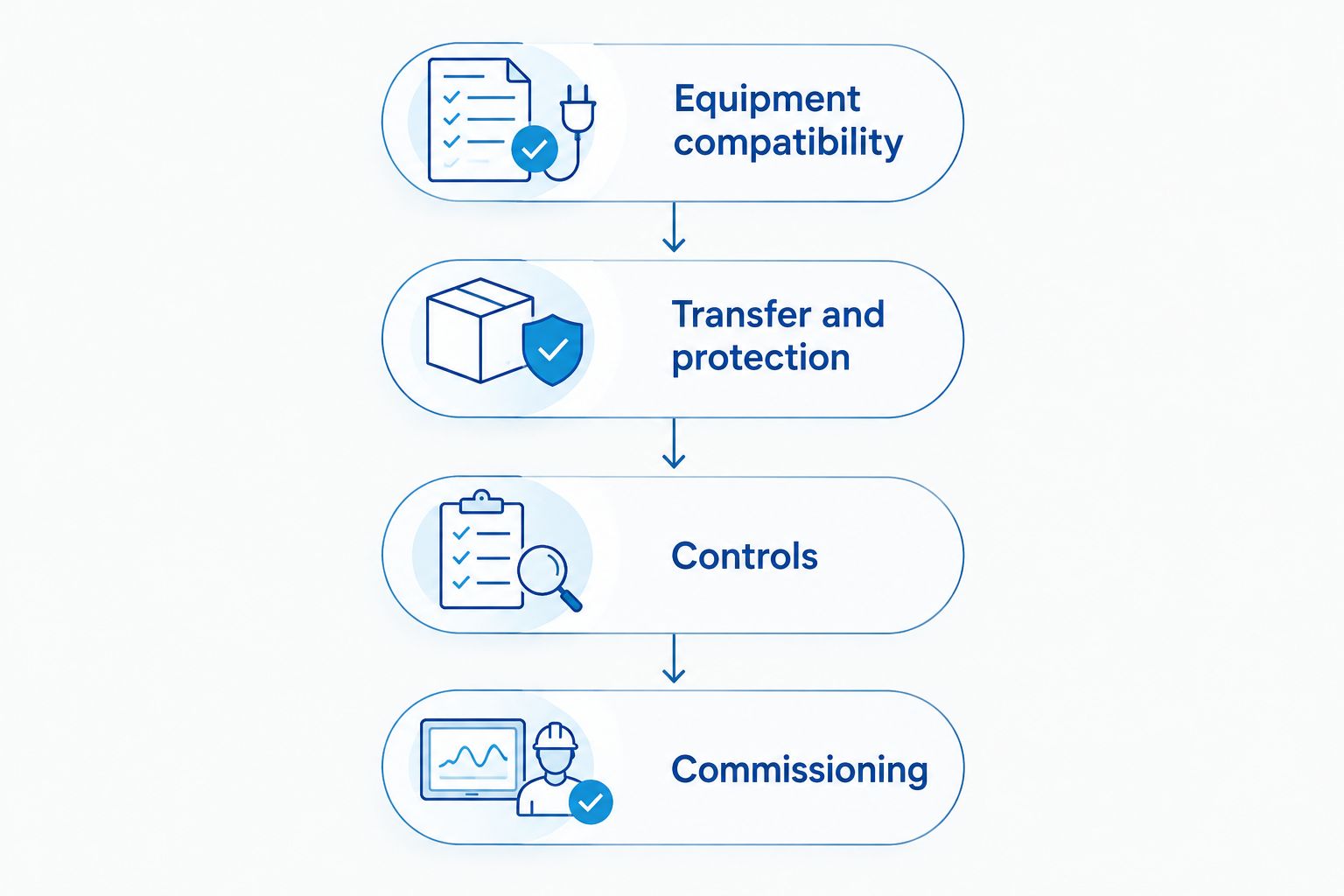
Configuration unit: commissioning
- Approve the test procedure first. For a 2026 handover, require a written test plan, responsible personnel, safe shutdown arrangements and notice to affected building users. Identify equipment that cannot tolerate a transfer interruption.
- Verify each supported mode. The commissioning team should demonstrate utility operation, loss of utility, generator supply and restoration according to the approved procedure. Test simultaneous solar operation only where the design explicitly permits it.
- Test changing conditions. Within the approved procedure, verify responses to reduced building demand, changing solar output, motor starting and relevant controller or communication faults. For storage systems, include the operating boundaries specified by the manufacturer.
- Collect the evidence. Request test results, final drawings, settings records, inspection documents and an operator walkthrough. Record outstanding defects before accepting the system as complete.
Expected result: The system follows its documented sequence under tested conditions. A successful sunny-day demonstration does not establish performance in every outage scenario.
Keep solar separate now, coordinate it later
A staged project is a legitimate alternative when your current objective is solar production during normal utility service. You can retain generator-only outage operation while assessing whether coordinated solar and storage would justify a later redesign.
Best for: Businesses that want to preserve an existing backup arrangement without requiring solar production during outages. The advantage is a clearly separated operating strategy; the limitation is that outage loads receive no contribution from the isolated solar array.
For a staged 2026 project:
- Tell the designer that future storage or coordinated generator operation is a planning objective, not an assumed capability.
- Ask which proposed equipment supports that objective in writing and which components would need replacement.
- Preserve drawings, equipment schedules and commissioning records for the future review.
- Reassess permits, protection and compatibility before changing the operating arrangement.
Do not accept future-ready as a substitute for a documented expansion path. Available electrical space and compatible controls are separate questions.
Troubleshooting
Solar shuts down when the utility fails
This is expected for a conventional grid-tied system without approved island operation. Island operation means supplying a local electrical network while disconnected from the utility. Check the approved sequence before treating the shutdown as a fault; never defeat anti-islanding protection to keep solar running.
The generator alarms or becomes unstable when solar starts
Stop the unsupported combined operating mode using the documented safe procedure and contact the commissioning team. Have the team investigate reverse power, control response, generator operating limits and inverter compatibility. Do not experiment with frequency or voltage settings to suppress alarms.
Essential equipment trips during transfer or startup
Ask the electrical team to compare recorded events with motor-starting requirements, transfer behavior and protection settings. The remedy can involve revised load sequencing or electrical design—not simply adding more solar panels. Keep sensitive equipment's interruption limits in the review.
Solar output drops while the generator is running
Reduced output can be intentional curtailment in an approved coordinated system. Compare controller logs with building demand, battery charging limits and the written operating sequence. Investigate unexpected behavior rather than disabling the limit.
Monitoring shows normal operation, but loads lose power
An app status is not proof that the entire backup path is functioning. Have the team check transfer equipment, branch protection, controller event records and the affected circuits. Add the failure to the documented test procedure before closing the issue.
Customize your workflow
Expand the design around business operations rather than connecting every available load. Refrigeration, communications, access systems and process equipment have different starting demands and interruption tolerances; your priority list should reflect what the building actually needs.
Ask Alpha Solar Solutions to include your existing generator records in the commercial solar consultation. Its local team, custom system designs and support after installation provide a starting point for discussing the solar scope; require the proposal to name who owns generator coordination, engineering and commissioning.
For your 2026 acceptance checklist, request these deliverables:
- Operating map: Which sources supply which loads in each supported mode.
- Responsibility list: Who handles solar, generator service, controls and electrical faults.
- Change procedure: Who reviews added equipment or revised operating settings.
- Maintenance plan: Which inspections and tests follow the installed equipment's instructions.
Discuss your commercial solar plan
Bring your generator details and essential-load list to a free consultation.
FAQ
Can I connect commercial solar directly to my existing backup generator?
Do not directly connect them without an approved engineered design. Commercial solar generator integration needs compatible equipment, isolation and controls that prevent unsupported power flow.
Will my solar panels work when the generator starts?
Only if the installed design explicitly supports solar operation with that generator. Many systems intentionally disconnect solar during generator operation.
Do I need a battery to combine solar and a generator?
A battery is not required for every supported solar-generator arrangement. Some approved designs coordinate solar with a generator directly; others use storage, and each needs documented compatibility.
Is an automatic transfer switch enough to integrate solar?
An automatic transfer switch alone does not establish compatibility. The solar connection location, protection and operating controls determine whether the arrangement is acceptable.
Can Alpha Solar Solutions assess commercial solar for a San Antonio business?
Alpha Solar Solutions offers commercial solar installation in San Antonio. Bring the existing generator and transfer-switch details to the consultation, and ask the proposal to identify responsibility for integration engineering.
Can solar replace all generator fuel use during an outage?
Solar does not guarantee elimination of generator fuel use. Solar output, building demand, storage limits and the approved control strategy determine the contribution during an outage.
What should I request before approving a commercial solar generator integration project?
Request a single-line diagram, manufacturer compatibility documentation, an operating sequence and a commissioning plan. The proposal should also identify permits, utility requirements and responsibility for ongoing service.
One last thing
Ask the commissioning team to demonstrate what happens when building demand falls—not just when demand rises. An approved combined system must handle surplus solar production as well as insufficient generation. That question exposes a control requirement a simple power-on demonstration misses.
Related guides
- Solar installation in San Antonio: what delays activation
- Commercial solar installation for warehouses
- Commercial solar installation for churches in San Antonio