

TL;DR:
- Smart solar monitoring involves real-time tracking and management of solar panel output to maximize savings and detect issues early. It connects panels, inverters, and home systems to cloud platforms, providing detailed data on production, consumption, and device status through user-friendly apps. Using smart monitoring improves system performance, increases self-consumption, and prevents silent energy losses that can cost homeowners significant money over time.
Smart solar monitoring is the continuous, real-time tracking and intelligent management of your solar panel output and home energy usage to maximize savings and catch problems before they cost you money. The industry term for this technology is a solar energy management system, and platforms like SolarEdge and Enphase have made it accessible to everyday homeowners. What is smart solar monitoring in practical terms? It is the difference between owning a solar system and actually understanding what it is doing every single day. Without it, faults can quietly reduce your output by 10–30% before you ever notice anything is wrong.
What is smart solar monitoring and how does it work?
Smart solar monitoring works by connecting your panels, inverter, and home electrical system to a cloud platform that collects and analyzes data around the clock. Three core components make this possible.
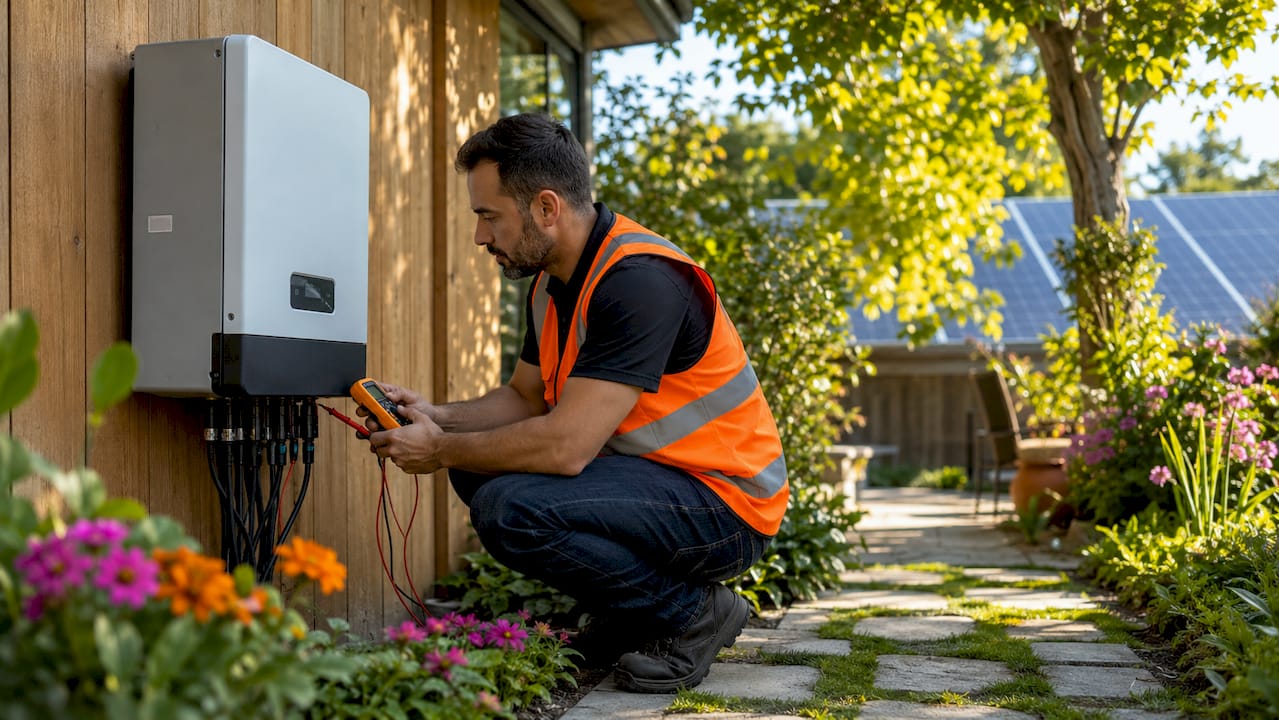
The inverter is the brain of the operation. It converts the direct current your panels produce into the alternating current your home uses. Modern inverters from brands like SolarEdge and Enphase include built-in communication hardware. Most modern inverters include free cloud monitoring accessible via web and smartphone apps, so you do not need to buy extra hardware to get started.
Module-level power electronics take monitoring one step further. Microinverters or power optimizers attach to each individual panel and report its output separately. This matters because a single shaded or faulty panel in a traditional string system drags down the entire array. With module-level tracking, panel-level data lets you pinpoint shading, wiring issues, or faults on a single panel without guessing.
The software dashboard ties everything together. Apps from SolarEdge, Enphase Enlighten, and platforms like Home Assistant display your production, home consumption, battery state, and grid interaction in one place. You can view live data, set performance alerts, and review historical trends from your phone.
- Production tracking: How many kilowatt-hours your panels generated today, this week, and this month
- Consumption tracking: How much electricity your home actually used and when
- Grid interaction: How much power you exported to the grid or pulled from it
- Battery status: Current charge level and how long it can power your home
- Alerts: Automatic notifications when output drops below your expected range
Pro Tip: Set a weekly calendar reminder to check your monitoring app. Five minutes of review each week is enough to catch most performance issues before they become expensive repairs.
Smart monitoring vs. basic solar: what is the real difference?
A basic solar setup gives you a single number: total system output. Smart solar monitoring gives you a complete picture of every panel, every hour, and every dollar. The gap between the two is significant.
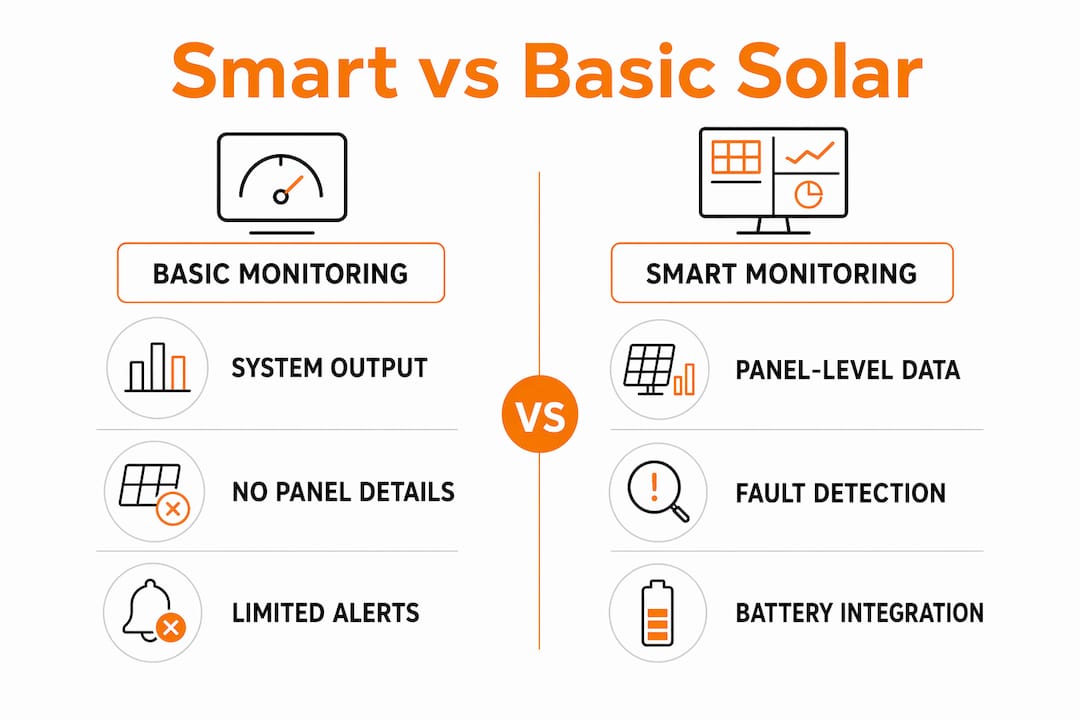
Unmonitored solar systems lose 3–8% of annual generation due to undetected faults that module-level monitoring would catch immediately. Over a 25-year system lifespan, that loss compounds into thousands of dollars. Smart monitoring also transforms how much of your solar energy you actually use yourself rather than selling back to the grid at a lower rate.
Integrating smart battery storage and intelligent automation increases self-consumption from 30–40% to as high as 70–95%. That means instead of exporting most of your solar energy for a small credit, you are using it to power your home, your appliances, and even your electric vehicle.
| Feature | Basic Monitoring | Smart Monitoring |
|---|---|---|
| System-level output data | ✓ | ✓ |
| Panel-level fault detection | ✗ | ✓ |
| Real-time consumption tracking | ✗ | ✓ |
| Automated load shifting | ✗ | ✓ |
| Battery and EV integration | ✗ | ✓ |
| Remote diagnostics and alerts | ✗ | ✓ |
| Self-consumption optimization | 30–40% | Up to 95% |
The financial case for smart monitoring is clear. A homeowner in San Antonio running a 10 kW system without monitoring could lose hundreds of kilowatt-hours annually to a single faulty panel or a tripped breaker. With smart monitoring, that fault shows up as an alert on your phone the same day it happens.
Pro Tip: When comparing solar quotes, ask specifically whether the system includes module-level monitoring or only string-level inverter data. The answer tells you a lot about the long-term value of what you are buying.
How homeowners can get the most from solar panel performance tracking
Owning a smart monitoring system is only valuable if you use the data it provides. These steps give you a practical framework for getting the most out of your solar energy management system from day one.
-
Establish your baseline on installation day. A well-installed solar system starts with a Performance Ratio of 75–85% at commissioning. Record this number. It becomes your reference point for every future performance check. If your ratio drops below that range months later, you know something has changed.
-
Set performance alerts in your monitoring app. Both SolarEdge and Enphase Enlighten allow you to configure email or push notifications when daily output falls below a threshold you define. This removes the need to check manually every day.
-
Shift heavy appliances to peak solar hours. Your dishwasher, washing machine, and dryer consume the most electricity. Running them between 10 a.m. and 3 p.m. on sunny days means you are powering them with free solar energy instead of grid electricity. Smart monitoring automates this load shifting when connected to smart plugs or home automation platforms like Home Assistant.
-
Optimize battery charging schedules. If you have a battery like the Tesla Powerwall or Enphase IQ Battery, your monitoring system can prioritize charging during peak production and reserve stored energy for evening use or grid outages. This is where solar and battery integration pays off most.
-
Coordinate EV charging with solar production. An electric vehicle is one of the largest electricity consumers in a home. Scheduling your EV to charge during peak solar hours through a smart charger turns your car into a mobile battery that runs on sunshine. Alphasolarsa installs home EV charging solutions designed to work alongside your solar system for exactly this purpose.
-
Review monthly performance reports. Most platforms generate automatic monthly summaries. Compare your current month to the same month last year. Seasonal variation is normal, but a consistent downward trend signals a problem worth investigating.
What are the common challenges with solar monitoring solutions?
Smart monitoring is not a set-it-and-forget-it solution. The technology works, but it requires your attention to deliver its full value.
The most common mistake homeowners make is treating monitoring as a passive feature. Solar monitoring is a critical active diagnostic tool, not just a data display. Homeowners who install a system and never check the app are no better off than those without monitoring at all. The data is only useful when someone reviews it.
Older inverters present a compatibility challenge. String inverters installed before 2018 often lack built-in communication hardware. Retrofitting them with third-party monitoring devices like Emporia Vue or Sense is possible, but the data granularity is lower than what you get from a modern SolarEdge or Enphase system. If your inverter is more than eight years old, a hardware upgrade may deliver better monitoring and better energy output at the same time.
Internet dependence is another real limitation. Cloud-based monitoring platforms require a stable WiFi connection to transmit data. A router outage or weak signal near your inverter can create gaps in your performance history. Placing a WiFi extender near your inverter location solves this in most homes.
- Problem: Ignoring alerts leads to silent output loss
- Solution: Set alerts and commit to a weekly five-minute review
- Problem: Older inverters lack monitoring capability
- Solution: Upgrade hardware or add a third-party energy monitor
- Problem: Internet outages create data gaps
- Solution: Install a WiFi extender near your inverter
Pro Tip: On the day your system is commissioned, take a screenshot of your monitoring dashboard showing your baseline Performance Ratio and daily output. Save it somewhere you can find it. That single screenshot becomes your most valuable diagnostic reference for the life of your system.
Key takeaways
Smart solar monitoring delivers its full value only when homeowners treat it as an active management tool, not a passive display.
| Point | Details |
|---|---|
| Define your baseline early | Record your Performance Ratio of 75–85% at commissioning to detect future degradation. |
| Panel-level monitoring matters | Module-level tracking catches individual faults that string-level systems miss entirely. |
| Self-consumption jumps significantly | Smart automation and battery integration can raise self-consumption from 30–40% to up to 95%. |
| Active review is required | Ignoring alerts can cause 10–30% output loss before a homeowner notices any problem. |
| Load shifting multiplies savings | Scheduling heavy appliances and EV charging during peak solar hours reduces grid dependence. |
Why i think most homeowners are leaving real money on the table
After working with solar installations across San Antonio, the pattern I see most often is this: a homeowner invests in a quality solar system, gets a monitoring app, and then never opens it again after the first week. The system runs, the bill goes down a little, and they assume everything is fine.
The problem is that “fine” and “optimal” are very different things. A tripped breaker, a critter chewing through wiring, or a single panel covered in debris can silently decrease energy output for months. The homeowner does not notice because their bill is still lower than before solar. They do not realize they are losing 15% of their system’s potential output every single day.
Smart monitoring changes that equation completely. The key value of smart solar monitoring is its ability to coordinate energy production and consumption so you rely on the grid as little as possible. That is not just a convenience feature. It is the mechanism that determines whether your solar investment pays off in 7 years or 12.
My honest advice: treat your monitoring app the way you treat your bank account. Check it regularly, set alerts for anything unusual, and act on what you see. The homeowners who do this consistently get the most out of their systems, period. The future of residential solar is moving toward AI-driven optimization and deeper home automation integration, and the homeowners who build that habit now will be positioned to benefit most as the technology matures.
— Anthony
See what your solar system is really doing with Alphasolarsa
If you have a solar system and you are not actively monitoring its performance, you may be leaving real savings uncaptured every month. Alphasolarsa designs and installs residential solar systems in San Antonio with smart monitoring built in from day one, so you always know exactly what your system is producing and where your energy is going.
Whether you are starting fresh or upgrading an existing system, our team sets you up with the right hardware and software to track performance, catch faults early, and maximize every kilowatt-hour your panels produce. Explore our residential solar installation services to see how we build smart monitoring into every system we install. Ready to take control of your energy? Contact Alphasolarsa today for a personalized consultation.
FAQ
What is smart solar monitoring in simple terms?
Smart solar monitoring is a system that tracks your solar panel output and home energy use in real time through an app or web dashboard. It alerts you to faults, measures self-consumption, and helps you use more of the energy your panels produce.
How does solar monitoring work with my inverter?
Your inverter collects performance data from your panels and sends it to a cloud platform via WiFi. You access that data through apps like SolarEdge or Enphase Enlighten on your phone or computer.
Can smart monitoring really save me money?
Yes. Systems with smart automation and battery integration raise self-consumption from 30–40% to up to 95%, meaning you buy far less electricity from the grid. Early fault detection also prevents the silent output losses that unmonitored systems suffer.
Do i need smart monitoring if my system is already installed?
Smart monitoring can be added to most existing systems using third-party energy monitors or by upgrading to a modern inverter. The investment pays off quickly by catching faults and optimizing how you use your solar energy.
What happens if my internet goes down?
Most monitoring platforms store data locally on the inverter and sync it to the cloud once your connection is restored. You will not lose historical data, but real-time alerts will pause until the connection returns.