
TL;DR:
- Photovoltaic technology converts sunlight directly into electricity using semiconductor materials like silicon, powering homes and businesses reliably and sustainably. It reduces energy bills by up to 70% and decreases CO2 emissions by about 1.5 tonnes annually through clean, low-maintenance systems that typically last over 25 years. Proper installation, system design, and component choice are essential for maximizing performance and long-term savings.
Photovoltaic (PV) technology is the process of converting sunlight directly into electricity using solar cells made of semiconductor materials like silicon. If you’ve been wondering what is PV technology and whether it applies to your home or business, the answer is straightforward: it’s the core science behind every solar panel on every rooftop you’ve ever seen. At Alphasolarsa, we work with this technology every day in San Antonio, and we’ve seen it transform how homeowners think about energy. PV systems use the photovoltaic effect, a physical process first observed by Edmond Becquerel in 1839, to generate clean, reliable electricity from sunlight with no fuel, no noise, and no moving parts.
How does photovoltaic technology work to convert sunlight into electricity?
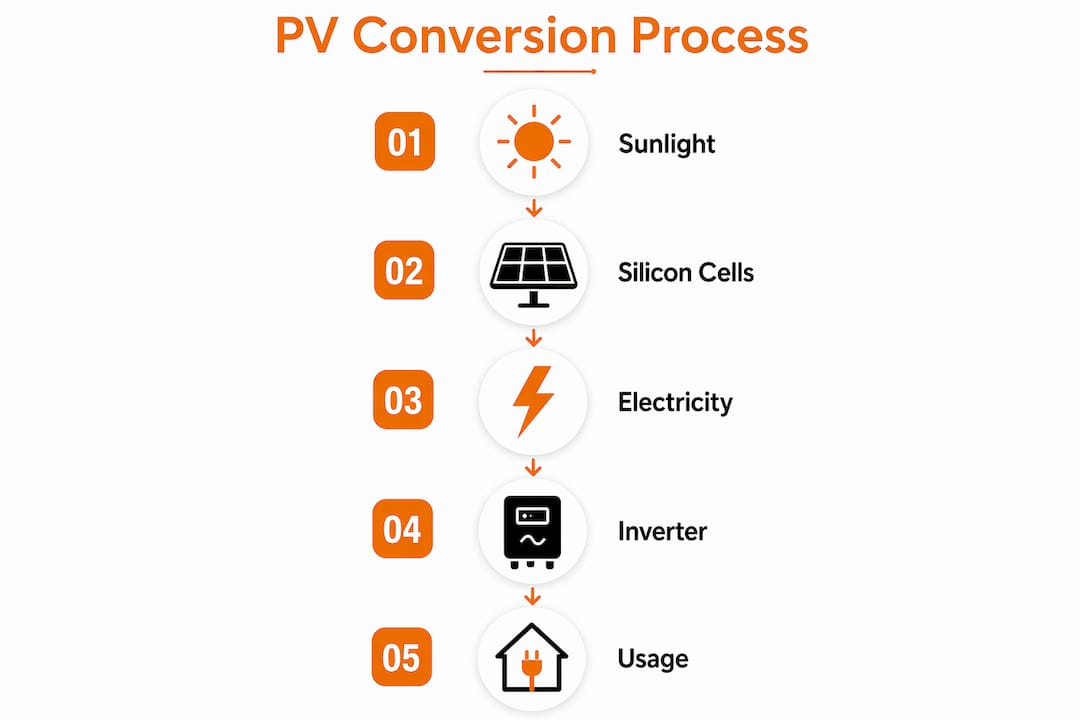
PV cells convert light into electrical current through the photovoltaic effect. When photons from sunlight strike a silicon-based solar cell, they knock electrons loose from their atoms. Those free electrons flow through the cell as direct current (DC) electricity.
Here is the full energy conversion process, step by step:
- Sunlight hits the solar panel. Photons from the sun reach the surface of the PV module.
- Electrons are excited. The semiconductor material, typically crystalline silicon, absorbs the photons and releases electrons.
- DC electricity is generated. The freed electrons flow through the cell, producing direct current.
- The inverter converts DC to AC. A solar inverter transforms the DC output into alternating current (AC), which is the standard form of electricity used in your home.
- Electricity powers your home. The AC electricity flows to your electrical panel and powers your appliances, lights, and devices.
- Excess power is exported or stored. Surplus electricity either goes back to the grid through net metering or gets stored in a battery system for later use.
PV panels come in two main types: crystalline silicon and thin-film. Crystalline silicon panels, including monocrystalline and polycrystalline variants, dominate the residential market because of their high efficiency and long track record. Thin-film panels are lighter and more flexible, making them useful for commercial rooftops with weight restrictions. Advanced formats like N-Type TOPCon technology push efficiency even higher by reducing electron recombination inside the cell.
One fact that surprises many homeowners: PV systems generate electricity on cloudy days, though output is reduced. Diffused light still carries enough energy to excite electrons. What affects your annual yield more than cloud cover is panel orientation and shading from trees or neighboring structures.
Pro Tip: Roof angle, compass direction, and local shading patterns matter more than peak sunshine hours. A south-facing roof at a 30-degree tilt in San Antonio will consistently outperform a poorly positioned system in a sunnier climate.
What are the primary benefits and environmental impacts of PV technology?
The financial and environmental case for PV is well established. Residential PV installations can cut annual electricity bills by 50–70%, delivering roughly 25 years of low-maintenance, emission-free energy. That kind of long-term cost stability is something utility companies simply cannot offer.
On the environmental side, the numbers are equally compelling. A typical residential PV setup reduces CO2 emissions by about 1.5 tonnes annually. Over a 25-year system life, that adds up to a meaningful reduction in a household’s carbon footprint, without any ongoing effort from the homeowner.
The table below compares PV energy against traditional grid electricity across the metrics that matter most to homeowners:
| Factor | PV technology | Traditional grid electricity |
|---|---|---|
| Operational emissions | Zero | High (fossil fuel dependent) |
| Annual bill savings | 50–70% reduction | No savings; costs rise over time |
| Maintenance requirements | Minimal; no moving parts | None required by consumer |
| System lifespan | 25+ years | N/A |
| CO2 reduction per home | ~1.5 tonnes per year | No reduction |
PV systems are also exceptionally reliable. Because there are no moving parts, mechanical failure is rare. The panels themselves typically carry 25-year performance warranties. The one component that does wear out faster is the inverter.
Solar inverters last 10–15 years, compared to 25 years for the panels themselves. That means most homeowners will replace their inverter once during the system’s life. Budget for this in your long-term cost planning, and you will avoid an unwelcome surprise mid-ownership.
Pro Tip: When you get a solar quote, ask specifically about inverter brand and warranty. A quality inverter from a manufacturer like SMA, Enphase, or SolarEdge adds years of reliable service and often includes remote monitoring so you can track your system’s output in real time.
What are the main components and types of PV systems?
Understanding what goes into a PV system helps you make smarter decisions when you’re ready to install. Every system, whether residential or commercial, shares the same core components:
- Solar panels: The modules that capture sunlight and generate DC electricity. Panel quality, efficiency rating, and warranty length vary significantly between manufacturers.
- Inverter: Converts DC electricity from the panels into AC electricity for home use. String inverters handle the whole array; microinverters work panel by panel for better performance in partial shade.
- Mounting structure: Holds panels at the correct angle on your roof or ground. Fixed-tilt mounts are standard for homes; tracking mounts follow the sun throughout the day and are used on large commercial or utility installations.
- Wiring and disconnect switches: Connect all components safely and allow the system to be shut down for maintenance or emergencies.
- Battery storage (optional): Stores excess electricity for use at night or during a grid outage. Pairing PV with battery backup is increasingly popular for homeowners who want full energy independence.
PV systems also divide into two main configurations. Grid-connected systems are the most common for homes and businesses. They stay linked to the utility grid, drawing power when solar output is low and exporting surplus when it’s high. Off-grid systems operate independently, relying entirely on battery storage, and are typically used in remote locations without grid access.
One distinction worth knowing: solar PV and solar thermal are completely different technologies. PV converts sunlight into electricity. Solar thermal uses sunlight to heat water or air for space heating. They are not interchangeable, and a solar thermal collector on your roof does not produce electricity.
How is PV technology applied in homes, businesses, and beyond?
PV technology scales from a single rooftop to a multi-acre utility farm. For homeowners, a typical residential system in San Antonio ranges from 6 to 12 kilowatts, enough to cover most or all of a household’s electricity needs. For businesses, commercial systems scale into the hundreds of kilowatts, reducing operating costs and supporting sustainability goals.
At the utility scale, solar farms covering hundreds of acres feed directly into the power grid. These installations use the same fundamental PV technology as a home system, just multiplied across thousands of panels.
Distributed PV generation reduces grid stress by enabling on-site power production. When thousands of homes generate their own electricity, the grid faces less peak demand pressure, which benefits everyone connected to it. This shift from passive energy consumer to active energy producer is one of the most significant changes PV technology brings to modern energy systems.
For beginners planning their first system, three factors determine success. First, site assessment: your roof’s age, orientation, and shading profile must be evaluated before any equipment is selected. Second, proper sizing: a system that’s too small won’t cover your bills; one that’s too large wastes your investment. Third, professional installation. Correct sizing and positioning are critical because poor installation cancels out the benefits of even the highest-quality panels.
Pro Tip: Before signing any contract, ask your installer to provide a shading analysis and a projected annual energy yield report. These two documents tell you exactly what to expect from your system before a single panel goes up.
Key takeaways
PV technology converts sunlight into usable electricity through the photovoltaic effect, and a properly designed residential system can cut your electricity bills by 50–70% while eliminating roughly 1.5 tonnes of CO2 emissions every year.
| Point | Details |
|---|---|
| Core mechanism | Silicon solar cells convert sunlight to DC electricity, which an inverter transforms to AC for home use. |
| Bill savings | Residential PV systems can reduce annual electricity costs by 50–70% over a 25-year lifespan. |
| Environmental impact | A typical home PV setup eliminates about 1.5 tonnes of CO2 emissions per year. |
| Inverter replacement | Plan for one inverter replacement mid-system life, as inverters last 10–15 years versus 25 years for panels. |
| Installation quality | Proper sizing, orientation, and professional installation determine whether your system performs as projected. |
Why I think most people underestimate how mature PV technology already is
I’ve been working in solar long enough to remember when homeowners treated PV as an experiment. That perception is outdated. Silicon-based PV modules are one of the most tested and proven energy technologies available today. Decades of real-world data back their performance claims, and high-quality silicon modules consistently deliver dependable energy yields across their full 25-year lifespan.
The conversation around emerging materials like perovskites is exciting, and those technologies will likely improve efficiency and reduce costs further in the years ahead. But I’d caution anyone against waiting for the “next big thing” before going solar. The panels available today are excellent. The savings are real. The technology is proven.
What I’ve seen trip up homeowners isn’t the technology itself. It’s the installation. A premium panel on a poorly designed system will underperform a mid-range panel on a well-engineered one. Consulting professional installers early in the planning process is the single most important step you can take. Get the design right, and the technology takes care of itself.
One more thing: the environmental benefit of PV extends beyond zero operational emissions. Manufacturing panels does carry a carbon cost, but most systems offset that production footprint within two to four years of operation. After that, every kilowatt-hour your system generates is genuinely clean energy. That’s a fact worth sitting with.
— Anthony
Ready to put PV technology to work on your roof?
At Alphasolarsa, we design and install custom solar PV systems for homeowners and businesses across San Antonio. Every project starts with a thorough site assessment, a shading analysis, and a system design built around your actual energy usage. We handle everything from permits to final inspection, so you don’t have to figure it out alone.
Whether you’re a homeowner ready to take control of your electricity bill or a business owner looking to reduce operating costs, we have the experience to get it right. Explore our residential solar installation services or learn about our commercial solar solutions for San Antonio businesses. You can also find out how hiring solar professionals protects your investment from day one. Reach out to Alphasolarsa today and get a free, no-pressure quote.
FAQ
What is the difference between PV and solar thermal?
PV technology converts sunlight directly into electricity using semiconductor cells. Solar thermal systems use sunlight to generate heat for water or space heating, and they do not produce electricity.
Does PV technology work on cloudy days?
Yes. PV systems generate electricity under diffused light conditions, though output is lower than on clear days. Panel orientation and shading have a greater impact on annual yield than cloud cover alone.
How long do PV systems last?
Solar panels typically carry 25-year performance warranties and often operate beyond that. Inverters last 10–15 years and will likely need one replacement during the system’s life.
What size PV system does a typical home need?
Most San Antonio homes require a system between 6 and 12 kilowatts, depending on energy usage, roof space, and orientation. A professional site assessment gives you the most accurate sizing recommendation.
Can I add battery storage to a PV system?
Yes. Battery storage can be added to most grid-connected PV systems, allowing you to store surplus electricity for use at night or during a power outage. It’s one of the most effective ways to maximize your energy independence.