
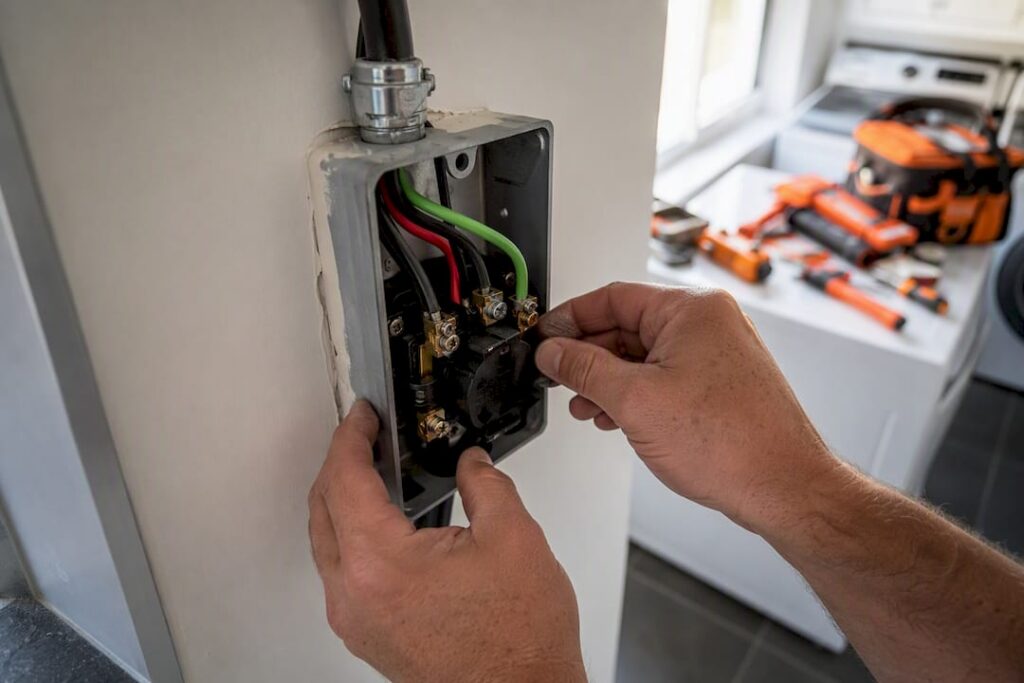
NEMA 14-50 includes a neutral wire that NEMA 6-50 does not, and that single difference decides almost everything else. For EV charging, the 14-50 is the practical pick because it matches most portable chargers and gives you flexibility for other 120V/240V gear. For a dedicated welder, the simpler three-wire 6-50 does the job without extra cost. One catch worth knowing now: code rules cap continuous EV charging on a 14-50 at 40 amps, even though the receptacle is rated for 50.
TL;DR:
- A 14-50 receptacle includes a neutral wire, allowing it to support both 120V and 240V appliances, unlike the 6-50 which only delivers 240V.
- Continuous EV charging is limited to 40 amps on a 14-50 outlet, despite its 50-amp rating, requiring careful breaker and charger configuration.
- Hardwiring a charger for 48A instead of using a plug-in 40A setup is often cheaper, more reliable, and avoids GFCI breaker conflicts.
- Matching receptacle type to equipment is crucial, as adapters between 6-50 and 14-50 are unsafe and non-code-compliant due to missing neutral connections.
- Proper installation depends on conductor size, breaker size, and circuit distance, with permits and inspections recommended to ensure safety and code compliance.
Table of Contents
- NEMA 6-50 vs 14-50: The Wiring and Electrical Basics
- How Does This Affect EV Charging Decisions?
- When Should You Choose a 6-50 vs a 14-50?
- What Does a Proper Installation Involve?
- Can You Use an Adapter Between a 6-50 and 14-50?
- What Should You Check Before Hiring an Electrician?
- Why Code-Driven Decisions Beat Guesswork Here
- Get Your EV Charger Installed the Right Way
- Sources
NEMA 6-50 vs 14-50: The Wiring and Electrical Basics
The difference between these two receptacles comes down to one conductor: the neutral. Everything about how you use them, and what you can safely plug into them, flows from that single wiring choice.
A NEMA 6-50 is a three-wire connector: two hot legs and a ground. It delivers 240 volts and nothing else. There’s no path back for 120V loads, which is exactly why it became the standard welder receptacle in home garages and small shops. Welders don’t need a neutral. They pull straight 240V power and send it through the arc, so the simpler three-wire design has been good enough for decades.
A NEMA 14-50 adds a fourth terminal: the neutral (W), alongside the two hots (X and Y) and ground (G). That neutral is what lets a single receptacle serve both 240V appliances and 120V circuits inside the same unit, which is why RVs, electric ranges, and most home EV chargers were built around it. It’s also the reason the 14-50 became the default plug for portable Level 2 chargers instead of the 6-50, according to background on how the outlet’s ubiquity in garages shaped the EV charging market.
Both receptacles carry the same nominal rating: 50 amps at 250 volts. That’s where a lot of confusion starts, because 50A on the label doesn’t mean 50A of continuous draw is allowed. The National Electrical Code treats EV charging as a continuous load, and continuous loads get derated. More on that math in the next section.
Typical wiring for either receptacle:
- #6 AWG copper conductors, sized for a 50A double-pole breaker
- #6 AWG copper is also common on 60A circuits when a charger is hardwired at 48A rather than plugged into a receptacle
- Dedicated double-pole breaker matching the receptacle’s amperage, never shared with other loads
- Proper box depth and conduit fill so conductors aren’t cramped behind the receptacle
Installation quality matters more on these circuits than on a typical 15A outlet, because continuous 240V draw generates heat that a sloppy connection can’t dissipate. Loose set screws, backstabbed connections, or worn contacts are the leading causes of scorched receptacles on high-amp circuits, a problem documented across installer write-ups on NEMA 14-50 durability. Every terminal should be torqued to the manufacturer’s spec, not just “snug.”
| Receptacle | Conductors | Voltage | Amp rating | Typical breaker |
|---|---|---|---|---|
| NEMA 6-50 | 2 hot + ground (3-wire) | 240V | 50A | 50A double-pole |
| NEMA 14-50 | 2 hot + neutral + ground (4-wire) | 120/240V | 50A | 50A double-pole |
Pro Tip: If an electrician quotes you a “50A install” without specifying receptacle type, ask directly whether it’s a 6-50 or 14-50. The wire count and box hardware differ, and mixing them up mid-project means a return trip.
How Does This Affect EV Charging Decisions?
This is where the wiring difference actually changes what you can plug in and how fast you charge. NEC Article 625 treats EV charging as a continuous load, which under the code’s 125% rule means a 50A receptacle on a 50A breaker can only be loaded to 40A continuously. That’s not a suggestion. It’s the reason plug-in chargers rated above 40A run into trouble on a standard 14-50 install.
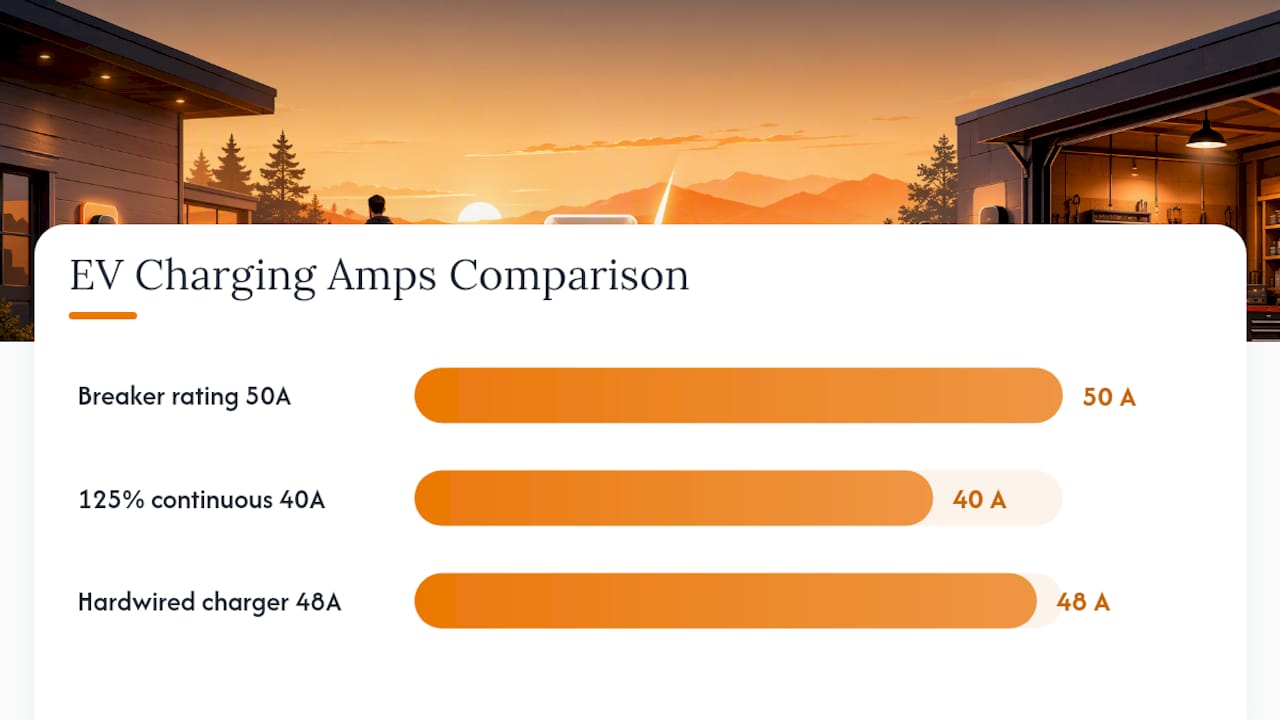
Here’s where it gets practical. A charger with rated output above typical plug-in receptacle limits typically requires a higher-capacity breaker and hardwired connection instead of a plug-in. Many installers, including Alpha Solar Solutions on jobs where a homeowner wants maximum charging speed, default to hardwiring a 48A-capable charger straight to a 60A circuit. The cost delta between a 50A receptacle install and a 60A hardwired run is often smaller than people expect, and hardwiring sidesteps two headaches at once: plug wear from repeated connect/disconnect cycles, and GFCI conflicts.
That second point deserves its own explanation. Many EV chargers include their own ground-fault protection built into the unit. When that charger also sits behind a breaker with GFCI protection, the two systems can disagree over normal, harmless current fluctuations and trip the breaker for no real reason. EnergySage’s comparison of hardwired versus plug-in chargers points to this exact interaction as one of the most common reliability complaints from EV owners. Hardwiring removes one layer of that redundant protection and tends to run cleaner over years of daily charging.
So what does this mean if you already have (or are installing) a 14-50 and want to use a plug-in charger?
- Confirm the charger’s amperage setting can be dialed down to 40A if it supports higher output
- Verify the breaker feeding the 14-50 is rated 50A, not something smaller left over from a range circuit
- Check the charger’s nameplate against the AFDC’s home charging guidance before assuming it will run at rated speed on that receptacle
- Ask your installer whether the existing run’s conductor gauge supports the amperage you actually want
Some installers, per guidance on repurposing existing 14-50 outlets, simply set the portable charger to 40A rather than rewiring an existing range or RV outlet. That’s often the fastest, cheapest path if the outlet is already in a good location.
What does 40A versus 48A actually mean for your driving? A 40A charger on a 240V circuit delivers roughly 9.6 kW, while a 48A hardwired setup delivers closer to 11.5 kW. In real terms, that means the difference between adding a moderate amount more miles of range per hour of charging, with the exact number depending on the vehicle’s onboard charger and efficiency. For most daily commuters who plug in overnight, that gap rarely matters. For someone who drives 150+ miles a day or needs a fast top-up between trips, it can mean the difference between a full charge by morning and waking up short.
The AFDC specifically names the NEMA 14-50 as one of the most common plug-in options for home Level 2 charging, which is part of why so many portable chargers ship with a 14-50 plug standard rather than a 6-50.
When Should You Choose a 6-50 vs a 14-50?
Matching the receptacle to the actual equipment sitting in your garage saves money and avoids rework. Here’s how to think through it:
- If the outlet is exclusively for a welder, the 6-50 is the right call. It’s simpler to install, uses one less conductor, and matches what nearly every stick or MIG welder expects out of the box.
- If there’s any chance the circuit will serve an EV charger, RV, or 120V equipment down the road, install a 14-50. The extra neutral wire costs little more at install time but opens the door to appliances a 6-50 physically can’t support.
- If you’re renting or expect to move within a few years, a plug-in 14-50 makes sense because portable chargers can travel with you. Hardwiring only benefits someone staying in the home long term.
- If you own the home and want maximum charging speed, talk to your electrician about hardwiring a 48A charger on a 60A circuit instead of settling for a 40A plug-in limit.
- Before buying anything, check the equipment’s nameplate. Chargers, welders, and RV shore-power cords all list their required amperage and plug type, and matching that nameplate to the receptacle prevents an expensive mismatch.
Pro Tip: Don’t oversize the outlet “just in case.” A 14-50 costs more to run than a 6-50 mainly in materials, and if your welder will never need 120V power, that extra neutral wire is money spent on flexibility you won’t use.
What Does a Proper Installation Involve?
Getting either receptacle installed correctly means paying attention to the same handful of variables every time: conductor size, breaker rating, and how far the run travels from your panel.
| Load type | Conductor (copper) | Breaker | Continuous amp ceiling |
|---|---|---|---|
| 6-50 or 14-50 receptacle | #6 AWG | 50A double-pole | 40A |
| Hardwired 48A charger | #6 AWG | 60A double-pole | 48A |
That 40A ceiling on receptacle installs is the same 125% continuous-load rule from the EV charging section, and it applies whether you’re plugging in an EV charger, a welder, or anything else that draws power continuously.
Permits and inspections aren’t optional paperwork. Most municipalities require a permit for new 240V circuits, especially when the run ties into the main panel, and inspection catches problems before they become fire hazards. Skipping this step can also void your homeowner’s insurance if a wiring-related incident happens later.
Cost varies mainly with three factors: how far the run travels from your electrical panel, whether your panel has spare capacity or needs an upgrade, and whether the receptacle sits outdoors and needs weatherproof housing. A short indoor run with available panel capacity is the cheapest scenario. A long outdoor run that also requires a panel upgrade costs considerably more, and outdoor installs need weatherproof covers and GFCI protection rated for exterior use.
Receptacle quality matters here too. A budget big-box-store receptacle rated for 50A can still fail under sustained continuous load if the internal contacts aren’t built for daily heavy use. Spending more on a commercial-grade receptacle, or skipping the receptacle entirely in favor of hardwiring, tends to pay for itself over years of nightly EV charging.
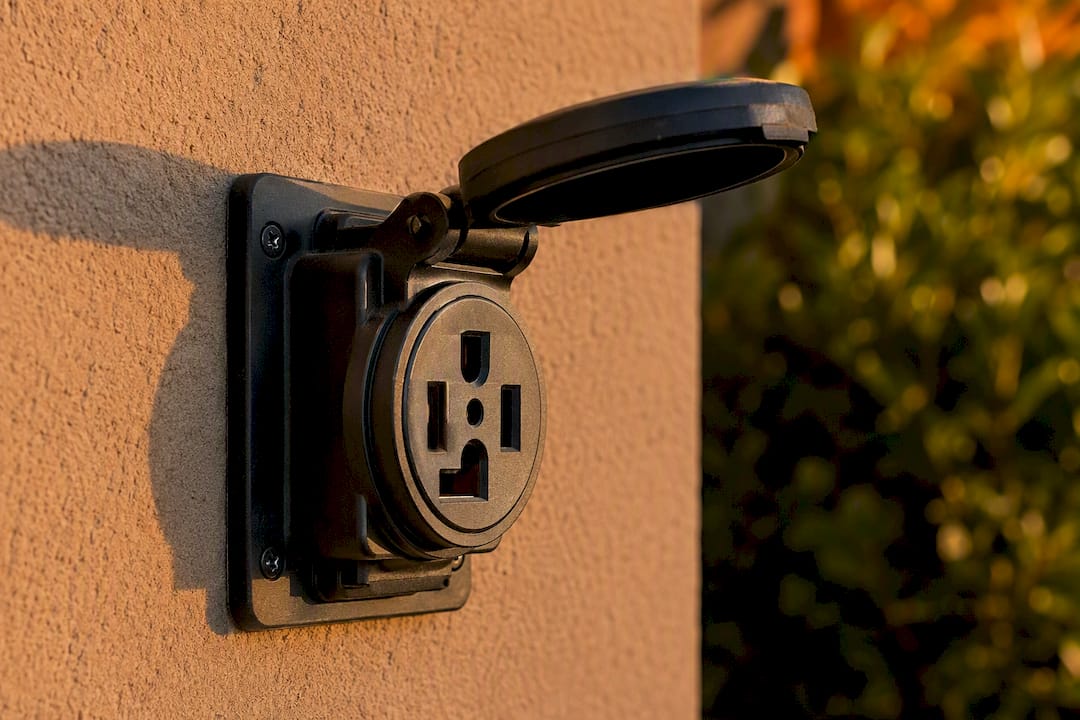
Can You Use an Adapter Between a 6-50 and 14-50?
No. There is no safe, code-compliant adapter that converts between a NEMA 6-50 and a NEMA 14-50, and any product claiming otherwise should be treated as a red flag rather than a shortcut.
The problem is the missing neutral. A 6-50 simply has no neutral wire to tap into, so any adapter promising to bridge the two either leaves the neutral unconnected (breaking anything that needs it) or improperly bonds neutral and ground, which bypasses safety protections the code requires. That’s not a minor technicality. It’s the kind of shortcut that causes fires.
If you have the wrong receptacle for your equipment, the fix is straightforward:
- Have an electrician install the correct receptacle type for your equipment, matched to the circuit’s existing wiring where possible
- If you need higher amperage than a receptacle allows, hardwire the charger directly instead of hunting for an adapter
- Never buy a “6-50 to 14-50” or “14-50 to 6-50” adapter online. If it exists, it isn’t code-compliant.
What Should You Check Before Hiring an Electrician?
An electrician worth hiring runs through the same checklist every time, regardless of which receptacle you’re leaning toward. Confirming these details up front is what separates a smooth install from a callback three weeks later.
- Panel spare capacity: does your service have room for another 50 or 60A circuit without an upgrade?
- Existing outlet verification: if you already have a 6-50 or 14-50, is the conductor gauge and breaker actually correct for it?
- Circuit labeling: is the panel clearly marked so future work (or a home inspector) doesn’t guess?
- Charger model and amp setting: does the nameplate call for 40A, 48A, or something else, and does the installer document that setting on the invoice?
- GFCI considerations: will the charger’s built-in protection conflict with a breaker-level GFCI, and has that been discussed before install day?
Alpha Solar Solutions typically recommends hardwiring when a homeowner wants a 48A or higher charging speed permanently installed, and reserves plug-in 14-50 setups for situations where flexibility, like reusing an existing range or RV outlet, matters more than squeezing out maximum amperage. If you’re comparing chargers before that conversation, this rundown of home EV charger amperage settings is a useful starting point.
Why Code-Driven Decisions Beat Guesswork Here
The conventional advice you’ll find online treats this like a shopping decision: pick the receptacle that matches your outlet chart and move on. That undersells how much the 125% continuous-load rule actually drives the real-world outcome. Most of the friction homeowners hit with EV charging speed, GFCI nuisance trips, and installer cost estimates traces back to that one NEC calculation, not to some mysterious quality difference between plugs.
What gets overlooked most is how often the “right” answer is hardwiring, even when a plug-in 14-50 is already sitting on the wall. People assume the existing outlet is the finish line. It’s often just a starting point, and reusing it at 40A instead of rewiring for 48A is a legitimate, code-compliant choice, not a compromise.
My take: prioritize the nameplate math before you fall in love with a specific charger model. Figure out your real continuous amperage need, confirm what your panel can support, and let those numbers, not marketing specs, decide whether you’re plugging in or hardwiring.
— Anthony
Get Your EV Charger Installed the Right Way
Reading about NEC continuous-load math is one thing. Getting the amperage, breaker size, and receptacle type right on your own panel is another. Alpha Solar Solutions installs EV chargers throughout San Antonio, TX and the surrounding area, and every install starts with a panel capacity check, followed by a dedicated circuit sized to your charger’s actual nameplate amperage, permitting, and final testing before we call the job done.
Hiring a licensed installer means you skip the pitfalls covered above: no guessing on breaker size, no GFCI conflicts discovered after the fact, and no adapter shortcuts that violate code. If you’re also weighing solar production against EV charging loads, our residential solar installation team can walk through how the two systems work together on one panel. Ready to get a real answer for your home? Request a site visit through our EV charger installation page and we’ll tell you exactly what your panel supports before any work begins.