
Solar installation in San Antonio requires a home-specific quote in 2026: your electricity use, roof, equipment and electrical work determine the installed total. Compare the full solar-only scope first, then separate battery backup, financing charges and any roof work so an attractive payment does not hide a different project.
- How much does solar installation cost in San Antonio? Compare a home-specific installed quote, not an advertised payment.
- Alpha Solar Solutions offers local solar installation and battery backup; compare the proposed scope before signing.
- Solar panels alone do not provide outage protection without equipment designed for backup operation.
- Compare cash purchase terms, financing totals and incentive assumptions separately.
Why this matters
You are buying an electrical installation, not just panels. A useful quote explains what the system will produce, what work your house needs and what happens after installation.
Start with your goals: reducing electricity purchases, keeping selected appliances running during outages, or both. The solar installation and battery backup services you select should match those goals rather than an advertised system size.
The right comparison is the same scope against the same scope. A solar-only proposal and a proposal that includes battery backup are not competing offers for the same job.
How much does solar installation cost in San Antonio?
Your installed cost is the total for the equipment and work specified for your property. For a 2026 buying decision, request a written breakdown that separates the following items before comparing proposals.
| Quote component | What you should see | What to clarify |
|---|---|---|
| Solar equipment | Panel models, inverter equipment and mounting hardware | Whether quoted models can change before installation |
| Installation labor | Mounting, wiring and connection work | Which site conditions trigger additional work |
| Design and approvals | System plans, permits and utility coordination | Who handles each approval and associated charges |
| Electrical work | Required changes to your home's electrical equipment | Whether upgrades are included or excluded |
| Battery backup | Battery equipment, controls and backed-up circuits | Whether backup is included at all |
| Roof work | Any preparation or repairs included in the proposal | Who handles work outside the solar contract |
| Payment terms | Purchase terms or the complete financing agreement | Whether the payment assumes an incentive or later contribution |
Ask for an installed total before incentives and a separate explanation of any projected benefit. That keeps the actual contract obligation distinct from a benefit that depends on eligibility.
A quote also needs a clear boundary. If roof repairs, electrical upgrades or battery controls are excluded, those exclusions belong beside the total—not buried in a conversation you cannot revisit.
Solar only: best for reducing grid electricity purchases
Solar-only installation suits homeowners whose main goal is to generate electricity during daylight hours. Its advantage is a narrower project scope: you are not also selecting battery storage and backup circuits.
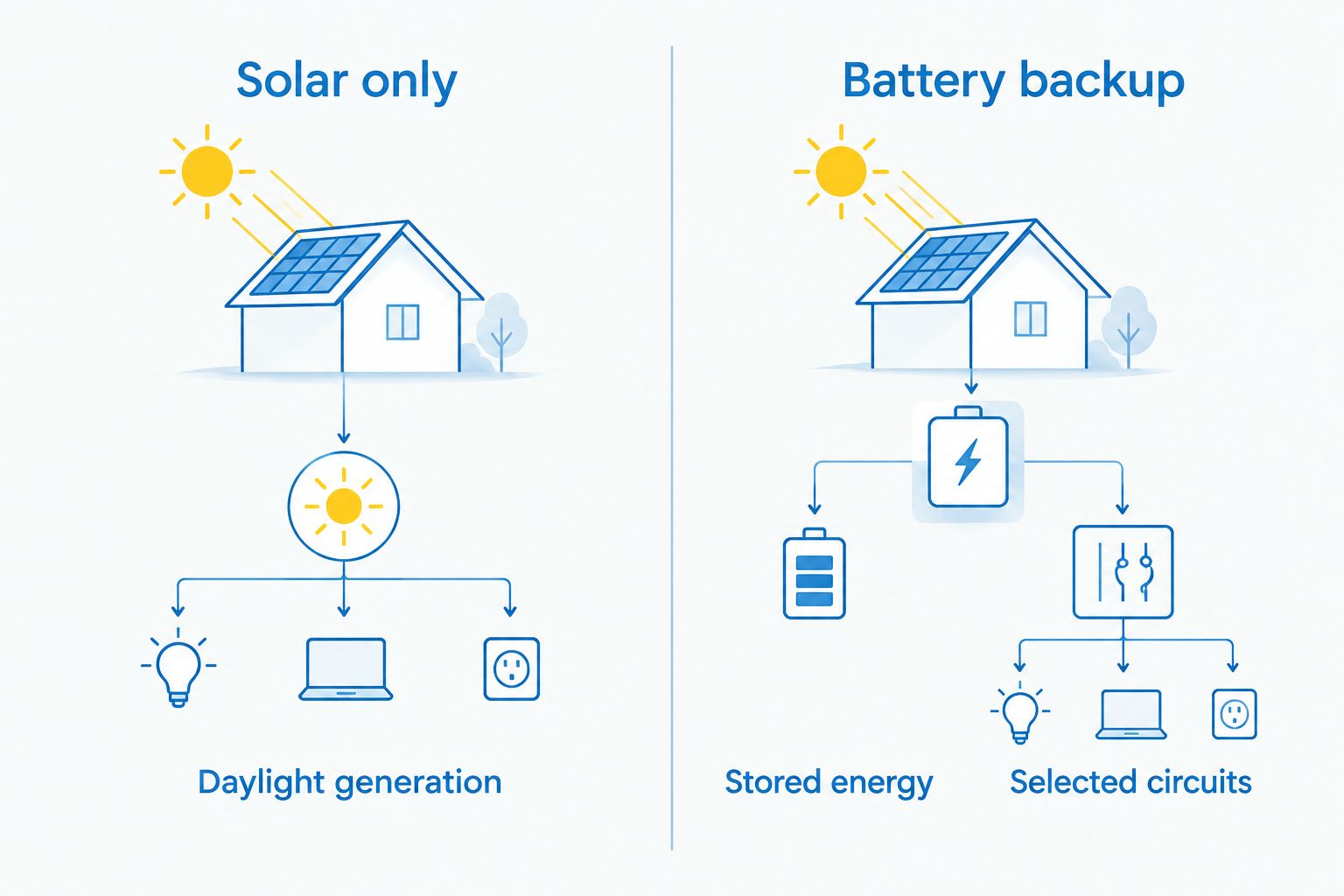
The trade-off is outage protection. Standard grid-connected solar shuts down when the grid fails unless the system includes equipment designed to operate safely during an outage. Panels on your roof do not automatically keep your refrigerator running.
Ask the installer to distinguish estimated production from estimated bill reduction. Your bill also depends on when you use electricity, your utility's current rate structure and how exported electricity is treated.
A large production estimate is not enough. You need the assumptions that connect that estimate to your household's actual electricity use.
Solar with battery backup: best for selected outage priorities
Solar paired with battery backup suits homeowners who want stored electricity available for designated loads during outages. Batteries add equipment and design decisions, including which circuits receive backup power and how the system manages stored energy.
The advantage is a backup capability that solar alone does not provide. The limitation is that usable backup depends on the battery system, appliance demand, starting requirements and available charge—not simply the presence of a battery.
| Configuration | Best for | Main advantage | Main limitation |
|---|---|---|---|
| Solar only | Reducing grid electricity purchases | Generates electricity without adding storage equipment | Does not inherently power the home during an outage |
| Solar with battery backup | Combining solar generation with selected outage protection | Stores energy and supports designated backup loads | Requires additional equipment and load planning |
Both configurations require a property-specific design. If you are weighing the timing, review the practical differences between adding a battery now or later.
Before selecting backup, write down the appliances you want operating. A refrigerator, internet equipment and selected lights create a different design problem from central air conditioning and other large loads.
Why solar installation costs vary
Different houses require different installation work. These are the factors to resolve before treating competing totals as equivalent:
- Electricity use: Your usage history helps establish the proposed system size. Planned changes, such as adding an EV, should be identified rather than silently assumed.
- Roof conditions: Available roof area, shading, roof geometry and roof condition affect the layout and installation scope.
- Equipment selection: Panel models, inverter arrangements, mounting equipment and battery components determine what you are actually purchasing.
- Electrical requirements: Existing electrical equipment and the proposed connection determine whether additional work is required.
- Backup priorities: Selected circuits and appliance starting requirements shape the battery and control design.
- Contract structure: Included services, exclusions and financing terms determine the full obligation beyond the headline proposal.
None of these factors justifies an unexplained surcharge. Ask the installer to connect each additional item to an identified condition or an agreed requirement.
A useful response names the work and its purpose. An unexplained equipment allowance or general upgrade line leaves you unable to compare proposals fairly.
How do you compare solar quotes fairly?
Compare equipment, installation scope and payment terms separately. Otherwise, a smaller system or an excluded electrical upgrade can look like a better offer without delivering the same result.
- Start with your usage. Gather 12 months of electricity bills so the design reflects seasonal demand rather than a single billing period.
- Match the system description. Check panel models, total panel capacity, inverter equipment and any battery scope.
- Check the production assumptions. Ask how shading, roof orientation and other site conditions affect the estimate.
- Identify exclusions. Highlight roof repairs, electrical work, approval responsibilities and other work outside the quoted scope.
- Separate purchase and finance terms. Compare the equipment-and-installation agreement with the lender's complete repayment terms.
- Confirm handover and support. Ask who explains monitoring, documents the installation and responds when you report a problem.
Read the units carefully. A kilowatt, or kW, measures power; 1 kW equals 1,000 watts. A kilowatt-hour, or kWh, measures energy used or generated over time; a 1 kW load running for 1 hour uses 1 kWh.
Those units answer different questions. System capacity does not, by itself, tell you annual production or battery runtime.
Is financing a better choice than paying upfront?
Financing spreads payment over time; paying upfront avoids borrowing under a solar loan. Neither choice changes the need for a complete installation scope.
For a 2026 financing offer, inspect the APR, repayment period, fees, total payments and any conditions tied to an expected contribution. Ask whether the financed contract amount differs from the cash purchase terms.
The advantage of financing is avoiding the full upfront payment. The trade-off is a repayment obligation whose total and conditions need their own review. An upfront purchase avoids loan obligations but requires you to commit the funds at installation.
Do not compare a loan payment with your current electricity bill as though the utility bill disappears. Ask for a projection that shows any remaining utility charges alongside the loan payment, with the assumptions clearly identified.
If the proposal shows a payment changing later, get the reason in writing. You should understand the contractual schedule before judging affordability.
Do incentives reduce what you pay for solar?
An incentive only belongs in your decision after you verify the current program rules and your eligibility. Keep the contract total separate from any projected tax benefit, rebate or utility payment.
For a 2026 purchase, confirm the applicable rules through the responsible tax authority, utility or program administrator. A sales estimate is not an eligibility determination, and an installer cannot determine your individual tax situation.
Ask the proposal to identify each assumed incentive by name, explain who receives it and state what action or documentation it requires. Then ask what your payment obligation becomes if that benefit does not apply.
This is also a reason to avoid comparing proposals only by an after-incentive total. Different assumptions can make equivalent installation scopes appear different—or different scopes appear equivalent.
What should you bring to a solar consultation?
Bring 12 months of electricity bills, information about your roof and a short list of household changes you expect. Mention an EV, additional air conditioning or other planned electrical loads if they are part of your decision.
For backup planning, list your essential appliances and distinguish necessities from preferences. Ask the installer to explain which loads the proposed system supports and what conditions limit operation.
Alpha Solar Solutions solar installation is best for San Antonio homeowners seeking a local contractor for solar and battery backup. Its stated services cover both needs; the proposed design, backup scope and contract still need your review.
Ask the local team how the custom design reflects your roof and usage, and what support after installation includes. Specific answers are more useful than a general assurance that everything is covered.
Discuss your home’s solar plan
Request a free consultation about your electricity use, roof and battery backup priorities.
FAQ
How much does solar installation cost in San Antonio in 2026?
Solar installation in San Antonio requires a property-specific installed quote. Compare equipment, labor, approvals, electrical work and any battery backup before evaluating payment terms or incentive assumptions.
Will solar panels keep my house powered during an outage?
Solar panels alone do not automatically power your house during an outage. Backup operation requires equipment designed to isolate safely from the grid and supply the designated loads.
Should I get a battery with my solar installation?
Include a battery in your evaluation if outage protection is one of your goals. Compare the supported circuits and operating limits against the additional equipment and installation scope.
How many electricity bills should I bring to a solar consultation?
Bring 12 months of electricity bills to help show seasonal usage. Also identify planned changes, such as an EV, that your past bills do not reflect.
Does a smaller monthly payment mean a better solar deal?
A smaller monthly payment does not establish that a solar offer is better. Compare the installation scope, APR, repayment period, fees and complete repayment obligation.
Can I count on a solar tax benefit before signing?
Count a tax benefit only after verifying the current rules and your eligibility. Keep the full contract obligation separate from projected benefits and seek advice about your individual tax situation.
Does Alpha Solar Solutions install solar and battery backup?
Alpha Solar Solutions offers residential solar installation and battery backup for San Antonio homeowners. Ask for a home-specific proposal that identifies equipment, electrical work and the intended backup loads.
One last thing
Before signing in 2026, ask the installer to show what changes if every incentive assumption is removed. The equipment scope should stay understandable, and your contractual payment obligations should remain clear.
Then ask for the outage plan separately from the savings projection. A system designed to reduce electricity purchases is not automatically a system designed to protect your essential appliances. Knowing that distinction before installation is more useful than discovering it during an outage.
Related guides
- Compare solar financing APR and total loan cost
- Understand what delays solar activation in San Antonio
- Check whether battery backup can run central air conditioning