
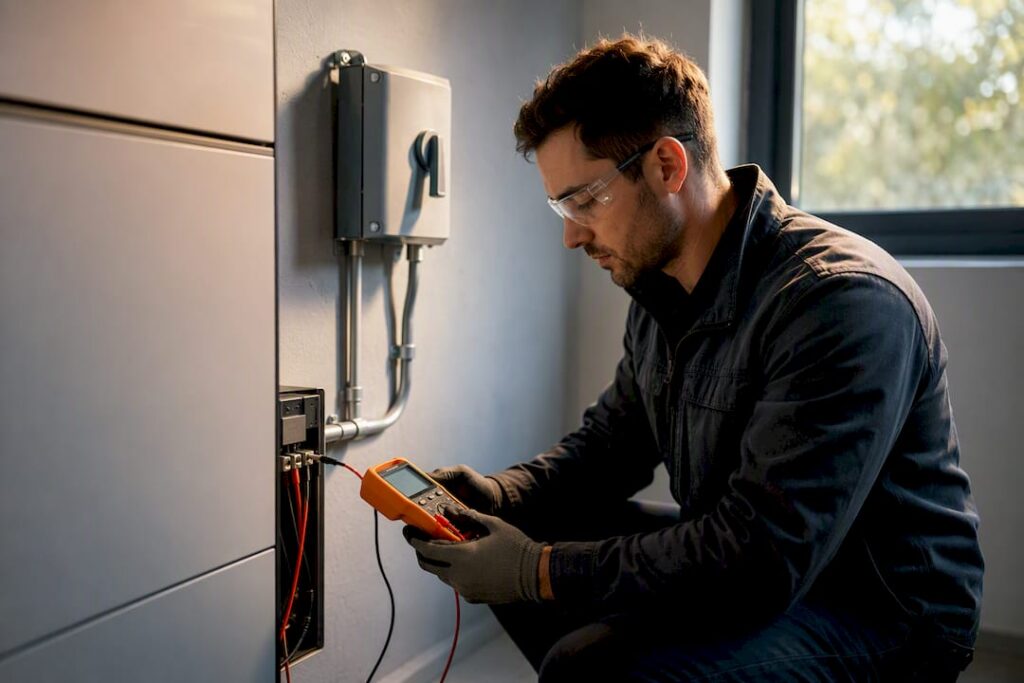
If you’re buying a home battery in 2026, there is no new federal tax credit waiting for you at filing time. The Residential Clean Energy Credit that once returned a share of your system cost expired for any battery placed in service after December 31, 2025. The only exception is if your system was commissioned and turned on before that deadline. Everything else now runs through state programs, utility rebates, or third-party ownership deals.
TL;DR:
- The federal residential battery tax credit ended for systems placed in service after December 31, 2025, with only a narrow exception for systems commissioned before that date.
- Eligibility depends strictly on the commissioning or permission to operate date, not on contract signing or deposit date, requiring homeowners to verify these with official documentation.
- Homeowners who installed and commissioned their batteries in 2025 can still claim the credit on their 2025 tax return, but all 2026 purchases rely on state rebates, utility incentives, or third-party lease arrangements.
- Third-party ownership under Section 48E offers indirect federal support, typically passing through 8% to 18% of project costs, but no direct homeowner tax credit remains for new purchases.
- Homeowners should assess the value of backup power, savings from time-of-use shifts, and available state or utility rebates before investing in a new battery system in 2026.
Table of Contents
- Federal Battery Tax Credit 2026: What Changed and Why
- How to Tell if Your Battery Project Still Qualifies
- Filing the Credit for a 2025 Battery Installation
- What’s Left at the Federal Level: Third-Party Ownership and Section 48E
- State and Utility Programs Worth Chasing in 2026
- Does a Battery Still Pencil Out Without the Federal Credit?
- Alpha Solar Solutions’ Take: What We Ask Before We Recommend a Battery
- Get a Straight Answer on Your Battery Options
- Sources
- FAQ
Federal Battery Tax Credit 2026: What Changed and Why
The Residential Clean Energy Credit, known to the IRS as Section 25D, used to let homeowners who purchased and owned their battery outright claim a percentage of the system cost back on their federal return. That program ended for good. Under the IRS’s formal guidance on the change, Section 25D no longer applies to any homeowner-owned battery placed in service after December 31, 2025.
There’s no soft landing here. Some federal incentive programs wind down gradually, stepping from a full credit to a partial one over a few years. That’s not what happened with the residential battery credit. It simply stopped. A system commissioned on January 1, 2026 gets nothing at the federal level, while one commissioned on December 30, 2025 could still qualify for the full 2025 credit.
That cutoff matters more than most homeowners realize, especially with sales conversations that haven’t caught up to the new rules.
What this means for you right now:
- Any 2026 quote that still advertises a federal battery tax credit needs a second look.
- If a system was contracted in 2025 but installed in 2026, the federal credit does not apply.
- The old 3 kWh minimum battery capacity requirement is no longer relevant for new purchases, since the credit itself no longer exists for homeowner-owned systems.
The bottom line: Section 25D is gone for new homeowner purchases in 2026. There’s no phase-down, no partial percentage, and no federal battery tax credit to claim on a system installed this year unless it falls under the narrow 2025 exception covered below.
How to Tell if Your Battery Project Still Qualifies
Whether your project falls under the old rules or the new ones comes down to one phrase: “placed in service.” The IRS doesn’t care when you signed a contract or made a deposit. It cares when your battery was actually commissioned and ready to do its job.
Here’s how to check where you stand:
- Find your Permission to Operate (PTO) date. This is the date your utility formally authorized your system to run, and it’s usually the strongest evidence of when the system was placed in service.
- Check for a commissioning report. Your installer should have documented the exact date the battery was activated and tested.
- Compare that date to December 31, 2025. If commissioning or PTO happened on or before that date, you’re likely covered under the old Section 25D credit. If it happened after, you’re not.
- Confirm your signed acceptance paperwork matches. Discrepancies between contract dates and commissioning dates are common and can complicate a claim.
The IRS guidance on Section 25D’s termination is explicit that placed-in-service date, not contract date, determines eligibility.
Pro Tip: Call your installer and ask for your PTO letter and commissioning report in writing, even if you think you clearly qualify. If your return gets flagged, a contract alone won’t satisfy the IRS. A dated commissioning document will.
Filing the Credit for a 2025 Battery Installation
If your battery was placed in service by December 31, 2025, you can still claim the Residential Clean Energy Credit on your 2025 federal tax return. The process runs through IRS Form 5695, which calculates your credit and carries the result over to Schedule 3 of Form 1040.
A few filing details matter more than homeowners expect:
- The standard filing deadline is April 15, 2026, with an automatic extension available to October 15, 2026 if you file for one.
- If your credit is larger than your tax liability for the year, the unused portion carries forward to future tax years rather than disappearing.
- Keep your itemized installer invoice, your commissioning report, and your PTO letter together in one file. These are exactly what the IRS asks for if your return is reviewed.
- Double check that your installer’s paperwork lists the system as “placed in service” in 2025, not just “installed” or “contracted.”
Homeowners who installed in 2025 are in the last group to benefit directly from this credit. Everyone buying in 2026 needs a different plan.
What’s Left at the Federal Level: Third-Party Ownership and Section 48E
Homeowner-owned batteries lost their federal credit, but that doesn’t mean the federal government stepped out of battery incentives entirely. The Section 48E Clean Electricity Investment Credit remains active for storage projects that begin construction before 2033, according to the Department of Energy’s overview of residential clean energy incentives. The catch is that Section 48E is claimed by the system owner, and under a lease or power purchase agreement, that owner is the leasing company, not you.
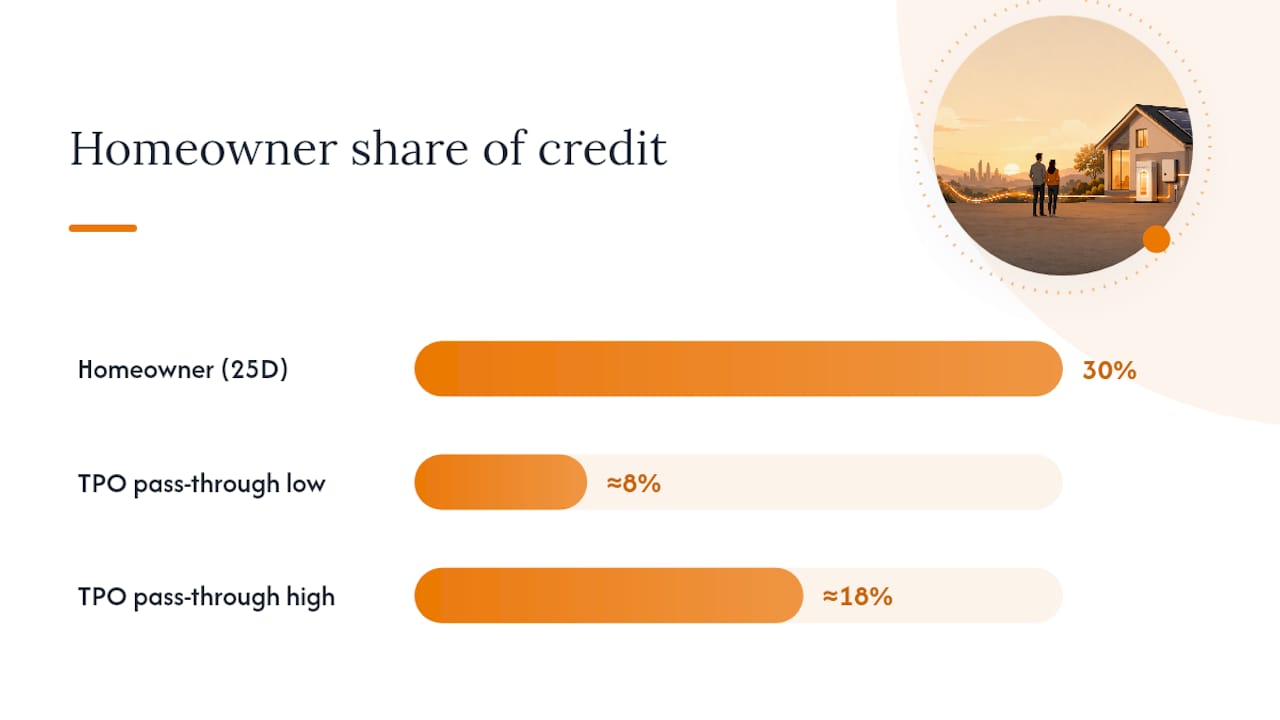
That structure creates an indirect benefit. The leasing company claims the federal credit and can pass some of that value to you through a lower monthly lease payment or a reduced per-kWh charge. It’s a real savings mechanism, just a smaller and less direct one than what homeowners had under Section 25D.
Realistically, that pass-through tends to land well below what homeowners used to receive. Industry reporting on 2026 battery incentives puts typical TPO pass-throughs in the range of roughly 8% to 18% of system cost, not the 30% homeowners once claimed directly. The exact number depends on the installer’s margins, your financing terms, and whether state incentives stack on top.
Before signing a lease or PPA, ask about:
- The exact percentage of Section 48E value the company commits to passing through, in writing.
- How your monthly payment or rate compares to a straight cash purchase over the system’s life.
- Material sourcing and Foreign Entity of Concern (FEOC) compliance, since Section 48E now ties certain credit values to domestic content thresholds that can affect how much value the owner actually captures.
State and Utility Programs Worth Chasing in 2026
With the federal homeowner credit gone, state and utility programs have become the main lever left for cutting battery costs. They’re inconsistent by design, since each state sets its own rules, but several are substantial enough to change your math.
California’s Self-Generation Incentive Program (SGIP) pays per kilowatt-hour of battery capacity, with higher tiers for equity and wildfire resiliency customers. New York’s NYSERDA offers rebates that reduce upfront battery costs for qualifying households. Connecticut runs a performance-based program that pays out over time rather than as a single upfront rebate, and Colorado has its own set of utility-level incentives worth checking before you sign a contract.
A few things to know before counting on any of these:
- Most state and utility rebates require you to work with a participating, pre-approved contractor. Signing with an installer who isn’t enrolled can disqualify you entirely.
- Some programs have waitlists or capped annual budgets, so timing your application matters as much as your eligibility.
- Rebate structures vary between upfront payments and performance-based payments spread over months or years.
The ENERGY STAR database of state and tribal rebate programs and the DSIRE database are the two best places to check current amounts and eligibility for your specific ZIP code, since these programs change more often than most homeowners expect.
Pro Tip: Before you request quotes, check DSIRE for your state and utility territory first. Knowing what rebates exist changes how you should be pricing installer proposals, not the other way around.
Does a Battery Still Pencil Out Without the Federal Credit?
Losing the previous federal credit changes the math, but it doesn’t necessarily make a battery a bad investment. It does mean you need to evaluate the purchase on its own merits rather than assuming a subsidy will carry part of the cost.
Run through this checklist before you sign anything:
- Backup value. What’s the cost of an outage to your household? Medical equipment, a home office, or a well pump can make backup power worth the cost on its own, credit or no credit.
- Time-of-use savings. Ask your installer for a realistic estimate of how much you’ll save shifting usage away from peak utility rates.
- Rebate and VPP revenue. Factor in any state rebate you actually qualify for, plus potential income from virtual power plant (VPP) programs that pay you for letting your utility draw on your battery during peak demand.
- Lease pass-through, if applicable. If you’re considering a TPO deal, get the exact pass-through percentage in writing before comparing it to a cash purchase.
- Warranty and lifecycle. Most residential batteries carry warranties in the 10 year range; confirm what capacity guarantee comes with that warranty.
When comparing quotes, ask each installer for the installed cost per usable kilowatt-hour, not just the sticker price, along with any projected dispatch or VPP revenue in writing. Watch for red flags: any 2026 proposal that still lists a 30% federal tax credit for a homeowner-owned system is working from outdated information, and vague promises about lease pass-through percentages without a number attached deserve real skepticism.
Alpha Solar Solutions’ Take: What We Ask Before We Recommend a Battery
We walk every San Antonio homeowner through the same checklist before recommending a battery in 2026. First, we confirm the realistic PTO timeline for their project, since that date now decides everything. Second, we check which state or utility rebate programs their location qualifies for and whether we’re an enrolled contractor for those programs. Third, if a lease or PPA is on the table, we push for a written pass-through percentage before anyone signs.
We also keep an eye on marketing claims that haven’t caught up with the law. If you’ve seen a battery ad promising a federal credit that no longer applies to homeowner-owned systems, that’s worth asking about directly. Keeping your commissioning report and itemized invoice organized from day one saves real headaches later, whether you’re filing a 2025 return or applying for a state rebate.
— Anthony
Get a Straight Answer on Your Battery Options
Some battery quotes skip providing a clear, honest read on what incentives actually apply to your project in 2026, not what applied two years ago.

We help confirm your placed-in-service timeline, check which state and utility rebate programs you actually qualify for, and walk you through lease or PPA pass-through terms if that route makes sense for your budget. Consults include a documented PTO plan and a breakdown of what paperwork is needed, whether for filing for a rebate or keeping records. If you’re weighing whether a battery backup system fits your home this year, request an evaluation and get numbers specific to your property instead of a generic estimate.
This article is general information, not a substitute for advice from a qualified financial advisor. Consult a qualified financial professional about your own circumstances before acting on anything here.
Sources
- HowToStoreElectricity: Home battery rebates, tax credits and incentives in 2026
- ENERGY STAR: State and tribal rebate program resources
FAQ
Is there a federal tax credit for home batteries in 2026?
No. The Residential Clean Energy Credit under Section 25D ended for any homeowner-owned battery placed in service after December 31, 2025, according to IRS guidance. If your system was commissioned by that date, you can still claim it on your 2025 return.
Will the federal solar tax credit be available in 2026?
The homeowner-owned Residential Clean Energy Credit for solar and battery systems purchased outright ended the same way, for installations placed in service after December 31, 2025. Third-party owned systems can still access federal support indirectly through Section 48E, claimed by the system owner rather than the homeowner.
Will the federal EV tax credit be available in 2026?
This article focuses on the residential battery storage credit rather than EV purchase credits, and EV credit rules fall under separate IRS provisions. Homeowners adding an EV charger installation alongside a battery should check current IRS guidance specifically for vehicle credits, since the two programs are governed separately.
What is the federal tax credit for batteries in 2026?
There isn’t one for new homeowner-owned battery purchases in 2026. The only federal pathway remaining is Section 48E, which applies to third-party owned systems like leases or PPAs, where pass-through savings to homeowners typically run 8% to 18% of system cost rather than a direct credit.
How do I claim the battery credit if I installed in 2026?
File IRS Form 5695 with your 2025 tax return, which carries the credit amount to Schedule 3 of Form 1040. Keep your PTO letter and itemized invoice on hand, and remember the filing deadline is April 15, 2026, with an extension available to October 15, 2026.
Does Alpha Solar Solutions help with rebate paperwork?
Yes. Alpha Solar Solutions documents PTO dates, tracks state and utility rebate enrollment, and provides the itemized paperwork homeowners need for filing or rebate applications as part of every residential installation consult.