
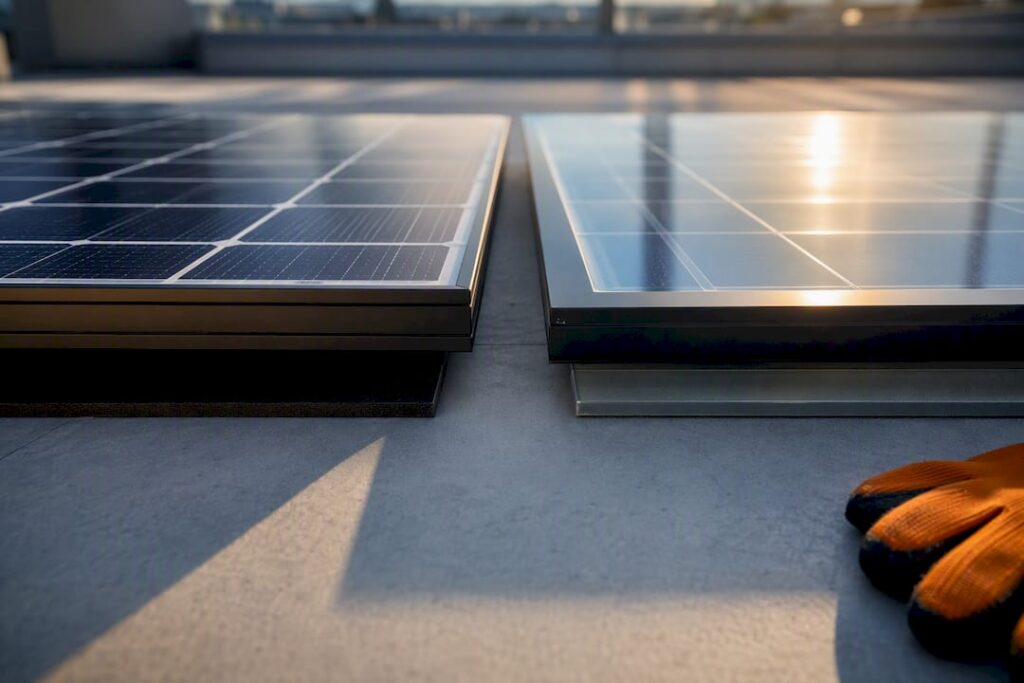
Bifacial panels usually win on elevated ground-mounts, flat commercial roofs, and tracker systems, where reflected light hits their rear cells freely. Monofacial panels usually win on standard pitched residential roofs mounted close to the shingles. The reason comes down to one factor: bifacial output depends on rear-side irradiance, which requires ground reflectivity (albedo) and enough clearance underneath the module. Ask any installer quoting bifacial for your roof to show you an albedo-adjusted production estimate before you sign anything.
TL;DR:
- Bifacial panels generally outperform monofacial ones only when elevated above ground or mounted over highly reflective surfaces like white membrane roofing or white gravel.
- Gains from bifacial systems typically range from 4% to 7.8% on constrained rooftops and can reach 20% to 30% in high-albedo, high-elevation, or tracker setups.
- The actual benefit depends heavily on site-specific factors such as ground reflectivity, panel height, orientation, and shading, so installers must model these conditions accurately.
- Bifacial modules cost more upfront but are more durable, degrading at a lower annual rate than monofacial panels, which can lead to higher lifetime output if conditions are optimal.
- For standard pitched residential roofs with dark shingles and limited clearance, monofacial panels usually provide better value, whereas bifacial is more suitable for flat roofs, ground-mounts, or elevated arrays.
Table of Contents
- Bifacial vs Monofacial Panels: The Technology Difference
- What the Real-World Data Says About Bifacial Gains
- The Site Factors That Actually Control Bifacial Output
- Costs, Degradation, and When the Premium Pays Off
- Maintenance Realities Installers Watch For
- Your Decision Checklist: Bifacial or Monofacial?
- How Alphasolarsa Recommends Choosing
- Get a Site-Specific Panel Recommendation From Alphasolarsa
- Sources
- FAQ
Bifacial vs Monofacial Panels: The Technology Difference
A monofacial panel generates power from one side only. Its rear surface sits against an opaque backsheet, so any light bouncing off the roof or ground never gets used. A bifacial panel has active photovoltaic cells on both sides, usually sealed between two sheets of glass instead of glass and backsheet. That second face lets it collect reflected and diffuse light in addition to direct sunlight from above.
The rear side doesn’t work like the front. It relies on albedo, the fraction of sunlight a surface reflects back, plus scattered light from clouds and haze. Illumination on the back is rarely even. Racking rails, junction boxes, and mounting clamps all cast small shadows across the rear cells, which is part of why lab-rated bifacial gains rarely show up in full on an actual roof.
A few things determine how much of that rear-side potential a system actually captures:
- The mounting hardware’s design, since bulky frames and boxy junction boxes block more rear surface than slim racking
- The module’s height off the ground or roof deck
- What’s underneath and around the array, since light gravel behaves nothing like a dark asphalt roof
What the Real-World Data Says About Bifacial Gains
Marketing brochures love to cite bifacial’s upper limits. Field data tells a more complicated story, and the range is wide enough that “it depends on your site” is not a dodge, it’s the actual answer.
By the numbers: A floating PV performance study measured bifacial panels averaging 19.64% efficiency, about 6.59% ahead of comparable monofacial modules, with the gap widening as irradiance climbed. Meanwhile, rooftop field tests on industrial-style buildings found bifacial modules adding only 4.3% to 7.8% more power under constrained mounting heights, though that figure jumped toward 15% during overcast, high-diffuse-light conditions.
The spread between those two numbers is the whole story. Close to the roof deck, on a typical shingle installation, bifacial gains often land in the single digits. Elevate the array, put it over a reflective surface, and let irradiance climb, and gains stretch much higher.
A broader technology review synthesizing multiple simulation and field studies puts a rough global average around 10% gain at moderate albedo (0.25), climbing toward 20% to 30% when elevation reaches about 1 meter and albedo hits 0.5. EnergySage’s consumer guidance lands in a similar place: 5% to 30% more energy depending entirely on the site, with a blunt warning that standard rooftop mounts often don’t earn back the premium.
- Close-mounted residential roof: low single digits to high single digits
- Elevated ground-mount over grass or gravel: roughly 10% to 20%
- High-albedo, high-clearance, or tracker setups: 20% to 30%, sometimes more
The Site Factors That Actually Control Bifacial Output
Four variables decide whether bifacial earns its premium, and none of them is the panel itself.
- Albedo of the surface underneath. Snow reflects around 0.8 of incoming light. White membrane roofing or light gravel runs roughly 0.4 to 0.6. Grass sits near 0.2. Dark asphalt or dark shingles drop to 0.05 to 0.15, which is why a typical composition roof gives the rear cells almost nothing to work with.
- Elevation off the mounting surface. Modeling work on bifacial optimization shows raising panels roughly 1 meter above the surface, paired with albedo near 0.5, can push gains from around 10% toward 20% to 30%. Standard rooftop racking, by contrast, often leaves only inches of clearance.
- Tilt, orientation, and tracking. Single-axis trackers and some vertical east-west layouts can outperform fixed south-facing tilt in low-latitude, high-albedo sites, though global optimization studies note the winning configuration is location-specific, not universal.
- Shading and uneven rear illumination. Racking obstructions, nearby fences, or parked equipment create patchy rear-side light that quietly erases a chunk of the theoretical gain, a weak point outdoor comparison studies flag repeatedly.
Pro Tip: If your installer’s bifacial quote doesn’t mention assumed albedo or rack height, ask directly. Those two numbers drive more of the outcome than the panel’s datasheet.
Costs, Degradation, and When the Premium Pays Off
Bifacial panels typically carry a per-panel premium over comparable monofacial units. On a 6 kW residential system, that premium adds up fast, so it needs to be weighed against realistic gain, not the brochure number.
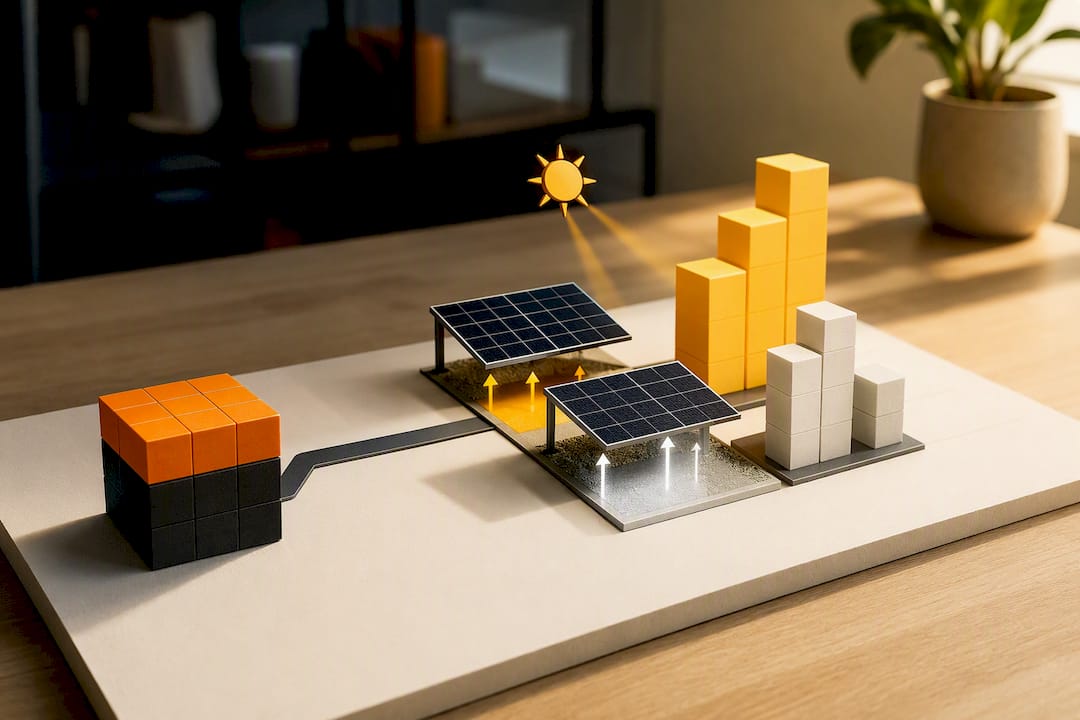
The durability side tilts in bifacial’s favor over the long run. Glass-glass bifacial construction tends to degrade around 0.45% per year, compared with roughly 0.55% per year for glass-backsheet monofacial modules, according to comparative degradation research. Over 25 years, that difference compounds into meaningfully more lifetime output, warranty terms aside.
A workable rule of thumb: pay the bifacial premium only when your expected percentage gain, once realistically modeled for your site, exceeds the percentage premium you’re paying over the system’s lifetime. If your roof can’t clear that bar, adding more monofacial wattage or a higher-efficiency monofacial panel is usually the better use of the same budget.
- Confirm whether the quote uses microinverters or string inverters, since uneven rear-side output can create mismatch losses that string systems handle worse
- Ask whether module-level power electronics are included to manage that mismatch
- Compare the installed cost per watt for both options before deciding
You can dig deeper into ROI math and comparison frameworks in our guide on maximizing solar panel return on investment.
Maintenance Realities Installers Watch For
Rear-side soiling is the sneaky one. In dusty or arid climates, dirt accumulates on the underside of elevated bifacial arrays just as it does on top, and cleaning crews need to plan for both faces, not one.
- Snow tends to shed faster off vertical or steeply tilted bifacial installations, a small but real seasonal advantage
- Mismatch losses from uneven rear lighting are best managed with microinverters or module-level electronics
- Racking with narrow rails and minimal rear obstructions preserves more of the rear-side gain than bulky frames
- Routine solar panel cleaning matters more for bifacial systems simply because there’s twice the surface collecting grime
Your Decision Checklist: Bifacial or Monofacial?
Work through these steps before you commit to either technology.
- Check your roof material and color. Dark shingles close-mounted to the roof deck rarely justify bifacial.
- Measure your clearance. Less than a few inches of rack height means minimal rear-side benefit.
- Look at what’s underneath and around the array. Light gravel, white membrane, or open ground beats dark asphalt or shaded yards.
- Request an albedo-adjusted production estimate, not a generic bifacial gain percentage, from every installer bidding the job.
- Ask for the assumed rack elevation and soiling assumptions behind that estimate.
- Compare the bifacial quote against adding equivalent monofacial wattage, using simple payback period and lifetime kWh, not just sticker price.
Pro Tip: If your roof has tight clearance, dark shingles, and minimal reflective ground cover nearby, stop the bifacial conversation there. Monofacial is almost certainly the smarter buy for your situation.
How Alphasolarsa Recommends Choosing
For most homeowners on standard pitched roofs, monofacial panels are generally recommended. For flat commercial roofs, ground-mounts, and elevated arrays, bifacial usually earns its keep. The most common bidding mistake we see elsewhere is a bifacial gain number pulled from a datasheet instead of the actual roof. A trustworthy proposal always models your specific albedo and clearance first.
— Anthony
Get a Site-Specific Panel Recommendation From Alphasolarsa
Choosing between bifacial and monofacial isn’t a guess you should make from a brochure, it’s a site calculation. Alphasolarsa builds albedo-adjusted production estimates before recommending either technology, so your quote reflects your actual roof, ground cover, and clearance rather than a manufacturer’s best-case number.
If you’re on a standard pitched roof, our team can tell you honestly whether bifacial is worth the premium or whether your money is better spent on additional monofacial capacity through our residential solar installation service. Business owners with flat roofs or ground-mount potential should look at our commercial solar installation options, where bifacial’s rear-side advantage tends to show up in real kilowatt-hours. If you already have panels and want to know if a rear-side upgrade or reinstallation makes sense for your setup, consider requesting a site evaluation to assess your property before making decisions.
Sources
- Performance study (floating PV) — White Rose ePrints
- EnergySage — Bifacial solar panels: what you need to know (2022)
- Outdoor performance comparison of bifacial and monofacial PV modules — MDPI Applied Sciences (2022)
FAQ
Which is better, bifacial or monofacial solar panels?
Neither wins universally. Bifacial performs better on elevated, high-albedo, ground-mounted, or commercial flat-roof sites, while monofacial usually delivers better value on standard close-mounted residential roofs.
What is the 20% rule for solar panels?
There’s no single standardized “20% rule,” but many installers use roughly 20% as a rough benchmark for solid bifacial gain under favorable albedo and elevation conditions. Actual results vary widely by site, so treat any flat percentage as a starting estimate, not a guarantee.
What are the downsides of bifacial solar panels?
Bifacial panels cost more per watt, deliver minimal extra output on close-mounted or dark-roof installations, and are more sensitive to rear-side soiling and shading than monofacial panels.
What are the disadvantages of monocrystalline panels?
Standard monofacial monocrystalline panels carry a higher upfront cost than some polycrystalline alternatives and can’t capture reflected rear-side light, which caps their output ceiling on sites with strong ground reflectivity.