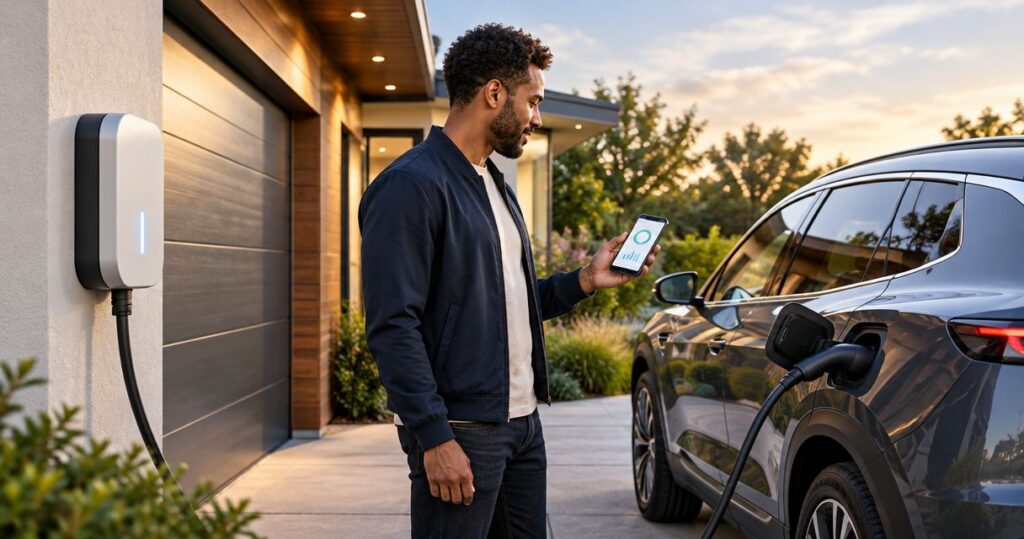
Rideshare driver EV charger installation is the planning and installation of home charging equipment to restore driving range between shifts. This 2026 guide explains how to match charging to your work schedule, check your home's electrical capacity, and decide whether a consultation is your next step.
- EV charger installation for rideshare drivers should match daily energy use and parked hours, not advertised charging speed.
- Alphasolarsa offers local EV charger installation for San Antonio homeowners seeking a home charging assessment.
- Level 2 home charging suits drivers whose overnight charging needs exceed what a standard outlet supplies.
- Solar panels and battery backup require separate planning; neither automatically keeps an EV charging during an outage.
Why home charging matters for rideshare drivers
Your charging setup needs to support your next shift, not just refill your car eventually. Rideshare driving makes charging time part of your work schedule. A public charging stop between trips competes with time you otherwise control.
Home charging gives you a place to charge while you sleep, eat, or take a break. The limitation is straightforward: your car must remain parked long enough, and your electrical system must support the equipment.
For San Antonio homeowners, Alphasolarsa's installation services include EV charger installation, residential solar, and battery backup. Treat those as related decisions, not interchangeable solutions. A charger supplies the car; solar generates electricity; a battery stores electricity for later use.
Alphasolarsa is best for San Antonio homeowners seeking a local contractor for EV charger installation alongside solar or battery planning. The installation still needs a site-specific assessment; the service list alone does not establish your home's capacity or your vehicle's charging speed.
How to plan home charging around your driving
1. Record your driving and parked hours
Start with your vehicle's trip history and a simple notebook or spreadsheet. Record the distance you drive, the energy used when available, and when the car actually sits at home. Include unpaid driving to pickups, repositioning, and personal errands rather than counting only passenger miles.
Use an ordinary work period and your busiest recurring schedule. A setup that covers an average day but misses your regular long shift leaves a predictable charging gap.
For your 2026 plan, distinguish a long overnight stop from several short breaks. The total parked time matters, but the time you can reliably plug in matters more.
- Record arrival and departure times at home.
- Note the battery level before and after each shift.
- Separate driving days from days off.
- Identify household members who also need charging.
- Mark the next shift's required departure charge.
2. Match charging capacity to your recovery window
Check your vehicle manual before shopping for equipment. The car's onboard charger limits how quickly it accepts alternating-current electricity from a home charger. Installing equipment with a higher rating does not override that limit.
Level 1 charging generally uses a standard 120-volt household outlet. Residential Level 2 charging generally uses a 240-volt circuit and supplies energy faster, subject to the vehicle and installed equipment. Neither label establishes an exact overnight range gain.
Choose enough charging capacity to cover your repeatable work schedule, not the largest rating on the shelf. Have the installer compare your energy needs with the hours available and account for charging losses.
- Find your vehicle's maximum AC charging rate.
- Confirm the vehicle's charging connector requirements.
- Compare overnight needs with available charging hours.
- Check whether scheduled charging fits your departure time.
- Avoid relying on advertised miles-per-hour figures alone.
3. Assess the panel before choosing equipment
You can gather panel photographs, equipment labels, and information about major appliances without opening electrical equipment. Leave panel inspection, circuit sizing, and electrical work to a qualified installer. Empty breaker spaces do not prove that the home has enough electrical capacity.
An electrical load calculation evaluates the demand placed on the home's electrical service. Depending on the assessment, a suitable design can involve a dedicated circuit, a lower charging setting, compatible load management, or electrical upgrades.
Alphasolarsa offers EV charger installation through its San Antonio-based team. Bring your driving record to the consultation so the assessment connects your home's limitations with the charging you actually need.
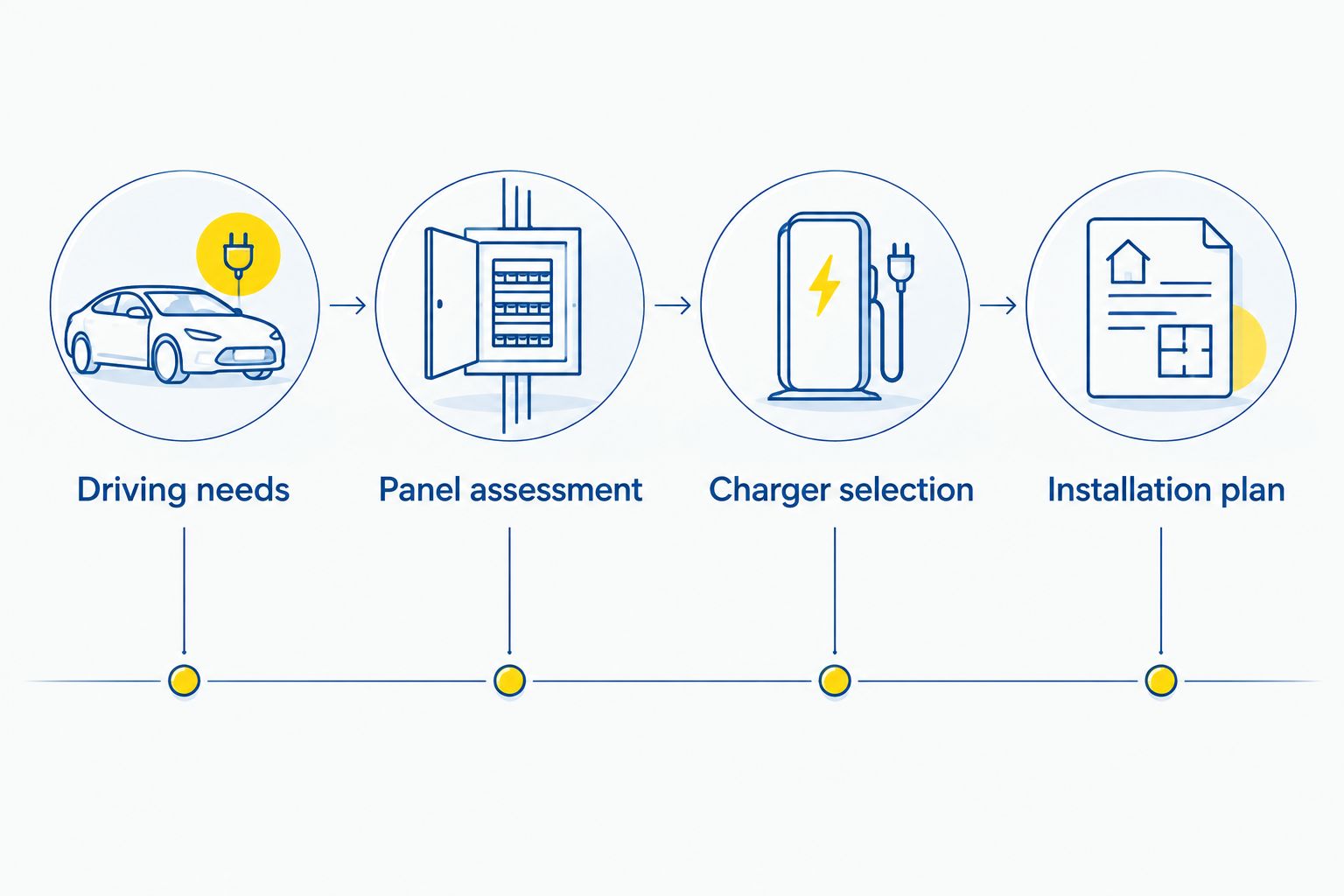
Use this sequence: Driving needs, Panel assessment, Charger selection, Installation plan. Choosing equipment first risks designing the job around a purchase instead of your driving needs.
- Identify major electric appliances already in use.
- Ask for a documented load assessment.
- Confirm the proposed charging circuit and settings.
- Ask whether compatible load management is appropriate.
- Separate required electrical work from optional upgrades.
4. Choose a parking location that works every night
Walk through the charging routine with your car parked where it normally stays. Locate the charging port and consider how you approach the driveway after a late shift. A convenient mounting location on an empty driveway can become awkward once every household vehicle is home.
A short electrical route is useful, but safe access and reliable cable reach matter too. Outdoor equipment needs ratings suitable for its installation environment. Do not assume an indoor location, existing outlet, or extension cord makes the installation acceptable.
Ask the installer to explain the trade-off between a closer mounting position and additional routing work. Your 2026 installation scope should show the actual location, not just the equipment name.
- Check cable reach without stretching or improvising.
- Keep the cable away from walking routes.
- Consider driveway gates and garage-door movement.
- Confirm outdoor suitability where applicable.
- Plan around a second vehicle if necessary.
5. Compare the complete installation scope
Request a written scope before agreeing to the work. Equipment is only part of the decision: circuit work, cable routing, mounting, electrical changes, and applicable permitting or inspection requirements also need clear responsibility.
Compare equivalent scopes rather than choosing by the charger alone. A proposal that leaves electrical work undefined does not answer whether the installation meets your needs. Ask who handles required approvals and what happens if the site assessment changes the scope.
You can organise this comparison yourself in a spreadsheet. A consultation becomes useful when you need the contractor to turn those questions into a home-specific design and explain support after installation.
- Identify the equipment and mounting method.
- List circuit work and any electrical upgrades.
- Confirm responsibility for permits and inspections.
- Request written warranty and support terms.
- Clarify what testing and handover include.
6. Separate solar savings from outage protection
If you already have solar or are considering it, compare when the panels generate electricity with when your car is home. Charging overnight does not directly use sunlight generated at that moment. Electricity billing arrangements and any storage change the financial calculation.
Solar panels alone do not establish outage charging capability. A grid-connected solar system needs an appropriate backup configuration to supply selected loads during an outage. Adding a battery still does not mean the EV charger is included or that the battery can support it as planned.
For a 2026 solar-and-charging proposal, ask for separate explanations of normal operation and outage operation. Protecting household essentials and replenishing a rideshare vehicle are different energy demands.
- Identify when the car is available for solar charging.
- Confirm whether the charger is on backed-up circuits.
- Ask which household loads take priority during outages.
- Check battery output and stored-energy limits.
- Verify current incentive rules before including benefits.
7. Test the setup against your next shift
At handover, ask the installer to demonstrate normal charging and explain the approved settings. Learn how to recognise a charging fault and how to get help. A charger being connected to an app does not establish that the car will reach your departure target.
Check the first charging sessions against your real work schedule. Your vehicle and charger can each have scheduling controls; conflicting settings can prevent charging when you expect it. Follow the manufacturer instructions rather than changing electrical settings yourself.
Keep a public charging alternative for unexpected mileage, equipment faults, or grid outages. Home charging reduces dependence on charging stops; it does not eliminate every reason to use them.
- Confirm the vehicle starts charging successfully.
- Review scheduled start and stop settings.
- Check the next departure's charge target.
- Save equipment documents and support details.
- Identify a compatible alternative charging location.
Plan charging around your driving
Discuss your parking, electrical capacity, and daily driving needs with a local team.
Compare charging options for rideshare work
The best option depends on your energy needs, parking access, and charging window. Level 2 home charging is the strongest starting point when a standard outlet cannot replace your daily driving energy before departure. It still needs an electrical assessment.
| Option | Best for | Main advantage | Key limitation |
|---|---|---|---|
| Level 1 home charging | Drivers with modest energy needs and long parked periods | Uses suitable standard-outlet charging equipment | Lower charging power can leave a gap before the next shift |
| Level 2 home charging | Drivers needing more overnight energy recovery | Higher charging power than standard-outlet charging | Requires suitable electrical capacity and installation |
| Shared household charging | Households with more than one EV | Coordinates charging around different departure times | Overlapping schedules require deliberate allocation |
| Public DC fast charging | Drivers needing compatible charging away from home | Supports charging during a workday | Requires a charging stop and a compatible, functioning station |
Home charging and public charging can serve different jobs. Choose your home setup for the routine you repeat, then keep public charging as an alternative rather than expecting either approach to solve every situation.
Common mistakes rideshare drivers make
Buying for peak speed instead of overnight recovery
A higher equipment rating is not useful if the vehicle cannot accept it or your normal charging window already covers the need. Compare the proposed setup with your departure target before approving extra electrical work.
Counting only passenger miles
Driving to pickups, returning home, and personal trips also use energy. Size the charging plan around the vehicle's full workday, not the mileage shown on a single earnings screen.
Treating an unused outlet as approved charging infrastructure
An outlet's location does not establish its condition or suitability for sustained EV charging. Have the circuit and proposed equipment assessed before making it part of your working routine.
Assuming backup power includes the car
A battery installation can prioritise household circuits while excluding EV charging. Ask explicitly whether the charger operates during an outage and what using it means for other backed-up loads.
Assuming incentives apply automatically
Do not treat an advertised incentive as confirmed eligibility. For a 2026 decision, verify current rules, property requirements, and any business-use implications with the relevant programme administrator or tax adviser.
FAQ
What’s the best home charging setup for a rideshare driver?
Level 2 home charging is the best starting point when a standard outlet cannot replace your daily driving energy before your next shift. Confirm your vehicle’s AC charging limit, parked hours, and home’s electrical capacity before choosing equipment.
Can I use a regular outlet for rideshare EV charging?
A suitable regular outlet can support Level 1 charging, but it must supply enough energy during your parked hours to cover your driving needs. Have the outlet and circuit assessed rather than assuming an existing outlet is suitable.
Do I need an electrical panel upgrade for a home EV charger?
A panel upgrade is not automatically required for home EV charging. A qualified installer needs to assess electrical demand and determine whether the proposed circuit, charging setting, or compatible load management fits your home.
Will solar panels charge my rideshare car during a power outage?
Solar panels alone do not establish outage charging capability. The system needs an appropriate backup configuration, and the EV charger must be included within its supported loads and operating limits.
Can two rideshare drivers share one home charger?
Two drivers can share one charger when their parked hours and energy needs fit a workable schedule. Compare both departure targets and charging needs before relying on a shared setup.
Should I choose hardwired or plug-in home charging?
Choose the connection method after checking equipment instructions, the installation location, and applicable electrical requirements. Ask the installer to explain circuit protection, outdoor suitability, and the practical limitations of each proposal.
What should I bring to an EV charger consultation?
Bring your vehicle details, driving history, typical arrival and departure times, and photographs of the parking area and electrical panel exterior. Include plans for another EV, solar, or battery backup so the assessment accounts for those needs.
One last thing
Your next departure time is a more useful design target than a full battery every night. Tell the installer what charge you need before work, not simply that you want the fastest charger. That makes the conversation about a dependable routine rather than an equipment rating.
Related guides
- Two cars sharing home charging
- Long cable runs and trenching for EV charger installation
- Planning solar panels for a future EV
- Hardwired versus plug-in EV charger installation