
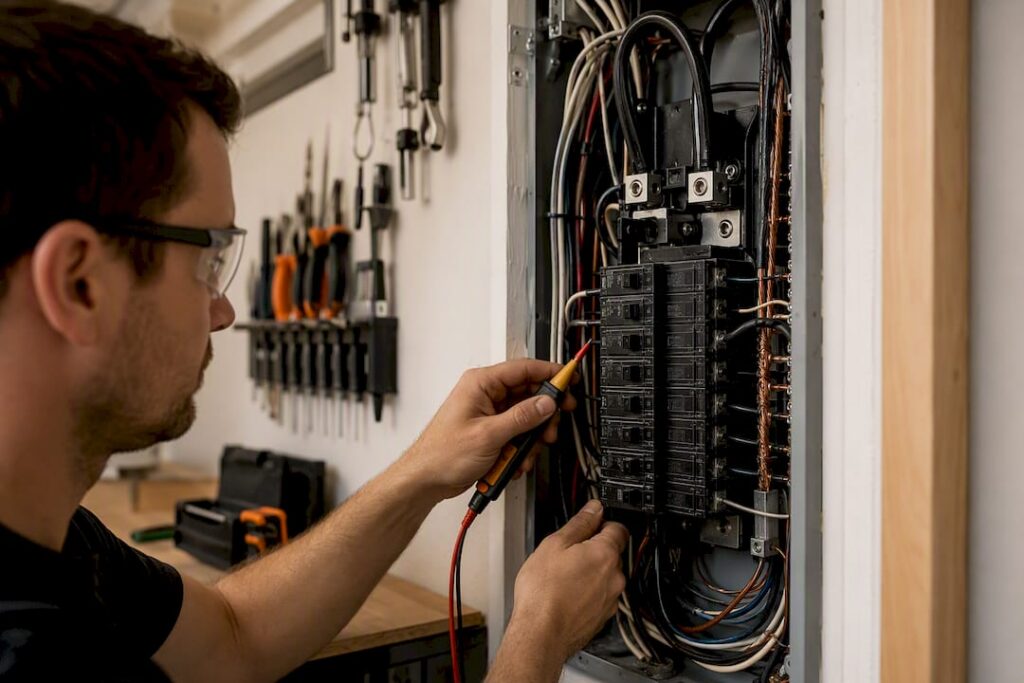
Most homes with 200-amp electrical service can add a Level 2 EV charger without touching the main panel. Some homes need additional electrical work before installation, usually because the panel is undersized, physically full, or older than the neighborhood.
You can get a rough answer yourself before calling anyone. Check these two things first:
- Read your main breaker’s amp rating. It’s printed on the largest breaker at the top of your panel: look for 60, 100, 150, or 200.
- Count your empty slots. An EV charger needs a double-pole breaker, so you need two adjacent open slots, not just one.
If your panel reads 200A and has open slots, you’re probably fine. If it reads 100A or lower, or the panel looks packed, your next move is scheduling a licensed electrician for a proper load calculation. That’s the only way to know for certain.
Key Takeaways
Most 200-amp homes can add an EV charger without a full panel upgrade, but the only way to confirm it is a licensed electrician’s NEC load calculation.
| Point | Details |
|---|---|
| Check your panel first | Read the main breaker amp rating and count open double-pole slots before calling anyone. |
| Load calculation decides everything | NEC Article 220 math, with the EV counted at 125% continuous load, determines if you need work at all. |
| Cheaper alternatives often work | Load management, a smaller charger, or a sub-panel can replace a $2,000 to $4,500 full service upgrade. |
| Get itemized quotes | Ask electricians to show the load calculation numbers, not just a lump-sum price. |
| Alpha Solar Solutions runs the full checklist | Site visits cover breaker rating, load calc, wire run, and panel age, with itemized quotes and permit handling included. |
Where to verify the details yourself
For readers who want to check the code and cost claims directly, these are the sources worth bookmarking:
- The National Electrical Code overview from ESFI for continuous-load and GFCI rules under NEC 625.
- The EPA’s home EV charging guide for hiring guidance, load calculations, and permit steps.
- DSIRE for looking up state and utility rebates that may offset installation costs.
- TradeHub Tools’ circuit sizing calculator for a rough screen of breaker and wire size before your electrician confirms it in the field.
Table of Contents
- What does an electrician check for an electrical panel upgrade for an EV charger?
- How are EV charger circuits and breakers sized?
- Are there alternatives to a full panel upgrade?
- What does an electrical panel upgrade for an EV charger cost?
- What permits and inspections does the work require?
- What does Alpha Solar Solutions check during an EV charger site visit?
- Sources
What does an electrician check for an electrical panel upgrade for an EV charger?
An electrician’s assessment isn’t guesswork, and it isn’t a quick glance at the panel door either. It follows a specific sequence, and understanding it helps you make sense of whatever quote lands in your inbox.
- Read the main breaker rating. A 60A panel is common in older homes and almost always needs upgrading before EV charging. A 100A panel is borderline and depends on your other loads. A 150A or 200A panel usually has enough headroom.
- Count physical breaker slots. EV chargers need a double-pole breaker, meaning two stacked slots. A panel with no open pairs needs either a sub-panel, tandem breakers, or a swap for a larger enclosure, regardless of amperage.
- Run a load calculation. This is the real test. Under NEC Article 220, the electrician totals your existing loads (HVAC, water heater, range, dryer) and adds the EV charger as a continuous load at 125% of its rated draw. If the total stays under your panel’s rating, you’re clear. If it exceeds it, something has to give: a smaller charger, a load-management device, or an upgrade.
A load calculation that comes back at 185A on a 200A panel means you’re fine with margin to spare. One that comes back at 210A means you need a fix, but not necessarily a full service upgrade.
Some panels need replacing no matter what the math says. If your panel has been subject to a manufacturer recall, trips breakers randomly, shows scorch marks, or hums audibly, replace it before you add any new circuit.
Pro Tip: Ask your electrician to write the load calculation numbers on your quote, not just the conclusion. If they don’t show the math, get a second opinion.
How are EV charger circuits and breakers sized?
Once your panel passes the load calculation, the electrician sizes your dedicated circuit. This part is governed by code, not preference, so there’s little room for a contractor to cut corners without you noticing.
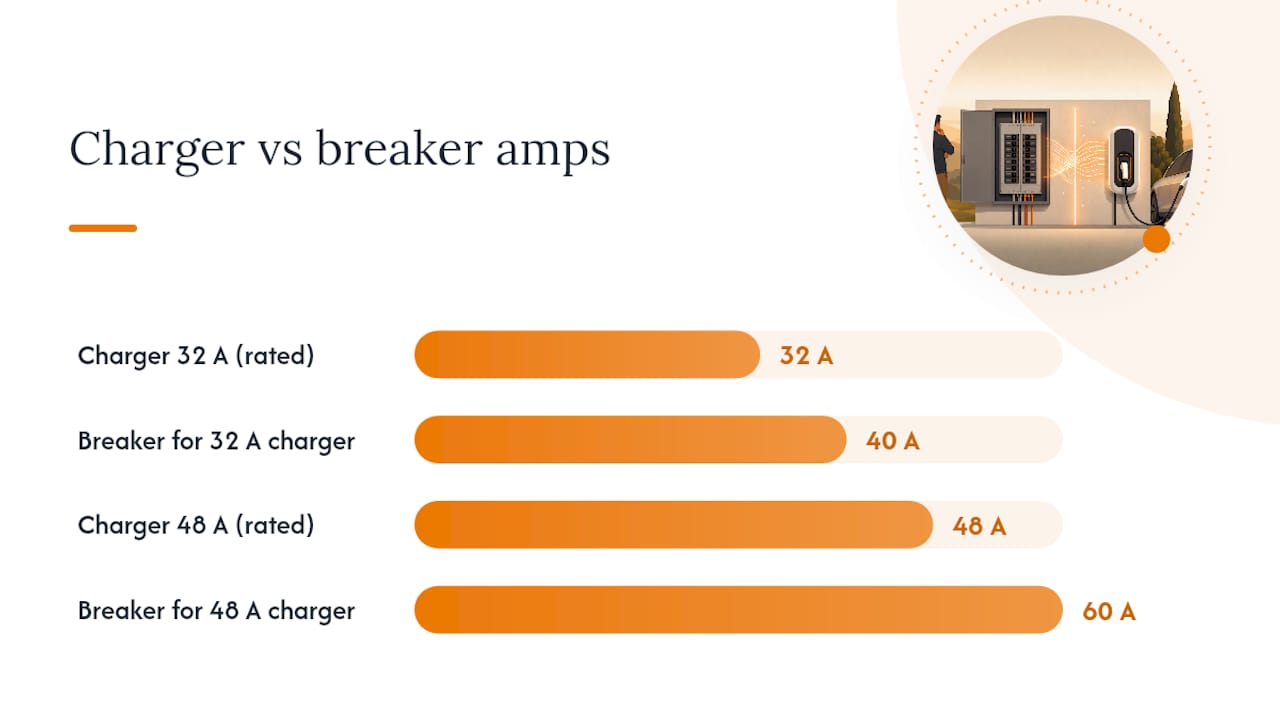
The core rule is the NEC’s continuous-load requirement: EV charging equipment runs long enough to count as a “continuous load,” so the circuit must be sized at 125% of the charger’s rated output. That’s why a 32A charger needs a 40A breaker, and a 48A charger needs a 60A breaker, even though the charger itself never draws that much.
Wire gauge follows from the breaker size. A rough guide:
- 40A breaker: typically 8 AWG copper conductor
- 60A breaker: typically 6 AWG copper conductor
- Longer runs (50+ feet) may need a larger gauge to offset voltage drop
Every EV circuit also needs GFCI protection under NEC 625.54, whether the charger plugs into an outlet or gets hardwired. And here’s a detail inspectors catch often: your breaker size has to match the charger’s actual nameplate rating, not the number in the sales brochure. If those two numbers don’t line up, the inspection fails.
Are there alternatives to a full panel upgrade?
A full service upgrade is the most expensive fix, and it’s often not the necessary one. Three alternatives solve the same problem for less money:
- Load management systems (EVEMS). These devices monitor your home’s total draw in real time and throttle charging when other big appliances kick on. NEC 625.42 formally recognizes this approach, and it can eliminate the need for a service upgrade in many homes.
- Lower-amperage chargers. A 32A charger instead of a 48A unit draws less, charges slower, and may fit your existing panel without any changes. Pairing it with off-peak scheduling covers most daily driving needs anyway.
- Sub-panels and tandem breakers. If your main panel is out of physical space but has amperage to spare, a sub-panel adds room for the new circuit without replacing anything.
Load-management hardware typically runs $300 to $600, a fraction of what a service upgrade costs.
Pro Tip: If your electrician jumps straight to “you need a full panel upgrade” without mentioning load management or a smaller charger, ask why those options are off the table for your specific home.
What does an electrical panel upgrade for an EV charger cost?
Cost depends entirely on how much electrical work your home actually needs, and that range is wide enough that a lowball or inflated quote can hide in the middle.
These ranges reflect typical installer pricing nationally, and your actual number moves based on a few specific factors: how far the charger sits from the panel, whether the utility meter needs upgrading alongside the panel, trenching for underground conduit, and local permit fees.
When you get a quote, ask for an itemized breakdown and the load calculation numbers behind it. A vague lump-sum quote for “panel work” tells you nothing about whether you’re paying for a $1,500 circuit or a $4,500 service upgrade you didn’t need.
What permits and inspections does the work require?
Skipping permits on electrical work isn’t just a code violation. It can void your homeowner’s insurance and create problems when you sell the house, since unpermitted electrical work often surfaces in a home inspection.
Here’s the typical sequence from decision to power-on:
- Site visit and load calculation (same day to a few days after you call).
- Permit application filed with your local Authority Having Jurisdiction, usually a one to two week approval window.
- Installation day, which runs a few hours for a simple circuit addition, or a full day for a panel replacement.
- Utility coordination, needed only if you’re upgrading service size, since the utility company has to authorize and sometimes replace the meter connection.
- Final inspection, where the inspector verifies breaker sizing matches the load calculation, GFCI protection is present, conductor size matches the ampacity, and all equipment is listed for its use.
A circuit addition might mean zero outage time. A full service upgrade usually means a few hours without power while the utility disconnects and reconnects service.
What does Alpha Solar Solutions check during an EV charger site visit?
When Alpha Solar Solutions evaluates a home for EV charging, the checklist covers the same fundamentals: main breaker rating, a full load calculation, open breaker slots, the wire run distance from panel to charger location, and the panel’s brand and age against known recall lists.
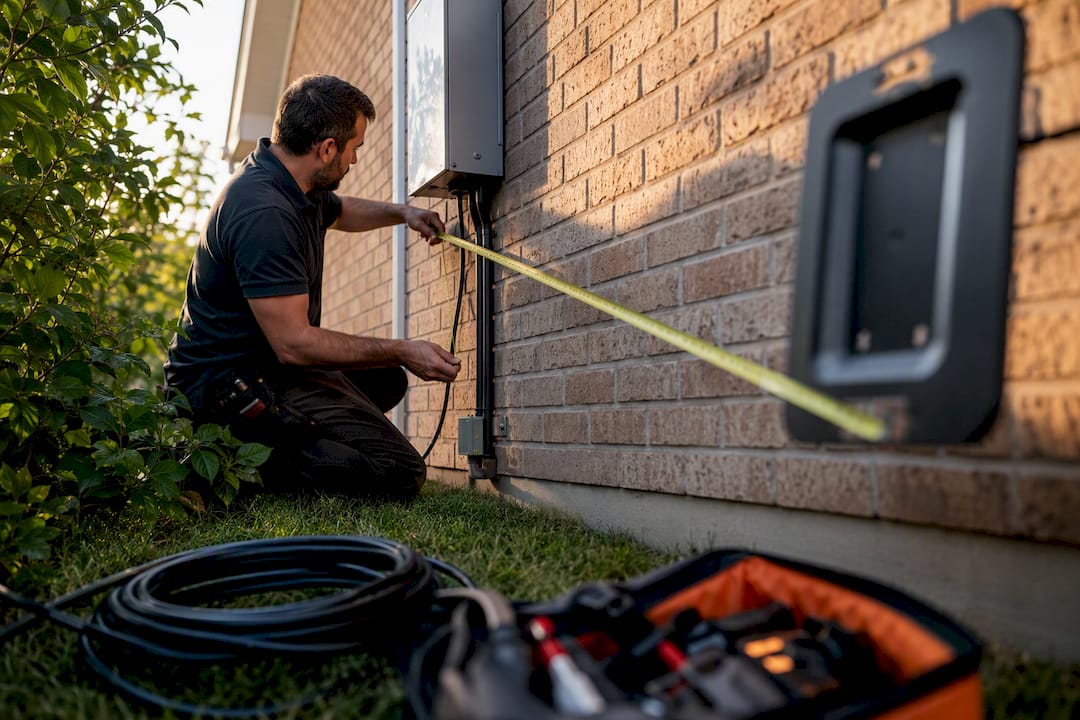
That assessment determines the recommendation. A sub-panel or load-management device gets proposed when the math supports it. A full service upgrade only comes up when the load calculation genuinely requires one. Every Alpha Solar Solutions quote includes itemized costs, permit handling, and inspection coordination, so you see exactly what you’re paying for before work starts.
Vetting quotes without getting oversold
Ask any electrician to show you the load calculation, not just the recommendation. If a quote pushes a full service upgrade without math to back it up, or the numbers seem vague, that’s a signal to get a second opinion. A clear scope, tied to your actual panel and usage, is what a fair quote looks like. If you want that clarity from the start, Alpha Solar Solutions will walk your panel through the same checklist during a site visit.
— Anthony
Ready to find out what your panel actually needs?
You’ve now got the framework an electrician uses: amp rating, breaker slots, and the load calculation that ties it all together. The next step is getting those numbers pulled for your specific home, not a generic estimate.

Alpha Solar Solutions handles the entire process on-site in San Antonio, from the load calculation and permit filing to the physical install and final inspection coordination. If your charger needs to sit outside, the team also builds weatherproof outdoor setups rated for South Texas heat and storms. And if you’re weighing whether to pair your charger with home solar down the line, that’s worth a conversation during the same visit, since the panel work often overlaps. A site visit gets you a real number, not a phone estimate: request your EV charger installation quote and get a licensed electrician looking at your actual panel.
Sources
- Do You Need an Electrical Panel Upgrade for Your EV? — EnergySage
- Getting Started with Home EV Charging — EPA
- Panel Upgrade for EV Charger: Cost, Process & NEC Requirements — ChargeRight