
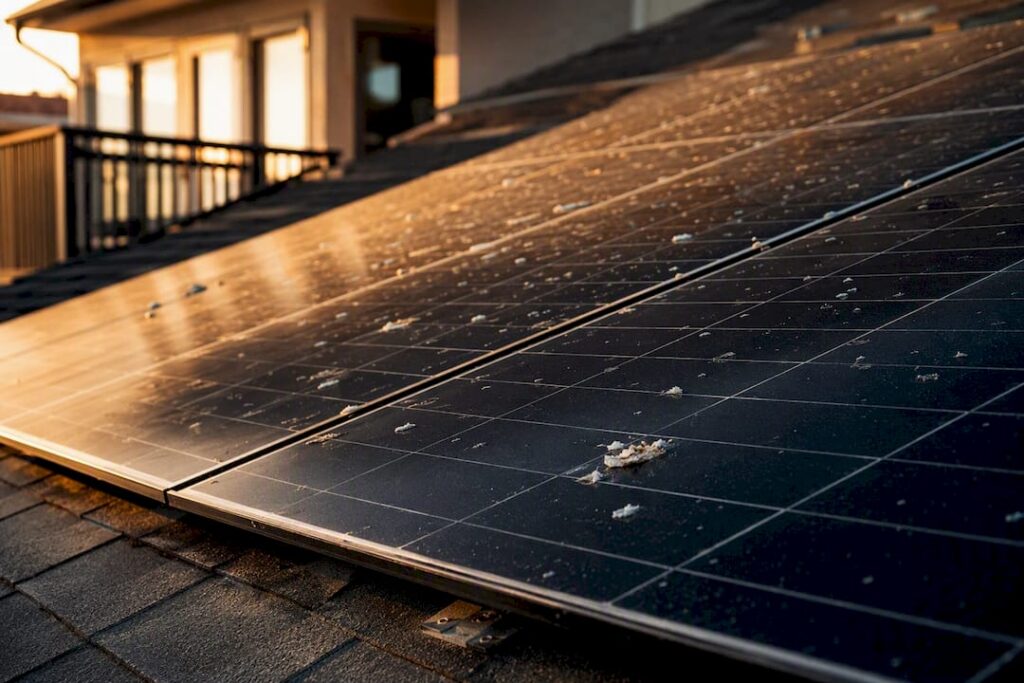
Yes, bird droppings on solar panels reduce your energy output, and if you leave them alone, they can permanently damage the glass and coating underneath. The fix depends on how bad the mess already is.
If you just spotted fresh droppings on your array, here’s what to do first:
- Wet-soften the spot with water or a diluted white vinegar solution, let it sit, then wipe gently.
- If the deposits look baked on and chalky, or your roof is steep or hard to access safely, skip the DIY approach and call a professional.
Two signs mean it’s time to stop and call a pro rather than grab a hose: droppings that have hardened into a crust that won’t lift with light wiping, and any roofline steep enough that you’d need harness gear to reach it safely. Neither is worth the risk to your panels or to you.
Key Takeaways
Bird droppings on solar panels reduce output through shading and hot spots, and baked-on deposits require wet-soften cleaning or professional help to avoid permanent glass damage.
| Point | Details |
|---|---|
| Output loss is real | Clusters of droppings can cut output current significantly in thermography studies. |
| Never dry-clean droppings | Dry disturbance can aerosolize fungal spores linked to histoplasmosis and other respiratory illnesses. |
| Wet-soften before wiping | Soak with water or diluted white vinegar for 5 to 10 minutes, then wipe with a soft cloth. |
| Exclusion beats repeat cleaning | Mesh or netting under panels stops nesting at the source instead of treating symptoms monthly. |
| Call a pro for tough jobs | Alpha Solar Solutions handles baked-on deposits, steep roofs, and removal/reinstallation safely across San Antonio. |
Table of Contents
- How Bird Droppings on Solar Panels Cut Your Output
- Health and Damage Risks You Shouldn’t Ignore
- How to Remove Bird Droppings From Solar Panels Safely
- Preventing Birds on Solar Panels for Good
- When to Call a Professional for Solar Panel Cleaning
- Do Different Bird Species Leave Different Damage?
- How Often Should You Clean Solar Panels for Bird Droppings?
- Cleaning Products That Won’t Damage Your Panels
- What Homeowners Get Wrong About Bird Droppings on Panels
- Book Professional Solar Panel Cleaning With Alpha Solar Solutions
- Sources
How Bird Droppings on Solar Panels Cut Your Output
A single dropping doesn’t sink your production for the day. A cluster of them, sitting in the same spot for weeks, is a different story. Bird droppings block sunlight from reaching the photovoltaic cells underneath, and because panels are wired in series, one shaded cell can throttle the output of the entire string. This is not a minor cosmetic issue. It’s an electrical one.
Researchers found that natural bird droppings measurably lower the output performance of photovoltaic panels, with losses increasing with the extent and duration of coverage. The experimental analysis of bird droppings on PV output also documented something homeowners rarely think about: localized hot spots forming under the shaded patches.
A shaded cell doesn’t just stop producing power. It can start consuming it, heating up as the surrounding cells push current through it. That’s how a few droppings turn into a hot spot, and over time, repeated heat stress accelerates wear on the cell itself.
A separate thermography study on bird-dropping accumulation put numbers to this. That’s not a rounding error. That’s the difference between a panel pulling its weight and one quietly dragging down your whole system’s production.
What this looks like in practice:
- A handful of scattered droppings across an array: minor, often single-digit percentage losses.
- Dense clustering on one or two panels, especially near a favorite roosting spot: losses climbing into the double digits on those specific modules.
- Left long enough, the hot spots created by shading can contribute to permanent cell degradation, not just a temporary dip.
The good news: mitigation works. Research on cooling and cleaning interventions for contaminated panels found that addressing the contamination, whether through cleaning or supplemental cooling, restored a meaningful share of lost output. Cleaning isn’t just cosmetic upkeep. It’s a direct performance lever.
Health and Damage Risks You Shouldn’t Ignore
Bird droppings aren’t just an efficiency problem. They’re a health and materials problem too, and this is where a lot of homeowners get the cleanup wrong.
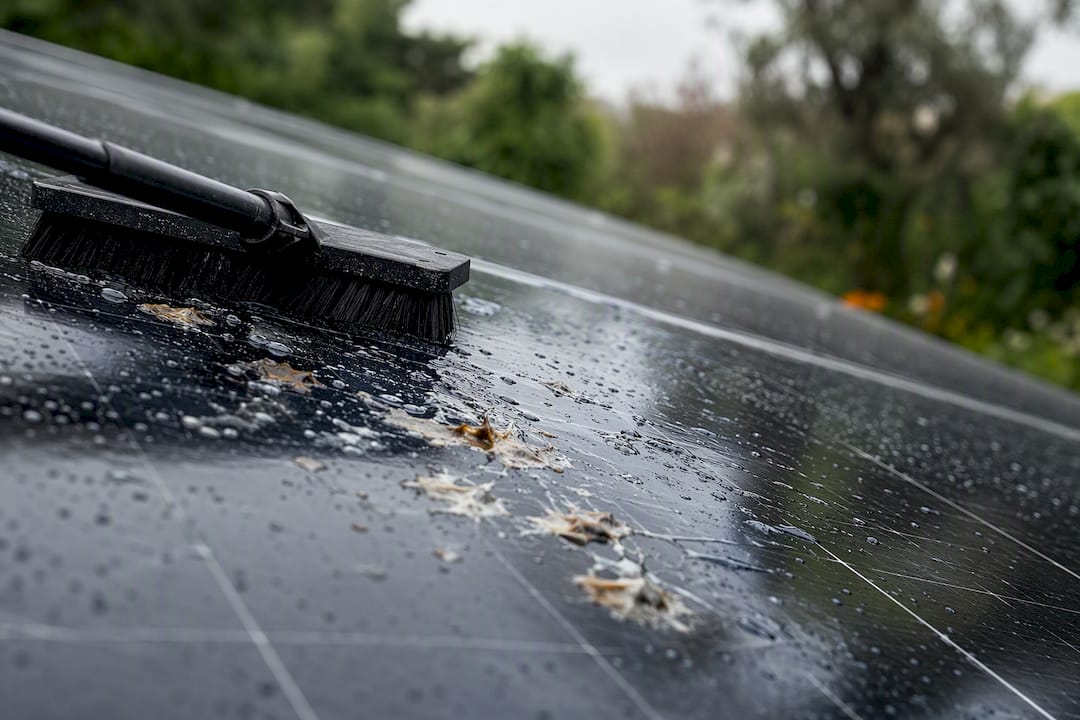
Dried droppings can harbor fungal and bacterial pathogens, including organisms linked to histoplasmosis, cryptococcosis, and psittacosis. According to a factsheet on bird and bat waste from Washington State University’s environmental health and safety program, disturbing dried droppings, by sweeping, brushing, or blasting them with a pressure washer, can aerosolize spores that are dangerous to inhale. That’s the core reason every cleaning guide for this problem says the same thing: wet it first, never dry-disturb it.
There’s a materials angle too. Guano is acidic, and as it breaks down, fungal activity produces compounds like glyoxylic acid that chemically attack surfaces they sit on. Research on bird excreta’s effect on stone and concrete documents this kind of chemical deterioration on building materials generally, and the same corrosive chemistry is part of why droppings left on solar glass for extended periods risk etching the surface or degrading anti-reflective coatings.
Quick safety rundown:
- Never dry-sweep, brush, or vacuum dried droppings on or near your roof.
- Always wet the area first to keep spores contained.
- Treat any large accumulation, especially near a nest, as a job for someone with proper respiratory protection.
The pattern to remember: droppings that sit for a single afternoon wipe off easily. Droppings that bake in the Texas sun for a week or two start bonding to the glass, and that’s when both the health risk and the damage risk climb together.
How to Remove Bird Droppings From Solar Panels Safely
If your panel is easily and safely reachable from the ground or a stable single-story ladder, cleaning it yourself is reasonable. Here’s the sequence that actually works without scratching your panels or putting you at risk.
1. Assess the roof before you touch anything.
Look at pitch, height, and how you’d actually get up there. If reaching the panel means a multi-story ladder, a steep pitch, or anything requiring fall protection, stop here and book a professional instead. No cleaning job is worth a fall.
2. Wet-soften before you touch the droppings.
Never scrape or wipe dried droppings straight off the glass. Spray the area with plain water or a diluted white vinegar solution, then let it sit for 5 to 10 minutes. This softens the crusted material so it lifts instead of scratching the panel surface, a method Martha Stewart’s guide to cleaning bird droppings recommends for exactly this reason. Skip bleach or ammonia-based cleaners. They can degrade the anti-reflective coating on solar glass over time.
3. Wipe gently with a soft cloth or soft-bristle brush.
Once softened, the residue should lift with light pressure. Work in one direction rather than scrubbing in circles, which can leave faint swirl marks on the glass over months of repeated cleaning.
4. Rinse from the top down with a low-pressure hose.
Never use a pressure washer on solar glass. The seals around the panel frame and the junction box aren’t built for that kind of force, and pressure washing can drive water into places it shouldn’t go. A garden hose on a gentle setting, working from the top of the panel downward, clears the loosened residue without risk.
5. Inspect what’s left behind.
Once the panel is dry, check for a faint outline, discoloration, or a rougher texture where the droppings sat. That’s early etching, and it’s worth photographing for your records, whether for a warranty claim or to show a professional if you bring one in later.
Pro Tip: Snap a quick photo before and after you clean any panel with visible droppings. If you ever need to make a warranty claim over reduced output or a suspected hot spot, dated photos are the easiest way to show the timeline.
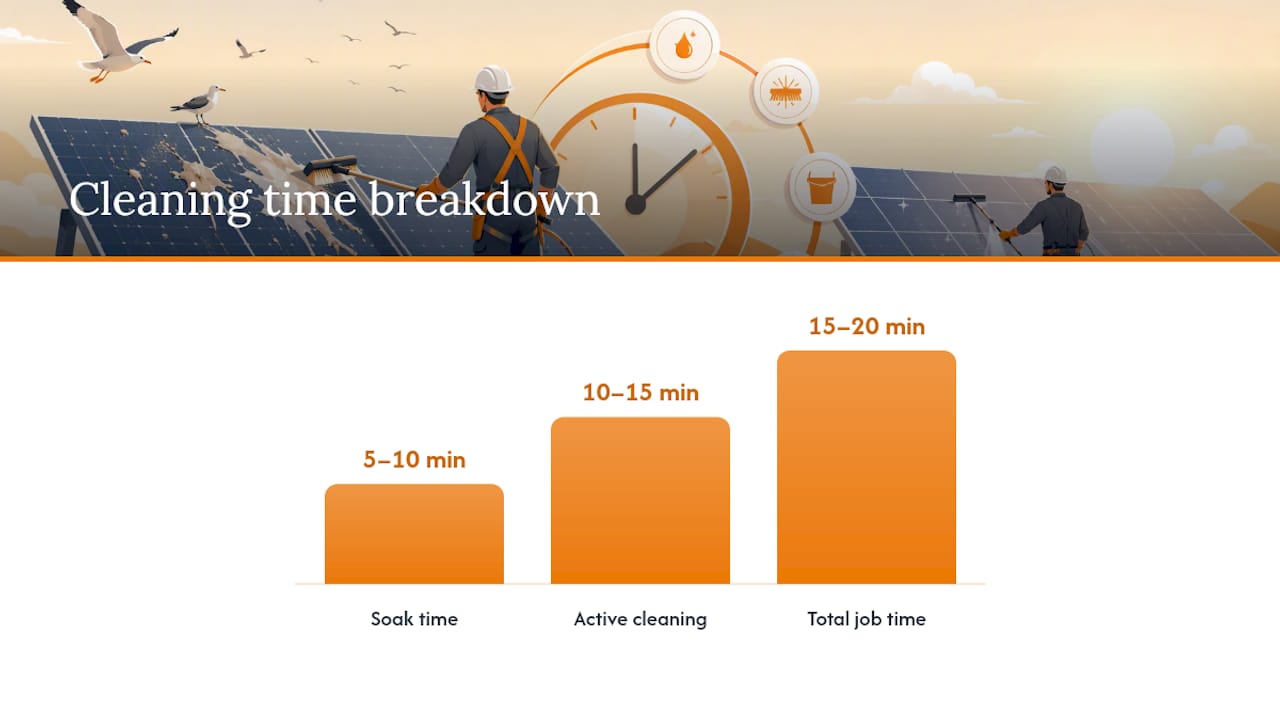
Supplies for a single-panel cleaning: a garden hose, a soft microfiber cloth or soft-bristle brush, a spray bottle with diluted white vinegar, and about 15 to 20 minutes including soak time. That’s it. If your setup calls for more than that, from ladder height to a full-array infestation, it’s a sign to bring in help.
- Do soak before wiping.
- Do rinse top to bottom with low pressure.
- Don’t dry-sweep, brush, or scrape dried droppings.
- Don’t use a pressure washer or abrasive pads.
Preventing Birds on Solar Panels for Good
Cleaning solves today’s problem. It does nothing about tomorrow’s, because birds that found your roof once tend to come back, especially if they’ve started nesting in the gap beneath your panels. That warm, sheltered void is exactly what pigeons and grackles look for, and once a pair sets up there, cleaning becomes a monthly chore instead of an occasional one.
Physical exclusion is the most reliable long-term answer. Fine mesh or netting installed around the perimeter of the array closes off that under-panel space entirely, denying birds the roosting spot in the first place. Guidance on bird damage and proofing methods consistently points to exclusion, not repeated cleanup, as the strategy that actually breaks the cycle.
Anti-perching spikes and taut wires work for a narrower use case: they discourage birds from landing on the panel edges or nearby ledges but don’t stop nesting underneath. They’re a reasonable add-on, not a substitute for mesh if nesting is already the issue.
One caution worth taking seriously: mesh and netting installation on an active solar array isn’t a simple weekend project. Done poorly, it can void your panel warranty, damage mounting hardware, or create new points where water pools. This is one of the more common reasons homeowners in San Antonio end up calling Alphasolarsa’s team rather than tackling exclusion themselves.
| Prevention method | Best for | Trade-off |
|---|---|---|
| Mesh/netting exclusion | Recurring nesting under panels | Requires careful, often professional, installation |
| Anti-perching spikes | Birds landing on frame edges | Doesn’t stop under-panel nesting |
| Tensioned wire systems | Ledges and panel corners | Visible; needs periodic tightening |
| Routine visual inspection | Catching new nests early | Doesn’t prevent birds, just catches problems sooner |
Cost-wise, exclusion almost always wins over the long run. A homeowner paying for repeated cleanings every few months, plus absorbing the output losses in between, typically spends more over a year or two than a one-time mesh installation would cost. If your roof has already become a regular roost, prevention isn’t optional maintenance. It’s the fix that actually stops the bleeding, a point echoed in the broader research on proofing buildings against bird damage. Our preventive solar care guide walks through inspection scheduling if you want to build this into your regular home maintenance routine.
When to Call a Professional for Solar Panel Cleaning
Some jobs are DIY-friendly. Others aren’t, and knowing the difference upfront saves you a trip to the ER or a call to your panel manufacturer about a voided warranty.
Call a professional when you’re dealing with:
- A roof pitch or height that requires fall protection or specialized ladder work.
- Baked-on, crusted droppings that don’t soften with a simple water or vinegar soak.
- Nests or large bird colonies established under or near the array.
- Any concern about hot spots, microcracks, or output drops tied to a warranty claim.
A professional cleaning visit typically includes safe rooftop access with proper equipment, an appropriate softening solution matched to how long the residue has been sitting, a low-pressure rinse, and a post-clean inspection that documents panel condition with photos. That documentation matters if you ever need to show a manufacturer or your insurer what happened and when.
Before hiring anyone, ask a few direct questions: Are you insured for rooftop work? What cleaning solution do you use, and is it safe for anti-reflective coatings? Will this affect my panel warranty? How do you handle the panels physically to avoid microcracks?
Pro Tip: Ask any solar cleaning service whether they document panel condition with dated photos before and after the job. If they don’t, that’s a red flag, not a detail.
Alpha Solar Solutions handles exactly this kind of work across San Antonio, combining safe rooftop access with cleaning methods that protect panel coatings and warranties, backed by the same team that installs and services residential solar systems in the area.
Do Different Bird Species Leave Different Damage?
Not all droppings are created equal. Pigeons, grackles, and doves are the most common offenders on residential rooftops in most parts of the country, and they tend to leave frequent, smaller deposits concentrated wherever they perch or roost repeatedly. That repetition is exactly what turns a minor mess into a hot spot: the same corner of the same panel getting hit day after day.
Larger birds like grackles, common in Texas neighborhoods, tend to produce bigger, denser droppings that take longer to dry and are more prone to baking hard in direct sun. Smaller songbirds usually leave lighter, more scattered deposits that wash off more easily and pose less of a shading risk.
The real variable isn’t species so much as behavior. A bird that merely flies over leaves a one-time mess. A bird that roosts or nests nearby creates a recurring problem in the same location, which is what drives the density-dependent output losses documented in the experimental PV performance study. If you notice droppings clustering in the same spot week after week, that’s a signal you have a regular visitor, not a random accident, and it’s worth addressing the root cause with exclusion rather than just cleaning the symptom.
How Often Should You Clean Solar Panels for Bird Droppings?
There’s no single fixed schedule that fits every roof, because it depends on how much bird activity your property attracts. That said, a reasonable baseline for most homes is a visual inspection every month, with actual cleaning triggered by what you see rather than the calendar.
If your panels sit under trees, near power lines, or close to a spot where birds regularly perch, check more often, every two to three weeks isn’t excessive. Properties with minimal bird traffic can often get away with a seasonal inspection and clean as needed.
The bigger mistake homeowners make isn’t cleaning too rarely. It’s waiting to notice a production drop on their monitoring app before checking the panels at all. By then, droppings may have already baked on for weeks. A quick visual check from the ground, binoculars work fine for most roof heights, takes two minutes and catches problems while they’re still easy to solve. Our expert tips for efficient solar panel cleaning breaks down a simple inspection routine you can fold into your regular home maintenance checklist.
Cleaning Products That Won’t Damage Your Panels
Not every household cleaner belongs anywhere near solar glass. Anti-reflective coatings are thin and can be degraded by the wrong chemistry, so the safest products are also, conveniently, the simplest ones.
Plain water handles most light residue on its own. For anything that needs a bit more help breaking down, a diluted white vinegar solution is the standard recommendation, mild enough to be safe on coated glass, effective enough to loosen dried organic material after a short soak. Avoid bleach, ammonia-based glass cleaners, and anything abrasive. These can strip protective coatings or leave streaking that reduces light transmission over time.
Skip dish soap with added moisturizers or fragrances too. They can leave a film that attracts more dust and pollen, ironically making your panels dirtier faster. If you want a dedicated product, look specifically for one labeled safe for solar glass and anti-reflective coatings, rather than a general-purpose outdoor cleaner. When in doubt, water and a soft cloth remain the safest combination available, and they cost nothing extra to keep on hand.
What Homeowners Get Wrong About Bird Droppings on Panels
Most homeowners treat bird droppings as a cosmetic annoyance, something to deal with whenever they happen to notice it. The research doesn’t support that level of casualness. A cluster of three or four droppings sitting in one spot for a couple of weeks can meaningfully drag down a panel’s output, and the hot spots that form underneath don’t reverse themselves once the mess is cleaned off.
Where I think the conventional advice falls short is the assumption that rain handles it. It doesn’t, not reliably, and definitely not once droppings have had a few sunny Texas afternoons to bake on. Waiting for rain is really just waiting for the damage to compound.
If I had to prioritize one thing, it’s exclusion over cleaning. Cleaning treats a symptom that keeps coming back. A properly installed mesh barrier ends the cycle. Homeowners who clean every month without ever addressing why birds keep coming back are solving the wrong problem, repeatedly, and paying for it in both labor and lost production.
— Anthony
Book Professional Solar Panel Cleaning With Alpha Solar Solutions
If your panels have baked-on droppings, sit on a roof you shouldn’t be climbing, or show signs of a hot spot you can’t explain, this is exactly the situation Alpha Solar Solutions built its cleaning service around. Rather than guessing at the right cleaning solution or renting equipment for a one-time job, you get a team that already knows how to protect your panel coatings and your warranty while they’re up there.

Alpha Solar Solutions provides residential solar panel cleaning across San Antonio and the surrounding area, with safe rooftop access, appropriate softening methods for baked-on residue, and a low-pressure rinse process that won’t strip your anti-reflective coating. Every visit includes a post-clean inspection with before-and-after photo documentation, so you have a record if a warranty question ever comes up. For cases where droppings, nesting, or corrosion require pulling a panel entirely, the team also handles solar panel removal and reinstallation without disrupting your system’s wiring or mounting. If you’re seeing reduced output and suspect droppings are the cause, book a cleaning through Alpha Solar Solutions and get an inspection report showing exactly what shape your panels are in.
Sources
- Impact of Natural Bird Droppings on the Output Performance of Photovoltaic Modules: An Experimental Data Analysis
- Performance evaluation of solar photovoltaic panels under bird droppings accumulation using thermography
- Factsheet – Bird and Bat Waste | Environmental Health & Safety | Washington State University
- How to clean bird droppings — Martha Stewart
- Improving solar PV performance under bird-dropping conditions with a dual-cooling approach | Scientific Reports