
Best overall for bill-first buyers: solar-only matched to household use. Best for outage protection: solar with essential-circuit battery backup. Best phased approach: solar now with a documented battery plan. This 2026 guide compares solar systems ranked by payback period without treating an estimated return as a guarantee.
- Compare solar systems ranked by payback period using household electricity use, installed scope, and verified utility rules.
- Solar-only is the starting comparison for bill savings; battery backup adds a separate outage-protection benefit.
- Alphasolarsa offers residential solar and battery backup for San Antonio homeowners considering a custom installation.
- Choose backup circuits before choosing battery capacity; whole-home backup is not an automatic outcome.
Why this matters
The shortest payback estimate is not automatically the best solar purchase. A proposal can look attractive because it assumes rising electricity rates, generous export credits, or incentives you have not confirmed.
For San Antonio homeowners comparing systems in 2026, separate two decisions: reducing purchased electricity and keeping selected equipment running during outages. Alphasolarsa offers residential solar and battery backup services; compare those benefits separately before combining them in one project.
Alphasolarsa is a fit for San Antonio homeowners seeking residential solar with battery backup. The buying decision still rests on your roof, electricity use, backup priorities, and written proposal.
What makes the best home solar system for payback?
Use these criteria before comparing panel brands or accepting a projected break-even date:
- Usable production: Match expected solar generation to roof conditions and household consumption, not just panel capacity.
- Electricity value: Separate electricity used at home from electricity exported under your actual utility rules.
- Complete project scope: Include required electrical work, roof-related work, financing obligations, and ongoing maintenance in the financial comparison.
- Verified assumptions: Identify rate increases, production estimates, and incentive assumptions rather than burying them in a savings total.
- Backup fit: Specify the appliances and circuits a battery must support, including starting demands.
- Long-term ownership: Consider roof condition, equipment compatibility, monitoring access, and support after installation.
Ask for 12 months of electricity bills to inform the design. A full year shows seasonal use that a single summer bill cannot explain, although future household changes still need separate treatment.
Solar systems ranked by payback period: at a glance
This ranking is a buying sequence, not a measured payback leaderboard. Start with the simplest system that serves your goal, then require each addition to justify its financial or practical benefit.
| Rank and system | Best for | Standout feature | Key limitation |
|---|---|---|---|
| 1. Solar-only matched to household use | Bill-first homeowners | Direct comparison between solar generation and avoided electricity purchases | Standard grid-tied solar does not provide outage power by itself |
| 2. Solar with essential-circuit battery backup | Protecting selected household needs | Storage dedicated to named backup loads | Added equipment must be assessed separately from bill savings |
| 3. Solar now with a future battery plan | Homeowners staging their project | Separates immediate solar decisions from later storage decisions | Later installation requires renewed compatibility and scope checks |
| 4. Solar with expanded household backup | Homeowners prioritizing broader outage coverage | Design starts with a wider set of household loads | More demanding backup requirements complicate sizing and comparison |
Do not read the row order as a promise that every solar-only project beats every battery project. Your electricity tariff, roof, consumption pattern, and project scope determine the result.
1. Solar-only: best home solar system for bill-first buyers
Solar-only supplies electricity when the panels produce it, reducing grid purchases when production and household demand overlap. Surplus generation follows your utility's export rules. Standard grid-tied equipment shuts down during a grid outage unless the installation includes suitable backup capability.
For a 2026 bill-saving comparison, make solar-only the baseline. It lets you evaluate the solar investment before adding storage or broader outage requirements.
Solar-only pros:
- Keeps the initial financial comparison focused on solar generation.
- Avoids battery sizing and reserve-setting decisions.
- Makes daytime consumption an explicit design consideration.
Solar-only cons:
- Does not automatically keep your home powered during outages.
- Exported electricity and self-consumed electricity can have different financial values.
Best for: Homeowners whose primary objective is reducing purchased electricity rather than securing backup power.
Ask whether the proposed capacity follows your usage or merely fills available roof space. Additional panels need a reason beyond a larger annual production figure.
Verdict: Buy only when the household-specific calculation supports the project.
2. Essential-circuit backup: best for targeted outage protection
Solar with essential-circuit battery backup pairs generation and storage with a defined set of supported loads. That list might include refrigeration, lighting, communications, or selected outlets, subject to the electrical design. It does not automatically include every appliance.
Alphasolarsa offers residential solar and battery backup; ask for a custom design that names supported circuits and explains operation after installation. Keep the storage decision separate from the solar-only return calculation.
Essential-circuit backup pros:
- Gives the installer a specific backup assignment.
- Connects battery sizing to equipment you actually need.
- Makes the trade-off between stored reserve and everyday use visible.
Essential-circuit backup cons:
- Equipment outside the backed-up scope remains unsupported.
- Runtime depends on charge level, demand, and operating conditions.
Best for: Homeowners who want selected household functions protected without making whole-home operation the default requirement.
Ask what happens when several supported appliances start together. A list of appliances is not enough unless the design also addresses their combined power demand.
Verdict: Buy when the named backup loads justify the storage scope.
3. Solar now, battery later: best for a staged installation
A staged installation puts solar generation first while documenting how storage could be added. The important word is documented: a future battery plan needs more than a verbal statement that the system is ready.
Ask which equipment, wiring provisions, space, and electrical changes the later phase would require. Compatibility must be checked against the equipment selected when storage is actually installed.
Staged solar pros:
- Separates the solar decision from an unsettled backup requirement.
- Gives you operating data before finalizing storage needs.
- Allows future household changes to inform the battery design.
Staged solar cons:
- Does not provide battery backup before the second phase.
- Later work introduces another installation scope and compatibility review.
Best for: Homeowners ready for solar but still deciding which loads need outage protection.
For a 2026 proposal, request a written explanation of what is included now and what remains future work. Do not treat a later battery as part of the current system's benefits.
Verdict: Hold the battery decision until the future installation path is clear.
4. Expanded household backup: best for broader outage priorities
Expanded backup starts with more household loads than an essential-circuit design. The design must address both the energy those loads consume and the power they demand at any moment, including equipment startup.
This option belongs in a resilience comparison before a payback comparison. Broader backup has a practical purpose, but an outage-protection benefit is not the same as a reduction on your electricity bill.
Expanded household backup pros:
- Brings more household activities into the backup discussion.
- Makes large-load priorities explicit before installation.
- Supports a detailed conversation about automatic load control.
Expanded household backup cons:
- A broader supported-load list does not guarantee unrestricted operation.
- Runtime estimates depend on clearly stated operating assumptions.
Best for: Homeowners who prioritize broader outage coverage and accept the resulting design requirements.
Ask the installer to explain what must turn off when demand exceeds the system's capabilities. Central air conditioning needs its own assessment, not an assumption based on the words whole-home.
Verdict: Hold until the supported-load list and operating limits are written down.
How to compare payback without fooling yourself
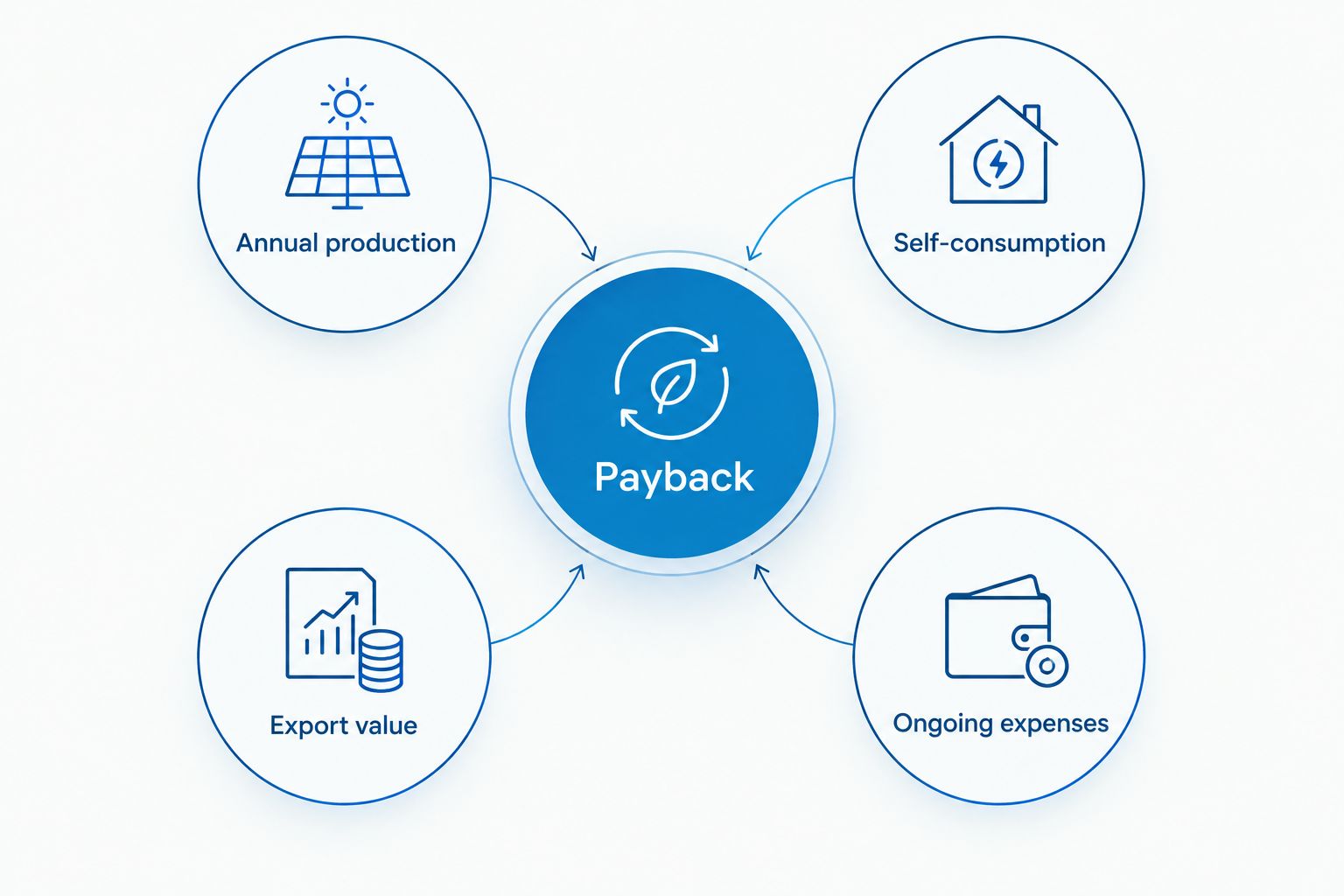
Simple payback divides net project investment by estimated annual net savings. It is a screening calculation, not a complete forecast: equipment performance, electricity rates, maintenance, and household use change over time.
Use the same assumptions across every proposal. For a 2026 comparison, ask each installer to identify these inputs explicitly:
- Annual production: Estimated generation in kilowatt-hours, or kWh.
- Self-consumption: Generation expected to serve household loads directly.
- Export value: Treatment of electricity sent to the grid.
- Project obligations: Complete installation scope and financing terms.
- Ongoing expenses: Maintenance and other included operating assumptions.
- Incentive treatment: Only benefits supported by current rules and your eligibility.
Keep units straight. A 1 kW load running for 1 hour uses 1 kWh of energy. Kilowatts describe power; kilowatt-hours describe energy. Battery power affects which equipment can operate together, while usable stored energy affects duration.
Run a second comparison with less favorable assumptions, such as lower self-consumption or no assumed electricity-rate increase. Ask what changes the result most. A proposal that depends on one optimistic assumption deserves closer review before you sign.
Keep financing separate from electricity savings
A smaller monthly payment does not establish a shorter payback period. Loan duration, interest, fees, and payment structure affect your obligations even when two proposals show the same solar production.
Compare the installation scope separately from the financing agreement. Then review solar panel financing APR and total loan cost before deciding whether a payment fits your plans.
For a 2026 purchase, ask what happens if an expected incentive does not apply. Your repayment obligations should remain understandable without assuming a tax outcome. Confirm current eligibility with a qualified tax professional rather than treating a sales projection as tax advice.
Maintenance belongs in the return calculation
Solar output estimates should not be treated as a substitute for monitoring actual performance. Ask how you will identify a production problem, who reviews alerts, and how service requests are handled after installation.
Cleaning decisions also need a reason. Roof access, panel condition, debris, and manufacturer instructions matter; coastal solar panel cleaning methods should not automatically become a San Antonio maintenance schedule because the site conditions differ.
Do not add a guaranteed production improvement from cleaning to your payback estimate. Instead, ask what evidence supports the recommended work and how the installer distinguishes soiling from shading, equipment faults, or normal seasonal changes.
How the ranking works
The ranking prioritizes decision clarity: establish a solar-only baseline, add targeted backup when you need it, document staged installation requirements, and assess broader backup against explicit household priorities.
The criteria are usable production, electricity value, complete scope, verified assumptions, backup fit, and long-term ownership. Panel efficiency alone cannot settle those questions. A highly efficient panel still needs an appropriate roof layout and a sound financial calculation.
This is a configuration ranking rather than a panel-brand contest. The right equipment follows the design requirements; a recognizable product name does not establish household payback.
Which home solar system should you choose?
Choose solar-only as your starting comparison when bill savings come first. Choose essential-circuit battery backup when selected outage needs justify storage. Consider expanded backup only after defining the equipment you expect to operate.
Bring your bills, planned household changes, roof concerns, and backup priorities to an Alphasolarsa free consultation. Ask for the solar-only case and the battery addition to be explained separately, including installation scope and support after installation.
Discuss your solar and backup priorities
Bring your electricity bills and backup needs to a free consultation.
FAQ
What’s the best home solar system for the shortest payback?
Start by comparing solar-only matched to your household use. The shortest household-specific payback depends on project scope, production, electricity value, and verified incentives, not a universal panel ranking.
Does adding a battery make solar pay back faster?
Adding a battery does not automatically shorten solar payback. Its financial effect depends on how stored electricity is used and valued; outage protection is a separate benefit.
Will solar panels keep my house running during an outage?
Standard grid-tied solar does not keep your house running during an outage by itself. Backup operation requires suitable equipment and a design that identifies supported loads.
How many electricity bills should I bring to a solar consultation?
Bring 12 months of electricity bills. A full year helps establish seasonal usage, and you should also identify planned changes such as an electric vehicle or new household equipment.
Can I install solar now and add a battery later?
A staged installation is an option when the equipment and electrical design support it. Get the future installation requirements in writing and confirm compatibility when selecting the battery.
Is whole-home battery backup better than essential-circuit backup?
Whole-home backup is not automatically the better choice. Essential-circuit backup suits targeted priorities, while broader backup requires a detailed assessment of supported loads and operating limits.
Should I include tax incentives in my solar payback estimate?
Include an incentive only after confirming current rules and your eligibility. Keep a comparison without an unverified benefit so you understand the commitment independently of that assumption.
One last thing
Ask for the payback calculation with electricity-rate growth removed. That single change shows how much of the projected return comes from today's electricity use and how much depends on a future assumption.
Then ask for the battery's purpose in one sentence. If the answer is outage protection, judge it against your backup priorities—not as though every benefit must appear on an electricity bill.
Related guides