
Residential solar is worth considering in San Antonio in 2026 when your roof, electricity use and financing support a favorable long-term result; battery backup is a separate decision about outage protection. Solar panels alone do not normally keep your home powered during a grid outage, and reducing your utility bill does not automatically mean reducing your total monthly spending.
- Is residential solar worth it in San Antonio? Decide from household-specific savings, financing terms and roof suitability—not a sales estimate alone.
- Solar panels reduce purchased electricity; battery backup adds stored energy for supported household circuits.
- Alpha Solar Solutions is a local option for San Antonio homeowners considering residential solar with battery backup.
- Compare total spending and outage coverage separately before booking an installation.
Why this matters
A solar proposal answers two different questions: how much utility electricity you can replace, and what happens when the grid goes down. Confusing those benefits makes it harder to judge whether the proposed system fits your home.
Alpha Solar Solutions offers residential solar and battery backup services in San Antonio. Before comparing equipment, decide whether your priority is a lower electricity bill, backup for essential circuits, or both. That choice should shape the design—not the other way around.
Is residential solar worth it in San Antonio in 2026?
Residential solar earns its place when the household-specific financial case works without treating outage protection or incentives as guaranteed benefits. Start with your electricity bills, roof condition and written proposal, then compare the following approaches.
| Approach | Best for | Main benefit | Main limitation |
|---|---|---|---|
| Solar without battery backup | Homeowners focused on replacing purchased electricity | Generates electricity for household use while sunlight is available | Standard grid-connected systems shut down during outages |
| Solar with battery backup | Homeowners seeking electricity generation and support for selected outage loads | Stores energy and can supply supported circuits when configured for backup | Adds equipment and design requirements; runtime is limited |
| Keep grid service without adding solar | Homeowners whose roof or financial terms do not support installation | Avoids taking on a solar project before the home is ready | Does not add household generation or outage backup |
Ask for the assumptions behind the projected result. A useful proposal distinguishes electricity generated, electricity used at home, electricity exported and electricity still purchased from the utility.
For a 2026 decision, use the current rules for your actual electric account. Do not assume that every San Antonio-area address has the same utility, export treatment or interconnection requirements.
What would make the answer “not yet”?
Pause if your roof needs work, the financing terms are unclear, or the savings calculation depends on benefits you have not confirmed. These are reasons to resolve the proposal—not reasons to accept a rushed deadline.
Do not sign until you can explain where the projected savings come from. If the explanation stops at panel output, the financial analysis is unfinished.
Solar without a battery: best for electricity-bill reduction
Solar without storage is the more direct option when your main goal is generating electricity for use at home. Its value depends on when your panels produce power, when your household uses it and how your utility handles exported electricity.
Daytime generation does not necessarily match your household's demand. A home that uses substantial electricity after sunset still needs another source at those times, even if its panels generate considerable energy during the day.
The advantage is a system focused on generation without the additional storage equipment. The limitation is equally important: standard grid-connected solar is not outage backup. Protective equipment normally stops the system from supplying electricity when the grid fails.
Ask the installer to separate the expected utility-bill reduction from the remaining utility charges. A smaller bill is useful, but it is not the same as eliminating your electric account or all charges associated with it.
Solar with battery backup: best for selected outage needs
Solar paired with a backup-capable battery addresses a different concern: keeping designated equipment running when utility service fails. The system must include the equipment and configuration needed to isolate supported loads from the grid.
Start with the circuits you want to protect. Refrigeration, lighting, communications equipment and selected outlets create a different backup requirement from central air conditioning, electric cooking or vehicle charging.
A battery's benefit is stored electricity available for supported loads. Its limitation is finite energy and output: it cannot power every appliance indefinitely, and a full battery does not prove that it can start a particular large appliance.
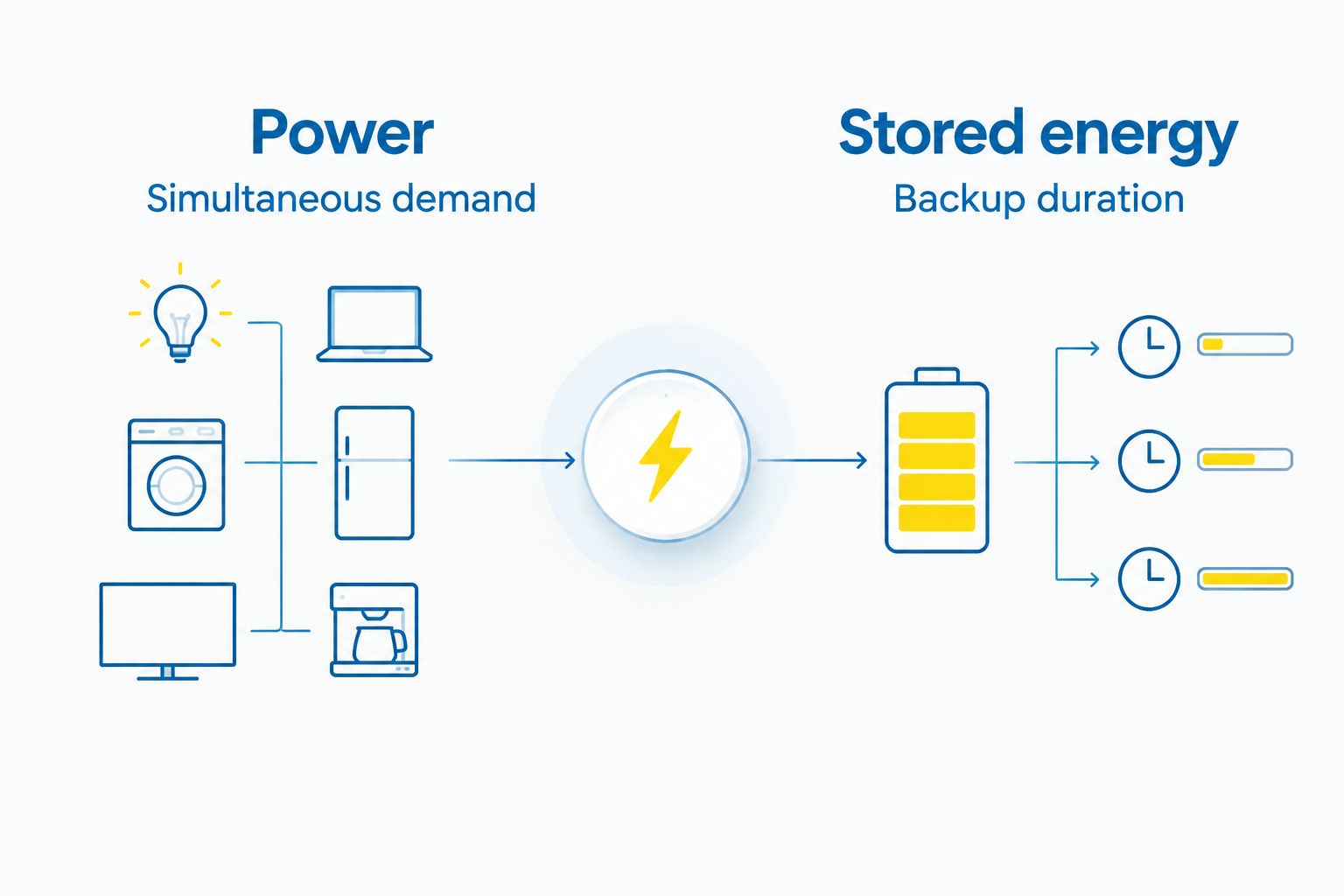
Understand power versus stored energy
Power describes how much electricity equipment can deliver at a moment. Energy describes how much electricity is available over time. You need both measurements to evaluate a backup proposal.
- 1 kilowatt equals 1,000 watts: this is a measure of power, useful when checking simultaneous appliance demand.
- 1 kilowatt-hour equals 1,000 watt-hours: this is a measure of energy, useful when discussing battery storage.
- A steady 1-kilowatt load uses 1 kilowatt-hour in 1 hour: this unit relationship explains why running more equipment shortens backup duration.
Actual backup duration also depends on usable battery capacity, operating conditions, system losses and any solar recharging. Ask for the proposed circuit list and its assumptions rather than accepting an unsupported whole-home runtime claim.
Why residential solar value varies
The same equipment does not produce the same financial result at every home. These factors explain why your proposal needs to reflect your property and household rather than a neighborhood average.
- Roof condition and sunlight: shading and usable roof space affect system design. Roof work also needs to be considered before panels are installed.
- Electricity-use patterns: the timing of household demand affects how much solar electricity you use directly instead of exporting.
- Utility rules: import charges, export credits and interconnection requirements affect the value and operation of a grid-connected system.
- Financing terms: interest, fees, payment changes and loan length affect total spending, even when equipment is identical.
- Backup requirements: adding storage for selected circuits is a different project from designing around large household loads.
- Ownership plans: an expected move changes how you should evaluate the agreement, remaining loan obligations and the assumptions behind long-term savings.
For 2026, request a proposal that identifies these assumptions in writing. Treat an unexplained savings figure as a question to resolve, not as a reason to buy.
How do you check whether the savings calculation holds up?
Compare the household's projected spending with solar against the household's projected spending without it over the same period. Keep any battery-related backup benefit separate so you can see what you are paying for each goal.
Start with your actual electricity use
Provide bills that show seasonal changes, not just a recent high-bill month. Ask the designer to explain how the proposed generation relates to that consumption and how shading was assessed.
Mention planned changes, such as adding an electric vehicle or changing major electric appliances. Those plans belong in the discussion, but they should be identified as assumptions rather than treated as existing demand.
Separate the electric bill from the solar payment
A solar payment does not replace every utility charge. Compare the proposed payment alongside the projected remaining electric bill, and ask which expenses the estimate leaves out.
Review solar financing APR and total loan cost before judging a proposal by its monthly payment. A payment that looks manageable does not, by itself, establish a favorable total result.
Test the assumptions before accepting the outcome
Ask how the estimate treats future utility rates, equipment performance, maintenance and financing. Also ask whether the projected payment or savings depends on making an additional payment later.
For a 2026 proposal, do not subtract a tax benefit unless its current rules and your eligibility have been verified. Have the installer explain what the financial result looks like without an unconfirmed incentive.
Will solar panels keep my house powered during an outage?
Solar panels alone normally will not keep a standard grid-connected home powered during an outage. Backup operation requires a suitable system design, including equipment that safely separates supported household circuits from the utility grid.
With a battery, ask which circuits remain available and which appliances must stay off. Also confirm whether the proposed solar-and-battery configuration can recharge from sunlight during an outage; do not assume that every installation operates the same way.
Should I add a battery now or later?
Add a battery now when defined outage needs are part of the reason you are buying solar. Consider adding storage later when bill reduction is the immediate goal, but ask what future compatibility and electrical work would involve before selecting the initial system.
Neither choice removes the need for a written backup plan. “Battery-ready” is not a substitute for identifying compatible equipment, supported loads and the work required to add storage.
Is solar still worth considering if I might move?
Solar still deserves evaluation if you might move, but the decision must account for your agreement and remaining financial obligations. Do not assume a buyer will take over a loan or that a future sale will recover the entire investment.
Ask how ownership, financing and any transfer requirements would be handled. Compare those answers with your likely time in the home before committing to a long-term arrangement.
What should you bring to a free consultation?
Bring electricity bills, information about your roof and a practical list of outage priorities. A useful consultation turns those details into design questions rather than starting with a predetermined package.
Ask Alpha Solar Solutions about a custom residential solar design, battery backup for your chosen circuits and support after installation. Have the local team explain what the proposed system includes and which responsibilities remain with you.
Before deciding, request written answers to these questions:
- What roof and electrical conditions does the proposal assume?
- Which utility rules support the estimated bill reduction?
- Which circuits will operate during an outage?
- What financing conditions change the payment or total obligation?
- Who handles activation, monitoring questions and service requests?
Book the consultation to clarify the decision—not to commit before the details are clear. Installation, utility approval and permission to operate are separate parts of getting a grid-connected system into service.
Discuss your home’s solar options
Request a free consultation about your electricity use, roof and battery backup priorities.
FAQ
Is residential solar worth it in San Antonio in 2026?
Residential solar is worth considering when a home-specific assessment supports the roof, utility and financing assumptions. Compare total household spending, not just the proposed reduction in your electric bill.
Will I still have an electric bill after getting solar?
A grid-connected solar home can still have an electric bill because it can purchase electricity and remain subject to utility charges. Ask which charges remain under the rules for your account.
Do I need battery backup with solar panels?
You do not need a battery simply to generate solar electricity, but outage protection requires an appropriate backup-capable design. Choose storage around the circuits you want to support.
Can a solar battery run my central air conditioner?
A solar battery can support central air conditioning only when its output, usable energy and system design suit the equipment. Have the installer check starting demand and expected operation alongside other household loads.
Does getting solar guarantee lower total monthly spending?
Solar does not guarantee lower total monthly spending. Compare the remaining utility bill, financing payment and other applicable obligations against your current electricity spending.
Should I count a tax credit when deciding whether solar is worth it?
Count a tax benefit only after current rules and your eligibility have been verified. Ask for a financial comparison that does not depend on an unconfirmed incentive.
Does Alpha Solar Solutions offer residential solar and batteries in San Antonio?
Alpha Solar Solutions offers residential solar installation and battery backup in San Antonio. Request a free consultation to discuss your roof, electricity use and outage priorities.
One last thing
Before evaluating battery capacity, write down what you would deliberately leave off during an outage. That list makes your backup goal clearer than a request to “power the house.”
For your 2026 decision, ask for two separate explanations: how solar changes your electricity spending, and how the proposed backup system serves your chosen circuits. A worthwhile proposal makes both understandable without promising either guaranteed savings or unlimited power.
Related guides
- Solar panels in San Antonio: add a battery now or later
- Can solar battery backup run your central air conditioner?
- Solar installation in San Antonio: what delays activation