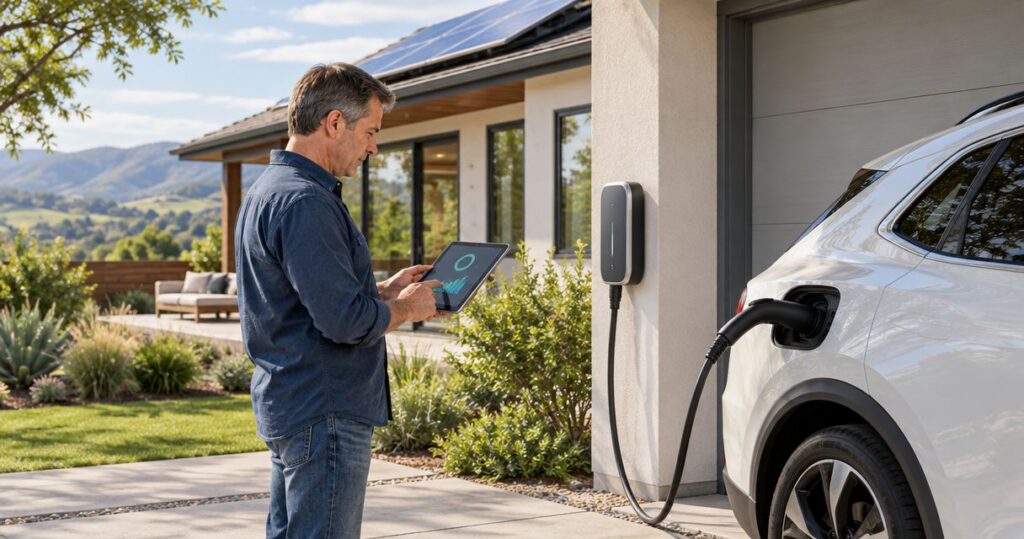
Your level 2 EV charger installation cost in Texas in 2026 depends on the electrical work your home needs, so use a site-specific, itemized quote—not a statewide headline figure—to make the decision. Separate the charger itself from circuit installation, permits, panel work and any trenching before comparing offers.
- Compare level 2 EV charger installation cost by scope, not just the quoted total.
- A 240-volt charging circuit needs an electrical capacity assessment, not merely an empty breaker slot.
- Alphasolarsa offers EV charger installation for San Antonio homeowners considering home charging.
- Choose charging output around your driving needs, available electrical capacity and overnight parking time.
Why this matters
The useful comparison is the same charging outcome with the same work included. A quote for mounting equipment beside an existing suitable circuit is not equivalent to a quote that includes a new circuit across your property.
For a San Antonio homeowner, the decision also connects to future solar, battery backup and another vehicle. Review the available installation services before your consultation so you can discuss those plans together without treating every future upgrade as a purchase you need today.
What does level 2 EV charger installation cost in Texas in 2026?
A useful installed quote separates equipment, electrical labor, materials, approvals and site-specific work. Ask the installer to identify each item as included, excluded or dependent on inspection. That makes the proposal useful even before you compare it with another contractor's offer.
Use this scope breakdown for your 2026 quote review:
| Quote component | What the written scope should explain | What to question |
|---|---|---|
| Charging equipment | Who supplies it, its connection method and selected output | Whether the quote includes the charger itself |
| Dedicated circuit | Breaker, conductors and wiring route | Whether existing wiring has been assessed for reuse |
| Mounting and connection | Charger location, cable reach and physical protection | Whether a different parking position changes the work |
| Electrical capacity | Load assessment and any required electrical changes | Whether panel work is included or listed separately |
| Permits and inspection | Applicable approvals and who handles them | Whether fees and corrections are excluded |
| Property work | Trenching, penetrations and surface restoration where needed | Who repairs disturbed finishes or landscaping |
| Testing and handover | Operating settings, charging test and homeowner instructions | What happens after installation if charging fails |
Do not accept “installation included” as a complete scope. Ask what that phrase covers at your address, especially when the installer has not inspected the panel or confirmed the wiring route.
Keep optional work separate from necessary work. A proposal should distinguish what makes the charger operate safely now from what prepares your home for a later vehicle or energy upgrade.
Match charging output to your home before choosing equipment
Residential Level 2 charging typically uses a 240-volt circuit. The charging equipment's advertised maximum is not automatically the output your home should use; your vehicle, electrical system and daily driving all matter.
For example, a 32-amp continuous charging load generally requires a circuit rated for at least 40 amps under continuous-load sizing rules. That relationship explains why selecting a charger by its largest advertised number can create electrical work you did not anticipate. The installer must confirm the applicable equipment instructions and electrical requirements.
Ask these questions before approving the design:
- How much charging do you need between arriving home and leaving again?
- What AC charging rate can your vehicle accept?
- What charging load can your electrical system support?
- Can an approved load-management arrangement meet your needs?
- Where will the cable reach without crossing a walking path?
Choose sufficient charging output, not the highest output on the specification sheet. Faster equipment has little practical benefit when your vehicle cannot use its full output or your normal parking window already covers your charging needs.
Do not turn the circuit example into a purchasing specification. The final design depends on your actual equipment and home, not a generic pairing copied from an article.
Hardwired or plug-in: compare the complete installation
Hardwired equipment connects directly to the electrical circuit. Plug-in equipment connects through a compatible receptacle, but that receptacle and its circuit still need to meet the installation requirements.
Neither approach eliminates the need to check electrical capacity. Choose between them after reviewing location, equipment instructions and how you intend to use the charger.
| Connection option | Best for | Main advantage | Main limitation |
|---|---|---|---|
| Hardwired | Homeowners planning a fixed charging location | Avoids a separate plug-and-receptacle connection | Moving or replacing equipment involves electrical work |
| Plug-in | Homeowners who value removable equipment where permitted | Equipment can be disconnected without undoing a hardwired connection | Requires a suitable receptacle, circuit and installation location |
An existing outlet is not proof that a plug-in installation is ready. Ask the electrician to assess its condition, circuit rating, grounding and suitability for the intended charging load.
Likewise, a hardwired installation does not justify unspecified panel changes. Require the proposal to explain why each electrical change is needed rather than treating the connection method as the reason for every added task.
Why EV charger installation scope varies
The same charging equipment can require very different work at different homes. These factors explain the differences you should look for in a 2026 proposal:
- Panel capacity: An electrical load calculation assesses demand. Empty breaker spaces alone do not establish available capacity.
- Wiring route: Distance, access and obstacles affect the conductors, conduit and labor involved.
- Connection method: Hardwired and plug-in designs require different connection details and equipment checks.
- Site work: Detached parking areas, buried wiring routes and surface restoration change the construction scope.
- Charging plans: Another vehicle or planned solar and battery installation can affect the design decisions you make now.
- Local approvals: Permit and inspection requirements depend on the authority responsible for your address and the work involved.
Ask for a clear explanation of the factor driving each additional task. “Your panel needs work” is less useful than a description of the capacity issue, the proposed correction and the alternatives considered.
For longer routes, ask the installer to show the proposed path before work starts. A route that looks short from the driveway can involve inaccessible walls, a walkway crossing or a separate structure.
How to prepare for an installation consultation
Good preparation gives the installer enough information to ask useful questions. It does not replace an electrical inspection or make a remote estimate final.
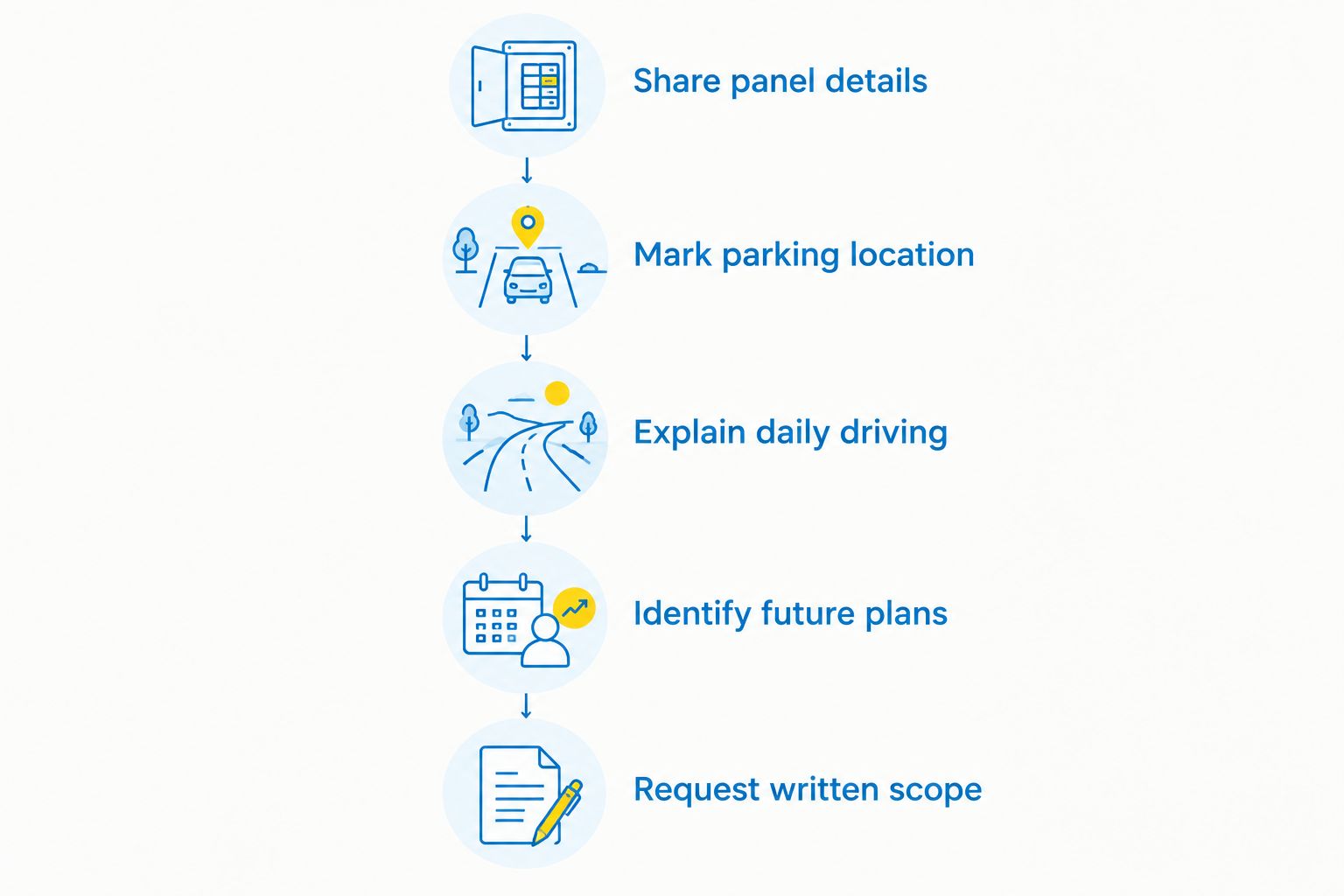
- Share panel details. Photograph the closed panel, visible labels and the surrounding working area. Do not remove the panel cover.
- Mark parking location. Show where the vehicle normally sits and where its charging port lands.
- Explain daily driving. Describe your usual driving pattern and how long the vehicle stays parked overnight.
- Identify future plans. Mention another EV, solar panels or battery backup before the circuit design is finalized.
- Request written scope. Ask for inclusions, exclusions, approval responsibilities and the process for unexpected work.
This sequence keeps the discussion focused on a workable installation rather than a charger model chosen before the home is assessed.
If you already own charging equipment, share its exact model and installation instructions. Ask the contractor to confirm compatibility before scheduling work, rather than assuming every unit fits every proposed circuit.
Alphasolarsa is best for San Antonio homeowners seeking local EV charger installation alongside solar or battery planning. Its local team, custom system designs and support after installation fit that coordinated discussion; homeowners should still request a written EV-specific scope rather than assume solar or battery work is included.
Discuss your home charging plans
Ask about a free consultation for EV charging, electrical scope and future solar or battery plans.
Do I need a panel upgrade for a Level 2 charger?
A Level 2 charger does not automatically require a panel upgrade. The answer depends on your home's calculated electrical load, existing equipment and proposed charging output—not simply the age of the house.
Ask the installer to explain the capacity assessment and whether an approved energy-management approach is appropriate. Such equipment can control charging demand, but it must be compatible with the proposed system and accepted for the installation.
Request the reason for a panel upgrade in writing. You need to understand whether the proposal addresses insufficient capacity, equipment condition, physical space or another specific issue. Those are different problems and should not be bundled into an unexplained recommendation.
Can solar or a home battery power my EV charger?
Solar can contribute electricity to EV charging when the system is producing, but production and charging demand will not always match. A home battery can supply an EV charger only when the system's design, output and available stored energy support that load.
For a 2026 solar-and-charging plan, discuss when the vehicle is home and whether charging can follow daytime production. Do not assume a scheduling feature, solar connection or backup capability exists without checking the actual equipment design.
During an outage, vehicle charging also competes with household priorities. Confirm whether the charger is backed up at all before planning to use it during a blackout. Keeping refrigeration or essential household circuits running is a different objective from charging a vehicle.
Compare proposals before you approve the work
Put proposals side by side and check whether each promises the same result. Differences in equipment ownership, circuit output, trenching, restoration and inspection responsibilities can explain why the totals differ.
Before signing, get clear answers to these questions:
- Is the quoted output the charger's maximum or its intended installed setting?
- Has the contractor confirmed the route and electrical capacity?
- Who handles permits, inspection scheduling and required corrections?
- What work requires a change order, and who approves it?
- What installation support is included after handover?
- What will the installer demonstrate before leaving?
Ask to see the charger operate with your vehicle when practical. You should understand its normal operating indication, how to stop charging and where to find the equipment instructions.
For Alphasolarsa EV charger installation, bring the same checklist you would bring to any contractor. A local consultation is most useful when it ends with a defined scope and clear next steps—not a promise that every household will get the same result.
FAQ
How much does Level 2 EV charger installation cost in Texas in 2026?
Level 2 EV charger installation cost depends on the charging equipment, electrical capacity, wiring route and required site work. Request an itemized, address-specific quote that separates equipment from installation and identifies exclusions.
Can I use an existing outlet for my home EV charger?
An existing outlet is usable only if the receptacle, circuit and installation meet the charging equipment’s requirements. Have an electrician assess it before connecting a sustained EV charging load.
Is a hardwired EV charger better than a plug-in charger?
A hardwired charger suits a fixed installation, while a plug-in charger suits removable equipment where the installation permits it. Compare the complete circuit and connection requirements rather than assuming either method is always better.
Does every Level 2 charger need a new electrical panel?
A Level 2 charger does not always require a new electrical panel. The installer should assess electrical demand, equipment condition and the proposed charging load before recommending panel changes.
Can I charge an electric car from solar during a power outage?
Outage charging requires a system specifically designed to supply the EV charger while disconnected from the grid. Solar panels alone do not establish that capability, and the charger must be included in the backup design.
What should I bring to a home EV charging consultation?
Bring your vehicle details, charger information if already selected, panel photographs and a clear description of where you park. Tell Alphasolarsa about planned solar, battery backup or another EV so the installation discussion includes those needs.
One last thing
Walk the cable path before you approve the charger location. The shortest electrical route is not useful if you must park awkwardly, stretch the charging cable or leave it across a walkway.
For your 2026 installation, mark the vehicle's normal position and check the charging-port location with the installer. That simple exercise connects the electrical design to how you will actually use the charger every day.
Related guides
- EV charger installation: hardwired versus plug-in
- EV charger installation: long cable runs and trenching
- Two cars sharing home charging
- Solar panels in San Antonio: planning for a future EV