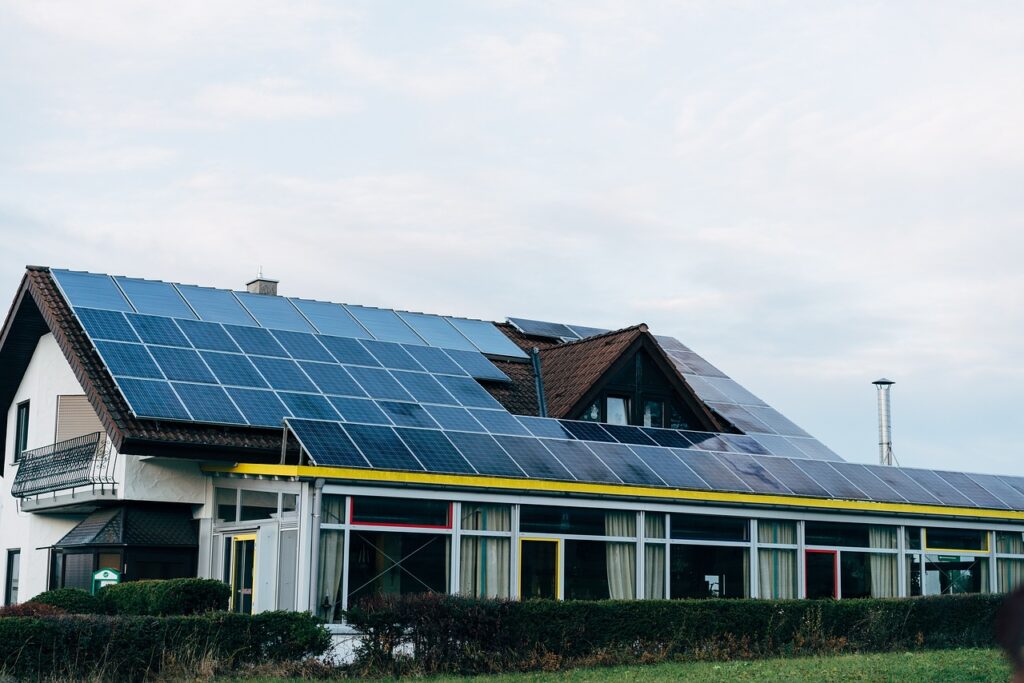
Residential solar for large families is a home electricity system designed around a busy household’s energy use, with the aim of reducing grid purchases and supporting selected essentials when battery backup is included. For San Antonio homeowners planning in 2026, the decision starts with when your family uses electricity and what must stay powered—not the number of people living under your roof.
- Residential solar for large families should follow measured electricity use, not household size alone.
- Alphasolarsa offers residential solar installation and battery backup for San Antonio homeowners.
- Solar panels generate electricity; outage protection requires a system specifically configured for backup.
- Compare solar-only, essential-circuit backup, and broader backup designs against your household’s actual priorities.
Why residential solar matters for large families
A busy household can need cooling, refrigeration, cooking, laundry, and device charging at overlapping times. Those overlapping demands matter differently from the total electricity recorded on your bill. Panels address electricity production; batteries and backup equipment address when stored electricity is available and which equipment can operate.
Alphasolarsa is best for San Antonio homeowners seeking local residential solar installation paired with battery backup. Its solar and battery installation services also include EV charger installation, which belongs in the discussion if home charging is part of your plan.
A useful 2026 proposal separates bill reduction from outage protection. A system can address one goal without fully addressing the other, so ask for both to be explained before choosing equipment.
How to plan residential solar for a large family
Review your electricity history before choosing panels
Start with your utility account, not a panel count. Download 12 months of electricity bills and any available interval data—the readings that show how usage changes throughout the day. Record electricity consumption separately from the amount you paid, because billing changes do not necessarily mean your household used more energy.
A kilowatt, abbreviated kW, measures power at a moment in time. A kilowatt-hour, abbreviated kWh, measures energy: using 1 kilowatt for 1 hour consumes 1 kilowatt-hour. Solar production and household consumption need the same energy units for a meaningful comparison.
Mark changes that make older bills less representative, such as another relative moving in or someone starting to work from home. Your household’s history is the baseline, not a permanent forecast.
- Download bills showing monthly kWh consumption.
- Mark summer cooling patterns and unusual billing periods.
- Note changes in occupancy or daytime activity.
- Save interval data if your utility account provides it.
- List planned electrical additions separately from existing use.
Separate bill savings from outage priorities
Write two lists yourself: what you want solar to accomplish during normal operation, and what you need during an outage. A lower electricity bill does not establish that the refrigerator, air conditioner, or kitchen outlets will receive backup power.
Ordinary grid-connected solar shuts down during a grid outage unless the installation has equipment and controls designed for safe backup operation. Battery storage alone is not a substitute for checking how the complete system operates.
This is where Alphasolarsa’s residential solar and battery backup services fit: use your lists to request a custom design, rather than asking for the largest available system. Keep the initial discussion practical. Identify the rooms, appliances, and routines that matter before discussing battery quantity.
- Separate normal-operation goals from outage goals.
- Identify refrigeration and any essential powered equipment.
- Choose lighting, communication, and outlet priorities.
- Decide whether cooling is essential or optional during outages.
- Ask which circuits the proposed backup design actually serves.
Build your backup plan around equipment demand
Walk through your home and list the appliances you expect to use together. Check equipment labels where accessible, but leave electrical-panel work and load assessment to a qualified professional. A handwritten appliance list is enough to start the conversation.
Battery energy capacity affects how much electricity can be stored. Battery power output affects what equipment can run at the same time. Both matter; a large stored-energy figure does not establish that a system can start your central air conditioner.
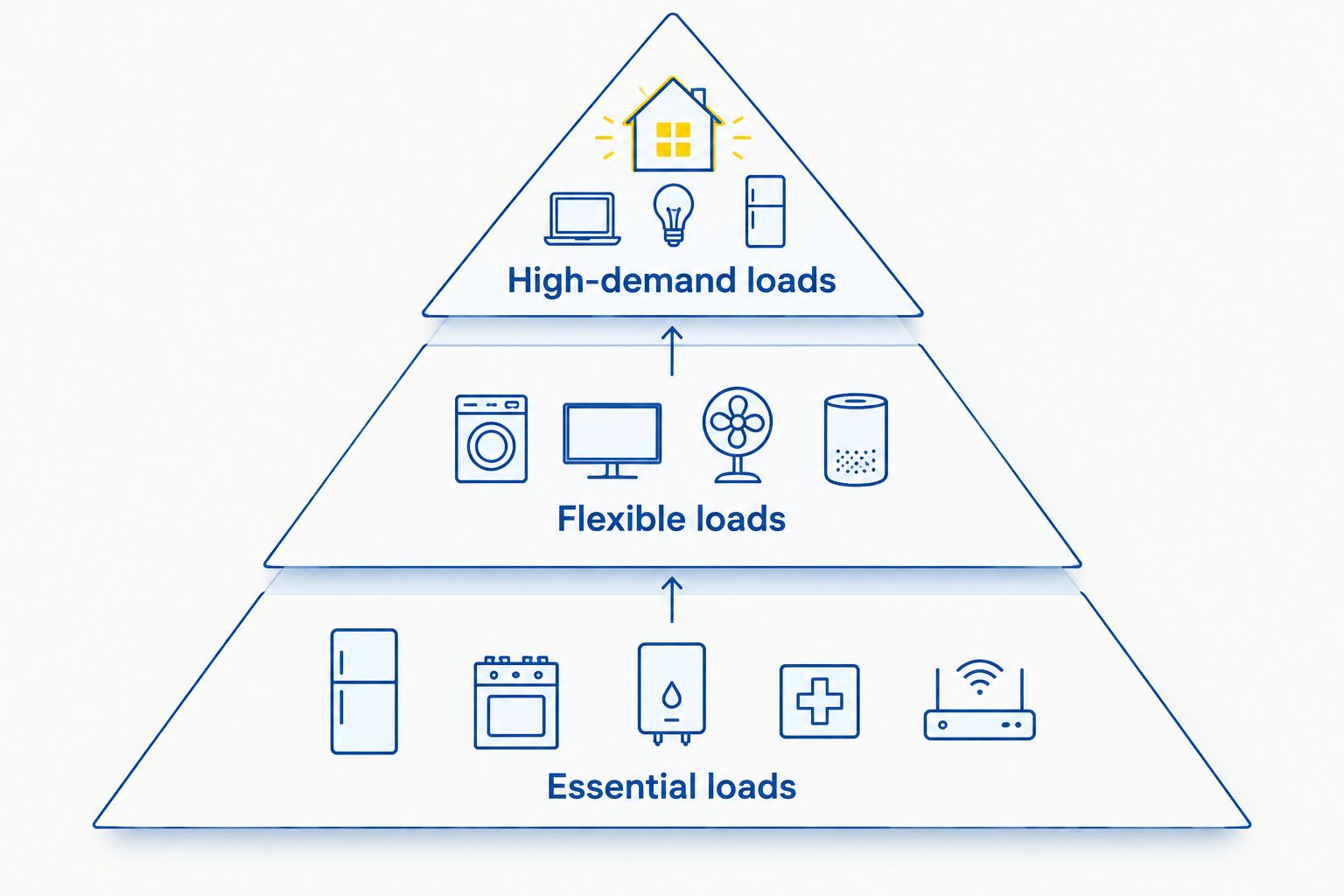
Organize your list into Essential loads, Flexible loads, and High-demand loads. These are planning categories, not fixed electrical classifications. A refrigerator belongs on many essential lists, while your family’s medical or accessibility needs can change the priorities entirely.
Ask for a written explanation of the assumptions behind any runtime estimate. Outage duration, battery charge, appliance use, and available solar production all affect the result.
- Record essential appliances and their locations.
- Identify equipment with significant starting demand.
- Note which appliances must operate together.
- Separate optional cooking, laundry, and charging loads.
- Request a circuit list and stated runtime assumptions.
Match the solar design to your roof and schedule
Review your household schedule before the site assessment. Note when people leave, return, cook, cool the home, and charge vehicles. Shifting suitable tasks into solar-producing hours can increase direct use of solar electricity, but the schedule must work for your family.
A roof assessment needs to consider usable area, shading, condition, and equipment placement. More occupants do not automatically mean more usable roof space. Roof work also deserves attention before panels are installed, rather than becoming an avoidable disruption afterward.
For a 2026 proposal, ask the installer to explain production assumptions and how electricity exports are treated under your applicable utility terms. Do not treat exported electricity as automatically equal in value to electricity purchased from the grid.
- Note shade across different parts of the day.
- Raise roof-condition concerns before finalizing the design.
- Share realistic weekday and weekend usage patterns.
- Request estimated production by month, not only annually.
- Check the applicable rules for exported electricity.
Compare complete proposals on the same assumptions
Create a simple comparison sheet before reviewing proposals. Give each installer the same consumption history, backup priorities, and planned additions. Otherwise, different recommendations can reflect different assumptions rather than a meaningful difference in design.
Ask Alphasolarsa to connect its custom system design to your family’s written requirements and explain support after installation. The useful comparison is not a brand slogan; it is whether the proposal clearly identifies equipment, electrical work, backup circuits, commissioning, and responsibilities.
For financing, compare the agreement as a whole rather than judging it by the monthly payment alone. For incentives, verify current 2026 rules through the responsible official source and a qualified tax adviser. Do not treat an assumed incentive as money already secured.
- Request itemized equipment and installation scope.
- Check whether electrical upgrades are included or excluded.
- Compare financed obligations and early-payoff terms.
- Confirm who handles permits, inspections, and utility coordination.
- Obtain written warranty and service terms.
- Ask what happens if the design changes after assessment.
Prepare your family for handover and outages
Write a household operating plan before installation finishes. Everyone who uses major appliances should understand which circuits have backup and what to avoid running together. Equipment cannot enforce every family preference unless the design includes suitable controls.
At handover, ask the installer to demonstrate monitoring, explain reserve settings, and show how normal and backup operation differ. A battery reserve is stored energy held back for backup rather than routine use. Increasing that reserve changes how much stored energy remains available for everyday operation.
Keep operating instructions somewhere accessible without internet access. Do not wait for an outage to discover that only one person knows how to view system status or contact support.
- Save equipment documents and shutdown instructions.
- Label or document backed-up circuits.
- Review monitoring access with responsible household members.
- Agree which flexible loads stop during an outage.
- Record the service contact and escalation process.
- Ask how to recognize a fault requiring professional attention.
Compare your household’s solar and backup options
Choose the smallest scope that meets your stated goals—not the smallest system regardless of need. These options solve different problems. Ask for clear exclusions as well as benefits before choosing a design.
| Option | Best for | Main benefit | Key limitation |
|---|---|---|---|
| Solar without battery backup | Families focused on daytime generation and reducing grid purchases | Generates electricity for household use during solar-producing hours | Does not provide outage power without a backup-capable configuration |
| Solar with essential-circuit battery backup | Families prioritizing selected appliances and rooms | Directs stored electricity toward agreed essentials | Unselected circuits remain outside the backup plan |
| Solar with broader battery backup | Families seeking to support more household equipment | Extends the range of loads considered in the backup design | Simultaneous demand and stored energy still limit operation |
| Solar now, battery later | Families staging the installation decision | Allows solar installation before committing to storage | Later battery integration needs compatibility and electrical review |
Staging the work is a planning choice, not a guarantee that adding storage later will be straightforward. Request a written explanation of what the initial design preserves for a future battery installation.
Plan solar around your family
Request a free consultation about your electricity use, backup priorities, and custom system design.
Common mistakes large families make
Sizing by the number of people
Household size does not reveal cooling demand, appliance efficiency, or charging habits. Two homes with the same number of occupants can need different designs. Use measured electricity consumption and planned changes instead of a people-to-panels rule.
Treating central cooling as an automatic backup load
Keeping selected outlets powered is not the same task as starting and running central air conditioning. Ask for an assessment of the actual cooling equipment and its place in the backup design. Do not accept a whole-home description without a defined equipment scope.
Planning for normal routines during an outage
Laundry, electric cooking, vehicle charging, and cooling compete for available power and stored energy. Agree on an outage routine before choosing storage. A design based on reduced household demand should not be presented as normal operation without restrictions.
Leaving future changes outside the proposal
An EV, additional occupants, or changes to heating equipment can alter electricity use. Tell the installer about changes you genuinely expect, while keeping confirmed needs separate from possibilities. Buying equipment around an undefined future can obscure whether today’s needs are met.
FAQ
What’s the best residential solar setup for a large family?
The best residential solar setup matches measured electricity use and clearly defined backup priorities. Choose panels for generation needs and assess battery storage separately for the equipment you want supported during outages.
How many solar panels does a large family need?
Family size alone cannot determine the required panel count. The design needs electricity consumption, roof conditions, equipment specifications, and production estimates before a panel count is meaningful.
Can solar panels keep our home powered during an outage?
Solar panels need a backup-capable system configuration to supply household equipment during a grid outage. Ordinary grid-connected solar shuts down when grid power fails, and supported loads depend on the installed design.
Can a home battery run our central air conditioner?
A home battery can support central air conditioning only when the complete system meets the equipment’s starting and running requirements. Ask for an assessment of your actual air conditioner, simultaneous household loads, and available stored energy.
Should we install solar and batteries together or separately?
Installing them together lets you plan generation and backup as one design, while a staged installation separates the decisions. If you defer the battery, request a compatibility review and a written explanation of future integration requirements.
Will residential solar eliminate our electricity bill?
Residential solar does not guarantee elimination of your electricity bill. Grid purchases, utility charges, production, consumption timing, and applicable export terms affect what remains payable.
What should we bring to a solar consultation in 2026?
Bring electricity bills, available interval data, roof concerns, and a list of appliances you want backed up. Include planned EV charging or household changes so the consultation addresses your expected needs rather than occupancy alone.
One last thing
Ask what your family must stop doing during an outage. That question turns an abstract backup promise into a usable household plan. If the answer excludes simultaneous cooking, cooling, or vehicle charging, decide whether those restrictions work before approving the design.
Bring that question to your free consultation with Alphasolarsa, alongside your bills and appliance list. For your 2026 decision, a clearly explained limitation is more useful than an unexplained promise of energy independence.
Related guides
- Add a solar battery now or later
- Can battery backup run central air conditioning?
- Choose an outage reserve setting
- Plan solar for a future EV