
Choose Alpha Solar if you want a San Antonio contractor offering solar installation, battery backup and related home electrical services; choose TXEN Solar if its written proposal better matches your backup needs, payment terms and service requirements. This 2026 comparison separates a documented service fit from the contract details that should decide your purchase.
- Alpha solar vs txen solar comes down to system design, battery backup, contract terms and after-installation responsibility.
- Alpha Solar fits San Antonio homeowners seeking residential solar installation with battery backup.
- Choose TXEN Solar when its written proposal better satisfies your specific requirements—not because of an unsupported ranking.
- Compare the same protected circuits, production assumptions and payment structure before choosing either contractor.
Why this matters
A solar installation changes both your electricity supply and your responsibilities as a homeowner. Panels address electricity generation; batteries address stored energy and backup. Those are related decisions, not interchangeable benefits.
Start with the work your home needs. The solar and battery installation services offered by the local contractor include residential solar, battery backup, EV charger installation and solar panel cleaning. That service scope establishes relevance, but your proposal still needs to explain equipment, electrical work and support.
Alpha Solar is a practical fit for San Antonio homeowners seeking residential solar with battery backup. A competing quote deserves the same scrutiny, without assuming that either company automatically wins on workmanship, financing or outage performance.
At a glance
Read this table as a buying framework, not a substitute for either installer's signed scope. In 2026, the deciding evidence is the proposal for your address.
| Dimension | Alpha Solar | TXEN Solar |
|---|---|---|
| Best for | San Antonio homeowners seeking solar paired with battery backup | Homeowners whose TXEN proposal better meets their documented requirements |
| Local service fit | San Antonio-based contractor | Confirm service coverage and the team responsible for your address |
| Standout service fit | Solar, battery backup, EV charger installation and cleaning within its stated service scope | Identify the proposal's specific advantage rather than assuming one |
| System design | Request a custom layout and documented production assumptions | Request the same layout detail and assumptions |
| Outage protection | Battery backup and Powerwall systems are offered; confirm protected loads | Require the proposed battery equipment and protected loads in writing |
| Activation | Require permitting, inspection and utility responsibilities | Require the same responsibility breakdown |
| Support after installation | Ask how the local team handles monitoring, faults and service requests | Ask who handles monitoring, faults and service requests |
| Pricing model | Compare the payment structure stated in your proposal | Compare the payment structure stated in your proposal |
| Contract clarity | Review exclusions, cancellation provisions and warranty responsibilities | Review the same provisions before signing |
Alpha Solar has a clear local service fit
For a San Antonio homeowner, a local contractor offering both residential solar and battery backup is a relevant starting point. The stated service scope also covers EV charging and panel cleaning, which matters when your project involves more than rooftop panels.
The advantage is fit, not an automatic quality verdict. A local address alone does not establish response times, installation quality or better financial terms.
Ask the local team to explain how its custom design handles your roof, electricity use and outage priorities. Then ask who supports that design after installation. A useful answer identifies responsibilities rather than simply promising that someone will help.
The limitation: a broad service offering does not mean every task belongs in your installation agreement. Cleaning, charger installation and future changes need their own explicit scope if you want them included.
TXEN Solar remains a genuine alternative when its proposal better addresses your property or project requirements. Confirm its service coverage and project team directly rather than inferring either from the company name.
TXEN Solar wins on design if its proposal explains more
A better solar design makes its assumptions visible. If TXEN Solar supplies a clearer roof layout, more transparent production assumptions and a better explanation of your electrical work, that proposal wins this dimension.
That is a conditional advantage, not a claim about its current designs. Apply exactly the same standard to the other installer.
Bring 12 months of electricity bills to a 2026 consultation so the discussion includes seasonal changes rather than a single billing period. Explain planned changes, such as an EV or a different heating system, without treating future consumption as certain.
Ask each contractor to explain:
- Roof layout: where panels go and how shade affects placement.
- Production assumptions: how the estimate accounts for orientation, shade and equipment.
- Electrical work: what changes the existing panel or wiring requires.
- Future changes: what adding storage or charging would involve.
The drawback of a detailed proposal is not the detail itself; it is false certainty. An electricity-generation estimate is not a promise that your utility bill disappears. Require the assumptions behind any savings calculation, including the electricity rate and treatment of exported energy.
Neither company wins backup without a load plan
A battery name does not tell you which appliances will operate during an outage. The proposed electrical design must identify the circuits the battery serves and the limits on running them together.
Keep two measurements separate. A kilowatt, or kW, measures power at a moment; a kilowatt-hour, or kWh, measures energy. A steady 1 kW load running for 1 hour uses 1 kWh of energy—an explanation of units, not a promise of battery runtime.
For your home, separate three questions:
- Protected circuits: what stays connected during an outage?
- Starting demand: can the system start the equipment you want to use?
- Stored energy: how does the planned usage affect runtime?
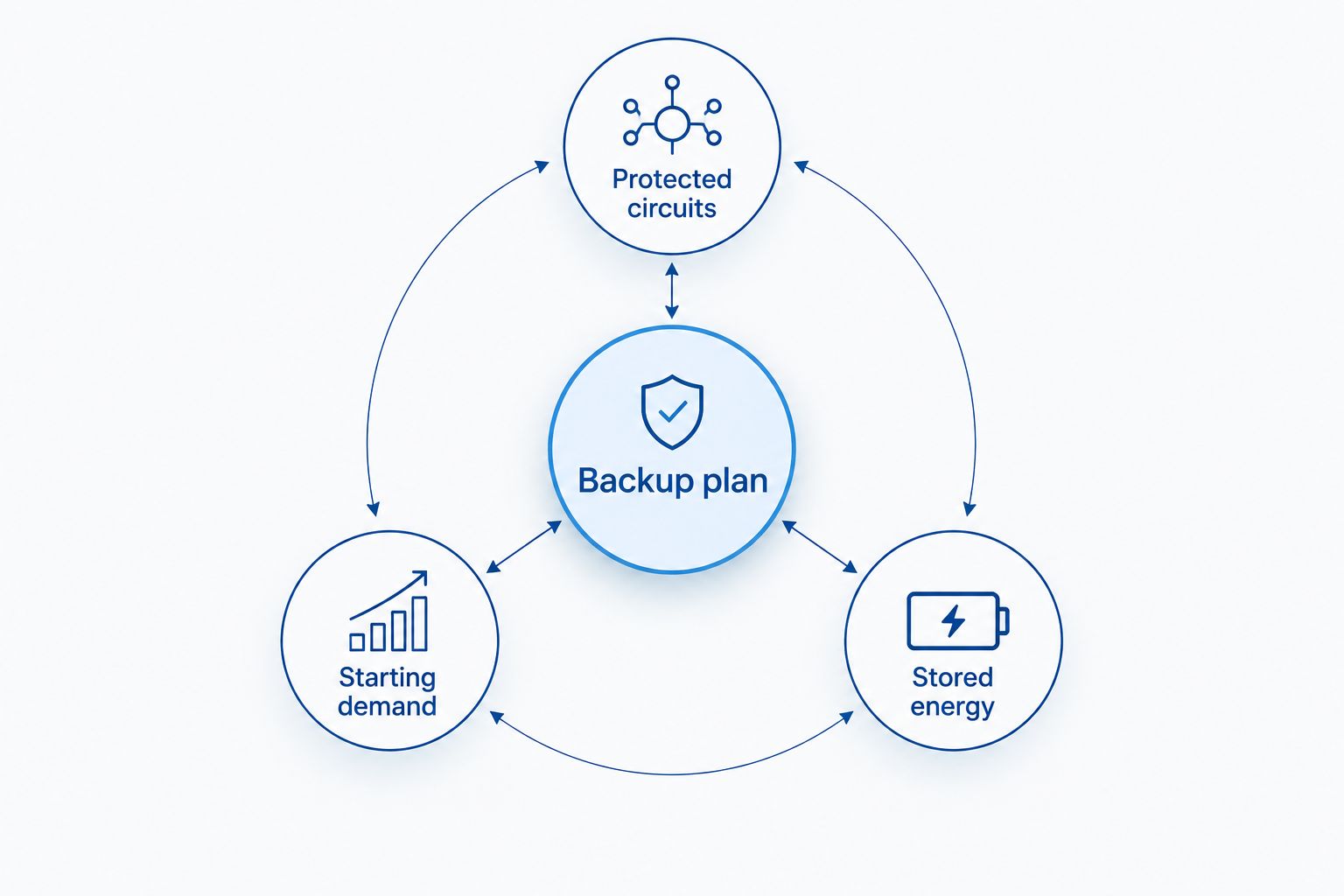
Ask for an explanation of what happens when the battery reaches its reserve limit and how solar recharging works in the proposed outage configuration. Whole-home backup and selected-circuit backup are different scopes.
This dimension is a tie until the written designs establish a difference. Neither installer deserves a backup-performance win based only on including a battery in the quote. The tradeoff is practical: protecting more equipment increases the demands the design must satisfy.
Activation responsibility matters more than a confident date
Installation and permission to operate are different milestones. A finished-looking roof does not by itself establish that the system is ready for normal grid-connected operation.
For a 2026 project, ask each contractor to identify responsibility for applications, inspections, corrections and utility coordination. Separate the installer's work from approvals controlled by another party.
A useful schedule names dependencies. An unqualified completion date leaves you without a clear answer when an inspection needs correction or an application needs more information.
Use the same questions for both proposals:
- Who submits the required documents?
- Who responds when an inspector requests changes?
- Who tells you when normal operation is authorized?
- When does any payment obligation begin relative to activation?
Neither company wins activation on a verbal timeline. Favor the agreement that clearly assigns work and communication, while recognizing that the installer does not control every approval.
Better support is the support you can actually identify
Support after installation deserves attention before you sign. A monitoring alert, an equipment fault and roof-related work can involve different responsibilities.
Ask the local team to describe its support process in concrete terms. Get the service contact, the route for reporting a problem and an explanation of how equipment warranty claims differ from workmanship claims.
Ask TXEN Solar the same questions. If one proposal identifies the responsible parties and exclusions more clearly, that proposal wins support clarity; a company name alone cannot decide it.
The benefit of clear support terms is accountability. The limitation is that a warranty does not automatically cover every service visit, electrical change or future removal task. Read what is covered, who supplies the labor and what remains your responsibility.
Keep the final layout, equipment details, approvals and warranty documents together. Those records help you explain the installation to a service provider without reconstructing the project from sales emails.
Pricing: compare the obligation, not just the monthly payment
For a 2026 decision, compare payment models only after confirming equivalent installation scope. A smaller monthly payment does not establish a better deal when the repayment period, equipment or included work differs.
If offered, a cash purchase concentrates payment around the purchase and installation. A loan spreads payments over its term and adds financing conditions. If another ownership arrangement is proposed, identify who owns the equipment and what obligations follow when you sell the home.
Do not assume that either contractor offers every model. Evaluate the actual documents you receive.
A practical comparison separates:
- Equipment and installation scope.
- Financing charges and repayment obligations.
- Electrical work and other exclusions.
- Ownership, transfer and early-payoff provisions.
- Assumptions used in any incentive or savings calculation.
For financed proposals, use APR and total loan cost together rather than choosing by payment size alone. Ask how the repayment schedule changes if an anticipated incentive does not apply to you or is not used toward the loan.
Neither contractor wins pricing until the scope and obligations are comparable. Verify current incentive rules for your circumstances; do not treat a sales estimate as a determination of eligibility.
TXEN Solar wins contract fit if its obligations suit you better
A homeowner with a pending move or concerns about long-term commitments needs more than an attractive equipment package. If TXEN Solar's written terms better address that homeowner's cancellation, transfer and payment requirements, it is the better contract fit.
Apply that test before signing either agreement. Identify which documents govern the installation, which govern financing and whether changes require separate approval. Keep a copy of every signed version.
If you are already committed to a project, distinguish an installer dispute from a financing dispute before considering solar contract cancellation services; ending one agreement does not automatically resolve obligations under another. Read the applicable documents and seek qualified advice when the consequences are unclear.
The advantage of contract flexibility is only real when the wording supports it. A reassuring sales conversation cannot replace written cancellation conditions, transfer requirements or exclusions. Do not assume a cancellation right or deadline without checking what applies to your agreement.
Final verdict: choose the proposal that fits your home
Choose Alpha Solar if you want a local solar-and-battery consultation
Best for: San Antonio homeowners planning residential solar with battery backup. Its stated services match that project, with EV charging and cleaning also available as service categories. Use a free consultation to discuss a custom design, outage priorities and support after installation.
Choose it when the resulting written scope answers your questions. Local relevance is a reason to start the conversation, not a reason to skip contract review.
Choose TXEN Solar if its written proposal wins your priorities
Best for: homeowners holding a TXEN Solar proposal that better satisfies their design or contract requirements. Choose TXEN Solar when its documented protected loads, project responsibilities or payment obligations are a better fit for your household.
Do not choose either contractor because a comparison page declares a universal winner. Your 2026 decision belongs to the proposal that explains what you receive and what you owe.
| Dimension | Winner |
|---|---|
| Local service fit | Alpha Solar for its stated San Antonio solar-and-battery scope |
| System design | TXEN Solar if its documented design is the better fit |
| Outage protection | Tie until protected loads and operating limits are compared |
| Activation | Tie until responsibilities are documented |
| Support | Whichever proposal assigns service responsibility more clearly |
| Pricing model | Whichever equivalent-scope agreement better fits your obligations |
| Contract fit | TXEN Solar if its written provisions better meet your needs |
Discuss your home’s solar and backup needs
Ask about a custom design, protected circuits and support after installation during a free consultation.
FAQ
Is Alpha Solar better than TXEN Solar?
Alpha Solar is a relevant choice for San Antonio homeowners seeking solar installation with battery backup. Choose between the contractors by comparing written designs, protected loads, payment obligations and support responsibilities.
Which installer should I choose for power outages?
Choose the installer whose written backup plan covers your required equipment and explains operating limits. A battery name alone does not establish runtime or whole-home coverage.
Will solar panels alone keep my house powered during an outage?
A typical grid-connected solar installation shuts down during a grid outage unless it has equipment designed for backup operation. Ask the installer to explain the proposed system’s outage configuration.
How do I compare solar financing proposals?
Compare equivalent installation scopes, then review APR, repayment obligations, fees and early-payoff provisions. A smaller monthly payment alone does not establish a better financing agreement.
What should I bring to a solar consultation?
Bring 12 months of electricity bills and a list of equipment you want to run during an outage. Explain planned changes such as EV charging so the design discussion reflects your household.
Does adding a battery guarantee whole-home backup?
No, adding a battery does not guarantee whole-home backup. Coverage depends on the electrical design, connected equipment, available energy and equipment operating limits.
Should I sign a solar contract before reviewing the financing?
Review the installation agreement and financing documents together before committing. Confirm equipment scope, payment timing, cancellation provisions and responsibility for changes.
One last thing
Ask each installer to name what the proposed system will not power during an outage. That answer tests whether the consultation has reached your household's real needs. A clear exclusion is more useful than a vague promise of energy independence.
Related guides
- Add a battery now or later
- Can battery backup run your central air conditioner?
- What delays solar activation in San Antonio?