Choose Alphasolarsa if you want a San Antonio contractor to plan solar, battery backup and related electrical work around your home; choose Sunrun if you specifically want to evaluate a solar lease or power purchase agreement rather than own the equipment. For your 2026 decision, compare the proposed system and contract—not just the company name.
- For alpha solar vs sunrun, Alphasolarsa fits homeowners seeking local solar installation and battery backup planning.
- Sunrun fits homeowners who prefer evaluating third-party ownership through a solar lease or power purchase agreement.
- Neither company name guarantees outage protection; the battery design and backed-up circuits determine what stays powered.
- Compare ownership, maintenance duties, home-sale terms and the complete installation scope before signing.
Why this matters
Your solar decision creates two separate commitments: equipment attached to your home and a contract governing payment, ownership and service. A strong equipment proposal does not cancel out unfavorable contract terms. A convenient payment arrangement does not fix a poorly matched battery design.
Alphasolarsa is the better starting point for San Antonio homeowners seeking locally planned solar installation with battery backup. Sunrun deserves a place on your shortlist when third-party ownership is a deliberate preference, not simply the first payment option presented.
The useful question is not which company wins everywhere. It is which proposal matches your roof, electricity use, outage priorities and ownership preference.
At a glance
| Dimension | Alphasolarsa | Sunrun |
|---|---|---|
| Best for | San Antonio homeowners seeking a local contractor | Homeowners evaluating a national provider and third-party ownership |
| Standout feature | Local planning across solar, batteries, EV charging and cleaning | Lease and power purchase agreement options |
| Battery backup | Choose through a home-specific load plan | Choose through a home-specific load plan |
| Pricing model | Request written purchase and financing terms | Compare lease or power purchase agreement terms with any purchase proposal |
| Maintenance responsibility | Establish installation and service duties in writing | Third-party ownership can place covered maintenance duties with the provider |
| Selling your home | Check ownership, financing and transfer requirements | Check lease or power purchase agreement transfer and buyout requirements |
| Support after installation | Local support is part of the stated service approach | Identify the responsible service team and contractual obligations |
These are buying distinctions, not equipment rankings. For a fair 2026 comparison, ask both companies to quote against the same electricity history, roof conditions and backup priorities. Otherwise, a smaller system or narrower work scope can look better without meeting the same need.
The local contractor wins for coordinated home upgrades
A San Antonio homeowner planning solar, battery backup and an EV charger has a coordination problem as well as an electricity problem. Roof layout, household demand, electrical-panel capacity and charging plans belong in the same conversation.
The local contractor offers residential solar installation, battery systems, EV charger installation and solar panel cleaning. Its stated approach includes custom system design and support after installation. That makes it a relevant first consultation when you want these needs considered together.
Best for: homeowners who want one local planning conversation across several home-energy services. The limitation is straightforward: a broad service list does not establish what your particular proposal includes. Ask who performs each task, which electrical changes are included and who handles follow-up work.
Sunrun's lease and power purchase agreement options address a different priority: how you obtain and pay for solar electricity without necessarily owning the system. That is useful, but it does not replace checking the actual installation scope.
Sunrun wins when third-party ownership is the goal
Sunrun is the more relevant starting point if your central requirement is a lease or power purchase agreement. Both are third-party ownership arrangements: another party owns the solar equipment while your contract defines what you pay and what each party must do.
A lease generally charges for use of the system. A power purchase agreement generally charges for the electricity the system produces. Those are different payment models, even when the panels look identical on the roof.
Best for: homeowners who deliberately prefer contracted solar service over equipment ownership. The tradeoff is that you must evaluate an ongoing agreement, including payment changes, transfer requirements and options at the end of the term.
Do not treat third-party ownership as automatically simpler. It moves some responsibilities away from equipment ownership while introducing contract obligations that deserve equal attention.
Battery backup is a design tie, not a brand-name win
Neither installer wins outage protection merely by including a battery in a proposal. Your usable stored energy, equipment power limits, starting loads and selected circuits determine what the system can support.
Power and energy describe different things. A load drawing 1 kW continuously for 1 hour consumes 1 kWh of energy, before accounting for system losses. Battery power describes how much equipment can run at once; stored energy helps determine how long it can run.
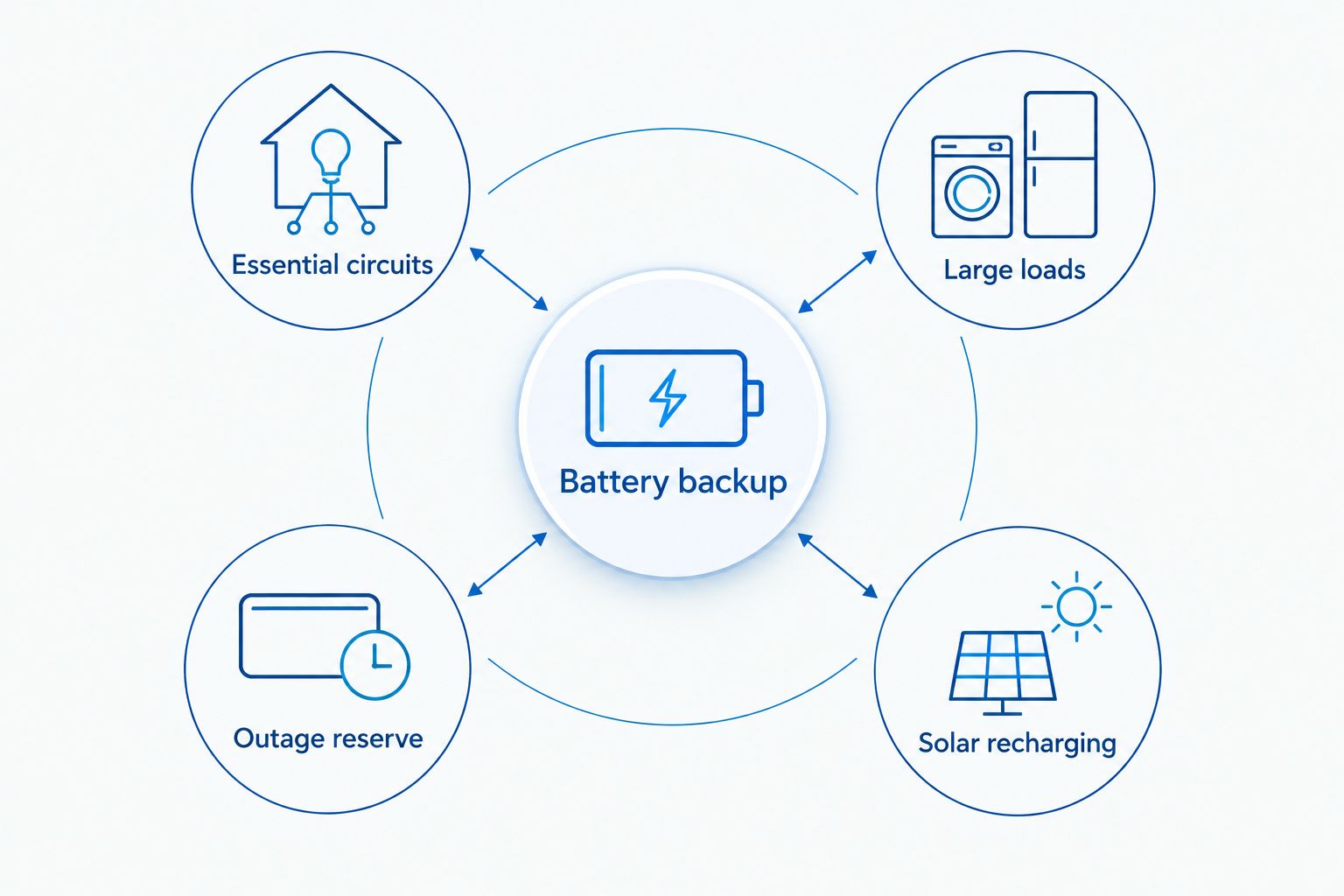
Give each company the same backup priorities:
- Essential circuits: refrigeration, lights, internet and other necessities you identify.
- Large loads: air conditioning, electric cooking, water heating or EV charging you want evaluated separately.
- Outage reserve: stored energy you want held back for an interruption instead of routine bill management.
- Solar recharging: how the proposed system operates and replenishes the battery when the grid is down.
Best for either company: homeowners whose proposal identifies backed-up circuits and operating limits in writing. Do not accept uninterrupted whole-home power as an assumption. Standard grid-connected solar without suitable backup equipment does not keep supplying your home during an outage.
For your 2026 comparison, ask whether central air conditioning is included in the backup design or excluded. That single distinction changes what an outage-protection proposal actually delivers.
Pricing: ownership offers control; contracts define the alternative
Compare the payment model before comparing the payment itself. Owning equipment, financing a purchase, leasing a system and purchasing its output create different rights and obligations.
For the local proposal, request the purchase terms and any financing terms separately. For Sunrun, identify whether the proposal is a lease, power purchase agreement or purchase arrangement. Do not compare unlike models as though they deliver identical ownership rights.
| Model | What you evaluate | Main tradeoff |
|---|---|---|
| Direct purchase | Complete installed scope and ownership responsibilities | Equipment control comes with responsibility for uncovered work |
| Financed purchase | Loan terms, total repayment and equipment ownership | Payments spread the purchase obligation over time |
| Lease | Scheduled payments, changes and contract duties | Payment structure is defined by the agreement, not equipment ownership |
| Power purchase agreement | Energy rate, production billing and contract duties | Payments relate to system output under the agreement |
A fixed payment schedule is not the same as a fixed household electricity bill. Your utility bill also reflects electricity imported from the grid, applicable charges and the utility's export-credit rules.
Ask for a 2026 projection that shows its assumptions about household consumption, solar production and utility treatment. Treat projected savings as an estimate, not a guarantee. Verify current incentive rules and your eligibility before including any benefit in your decision.
Sunrun's ownership model helps buyers seeking covered maintenance
A third-party-owned system can suit homeowners who want covered maintenance assigned to the system owner rather than handled as an equipment-owner responsibility. That is a genuine reason to consider Sunrun's lease or power purchase agreement route.
The contract still sets the boundaries. Ask which failures are covered, who diagnoses problems, what exclusions apply and whether roof-related work creates separate obligations. Do not assume every service visit or future equipment change falls within the agreement.
Sunrun wins this dimension for buyers specifically seeking provider responsibility under a third-party ownership contract. The limitation is contractual dependence: your remedy follows the written coverage and service process.
With an owned installation, separate manufacturer coverage from installation workmanship and ongoing service. A manufacturer's equipment warranty is not automatically a promise that every associated labor task is covered. Have the installer identify each responsibility before you sign.
Selling your home is a contract tie
Neither company earns a home-sale advantage without examining the agreement you sign. An owned system, financed system and third-party-owned system create different questions for you and a future buyer.
For a financed purchase, ask how the financing must be handled during a sale. For a lease or power purchase agreement, ask about transfer approval, buyer obligations and any contractual buyout route. Get the relevant clauses, not a verbal assurance that the process is easy.
Best for either company: homeowners whose contract matches their likely moving plans. If you expect to sell before your agreement ends, make the sale process a selection criterion now.
Use the same test for both proposals: can you explain, in plain language, what happens to the equipment and payment obligation when ownership of the house changes? If not, request clarification before proceeding.
Local support wins on access; written duties decide accountability
A local team is a useful fit when you want a contractor familiar with your installation and available for follow-up discussions. The stated service approach includes support after installation, which belongs in your evaluation alongside system design.
That is not evidence of faster repairs or better service than Sunrun. Those outcomes require evidence beyond a company description. Ask both providers who receives a fault report, who troubleshoots it and who authorizes a site visit.
Your handover should explain:
- How you view solar production and battery operation.
- Which alerts require action and whom you contact.
- What must happen before the system receives permission to operate.
- Which documents describe equipment, workmanship and service coverage.
For a 2026 installation, distinguish equipment installation from utility authorization and final system handover. A completed roof installation does not by itself establish that every activation step is finished.
Final verdict: match the provider to your ownership preference
Choose Alphasolarsa if you want local, coordinated planning
Named profile: the San Antonio homeowner planning solar plus battery backup. Start here when you want a local team to consider your roof, outage priorities and related services such as EV charging together.
The next move is a free consultation with your electricity bills, a list of essential circuits and any planned electrical upgrades. Ask for a custom design and a clear division of installation and ongoing service responsibilities.
Choose Sunrun if you want to evaluate third-party ownership
Named profile: the homeowner who prefers a lease or power purchase agreement. Start here when you want to compare a contracted solar arrangement with purchasing equipment.
Read the complete agreement before deciding. Payment changes, maintenance coverage, home-sale requirements and end-of-term options matter as much as the initial proposal.
| Dimension | Winner |
|---|---|
| Coordinated local home-energy planning | Local contractor |
| Lease or power purchase agreement focus | Sunrun |
| Battery backup performance | Tie—proposed design decides |
| Payment model | Your ownership preference decides |
| Provider maintenance under third-party ownership | Sunrun, subject to contract |
| Home-sale suitability | Tie—agreement decides |
| Local support relationship | Local contractor; verify written duties |
Plan your solar and battery system
Discuss your electricity use, outage priorities and installation scope in a free consultation.
FAQ
Is Alpha Solar or Sunrun better for a San Antonio homeowner?
Alphasolarsa is the better starting point for local solar installation and coordinated battery planning; Sunrun fits homeowners specifically evaluating a lease or power purchase agreement. Compare written system designs and contract terms before choosing.
Does Sunrun own the solar panels on my roof?
Sunrun retains system ownership under a third-party-owned lease or power purchase agreement. Check your proposed agreement rather than assuming every solar arrangement uses the same ownership model.
Will solar panels keep my house powered during an outage?
Standard grid-connected solar alone does not provide household backup during a grid outage. You need a suitable backup configuration, and the design determines which loads it supports.
Can either company back up my central air conditioner?
Central air conditioning requires a battery and electrical design matched to the equipment’s operating and starting demands. Ask each installer to state explicitly whether the proposed backup system includes your air conditioner.
How should I compare solar financing with a lease?
Compare equipment ownership, total contractual obligations, maintenance responsibility and home-sale requirements. A payment alone does not show whether two proposals provide equivalent equipment or rights.
What happens to a solar agreement when I sell my house?
The financing or solar-service contract determines what happens during a home sale. Review transfer, payoff and buyout provisions before signing, especially if you expect to move.
What should I bring to a solar consultation?
Bring your electricity bills, outage priorities and details of planned electrical upgrades. Include EV charging or air-conditioning requirements so the installer can evaluate them in the proposed design.
One last thing
Ask each provider to write two separate statements: what the system is designed to do during normal grid operation, and what it is designed to do during an outage. Lowering grid purchases and keeping essential circuits powered are different jobs. A proposal that explains both clearly is more useful than a broad promise of energy independence.
Related guides
- Solar installation in San Antonio: what delays activation
- Solar panels in San Antonio: add a battery now or later
- Solar panel financing: compare APR and total loan cost
- Can solar battery backup run your central air conditioner?