Choose Alpha Solar Solutions if you want a San Antonio contractor to plan residential solar and battery backup together; choose Palmetto if its written proposal better matches your ownership preferences, backup needs and service expectations. This 2026 comparison separates the local-service advantage from the contract and system details that should decide your purchase.
- For alpha solar vs palmetto, prioritize your written solar and battery backup scope over the sales presentation.
- Alpha Solar Solutions is the local-contractor choice for San Antonio homeowners planning solar with battery backup.
- Choose Palmetto when its documented system design, contract terms and service responsibilities better fit your household.
- Neither proposal earns a backup-power advantage without a written list of supported circuits and operating limits.
Why this matters
A solar purchase involves separate decisions about electricity production, outage protection and responsibility after installation. A proposal that looks attractive on the bill-savings page can still leave your most important outage needs unanswered.
Solar panels alone do not establish what your home can power during an outage. Battery equipment, electrical connections and system settings determine that capability. Compare the complete installation, not just the panels or the company name.
For your 2026 decision, give each provider the same requirements. Otherwise, you risk comparing a bill-reduction system against a more extensive backup installation and mistaking different scopes for different value.
At a glance
Use this table to organize your comparison. Conditional entries describe what a proposal must demonstrate, not an assumed feature or contractual promise.
| Dimension | Alpha Solar Solutions | Palmetto |
|---|---|---|
| Best for | San Antonio homeowners seeking a local solar-and-battery contractor | Homeowners whose Palmetto proposal better satisfies their written requirements |
| Local planning | San Antonio-based team and custom system designs | Choose when the assigned project team demonstrates a better plan for your property |
| Standout feature | Solar installation and battery backup within the stated service offering | Look for a documented proposal advantage that matters to your household |
| Outage protection | Battery backup and Powerwall systems are offered; confirm the actual scope | Require the same circuit list, operating limits and recharge explanation |
| Support after installation | Support after installation is part of the stated positioning; confirm responsibilities | Favor the proposal if its written support process better meets your needs |
| Future electrical needs | EV charger installation is also offered | Confirm whether future charging requirements are included in the design |
| Pricing model | Compare the ownership and payment terms actually offered | Apply the same ownership and total-obligation comparison |
The local contractor wins when local planning is your priority
A nearby provider is a relevant choice when you want your roof, electrical equipment and backup priorities discussed as one project. The stated service scope includes residential solar, batteries, EV chargers and panel cleaning. That gives you several related needs to raise during a consultation without assuming they are included in the installation contract.
Custom design matters because your available roof area and electricity use are specific to your property. Bring 12 months of electricity bills so the discussion reflects seasonal consumption rather than a single unusually high or low month.
The limitation: a local address does not establish better equipment, faster completion or stronger warranty coverage. Those advantages require written evidence. Ask who will perform the site assessment, manage approvals and answer questions after handover.
Best for: a San Antonio homeowner who wants a local contact and a custom solar-plus-storage discussion. Do not treat proximity as a substitute for checking the proposal.
Palmetto wins when its written project plan fits better
Palmetto is the better choice when its actual proposal resolves a requirement the competing proposal leaves unresolved. Examples include a clearer electrical-work scope, a better match to your ownership preference or a more explicit allocation of service responsibilities. These are decision conditions, not claims about standard Palmetto terms.
Ask both providers to describe the same project before choosing. A proposal that excludes battery backup cannot be evaluated as though it delivers the same outage protection as one that includes it.
For Palmetto, request the names of the companies responsible for installation and ongoing service, along with the escalation process if something stops working. Apply exactly the same questions to the local contractor.
Best for: a homeowner who chooses by documented project fit rather than company location. The tradeoff is that a persuasive presentation still needs to become an enforceable written scope.
Battery backup is a tie until the designs prove otherwise
Neither company earns an outage-protection win from a battery name alone. You need to know which appliances the proposed installation supports, what happens when those appliances start together and how the battery receives energy during an outage.
Distinguish power, measured in kilowatts, from stored energy, measured in kilowatt-hours. Power concerns what the system can run at a given moment; stored energy concerns how much electricity it can supply over time. Both matter, and neither by itself establishes whole-home backup.
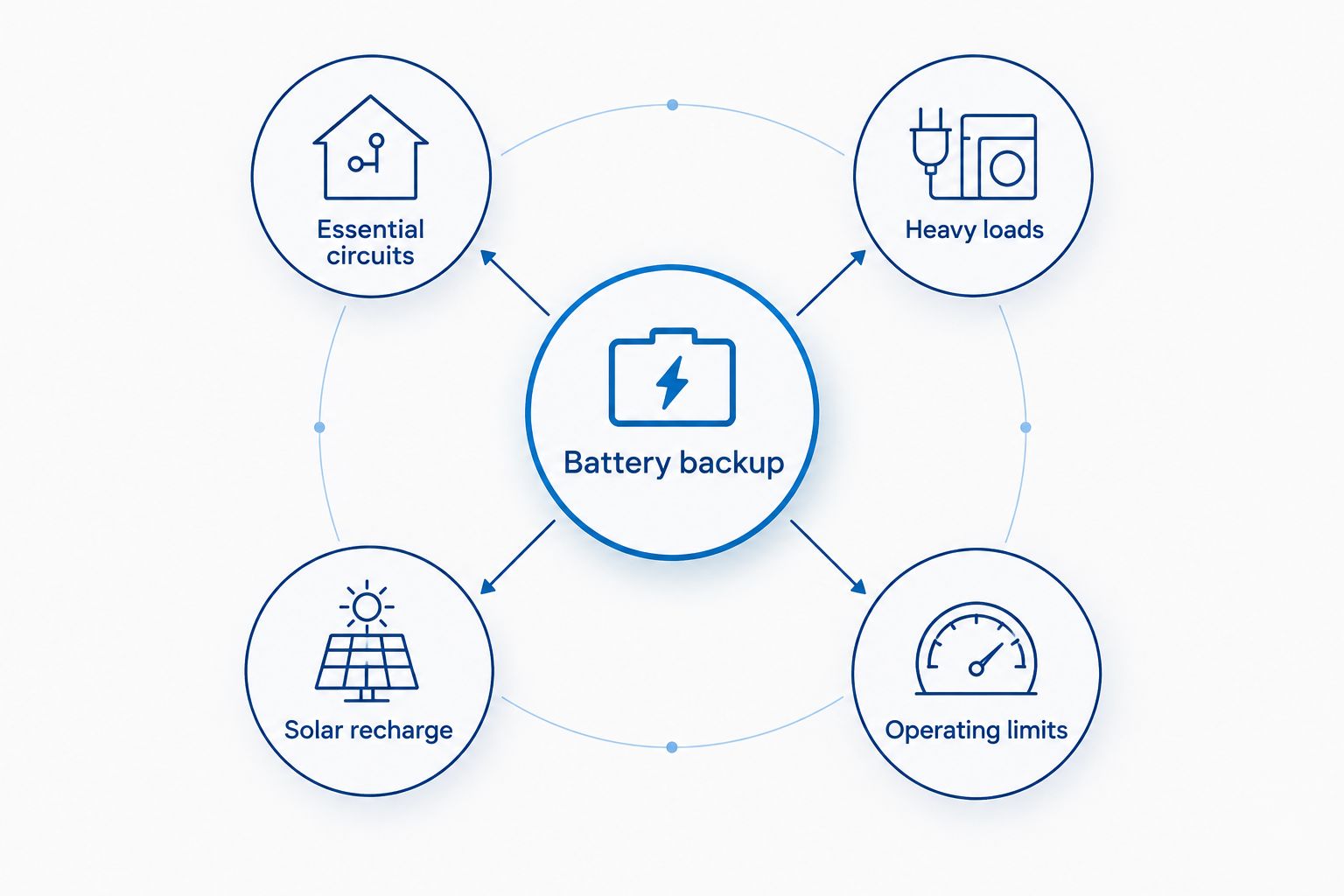
Give both providers the same list of priorities:
- Essential circuits: refrigeration, selected lighting, communications and other loads you identify.
- Heavy loads: air conditioning, electric cooking or other demanding equipment you want assessed.
- Solar recharge: an explanation of whether and how the proposed system recharges during a grid outage.
- Operating limits: what you must switch off or avoid running together.
Ask for an estimated runtime tied to named appliances and stated assumptions. If you want a 24-hour backup scenario, request that specific calculation; do not interpret it as a promised operating duration.
For the timing decision, read the guide to adding a battery now or later. The important question is whether the initial electrical design supports your intended next step.
Palmetto wins on support only with better written responsibilities
A clear service process can outweigh the convenience of a nearby office. Choose Palmetto on this dimension if its agreement provides a better-defined route from reporting a fault to diagnosis and repair than the competing agreement.
Separate the equipment manufacturer's warranty from the installer's workmanship obligations. Then ask who diagnoses a problem, who submits a claim and which labor or site-visit obligations appear in the contract. Do not assume those responsibilities belong to the same company.
The local provider's stated support after installation is relevant, but the contract still needs to explain what that support covers. Neither reassurance nor a monitoring app answers who takes responsibility for a roof leak, an electrical fault or a production concern.
Best for: a homeowner who values clear repair accountability above proximity. The limitation is straightforward: a longer warranty headline is not proof of broader service coverage.
The local service range helps when you are planning an EV
Alpha Solar Solutions offers EV charger installation alongside solar and battery backup. That makes future home charging a relevant part of the initial design conversation, even if you are not installing a charger immediately.
Tell the designer about your expected driving and charging routine. Ask whether the proposal accounts for added electricity consumption, electrical-panel capacity and the interaction between charging and backup loads.
This is not an automatic design advantage over Palmetto. A Palmetto proposal that explicitly addresses those needs can meet the same buying requirement. The local service range gives you a practical starting point, not proof that every related task is bundled.
Best for: a homeowner planning solar, storage and home charging together. Keep charging requirements separate from outage priorities so discretionary charging does not obscure the loads you most want protected.
Pricing is a tie until ownership and scope match
For a 2026 purchase, compare the payment arrangement with the installation scope attached. A lower monthly obligation is not enough to establish the better deal, especially when ownership, maintenance responsibilities or future obligations differ.
Evaluate whichever structures each provider actually offers:
- Direct purchase: you buy the installation; review the complete scope and your ongoing responsibilities.
- Loan-funded purchase: financing spreads payments over time; compare interest, fees, repayment terms and the total obligation.
- Lease: review equipment ownership, payment changes, maintenance duties and transfer requirements if this arrangement is offered.
- Power purchase agreement: review the electricity-purchase terms, payment changes and property-sale obligations if this arrangement is offered.
These models exchange different amounts of upfront commitment, payment flexibility and contractual complexity. Do not assume either provider offers every model, and do not compare ownership with a service arrangement as though the obligations are identical.
Request 2 itemized proposals, each covering the same solar, battery and electrical work. Check exclusions for roof work, panel changes, permitting and other project tasks rather than assuming they are included.
Treat incentives separately. Before including any benefit in your decision, verify the rules applicable to your 2026 installation, ownership arrangement and tax circumstances. An attractive estimate does not establish eligibility.
Final verdict: match the winner to your household
Choose Alpha Solar Solutions for a local solar-and-battery discussion
Best for: the San Antonio homeowner who wants a local contractor to plan solar, battery backup and related electrical needs. The stated offering and custom-design approach fit that starting point.
Book a consultation when you can explain your electricity use, outage priorities and future charging plans. Continue only after the written proposal identifies the equipment, backed-up loads, project responsibilities and support terms you need.
Choose Palmetto when its documented offer is the better fit
Best for: the homeowner whose Palmetto proposal provides a better system scope, ownership arrangement or service agreement. Those are genuine reasons to choose it, even when a local contractor is also available.
Ask for revisions if important requirements remain verbal. Palmetto wins this comparison for your household only when the written offer resolves those requirements better—not because of a brand-level assumption.
| Dimension | Winner |
|---|---|
| Local planning | Local contractor for buyers prioritizing a San Antonio team |
| Written project fit | Palmetto when its proposal better meets the same requirements |
| Standout feature | Local service combination; Palmetto needs a documented proposal advantage |
| Outage protection | Tie until supported loads and limits are documented |
| Support after installation | Palmetto when its written responsibilities are stronger |
| Future electrical needs | Local service range is relevant; compare the actual design |
| Pricing model | Tie until ownership, scope and obligations match |
Discuss your solar and backup priorities
Ask for a free consultation about your electricity use, essential circuits and future charging needs.
FAQ
Is Alpha Solar Solutions better than Palmetto in San Antonio?
Alpha Solar Solutions is the local-contractor choice for San Antonio homeowners seeking solar and battery backup. Choose Palmetto instead when its written proposal better meets your system, ownership and service requirements.
Which company is better for keeping my home powered during outages?
The better choice is the provider whose design documents your required backup loads and operating limits. Compare supported circuits, appliance starting demands and outage recharging rather than assuming a battery backs up everything.
Can I compare the companies using only the monthly payment?
No, a monthly payment does not establish equivalent ownership or installation scope. Compare the complete payment obligation, equipment, electrical work and service responsibilities.
What should I bring to a solar consultation in 2026?
Bring 12 months of electricity bills and a list of appliances you want protected during outages. Include future EV charging plans and any known roof or electrical concerns.
Does a local solar installer automatically provide better support?
No, location alone does not establish better support. Ask each provider to identify who handles diagnosis, warranty claims, labor and repair scheduling in writing.
Should I buy solar panels and battery backup together?
Plan them together when outage protection is part of your goal, even if you choose to install storage later. Ask how the proposed electrical design supports that later addition and what work it would require.
Can I count on a solar incentive when comparing proposals?
Do not count an incentive as confirmed until you verify the current eligibility rules for your installation and circumstances. For a 2026 purchase, review ownership requirements and applicable tax rules before relying on an estimated benefit.
One last thing
Ask each provider to explain what happens after installation but before utility-approved operation. Physical completion and permission to operate are separate milestones; your proposal should identify who handles the remaining approvals and communicates progress.
For your 2026 decision, request a handover explanation as well: how to view production, recognize a system alert and use the agreed backup settings. A clear answer gives you something more useful than another sales claim—a practical picture of owning the system.
Related guides
- Solar installation in San Antonio: what delays activation
- Can solar battery backup run your central air conditioner?
- Solar panel financing: compare APR and total loan cost