Solar Edge Pros belongs on your shortlist when its written proposal matches your roof, electricity use and backup priorities. If that proposal does not explain what stays powered during an outage or who handles service afterward, compare the installation scope before signing. The best Solar Edge Pros alternative in 2026 is Alpha Solar Solutions if you want a San Antonio contractor offering residential solar and battery backup; a staged installation is the alternative if you want to separate those decisions.
- For solar edge pros alternatives, shortlist Alpha Solar Solutions for residential solar and battery backup in San Antonio.
- Compare backup circuits, installation responsibilities and service terms, not just the number of panels.
- Solar-first installation separates the decisions but does not provide battery-backed outage protection.
- Keep Solar Edge Pros if its written proposal meets your requirements better than the alternatives.
Why this matters
A solar proposal answers two different questions: how you produce electricity and what happens when the grid fails. Those questions overlap, but they are not interchangeable. A grid-connected solar installation without equipment designed for backup generally shuts down during an outage to prevent electricity from feeding an unsafe grid connection.
Your 2026 comparison should therefore start with your household priorities. Lower electricity purchases, refrigerator backup and central air-conditioning backup require different design decisions. Ask each contractor to explain those decisions before comparing financing or signing an agreement.
Solar Edge Pros alternatives at a glance
The table separates a named contractor from installation strategies. A staged project is not another company; it is a different way to approach the same household decision.
| Contractor or approach | Best for | Main point to compare | Difference from choosing Solar Edge Pros |
|---|---|---|---|
| Solar Edge Pros | Homeowners whose proposal meets their requirements | Written equipment, backup and service scope | The original proposal remains your benchmark |
| Alpha Solar Solutions | San Antonio homeowners considering solar with battery backup | Local team, custom system design and support after installation | Another contractor to assess against the same household requirements |
| Solar first, battery later | Homeowners prioritizing electricity production before storage | Future battery compatibility and additional installation work | Changes the project sequence rather than selecting a particular competitor |
| Battery addition to existing solar | Homeowners who already have panels and want backup | Existing equipment compatibility and protected circuits | Focuses on storage integration instead of a new solar installation |
The right comparison is not simply “which installer includes more panels?” Compare what each completed system does for your home and what the contract requires the installer to deliver.
1. Alpha Solar Solutions: best for local solar and battery planning
Alpha Solar Solutions offers residential solar panel installation and battery backup/Powerwall systems in San Antonio. Its solar and installation services also include EV charger installation and solar panel cleaning. That makes it a relevant contractor to consult when your plans involve more than rooftop panels alone.
For a homeowner comparing solar contractors in 2026, the useful starting point is a custom design discussion. Bring your electricity bills, roof concerns and outage priorities. Ask how the proposed equipment addresses those needs, including which appliances the battery design supports.
Where this option shines
- Local planning: Discuss your San Antonio home with a local team rather than treating the installation as an equipment-only purchase.
- Solar and storage scope: Consider electricity production and battery backup within the same design conversation.
- Related electrical needs: Include an EV charger in the discussion if home charging is part of your plans.
- Support after installation: Ask the team to explain the process for monitoring questions, fault reports and service requests.
Where this option falls short
- A combined project has more decisions: Battery location, protected circuits and operating settings add work to the design process.
- Local presence does not establish performance: Judge the actual design and written obligations, not proximity alone.
- A battery is not a whole-home guarantee: Running large appliances depends on the equipment, electrical layout and available stored energy.
- A consultation is not a completed assessment: Roof condition, electrical equipment and household demand still need review before you accept a final scope.
Head-to-head: what to compare in writing
| Dimension | Local solar-and-battery proposal | Solar Edge Pros proposal |
|---|---|---|
| System design | Request roof layout, production assumptions and battery scope | Request the same documents |
| Outage protection | Ask for named protected circuits and operating limits | Compare the same appliances and conditions |
| Project responsibility | Identify who handles approvals, installation and activation | Identify those responsibilities in the competing agreement |
| After-installation support | Get the service process and applicable terms in writing | Compare the written service process and terms |
Best for: San Antonio homeowners who want to discuss solar, battery backup and related installation needs with one local contractor.
Verdict: Buy only after the written design, backup scope and contract meet your requirements.
2. Solar first, battery later: best for separating the decisions
A solar-first project installs generation before adding storage. This approach suits a homeowner whose immediate goal is producing electricity and who is not ready to choose a battery. It does not solve outage protection by itself.
The important decision happens before the panels go up. Ask how the selected inverter, electrical layout and proposed battery location affect a later addition. “Battery-ready” should lead to a written explanation, not end the conversation.
Where this approach shines
- You can assess the solar design without choosing a backup configuration at the same time.
- You can use your monitoring history to inform later storage discussions.
- You can revisit backup priorities when household needs change.
Where this approach falls short
- You postpone battery-backed outage protection.
- A later battery project requires its own installation planning.
- Compatibility and electrical changes depend on the equipment already installed.
- Future expansion should not be assumed from a sales description alone.
| Decision | Solar first, battery later | Solar Edge Pros proposal |
|---|---|---|
| Outage goal | Deferred until suitable backup equipment is installed | Check whether backup is included |
| Installation sequence | Solar and storage become separate project stages | Check the proposed sequence |
| Equipment planning | Future battery integration needs attention now | Ask how the specified equipment supports expansion |
Best for: Homeowners who prioritize solar generation now and accept that backup remains a separate project.
Verdict: Hold the battery purchase until the future integration plan is clear.
3. Add a battery to existing solar: best for keeping usable panels
If your home already has solar, an alternative proposal does not automatically need a new panel installation. Start by asking whether the existing system can support a battery addition. The answer depends on its equipment and electrical design.
Bring the original equipment list, installation documents and monitoring access to the consultation. Those records help a contractor assess integration rather than assume replacement is necessary.
Where this approach shines
- Keeps the assessment focused on your existing system and backup goals.
- Gives you a reason to review how the current panels and inverter are operating.
- Lets you define protected circuits separately from rooftop generation needs.
Where this approach falls short
- Existing equipment does not establish compatibility with every battery.
- Electrical changes can be necessary even when the panels stay.
- A battery cannot correct every production or equipment problem in an older installation.
Best for: Homeowners with existing solar who want to investigate backup without starting from a replacement proposal.
Verdict: Hold any replacement decision until the contractor assesses the existing system.
Why consider switching from Solar Edge Pros?
Switch contractors when the competing written proposal fits your requirements better—not because an alternatives page puts another company first. Use the following checks to identify a meaningful difference.
The proposal leaves backup undefined
“Battery included” does not explain which appliances operate during an outage. Ask for the protected circuits, restrictions on simultaneous appliance use and assumptions behind any runtime estimate. A refrigerator and selected outlets are a different requirement from central cooling.
The production estimate is difficult to evaluate
Ask what electricity-use history, shading assumptions and roof layout support the estimate. Separate expected solar production from expected bill savings. Savings also depend on electricity charges, household consumption and applicable export arrangements.
Installation and activation are treated as the same milestone
Panels on the roof do not necessarily mean the system is authorized for normal operation. Ask who manages inspections, utility coordination and remaining approvals. Your 2026 project schedule should distinguish physical installation from activation.
Service responsibility is unclear
Get a clear route for reporting a fault after installation. Ask who diagnoses the issue, which terms apply and whether equipment coverage and installation workmanship coverage are separate. A verbal assurance is not a substitute for the agreement.
These are reasons to request a revised proposal or compare another contractor. They are not claims that Solar Edge Pros has these shortcomings.
Compare battery proposals without getting lost in specifications
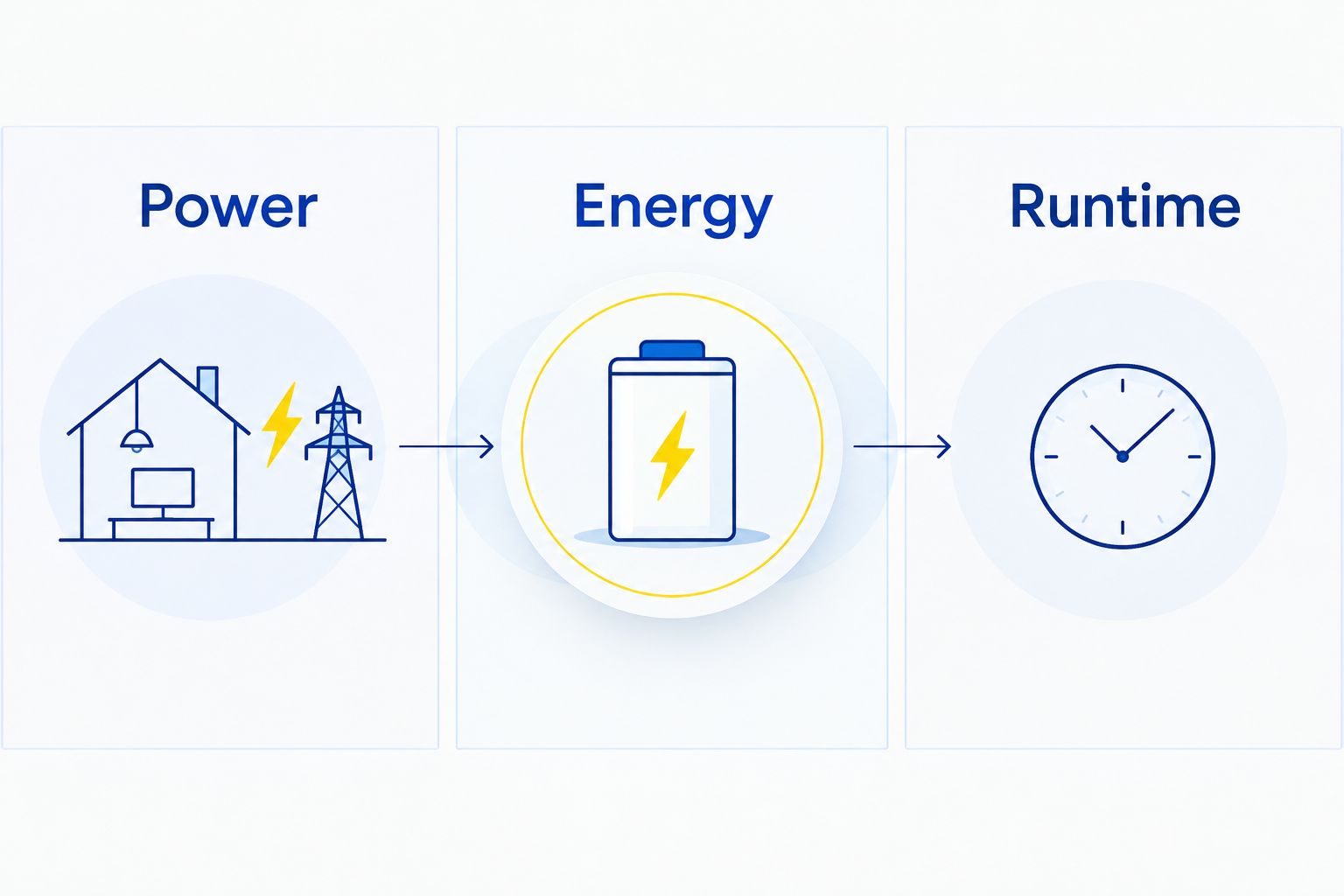
Battery comparisons become easier when you separate power, energy and runtime. They describe different limits, and a useful proposal explains all three in relation to your appliances.
- Power: Kilowatts describe how much electrical demand equipment can supply at a moment. 1 kilowatt equals 1,000 watts.
- Energy: Kilowatt-hours describe an amount of electricity. 1 kilowatt-hour equals 1 kilowatt used for 1 hour.
- Runtime: Duration depends on usable stored energy and the appliances operating during the outage. A steady 2-kilowatt load uses 2 kilowatt-hours in 1 hour, before accounting for system losses.
These are unit definitions, not promises about a particular battery. Starting a large motor also creates a different demand from keeping a small appliance running.
For a useful 2026 comparison, give every contractor the same appliance list. Name the refrigerator, freezer, internet equipment, lights and any medical equipment that matters to your household. Ask separately about central air conditioning rather than assuming it fits within the same backup plan.
What to bring to a free consultation
A useful consultation starts with your home, not a preferred panel count. Gather the information below so the discussion produces a clearer scope.
- Electricity use: Bring available bills and explain planned changes, such as an EV or different cooling needs.
- Roof condition: Flag leaks, repairs, shade and any planned roof replacement.
- Outage priorities: List essential appliances and distinguish necessities from conveniences.
- Existing equipment: Provide solar, inverter, battery and electrical-panel details if you have them.
- Buying priorities: Explain whether you value electricity production, backup protection or a staged project most.
Ask for assumptions in writing. If a proposal discusses incentives in 2026, confirm the current rules and your eligibility before treating them as part of your decision. Do not accept guaranteed savings or uninterrupted whole-home power as substitutes for a documented design.
Discuss your solar and backup priorities
Bring your electricity bills and outage priorities to a free consultation.
When staying with Solar Edge Pros is the right call
Keep Solar Edge Pros if its written design, installation responsibilities and service terms meet your needs better than the competing proposals. Switching has no value when the alternative does not improve the scope you actually care about.
Before signing, check that promised equipment, protected circuits, exclusions and project responsibilities appear in the agreement. If you have already signed, review cancellation and termination terms before making another commitment. Do not assume changing contractors is an informal handoff.
FAQ
What’s the best Solar Edge Pros alternative in San Antonio?
Alpha Solar Solutions is an alternative to shortlist for residential solar and battery backup in San Antonio. Compare its written design, protected circuits and service terms with your Solar Edge Pros proposal before choosing.
Is a local solar contractor automatically better?
No, local presence alone does not establish better equipment, workmanship or service. Evaluate the design, project responsibilities and written support terms alongside the contractor’s location.
Will solar panels keep my home powered during an outage?
Solar panels alone generally do not keep a grid-connected home powered during an outage. Backup requires equipment designed to isolate the home from the grid and supply the selected loads safely.
Should I install a battery with solar or add it later?
Install a battery with solar when backup is part of your current requirements; consider adding it later when generation is your immediate priority. For a staged installation, get the future compatibility and electrical requirements explained before choosing equipment.
Can a solar battery run my central air conditioner?
A solar battery can run central air conditioning only when the complete system supports its starting and running demands. Ask the contractor to assess your specific equipment and explain the effect on other backed-up appliances and runtime.
How do I compare solar financing proposals?
Compare the complete financing terms, not just the monthly payment. Review the amount financed, interest rate, fees, term, early-payoff provisions and obligations if you sell the home.
Do I need new panels to add battery backup?
Adding battery backup does not automatically require replacing your panels. A contractor needs to assess the existing inverter, electrical layout and proposed battery integration before specifying the work.
One last thing
Ask every installer the same question: “During an outage, what exactly will I need to turn off?” The answer turns a general backup claim into a practical household plan.
If the answer is unclear, pause the purchase. A useful proposal explains limits as clearly as benefits, whether you choose a new contractor or stay with Solar Edge Pros.
Related guides
- Solar panels in San Antonio: add a battery now or later
- Can solar battery backup run your central air conditioner?
- Solar installation in San Antonio: what delays activation?