
For most homes, plan on 10 to 13.5 kWh of usable capacity for essential backup. Plan on 20 to 40+ kWh if you want whole-home coverage during an outage. The exact number comes from a simple formula: daily kWh used, times the days of backup you want, divided by depth of discharge and round-trip efficiency. Everything below shows you how to run that math with your own numbers.
TL;DR:
- For critical backup needs, a battery capacity of at least 10 to 13.5 kWh typically powers essential loads for 12 to 24 hours, depending on appliances used.
- Homes with high energy needs or include air conditioning and EV charging in critical loads may require 25 to 40+ kWh batteries for whole-home or multi-day backup.
- The required usable kWh depends on daily consumption, desired backup days, battery DoD, and round-trip efficiency, with larger batteries needed for longer autonomy.
- Precise sizing should consider continuous and surge power ratings to ensure appliances like well pumps and AC units can start and run simultaneously.
- Homeowners should verify system components, local climate effects, and warranty terms with installers to ensure capacity and reliability meet actual backup and usage requirements.
Table of Contents
- How Many kWh Battery Do You Need? The Formula
- What Do Different Battery Sizes Actually Power?
- Worked Examples: From Daily Usage to Battery Count
- What Should You Confirm With Your Installer?
- How Alpha Solar Solutions Sizes a Battery System
- Battery vs. Generator: What Actually Makes Sense
- Ready to Get Your Actual Number?
- Sources
- FAQ
How Many kWh Battery Do You Need? The Formula
Before you can answer “how many kWh battery” your house needs, you need four numbers: your daily kWh usage, how many days of autonomy you want, your battery’s depth of discharge (DoD), and its round-trip efficiency.
Here’s how to gather each one:
- Daily kWh usage. Check your electric bill for total kWh over a billing cycle and divide by the number of days. A smart meter or your utility’s online portal gives you daily granularity, which is more accurate.
- Days of autonomy. Decide if you’re planning for a single evening outage, a 24 hour grid failure, or a multi-day storm scenario.
- Critical loads vs. whole house. List what you actually need powered (fridge, well pump, medical devices, some lighting) versus everything you currently run.
- DoD and round-trip efficiency. Most lithium batteries specify both on the spec sheet; expect usable capacity to run 20 to 35 percent lower than the nominal rating once you factor these in.
Two formulas apply depending on your goal. For backup sizing (the “insurance” frame), use: Required usable kWh = (critical-load kWh/day × days of autonomy × 1.2 safety factor) ÷ (DoD × round-trip efficiency), a formula SurgePV uses to build out sizing tables. For self-consumption sizing, the goal is different: matching evening usage to your solar production window rather than surviving an outage.
If you don’t have bill data handy, the EIA puts average U.S. household use at roughly 10,400 kWh per year, or about 28 to 30 kWh a day. That’s a reasonable placeholder until you pull your own numbers.
What Do Different Battery Sizes Actually Power?
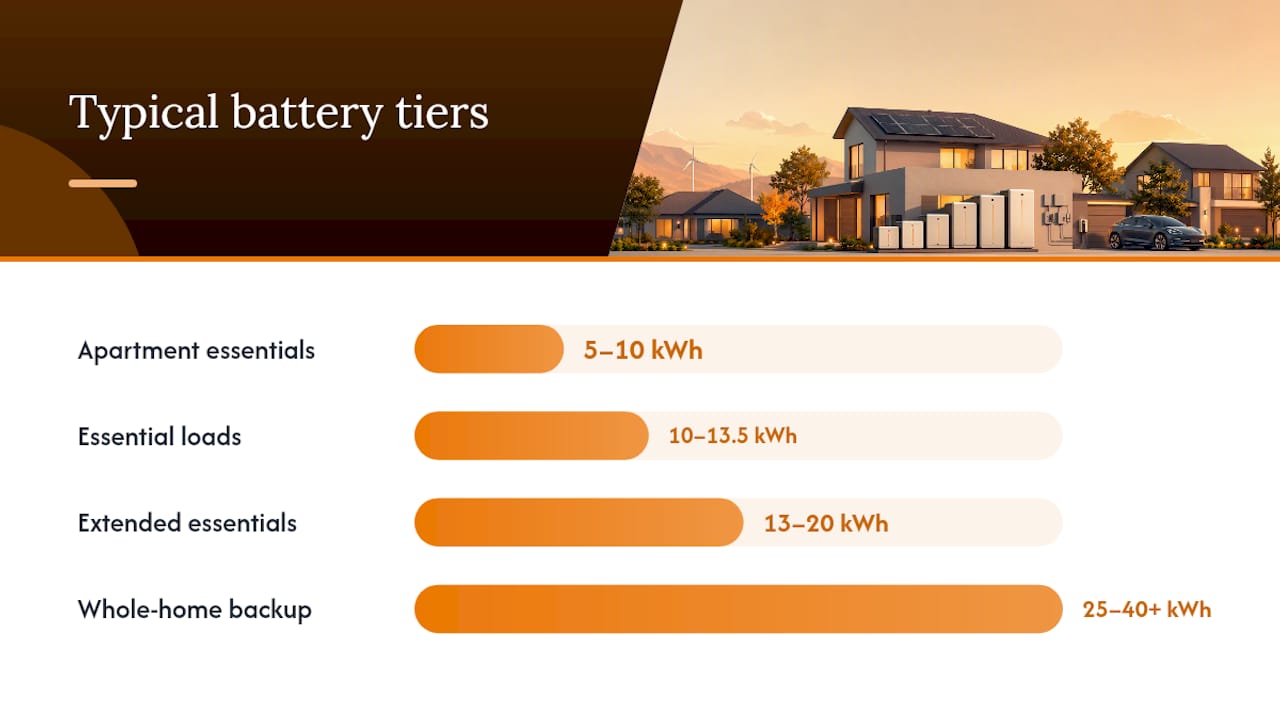
Battery specs get thrown around a lot, but the number only means something once you match it to a real outcome. Here’s how the common tiers break down:
- 5 to 10 kWh: Covers a fridge, Wi-Fi, some lighting, and phone charging for roughly half a day. Good for short outages or apartment-scale essentials.
- 10 to 13.5 kWh: The market’s sweet spot. A single unit here generally covers essential loads for 12 to 24 hours, based on SolarReviews data showing average homes use around 30 kWh a day.
- 13 to 20 kWh: Stretches essential-load coverage toward a full day and into a second, especially if HVAC stays off most of the time.
- 25 to 40+ kWh: Whole-home backup territory, usually built by stacking multiple standard units rather than buying one giant battery, according to StoryOfSolar.
Two loads wreck this math faster than anything else: air conditioning and EV charging. A window unit or central AC compressor can eat 3 to 5 kWh in an hour alone, and a Level 2 EV charger can pull 7 to 11 kWh per hour. If either is on your critical-load list, your autonomy window shrinks fast, no matter how big the battery label says it is.
Most residential systems ship in that 10 to 13.5 kWh range because it hits a sweet spot between cost and meaningful backup, and it stacks cleanly when a homeowner wants more.
Worked Examples: From Daily Usage to Battery Count
Numbers make more sense with real households attached to them. Here are two.
Small apartment, 5 kWh/day usage, 1 day of backup:
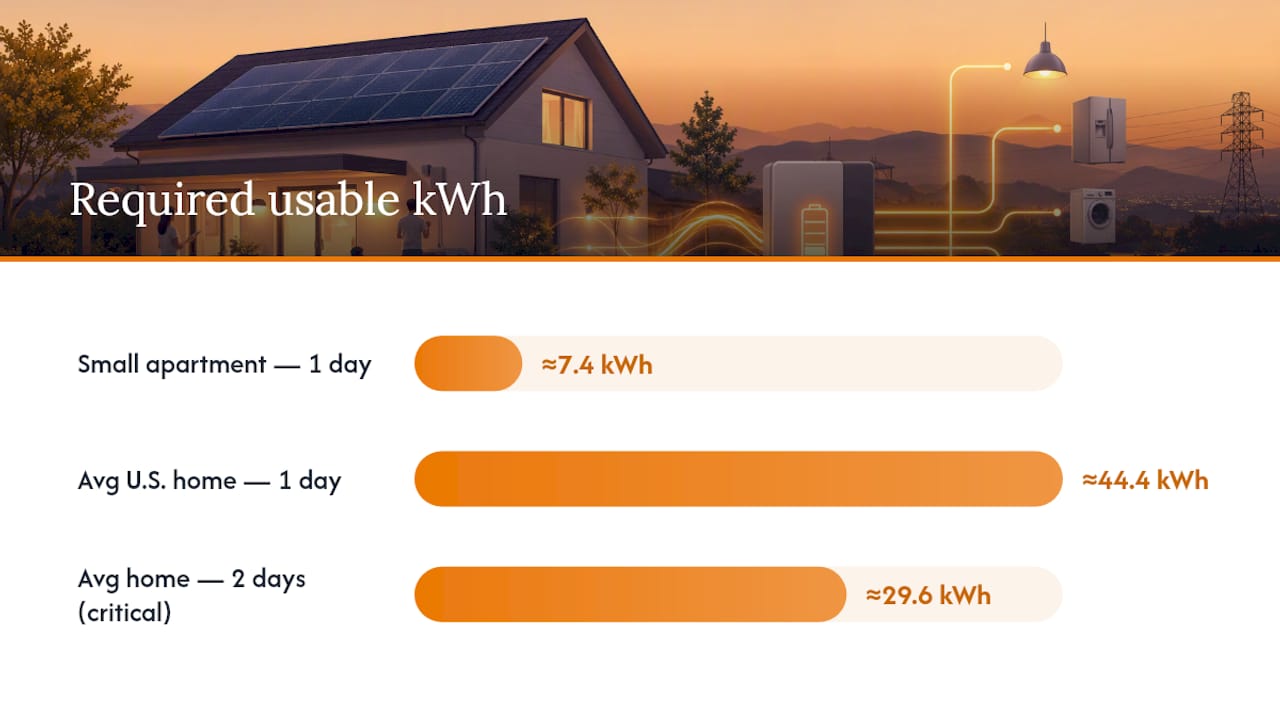
- Required usable kWh = (5 × 1 × 1.2) ÷ (0.9 × 0.9) ≈ 7.4 kWh
- A single 10 kWh unit comfortably covers this with margin to spare.
Average U.S. home, 30 kWh/day usage:
- One day backup: (30 × 1 × 1.2) ÷ (0.9 × 0.9) ≈ 44.4 kWh, meaning you’d need multiple 10 to 13.5 kWh units stacked for whole-home coverage, or a single 10 to 13.5 kWh unit if you’re only backing up critical circuits.
- Two day backup on critical loads only (say 10 kWh/day of essentials): (10 × 2 × 1.2) ÷ (0.9 × 0.9) ≈ 29.6 kWh, or about two to three standard units with 10 to 13.5 kWh usable capacity.
For readers converting spec sheets, the Ah to kWh formula is: kWh = voltage × Ah ÷ 1,000. A 12V, 200Ah battery holds 2.4 kWh nominal (12 × 200 ÷ 1,000). That’s a lead-acid or small LFP number, worth knowing when comparing older battery banks to modern lithium home units.
One catch that trips up a lot of DIY math: your battery might have plenty of kWh but not enough continuous power output to start a well pump or run central AC simultaneously with other loads. kWh sufficiency doesn’t guarantee kW sufficiency.
What Should You Confirm With Your Installer?
Kilowatt-hours only tell half the story. Before you commit to a system size, walk through this list with whoever’s doing the install:
- Continuous kW and surge capacity. Appliances like AC compressors and well pumps draw a power surge at startup that can exceed a battery’s continuous rating even when total kWh looks fine.
- Modularity and inverter pairing. Confirm your inverter’s maximum supported battery count, since most residential systems stack in fixed increments rather than scaling freely.
- Thermal derating. Extreme heat or cold reduces usable capacity, sometimes significantly, so ask how your installer accounts for local climate.
- Warranty and degradation terms. Most lithium batteries lose capacity over a 10 year warranty period; ask what percentage they guarantee at year 10.
- Installed cost versus benefit. Oversizing for whole-home backup gets expensive fast, and the marginal dollar spent on kWh 30 through 40 rarely buys as much peace of mind as the first 15.
Pro Tip: If you’re backing up medical equipment, size for that circuit first and separately from general essentials. A CPAP or oxygen concentrator running on a shared circuit with a refrigerator can push your critical-load number higher than expected.
How Alpha Solar Solutions Sizes a Battery System
A written kWh and kW spec should come out of your first site visit, not a guess. Alpha Solar Solutions builds that spec from a short audit:
- Pulling your meter data or bill history to establish real daily kWh usage
- Walking through your home to build a critical-load inventory (medical equipment, well pumps, HVAC)
- Checking inverter and existing solar compatibility before recommending a battery brand or count
- Reviewing local permitting requirements upfront so there are no surprises mid-project
The design philosophy starts small: size for essential loads first, then leave room to stack additional units later if your needs grow. Certified installers and ongoing support come standard with the process.
Battery vs. Generator: What Actually Makes Sense
Batteries win for short outages and daily time-of-use savings; they’re quiet, automatic, and require no fuel runs. Generators win on cost-per-kWh for multi-day, heavy-load outages, especially if HVAC or well pumps are involved. A lot of homeowners land on a hybrid: a critical-load battery for the instant, silent switch, backed by a generator for anything longer than a day or two. Lifestyle factors, like medical equipment or a home office that can’t go dark, should weigh as heavily as the math.
— Anthony
Ready to Get Your Actual Number?
Running the formula yourself gets you in the ballpark, but a site audit gets you the real number, tied to your actual panel, roof, and load profile. A straightforward first visit typically involves reviewing meter data, walking through critical loads, and providing a ballpark sizing recommendation along with next steps, no pressure attached.

From there, we handle permitting, paperwork, and the installation itself, whether you’re adding a single battery for essentials or building toward whole-home coverage. If you’re also weighing an EV charger, it’s worth sizing both at once since charging load changes your battery math more than almost anything else on the list. Ready to see what your home actually needs? Visit the residential solar and battery installation page to request a quote and get your written spec started.
Sources
- How many kWh does a house use? – SolarReviews
- Residential Battery Sizing kWh – SurgePV
- Solar Battery Size Calculator: How Many kWh Do You Actually Need? – StoryOfSolar
- How much electricity does an American home use? – U.S. Energy Information Administration (EIA)
FAQ
How Much Does a 1,000 kWh Battery Cost?
A 1,000 kWh battery is far beyond residential scale, it’s closer to commercial or utility-scale storage, so pricing isn’t typically listed for home installers. For residential systems, you’re realistically comparing 10 to 13.5 kWh units, and Alpha Solar Solutions can provide current pricing for battery backup systems sized to your actual home.
Is 8 kW Enough to Run a House?
Battery power capacity in kW is different from battery energy capacity in kWh, and whether your system size is enough depends on your critical loads and inclusion of high-draw appliances like AC or EV chargers.
How Long Will a 100 kWh Battery Last?
A 100 kWh battery is larger than most homes need, but for a typical U.S. home using about 30 kWh a day, it could provide roughly three or more days of autonomy under normal conditions. Actual duration depends heavily on your appliance load and whether HVAC or EV charging draws from it.
How Long Will a 20 kWh Battery Last?
For a home averaging 30 kWh of daily use, a battery in the 10 to 13.5 kWh range generally covers essential loads for 12 to 24 hours, and limiting usage to essentials like refrigeration, lighting, and Wi-Fi stretches backup duration well beyond that.