
New solar-plus-storage installs almost always do better with DC-coupled hybrid inverters, since they cut out an entire conversion stage and recover more clipped energy. Retrofitting a battery onto an existing, healthy solar system usually favors AC coupling instead, because it is cheaper to install and doesn’t touch your existing inverter. The right answer depends on your starting point more than any universal rule, and the tradeoffs below explain exactly why.
TL;DR:
- DC-coupled systems typically have higher efficiency on solar-to-battery charging pathways and recover clipped solar energy more effectively for oversize arrays.
- Retrofitting with a hybrid inverter makes sense mainly when replacing an aging inverter, expanding an existing array, or when your DC/AC ratio already exceeds 1.2.
- AC coupling usually costs less initially and allows for easier battery expansion, making it suitable for existing systems without inverter replacement or microinverter roofs.
- In backup scenarios, DC coupling offers cleaner, more reliable islanding, while AC coupling depends on two systems working together, which may introduce compatibility issues.
- The choice depends heavily on your current inverter’s age, your system’s oversizing, future expansion plans, and whether your roof uses microinverters.
Table of Contents
- AC vs DC Coupled: How the Wiring Actually Differs
- How Much Efficiency Do You Actually Lose With AC Coupling?
- Is DC Coupling Worth the Extra Upfront Cost?
- Which Setup Handles Backup Power Better?
- Which Coupling Fits Your Situation?
- How we evaluate coupling on real homes
- Get a Straight Answer for Your Own Roof
- Sources
- FAQ
AC vs DC Coupled: How the Wiring Actually Differs
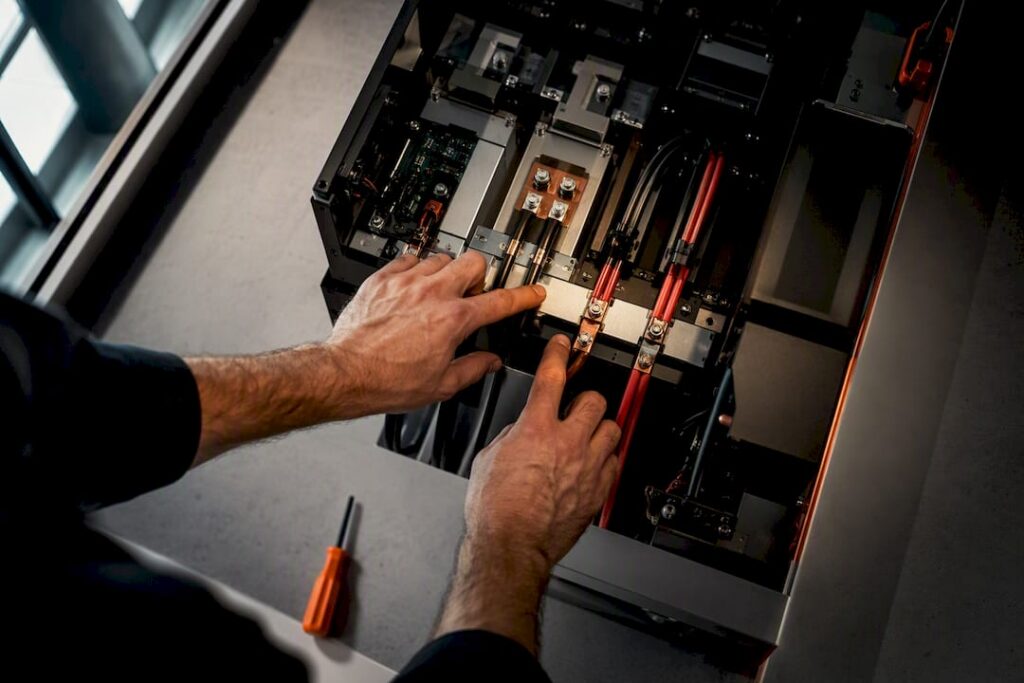
The fastest way to tell these two architectures apart is to look at where the battery physically connects. In an AC-coupled system, the battery has its own power conversion system (PCS) and ties into your home’s AC bus, right alongside your solar inverter. In a DC-coupled system, the battery shares a DC bus with the solar array, and both feed into a single hybrid inverter that handles the conversion once.
That single difference changes which hardware you need:
- AC-coupled: existing string or microinverter, plus a separate battery inverter (PCS)
- DC-coupled: one hybrid inverter with an internal DC-DC stage managing both solar and battery charging
- Microinverter roofs (Enphase-style systems) never have a DC bus, so AC coupling is the only practical path without replacing every panel-level inverter
If you want to check your own system in thirty seconds: count the inverters. One box handling both solar and battery means DC-coupled. Two separate boxes, one for solar and a smaller one for the battery, means AC-coupled. Batteries themselves always store direct current, since that’s simply how battery chemistry works, but the grid and your home’s outlets run on alternating current, which is why every architecture needs at least one conversion step somewhere along the line.
How Much Efficiency Do You Actually Lose With AC Coupling?
Every time electricity changes from DC to AC or back, you lose a small percentage as heat. DC-coupled systems skip a conversion step when charging the battery directly from solar, which is why they tend to run more efficiently on that specific path.
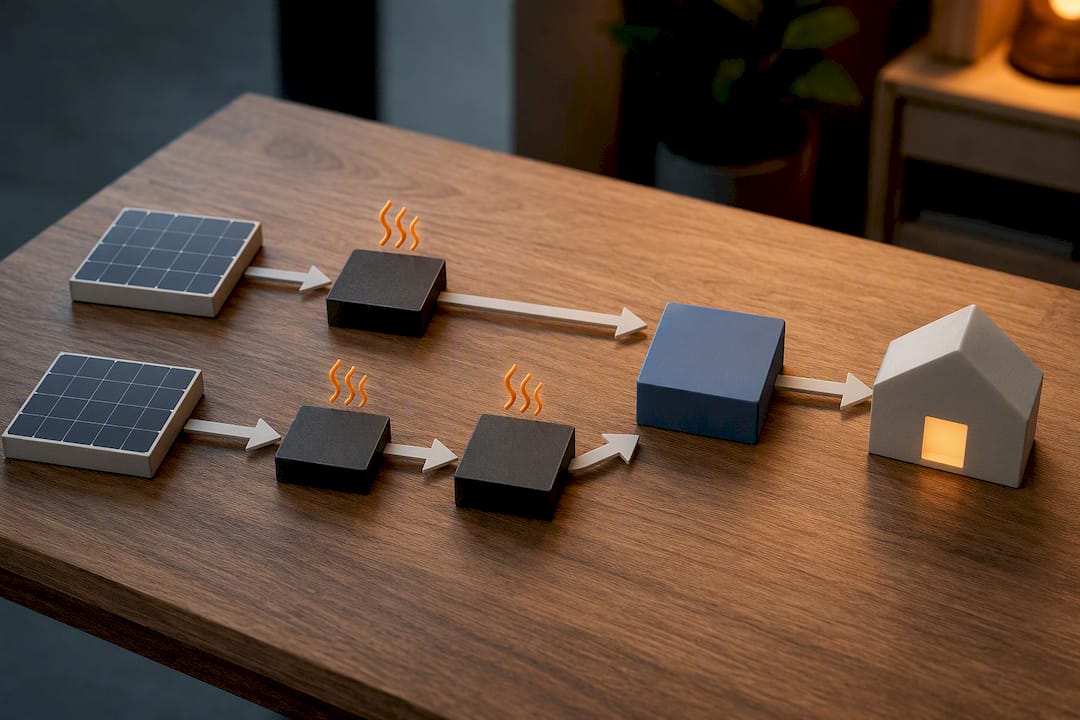
Pro Tip: Don’t judge coupling efficiency in isolation. A DC-coupled system’s advantage shows up mainly on the solar-to-battery charging path, not on every kilowatt-hour your home uses.
The numbers back this up:
- DC-coupled charge-path efficiency is often cited as very high, typically in the upper 90-percent range
- AC-coupled round-trip efficiency typically runs around 90–95%, depending on the specific inverter and battery hardware
- The gap between the two usually amounts to a few percentage points of round-trip efficiency, not a dramatic swing
Where DC coupling earns its keep is clipping recovery. If your solar array is oversized relative to your inverter, the inverter “clips” excess production it can’t push to the grid or your loads. A DC-coupled battery can absorb that clipped energy directly before it’s wasted. Analyses of realistic dispatch scenarios show this benefit becomes meaningful once your DC-to-AC ratio climbs to roughly 1.25 to 1.3, a common oversizing range for systems designed around battery charging.
Here’s a rough real-world example: a system with a DC/AC ratio around 1.25 might recover clipped energy amounting to a small but meaningful value annually in a sunny climate. Small on its own, but it compounds over a 20-plus-year system life. If your roof runs microinverters, none of this applies. DC coupling isn’t on the table without replacing the entire inverter fleet.
Is DC Coupling Worth the Extra Upfront Cost?
Hybrid inverters that enable DC coupling generally cost more upfront than adding a separate AC-coupled battery inverter to an existing system. That premium buys you fewer components and a simpler electrical path, but it only pays off under specific conditions.
Three signals suggest a DC retrofit, or a DC-first new build, makes financial sense:
- Your current inverter is near the end of its warranty or expected service life anyway
- You’re planning to expand your solar array and will need a bigger inverter regardless
- Your DC/AC ratio already sits above 1.2, meaning you’re clipping meaningful energy right now
If none of those apply, AC coupling is usually the cheaper retrofit path, since your existing solar inverter keeps doing its job untouched. To model payback quickly: take your estimated annual clipping recovery in kWh, multiply by your local utility rate, and compare that yearly figure against the price difference between a hybrid inverter swap and a standalone battery inverter. If the extra cost pays back within a reasonable stretch of your battery’s warranty period, DC coupling is the stronger buy. Homeowners weighing a full system redesign should also look at how design choices affect long-term value before locking in an inverter type.
Which Setup Handles Backup Power Better?
When the grid goes down, coupling architecture determines how smoothly your home transitions to battery power. Hybrid, DC-coupled inverters manage solar production and battery discharge from a single control system, which typically produces cleaner black-start behavior and fewer handoff glitches during islanding.
AC-coupled setups rely on two separate inverters talking to each other, often through frequency-shift signaling, to coordinate during an outage. That works well when both devices are certified compatible, but it introduces a dependency: firmware mismatches or unlisted hardware pairings can cause backup mode to fail or underperform.
Pro Tip: Ask any installer proposing an AC-coupled retrofit to demonstrate an actual islanding test, not just a spec sheet claim. Compatibility on paper doesn’t always match compatibility in practice.
- DC-coupled: often involves a single vendor for accountability and simpler troubleshooting, but less flexibility to mix brands
- AC-coupled: allows component independence and easier battery capacity expansion without inverter replacement, but relies on cooperation between two separate systems
For future battery augmentation, AC coupling’s flexibility can matter more than the efficiency edge DC coupling offers, especially if you expect to expand storage in phases.
Which Coupling Fits Your Situation?
Match your circumstances to the scenarios below before you call an installer:
- Building solar and battery together from scratch: default to DC-coupled hybrid inverters for the efficiency and clipping benefits.
- Retrofitting a battery onto a healthy, recently installed inverter: go AC-coupled and leave the existing hardware alone.
- Retrofitting onto an inverter that’s aging out anyway: consider a DC-coupled hybrid swap, since you’re replacing that inverter regardless.
- Microinverter roof: AC coupling is your only realistic option without a major rework.
- Heavy EV charging or high self-consumption goals: either architecture can work, but confirm the inverter’s continuous output rating supports your peak loads.
Before signing anything, ask your installer these questions directly: What’s the age and model of my current inverter? What DC/AC ratio are you designing to? How does the proposed system handle islanding, and can you show me a test? Are the battery and inverter firmware confirmed compatible, not just theoretically supported? What happens if I want to add battery capacity in three years?
Red flags worth walking away from: an installer who can’t name your inverter’s compatibility list, a microinverter roof proposal that ignores the DC-coupling limitation entirely, or any installer unwilling to walk through islanding behavior before you sign. Reviewing an integration checklist ahead of that conversation puts you in a stronger position to evaluate what you’re told.
How we evaluate coupling on real homes
We start every assessment with a one-line diagram of your existing setup, your inverter’s age and expected remaining life, and your household’s EV and backup power needs. If you’re not ready for a battery yet, we often recommend prewiring for one now rather than paying for rework later. When your inverter is already due for replacement, a hybrid unit usually makes more sense than patching around it. Request an on-site assessment and we’ll map out which architecture fits your roof and your goals.
Get a Straight Answer for Your Own Roof
Reading about DC/AC ratios and conversion losses only gets you so far when your actual answer depends on the inverter bolted to your wall right now and how old it is. Local solar providers handle the full picture for homeowners: solar and battery installation, EV charger integration, and honest inverter assessments that identify whether AC or DC coupling fits the situation.

A consultation with our team starts with a site walk and a look at your existing electrical setup, moves into an inverter compatibility check, and ends with a cost estimate that reflects your roof, your loads, and your goals, not a generic package. If you’re also weighing an EV charger alongside a battery, we size the whole system together instead of treating them as separate projects. Ready to find out which architecture actually makes sense for your home? Start with a residential solar and battery consultation and get a straight answer instead of a guess.
Sources
- Energy
- AC-Coupled vs DC-Coupled – pv magazine
- AC-Coupled vs DC-Coupled Battery Storage: Which Architecture Will Actually Save You Money in 2026? – HowToStoreElectricity
FAQ
When Should You Use AC Coupling Instead of DC?
Use AC coupling when you’re adding a battery to solar panels that are already installed and working well, especially on a microinverter roof, since it avoids touching your existing inverter.
When Should You Use DC Coupling Instead of AC?
Use DC coupling for new solar-plus-battery installs or when your current inverter needs replacing anyway, since a single hybrid inverter cuts conversion losses and recovers clipped solar energy.
How Do I Know if My Solar System Is AC or DC-Coupled?
Look at your equipment: one inverter box handling both solar and battery means DC-coupled, while two separate inverters, one for solar and a second smaller one for the battery, means AC-coupled.
What’s the Difference Between AC and DC Connectors?
AC connectors carry alternating current that constantly switches direction and matches what your home and the grid use, while DC connectors carry direct current that flows in one steady direction, which is how batteries and solar panels naturally produce and store power.
Is Tesla Powerwall 3 AC or DC-Coupled?
Powerwall 3 includes a built-in hybrid inverter, making it a DC-coupled system when paired with compatible solar panels, though configuration details vary by installation. A qualified installer can confirm compatibility with your setup during an on-site assessment.