
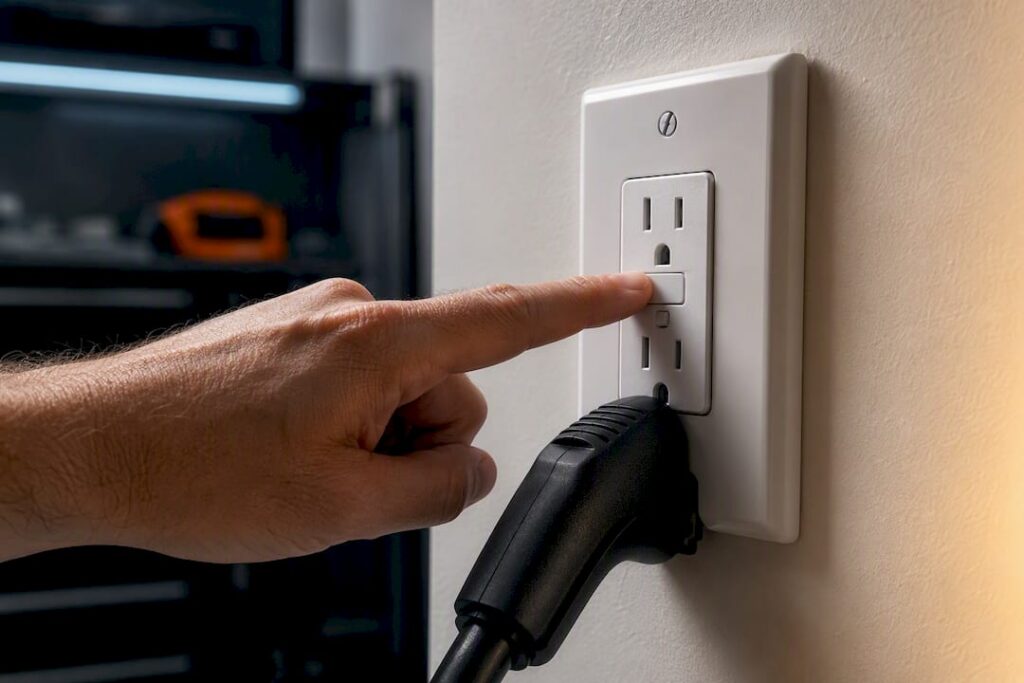
If your GFCI breaker trips every time you plug in your EV charger, you’re dealing with one of four things: a real ground fault, a nuisance conflict between your panel’s GFCI and your charger’s built-in ground monitor, an overload or thermal issue, or a failing breaker or receptacle. Stop charging, check the outlet and cable for heat, damage, or a burning smell, and reset the breaker only once as a test. If it trips again immediately, or you smell anything off, call a licensed electrician before you touch it again.
TL;DR:
- Most GFCI trips caused by damaged cables, water intrusion, or real ground faults occur immediately when plugging in, necessitating urgent electrician intervention.
- Nuisance trip conflicts between GFCI outlets and the charger’s built-in ground monitoring device often happen when devices with different leakage thresholds are stacked on the same circuit.
- Thermal or overload trips generally show after 30 to 90 minutes of steady charging, indicating heat buildup from loose connections or exceeding circuit capacity.
- Outdoor setups are vulnerable to moisture ingress, which can be mitigated with weatherproof enclosures or proper sealing, preventing frequent trips.
- Hardwiring the charger directly to a dedicated circuit typically reduces or eliminates GFCI conflicts, especially for chargers rated above 40 amps, with NEC code supporting this more durable solution.
Table of Contents
- Why Does My EV Charger Keep Tripping the GFCI Breaker?
- What’s Actually Causing the GFCI to Trip
- How to Troubleshoot a Tripping GFCI Step by Step
- NEC Rules and Code-Compliant Fixes That Actually Work
- What a Professional GFCI Inspection Actually Involves
- What Usually Fixes a Tripping EV Charger Circuit
- Getting Your EV Charger Fixed the Right Way
- Sources
- FAQ
Why Does My EV Charger Keep Tripping the GFCI Breaker?
The trip pattern tells you almost everything you need to know before you call anyone. When you know how fast it trips and under what conditions, you can rule out three of the four likely causes in under five minutes.
Here’s the fastest way to read the pattern:
| When it trips | Likely cause |
|---|---|
| Instantly on plug-in, every time | Real ground fault, damaged cable, or wet connector |
| Within a few minutes | Double-GFCI/CCID interaction (nuisance trip) |
| After 30 to 90 minutes of steady charging | Thermal issue from a loose connection or undersized wire |
| Only during rain or high humidity | Moisture intrusion at the receptacle or connector |
| Randomly, no clear pattern | Aging breaker, worn receptacle, or intermittent wiring fault |
A trip inside the first few seconds usually means current is finding a path it shouldn’t. That’s the scenario where you stop and call an electrician rather than experiment further. A trip that shows up reliably at the 30 to 90 minute mark, on the other hand, points toward heat building in a loose connection, which is a fire risk worth taking seriously.
Before you do anything else, run these three checks:
- Feel the outlet cover and the breaker itself. Warm or hot means stop charging immediately.
- Look at the charging cable and plug for cracks, discoloration, or moisture beading.
- Press the GFCI test button once. If it doesn’t reset cleanly, the device itself may be the problem.
Pro Tip: Write down the exact minute the trip happened, the amperage your charger was set to, and whether it was raining. That single data point often lets an electrician diagnose the issue over the phone before they even show up.
One pattern shows up constantly in owner forums: Level 1 charging cords plugged into a garage GFCI outlet trip repeatedly even when nothing is actually wrong with the car or the wiring. That’s usually a sensitivity mismatch, not a hazard, but it still needs to be confirmed rather than assumed.
What’s Actually Causing the GFCI to Trip
Real ground faults
A true ground fault means electricity is leaking outside its intended path, often through damaged insulation, a cracked cable jacket, or water inside a connector. This is the one scenario where speed matters more than patience. If the breaker trips on every single plug-in with no exceptions, treat it as a real fault until an electrician proves otherwise.
Nuisance double-GFCI trips
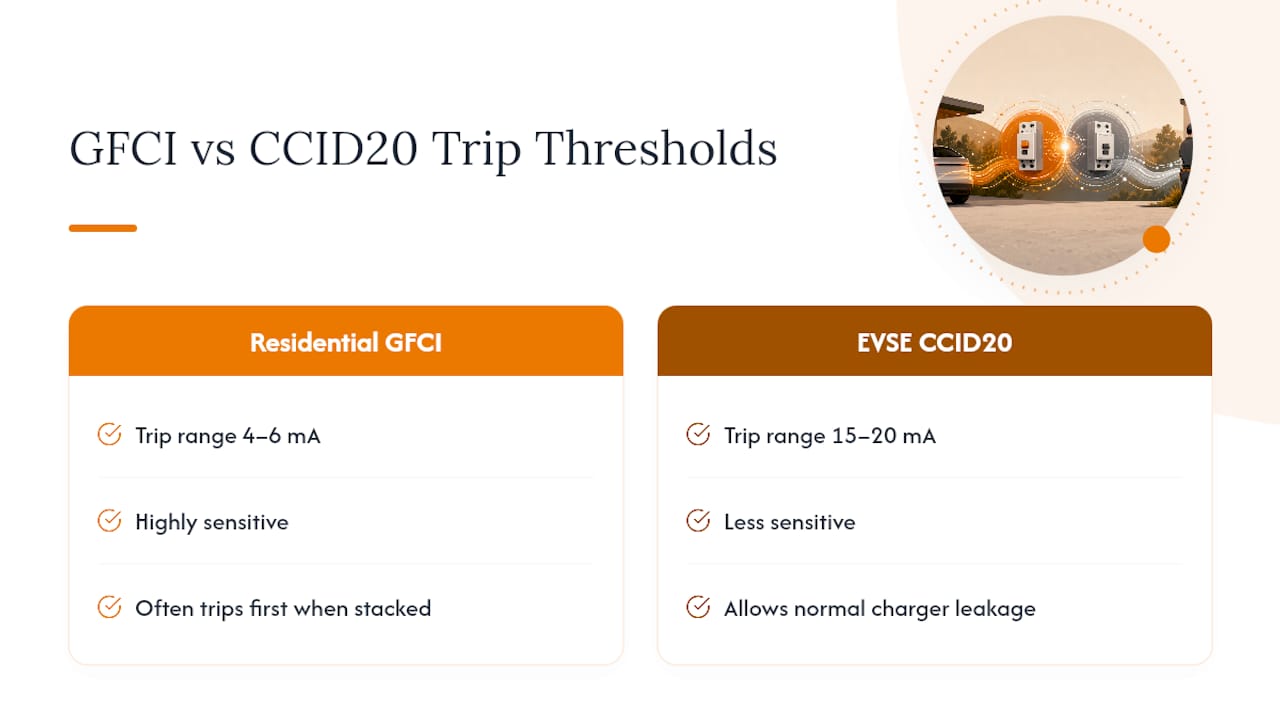
Most Level 2 home chargers ship with a built-in ground monitoring device called a CCID, and it’s tuned differently than the GFCI outlet or breaker feeding it. Residential GFCIs trip at roughly 4 to 6 milliamps of leakage, while most EVSE CCID units use a CCID20 threshold that allows 15 to 20 milliamps before tripping. Stack both devices on the same circuit and the more sensitive residential GFCI often trips first, even though the charger’s own leakage is well within its normal operating range. Electricians sometimes call this a “double-GFCI” conflict, and it’s the single most common reason a perfectly healthy charger trips a perfectly healthy breaker.
Overload and thermal buildup
The National Electrical Code requires continuous loads, and EV charging counts as continuous, to stay at or below 80% of a circuit’s rated capacity. A 40 amp breaker feeding a charger pulling more than 32 amps continuously is running outside that margin, and heat is the result. Heat degrades insulation and connections over time, which is exactly why a trip that shows up after 30 or more minutes of steady charging deserves attention rather than a quick reset and forget.
Moisture and equipment wear
Outdoor installations face a different enemy: water finding its way into a connector, a receptacle, or a poorly sealed junction box. Moisture ingress is one of the more common and most fixable causes of outdoor GFCI trips, usually solved with a proper NEMA-rated enclosure or an in-use weatherproof cover rather than any rewiring.
- Cracked or brittle cable jackets from UV exposure
- Loose prongs inside a worn receptacle
- Corrosion on aluminum wiring connections
- A GFCI device that’s simply reached the end of its service life
How to Troubleshoot a Tripping GFCI Step by Step
Work through these steps in order, and stop the moment you hit a red flag.
- Inspect first. Check the cable, plug, and receptacle for heat, cracking, or moisture. Any sign of burning or melted plastic means stop and call an electrician immediately.
- Isolate the variable. Plug the same charger into a different outlet, or try a public charger with your EV, to see if the problem follows the charger or stays with the circuit.
- Swap the equipment. If you have access to a different EVSE on the same outlet, test it. A different charger that works fine points to the original charger’s CCID or cable as the issue.
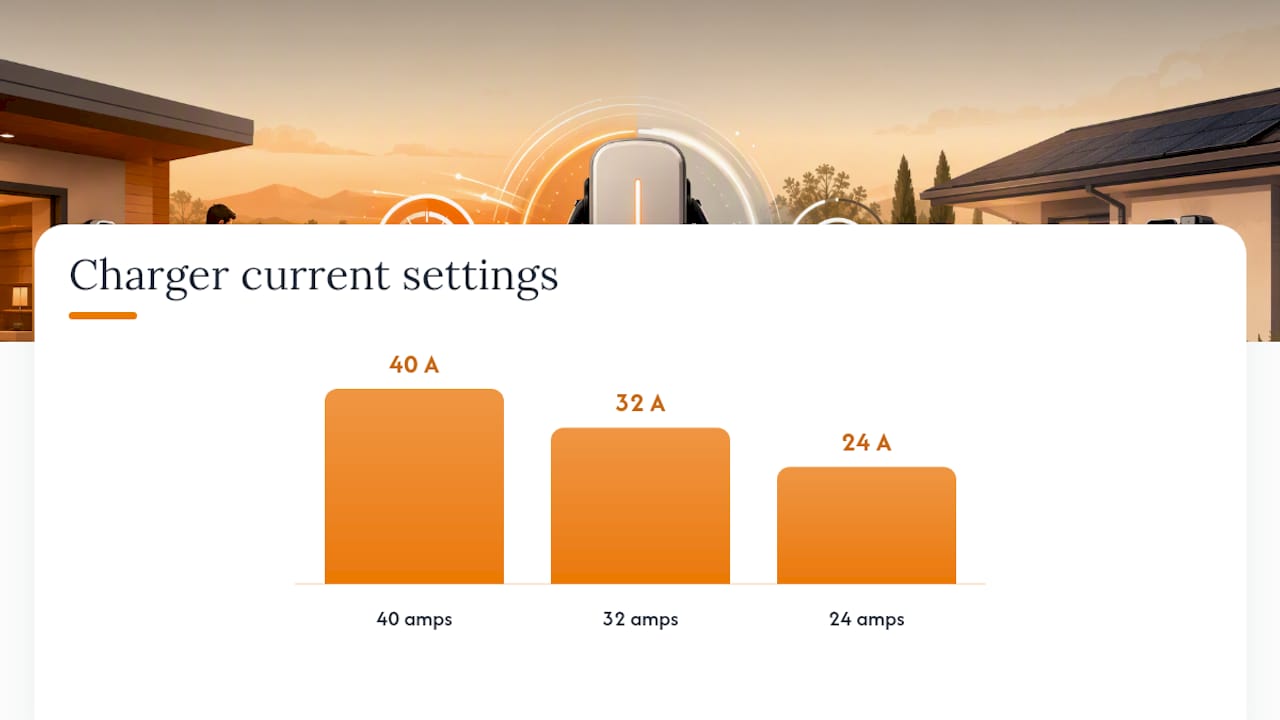
- Reduce the amperage. Most Level 2 chargers let you dial down the charging current through an app or a dip switch. Dropping from 40 amps to 32 or 24 amps often eliminates thermal trips outright, because you’re pulling the load further from the circuit’s ceiling.
- Observe over a full cycle. Run one complete overnight charge at the reduced setting and note whether the trip recurs.
Pro Tip: If dropping the amperage stops the trip completely, you’ve likely found a thermal or overload issue rather than a ground fault. That’s useful information to hand an electrician; it narrows the visit from a full diagnostic to a targeted repair.
When an electrician does get involved, expect a specific test sequence: insulation resistance testing on the circuit conductors, a continuity check on the equipment grounding conductor under load, and a torque check on every termination inside the panel and receptacle. Loose torque on a lug is one of the quietest causes of delayed thermal trips, and it’s invisible without the right tools.
NEC Rules and Code-Compliant Fixes That Actually Work
Article 625 of the National Electrical Code governs EV charging equipment, and 625.54 is the section that decides whether your setup even needs GFCI protection in the first place. Cord-and-plug EVSE rated 150 volts or less to ground and 50 amps or less must be protected by GFCI at the receptacle. Hardwired EVSE is explicitly excepted from that requirement.
That exception is exactly why hardwiring solves so many nuisance-trip cases. Remove the plug-and-receptacle configuration, hardwire the charger directly to a dedicated circuit, and you eliminate the upstream GFCI that was fighting with the charger’s internal CCID in the first place. Hardwiring a Level 2 charger rated 40 amps or higher is generally the most durable fix for double-protection conflicts, and it also removes a failure point: the plug and receptacle themselves.
If hardwiring isn’t in the cards, a few other fixes handle most cases:
- Confirm the breaker and conductor size actually match the charger’s rated draw, including the 80% continuous-load margin.
- Replace consumer-grade receptacles with industrial or commercial-grade NEMA 14–50 units if you’re plugging and unplugging frequently.
- Have a licensed electrician verify the GFCI device itself isn’t simply worn out.
Never replace a required GFCI breaker with a standard one to make the tripping stop. Bypassing protection instead of fixing the underlying fault is a safety violation, not a repair, and it can void your homeowner’s insurance if a fire investigation ever traces back to it. When you’re unsure whether your situation qualifies for the hardwired exception, your local Authority Having Jurisdiction or a licensed electrician can confirm before you commit to any work.
What a Professional GFCI Inspection Actually Involves
A properly run inspection doesn’t guess. It measures.
- Insulation resistance testing to rule out hidden leakage paths in the wiring
- Equipment grounding conductor continuity checked under an actual load, not just at rest
- Torque verification on every panel and receptacle termination
- Thermal imaging or manual heat checks on the breaker, receptacle, and connector under sustained charging
- Receptacle replacement with commercial-grade hardware when wear is found
Alpha Solar Solutions handles EV charger installation with NEC-compliant hardwire work built into the process from the start, along with weatherproofing for outdoor setups and ongoing blog resources for homeowners working through electrical questions.
What Usually Fixes a Tripping EV Charger Circuit
Most nuisance trips trace back to a mismatch between two protective devices doing their job correctly, not a hazard hiding in the wall. The fix is almost always smaller than homeowners fear: a lower amperage setting, a better receptacle, or a hardwire conversion on an existing circuit. The cases that turn into bigger jobs, like a panel upgrade or a full rewiring, are the minority, and they usually announce themselves early through heat, smell, or a breaker that won’t hold a reset. Treat those signs as your line between a DIY fix and a phone call.
— Anthony
Getting Your EV Charger Fixed the Right Way
We offer professional diagnosis and code-compliant repairs for EV charger circuit issues, addressing causes like CCID mismatches, loose terminations, or undersized circuits, to provide reliable solutions rather than temporary fixes.

Our process for addressing EV charger circuit issues includes an on-site inspection, a written quote before starting work, and repairs focused on safe, lasting solutions rather than quick fixes. That might mean hardwiring your charger to remove the double-GFCI conflict, upgrading a receptacle to commercial-grade hardware, or confirming whether your panel needs an upgrade to safely support the load. For outdoor setups, we also handle weatherproof installation practices that keep moisture out of the equation entirely. If your charger keeps tripping and you’d rather have a licensed electrician sort it out than keep resetting a breaker, get a quote through our EV charger installation page and we’ll schedule an inspection.
Sources
- EV charger electrical code and permit guidance — PermitDeck
- GFCI tripping on EV charger — WattSimple guide
- EV charger circuit troubleshooting — TestTalkHQ
FAQ
Should an EV charger be on a GFCI breaker?
Cord-and-plug EVSE rated 50 amps or less must have GFCI protection under NEC 625.54, but hardwired EVSE is exempt from that requirement, which is why many 40 amp and higher installs are hardwired.
Why is my EV charger tripping the breaker when I plug it in?
An immediate trip usually points to a real ground fault, damaged cable, or moisture in the connector, while a trip within a few minutes often signals a nuisance conflict between the panel’s GFCI and the charger’s built-in CCID.
Is a 50 amp GFCI breaker required for an EV charger?
Only for cord-and-plug EVSE rated at or below 50 amps and 150 volts to ground under NEC 625.54; hardwired units of any amperage don’t carry that same upstream GFCI requirement.