
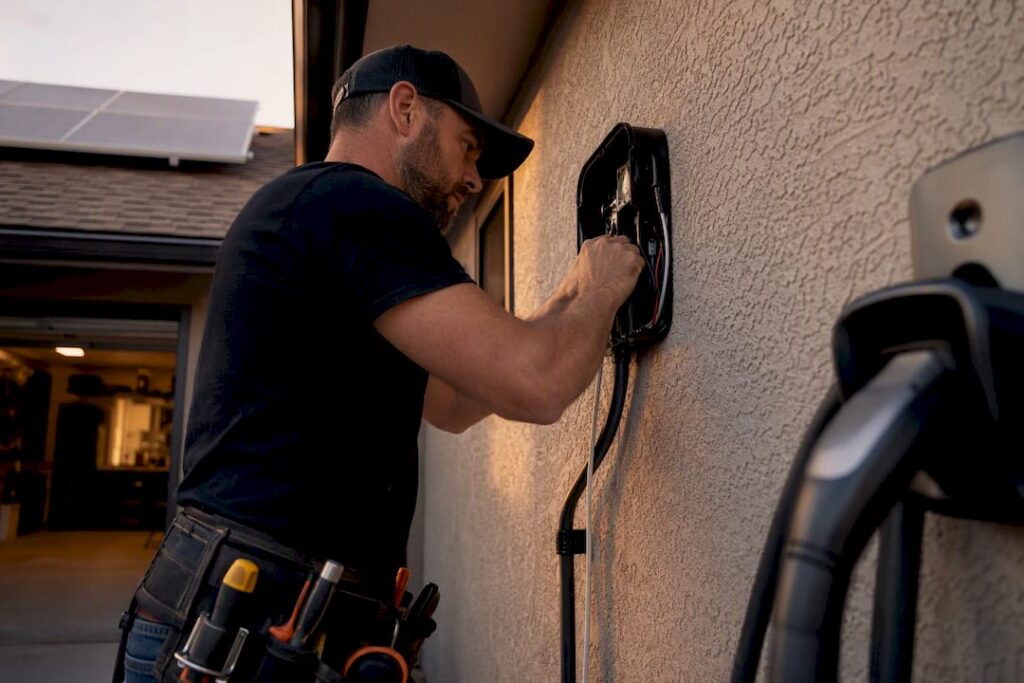
EV charging load management is the practice of controlling how much power each charger draws so total site demand never exceeds what your electrical service can safely handle. Two approaches exist: static (passive) load management, which splits power using fixed setpoints, and dynamic load management (DLM), which uses real-time metering and software to shift power among chargers automatically. For multi-charger commercial or mixed-use sites, dynamic is the clear recommendation. Simple residential installs often do fine with static sharing built into the charger itself.
What that means in practice:
- A parking garage can install 12 chargers on a service sized for 6, because dynamic software reallocates power as cars arrive and leave.
- A retail plot host can add charging stations without paying for a utility service upgrade, often the single biggest line item in a charging project’s budget.
Key Takeaways
Dynamic load management lets commercial and multi-charger sites add more chargers on existing electrical capacity while avoiding or delaying costly utility service upgrades.
| Point | Details |
|---|---|
| Choose dynamic for multi-charger sites | Static sharing works for simple residential setups, but commercial sites need real-time GCP-based control. |
| GCP metering drives performance | Systems reading grid data every 1 to 5 seconds use available capacity far better than slower, station-only systems. |
| Safety margin protects the site | A conservative fallback cap, tested during commissioning, keeps charging safe if the meter signal drops. |
| Fleet needs call for prioritization | Time-critical vehicles do better under fleet-scheduling modes than under equal proportional sharing. |
| Pairing with solar multiplies benefits | Onsite solar and battery storage give the EMS more levers to manage demand charges and grid draw. |
Table of Contents
- What Is EV Charging Load Management, and How Does It Work?
- Why Load Management Pays Off: Capacity, Cost, and Charger Count
- What You Need Before Installing a Load-Managed System
- How to Choose the Right Load Management Setup
- A Practical Checklist for Deploying Load-Managed Charging
- How Alpha Solar Solutions Supports Load-Managed Charging Projects
- Pairing Solar and Battery Storage With Load-Managed Charging
- How Load Management Affects Grid Stability
- Regulatory and Permitting Considerations
- Where Load Management Technology Is Headed
- Ready to Add Load-Managed EV Charging to Your Property?
- The Real Bottleneck Isn’t the Software
- Sources
What Is EV Charging Load Management, and How Does It Work?
Static load management divides available power using fixed caps, either an equal split across every charger or a manually assigned setpoint per station. It’s inexpensive and simple, but it has a real weakness: the system doesn’t know what’s actually happening on your electrical service at any given moment, so it has to assume worst-case demand at all times. If you’ve got four chargers and one is idle, that idle charger’s allotment often sits unused instead of going to the car that needs it.
Dynamic load management fixes that by watching the building’s real electrical draw. Here’s the sequence:
- A meter at the grid connection point (GCP) measures actual building load in near real time.
- The system subtracts that load from your total import limit and applies a safety margin, typically in the range of 8 to 12 percent of measured maximum import, so a metering blip never pushes the site over its limit.
- An algorithm redistributes whatever power remains among active charging sessions, honoring per-phase limits so no single phase gets overloaded on three-phase services.
Statistic callout: Well-configured DLM systems read GCP data and recalculate allocations every 1 to 5 seconds, a response speed that lets sites use significantly more of their available capacity than slower, aggregation-based approaches that only check in periodically.
Most systems let you choose between proportional sharing, where every active vehicle gets an even cut, and fleet-prioritization, which favors vehicles with time-critical charging needs over an even split.
Why Load Management Pays Off: Capacity, Cost, and Charger Count
The financial case for dynamic load management comes down to one word: deferral. A utility service upgrade, new transformer, new panel, new conduit run, can take months and cost tens of thousands of dollars depending on your utility and site conditions. DLM lets you sidestep that spend, at least for a while, by squeezing more chargers onto the capacity you already have.
Concretely, this means:
- Higher charger density. The same electrical service that supports 6 chargers running unmanaged might support 12 or more under dynamic control, since not every vehicle needs full power simultaneously.
- Deferred or avoided utility upgrades, which Eaton’s technical guidance identifies as a primary reason commercial sites adopt load management at all.
- Lower peak demand charges, since DLM can cap draw during utility peak windows and shift more charging into off-peak hours.
The tradeoff is speed at the charger. When many vehicles plug in simultaneously, individual charging sessions run slower than they would on a dedicated, unmanaged circuit.
Pro Tip: If your site hosts fleet vehicles with fixed departure times, prioritize DLM systems with fleet-scheduling modes rather than pure proportional sharing. Equal splits look fair on paper, but they can leave your most time-sensitive vehicle undercharged when it needs to leave.
What You Need Before Installing a Load-Managed System
Before anyone configures software, your site needs the right hardware and data in place. Here’s what to confirm during planning:
- A GCP meter with sub-5-second reporting. This is the sensor that makes dynamic management possible; without live, accurate data on building consumption, the algorithm is flying blind. Placement matters too, it needs to sit at the true grid connection point, not downstream of unrelated loads.
- Phase mapping for every AC charger. Facility teams need to know which electrical phase each charger sits on so the system can enforce per-phase limits, not just a whole-building limit. DC fast chargers often work differently, since they typically draw from all three phases at once and need separate handling.
- A conservative safety margin and fallback setting. If the GCP meter loses signal, a well-configured system reverts to a fixed, conservative cap rather than guessing. This fallback behavior is what protects your service from a nasty surprise during a communications outage.
- Communications compatibility. Your energy management system (EMS) or gateway hardware needs to talk to your EVSE (the charging stations themselves) using a shared protocol.
Most jurisdictions also want a heads-up. A quick notification to your local authority having jurisdiction (AHJ) and utility during permitting saves you from delays later, especially if the project involves new metering equipment.
How to Choose the Right Load Management Setup
Not every system marketed as “smart charging” actually does real-time load management. Some only aggregate station-level data on a slow cycle, which is fine for small sites but leaves capacity on the table for busy ones. When evaluating options, look for:
- True GCP-level measurement with 1 to 5 second response, not just periodic station polling.
- Prioritization modes that match your operations. A fleet depot needs scheduling logic; a public charging plaza usually does better with proportional sharing.
- Analytics and alerting. You want visibility into utilization, faults, and near-limit events, especially across multiple sites if you manage more than one property.
- Integration hooks for solar and battery storage, since many commercial sites are adding onsite generation alongside charging.
- Compliance and update cadence. Confirm UL listings for hardware and ask how the vendor pushes firmware and software updates over the system’s service life.
A Practical Checklist for Deploying Load-Managed Charging
Getting from decision to commissioned system follows a predictable sequence, whether you’re adding two chargers or twenty.
- Assess the site. An electrician or engineer measures existing panel capacity, identifies whether the service can support new metering, and flags any upgrades needed before installation starts.
- Choose static or dynamic. Small residential or single-charger sites can often use built-in static sharing. Anything with multiple chargers, fleet needs, or tight budget constraints benefits from dynamic management instead.
- Install the GCP meter and gateway hardware, then configure the EMS: set the maximum import limit, apply your safety margin, and define fallback behavior.
- Commission and test. Simulate a meter outage to confirm the fallback cap holds, verify per-phase limits are respected, and set up a monitoring routine so someone reviews utilization data regularly. Notify your utility and AHJ as required.
Pro Tip: Run your commissioning test during a simulated outage, not just a live one. If the fallback cap doesn’t hold when the meter signal drops, you’ll find out during a controlled test instead of during a real electrical event.
How Alpha Solar Solutions Supports Load-Managed Charging Projects
Alpha Solar Solutions handles the pieces that make dynamic load management actually work on site: EV charger installation, commercial solar, and battery integration for property owners across San Antonio and the surrounding area. Our team conducts the site assessment that determines whether static sharing is sufficient or whether your charger count justifies a dynamic setup.
From there, we handle:
- GCP meter installation and placement at the true grid connection point
- Phase mapping for every charger added to the circuit
- EMS configuration, including safety margin and fallback settings
- Coordination with your utility and local AHJ during permitting
If your project also involves relocating panels or working around existing solar arrays during installation, our crews manage that scope directly rather than handing it to a separate subcontractor.
Pairing Solar and Battery Storage With Load-Managed Charging
Onsite solar and battery storage change the math on load management considerably. Instead of managing only how power is distributed among chargers, an integrated system also decides when to draw from solar generation, when to pull from battery storage, and when to import from the grid, all while keeping total demand under your service limit.
This matters most during peak sun hours, when solar generation can offset a meaningful share of daytime charging demand without touching grid import at all. Battery storage extends that benefit into the evening, when many commercial sites see their highest charging volume as employees or customers plug in before heading home. A well-sized battery can discharge to cover that evening spike, keeping the site under its demand-charge threshold even when solar isn’t producing.
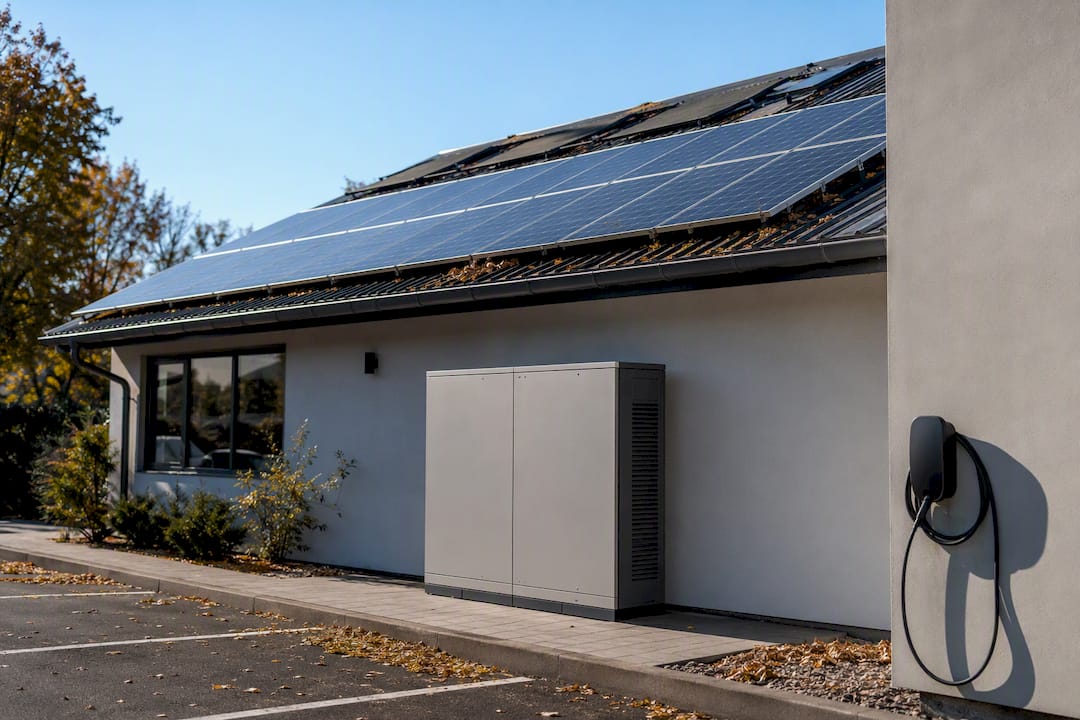
The practical upshot: pairing solar and EV charging isn’t just an environmental nicety, it’s a load management tool in its own right. A site with solar, storage, and dynamic charging control has three levers to pull instead of one when demand spikes, which gives the EMS more room to work with before it has to throttle charging sessions.
How Load Management Affects Grid Stability
Uncontrolled EV charging creates a specific problem for utilities: a cluster of vehicles plugging in at the same time, often right after the evening commute, can spike local demand sharply in a short window. Multiply that across a neighborhood or a commercial corridor and you get the kind of concentrated load that strains transformers and distribution equipment built for an earlier era of electricity use.
Load management softens that spike by spreading charging demand across a longer window and capping how much any single site pulls at once. Federal energy data on grid impacts and demand response points to exactly this kind of demand-side flexibility as a key tool for absorbing growing EV adoption without forcing utilities into constant infrastructure buildouts.
For property owners, this connects directly to your own bottom line. Sites that manage their charging load intelligently, shifting more sessions into off-peak windows, are also the sites best positioned to avoid demand charges and participate in utility demand-response programs as those programs expand. Grid stability and your operating costs move in the same direction here, which is part of why utilities in many regions are starting to favor or incentivize managed charging installations over unmanaged ones.
Regulatory and Permitting Considerations
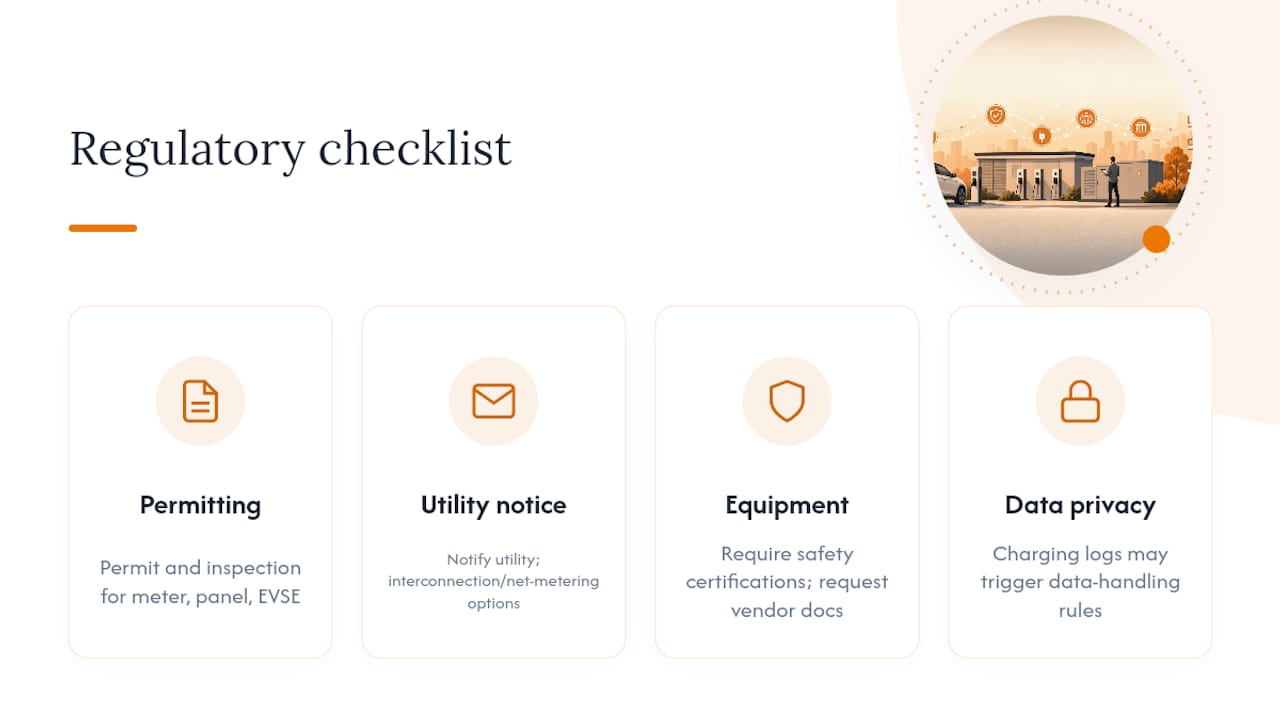
Requirements vary by jurisdiction and by utility, so treat this as a planning checklist rather than a fixed rulebook. Most projects touch a few common areas regardless of location.
Permitting and inspection. Adding a GCP meter, new panel capacity, or EVSE circuits typically requires a permit from your local authority having jurisdiction, and an inspection once work is complete. This is standard electrical work oversight, not something unique to load management, but it’s easy to underestimate the timeline if you haven’t budgeted for it.
Utility notification. Many utilities want advance notice when a site adds significant new load or new metering equipment, even if the load management system is specifically designed to avoid triggering a service upgrade. Some utilities offer interconnection or net metering programs relevant to sites pairing solar with charging, which adds another layer of paperwork worth starting early.
Equipment listings. Charging hardware and metering equipment should carry appropriate safety certifications for your market. Ask any installer or vendor for documentation before you commit to a system, and don’t treat a compliance claim as settled until you’ve seen the paperwork yourself.
Data and privacy. Systems that log charging session data, especially fleet-prioritization setups tracking individual vehicles or drivers, may fall under data handling expectations depending on your state and industry. It’s a smaller consideration than permitting, but worth a conversation with your installer if your site handles third-party fleet data.
Where Load Management Technology Is Headed
The trend line in load management points toward faster, smarter, and more connected systems. Response times that are already down to a few seconds will likely keep shrinking as metering hardware and communications protocols improve, letting sites push utilization even closer to their true capacity ceiling without added risk.
Vehicle-to-grid (V2G) capability is the bigger shift on the horizon. Instead of treating EV batteries purely as loads to manage, future systems will increasingly treat parked vehicles as flexible storage that can feed power back to a building or the grid during demand spikes. That turns load management from a one-directional throttle into a two-way balancing act.
Expect deeper integration with building-wide energy management too, where charging decisions get made alongside HVAC, lighting, and battery dispatch rather than in isolation. As more sites add solar and storage alongside charging, the software managing all three needs to work as one coordinated system rather than three separate tools bolted together. Partners in the mobility and charging hardware space, including firms like Indelec Mobility, are already building toward that kind of integrated depot and site electrification model.
The practical takeaway for property owners: whatever system you install today should have room to grow into these capabilities, rather than needing a full replacement in five years.
Ready to Add Load-Managed EV Charging to Your Property?
If you’re planning multiple chargers, evaluating a fleet installation, or simply want to avoid an expensive service upgrade, the right first step is a site assessment. Alpha Solar Solutions installs EV chargers throughout San Antonio and handles the meter work, phase mapping, and EMS configuration that make dynamic load management work as intended. For sites already running or planning solar, we also offer commercial solar installation that pairs directly with your charging setup to reduce demand charges further. Reach out and we’ll walk your property through what a load-managed system would actually look like, and cost, before you commit to anything.
The Real Bottleneck Isn’t the Software
Most articles on load management treat it as a software decision: pick the algorithm, set the parameters, done. That undersells the problem. The technology itself, GCP metering, safety margins, fallback logic, is mature and well documented. What actually determines whether a deployment succeeds is whether the site assessment, phase mapping, and commissioning tests were done properly before the system went live.
I’d argue the conventional advice underweights commissioning almost entirely. A system with excellent software but an untested fallback cap is a liability disguised as a solution. If nobody simulates a meter outage before the site goes live, you don’t actually know your safety margin works, you’re hoping it does.
Prioritize the boring parts first: an honest site assessment, correct phase mapping, and a fallback test under simulated failure. The prioritization mode, fleet versus proportional, matters far less than most vendor pitches suggest, unless your site genuinely has time-critical fleet needs. Get the fundamentals verified before you start comparing feature lists.