
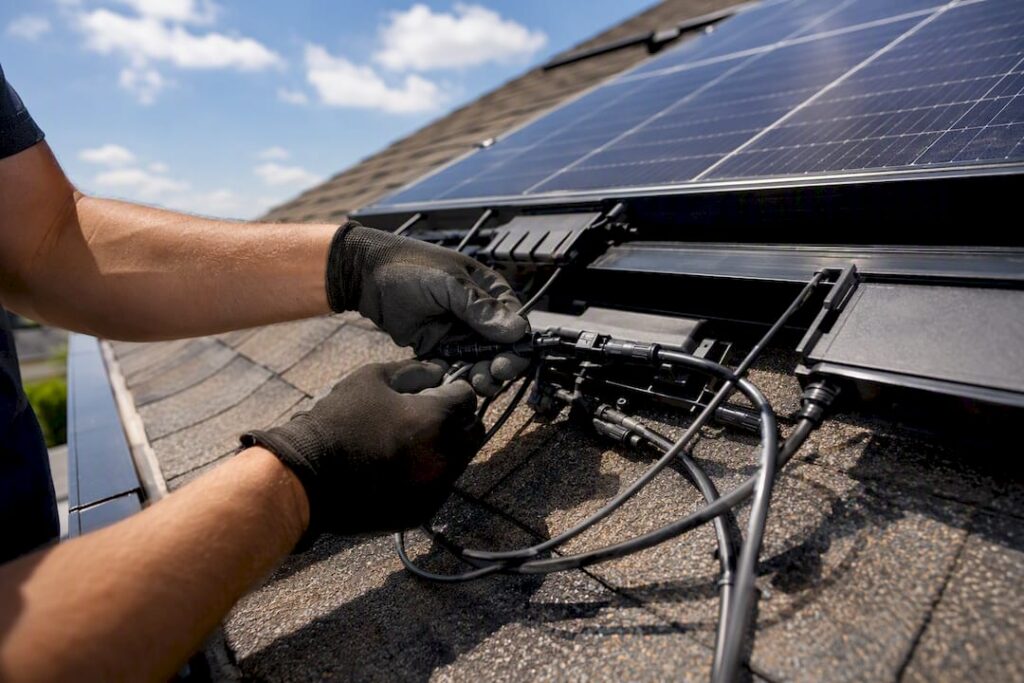
If your roof has shade from a tree, a chimney, or a neighbor’s house at any point during the day, or if your panels face more than one direction, microinverters usually outperform string inverters over the life of your system. If your roof is simple, single-facing, and gets full sun all day, a string inverter often delivers the same production for less money upfront. The deciding factors are shading, roof orientation, your budget today versus your plans for tomorrow, and how much you value a 25-year warranty over a shorter one.
- Shading: Any consistent shade pushes the advantage toward microinverters.
- Roof complexity: Multiple angles or facets favor panel-level electronics.
- Upfront budget: String inverters usually cost less to install initially.
- Expansion plans: Adding panels or a battery later is simpler with microinverters.
Key Takeaways
The right inverter choice depends less on price per watt and more on your roof’s shading, your expansion plans, and how much a single point of failure would cost you in lost production.
| Point | Details |
|---|---|
| Shading decides the winner | Shaded or multi-orientation roofs favor microinverters; simple unshaded roofs favor string inverters. |
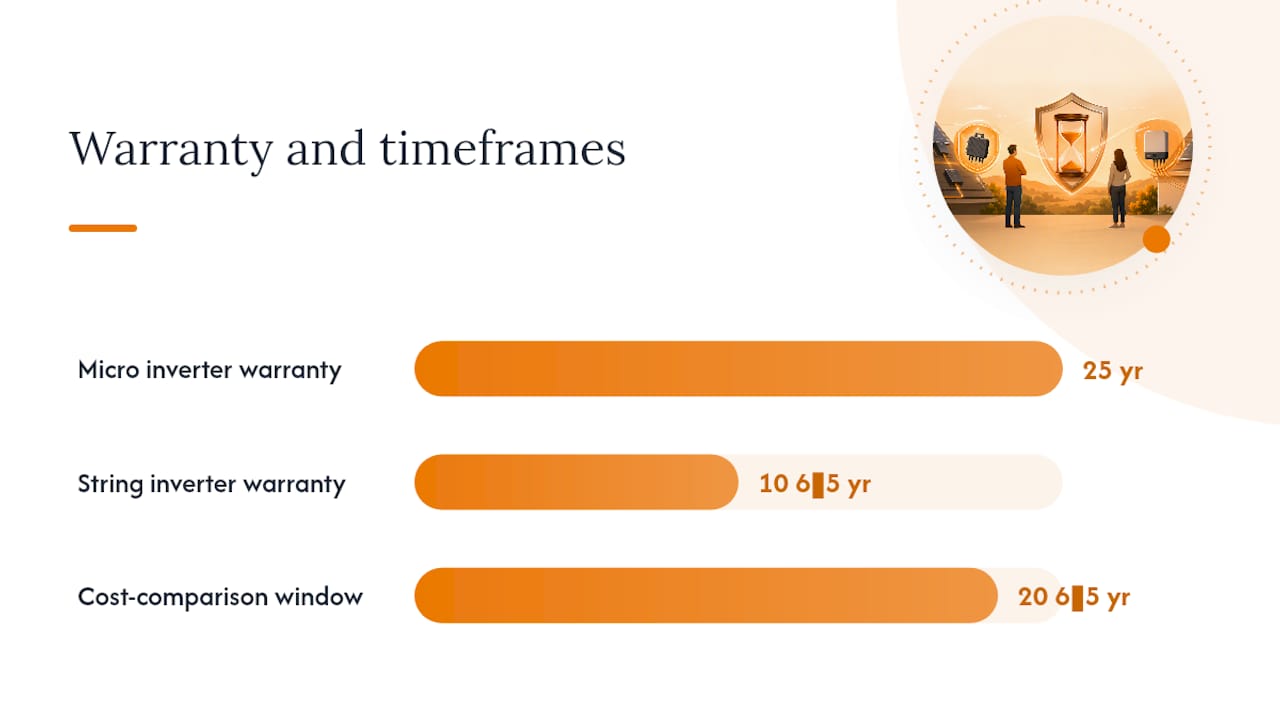
| Warranty gap is real | Microinverters commonly carry 25-year coverage versus 10 to 15 years for string inverters. |
| Failure mode matters most | A string inverter failure can shut down the whole array; a microinverter failure affects one panel. |
| Factor in replacement cost | String inverters often need a mid-life swap that changes the 20 to 25 year cost comparison. |
| Alphasolarsa evaluates your specific roof | Alphasolarsa’s free residential assessment compares both inverter types against your actual shading and budget. |
Table of Contents
- Microinverter vs String Inverter: A Quick Snapshot
- How Do String Inverters and Microinverters Actually Work?
- Weighing the Pros and Cons for Your Home
- What Does Total Cost of Ownership Actually Look Like?
- Warranties, Failure Modes, and Real-World Maintenance
- Which Inverter Fits Your Roof and Goals?
- How Does Your Inverter Choice Affect Future Upgrades?
- Monitoring, Rapid-Shutdown Rules, and Rooftop Safety
- What to Ask Your Installer Before Signing
- What Homeowners Get Wrong About This Decision
- Get a Straight Answer for Your Roof, Not a Sales Pitch
- Primary Sources and Further Reading
- Sources
Microinverter vs String Inverter: A Quick Snapshot
Before you dig into the mechanics, here’s the short version. A string inverter wires panels in series and converts all their DC power to AC at one central box, usually mounted near your electrical panel. Power optimizers are a hybrid: they sit on each panel to condition the DC output, but a central string inverter still does the AC conversion. Microinverters convert DC to AC right at each panel, so every module works independently.
- String inverters: lowest upfront cost, best for simple unshaded roofs, typically 10 to 15 year warranties.
- Power optimizers plus string inverter: mid-range cost, panel-level monitoring, good for mild shading.
- Microinverters: highest upfront cost, best for shaded or multi-orientation roofs, commonly backed by long warranties.
Your installer should walk you through all three, not just default to whichever one they stock.
How Do String Inverters and Microinverters Actually Work?
A string inverter wires a row of panels together like old Christmas lights: one weak link drags down the whole strand. All the DC electricity flows down the roof, into one box, and gets converted to usable AC power at once. Some modern string systems add power optimizers at each panel, which clean up the DC signal and support multiple maximum power point tracking (MPPT) inputs, but the AC conversion still happens centrally.
Microinverters skip that shared circuit entirely. Each panel has its own small inverter mounted on the rack, converting DC to AC right there. There’s no “string effect” because each microinverter operates independently, so a shaded panel doesn’t drag down its neighbors.
This distinction changes more than just production numbers:
- String systems carry high-voltage DC across the roof and down to the inverter, which affects code requirements.
- Microinverter systems keep voltage low and convert to AC at the source, simplifying wiring and safety design.
- Expansion is modular with microinverters since each addition is self-contained.
Weighing the Pros and Cons for Your Home
Microinverters give you panel-level optimization, which means one shaded or dirty panel won’t drag down the rest of your array. They typically come with longer warranties, often 25 years compared to 10 to 15 years for string inverters, and they’re mounted individually on the roof rather than centralized. The tradeoff is a higher equipment cost and more individual units that could theoretically need service, even though failure rates per unit are generally low.
String inverters cost less initially and centralize service, meaning a technician has one accessible box to check instead of climbing onto the roof. The catch is that a single point of failure can take down the entire system until it’s repaired, and some string setups need extra rapid-shutdown hardware added to meet code.
- Microinverters: better shading tolerance, longer warranty, higher install cost, distributed electronics.
- String inverters: lower cost, easier ground-level service, whole-system risk if it fails.
- Optimizers plus string inverter: a middle path that adds panel-level monitoring without full module-level AC conversion.
Pro Tip: Ask your installer to quote both a straight string system and a microinverter system for your exact roof. The price gap is often smaller than homeowners expect once rapid-shutdown hardware gets added to the string quote.
What Does Total Cost of Ownership Actually Look Like?
The sticker price on a microinverter system is usually higher per watt than a comparable string system. That’s the number most homeowners fixate on, and it’s also the number that tells the least about what you’ll actually spend over 20 to 25 years.
String inverters typically need replacement once or twice during a system’s lifespan, since their warranties run shorter than the panels they serve. That replacement cost rarely shows up in the original sales pitch, but it belongs in your math. Microinverters, distributed across the roof, are less likely to need a full swap all at once.
Here’s a simple way to estimate whether the microinverter premium pays off for your home:
- Note your roof’s shading pattern across a full day, not just a snapshot.
- Compare warranty length: 25 years versus 10 to 15 years, and estimate one mid-life replacement cost for the string option.
- Factor in your local electricity rate. Higher rates make production losses from shading more expensive.
- If shading is heavy or irregular, expect a production uplift of roughly 3 to 12 percent with microinverters. Light, occasional shading narrows that gap to just 1 to 3 percent.
Warranties, Failure Modes, and Real-World Maintenance
The warranty gap is the clearest tie-breaker on paper. Microinverters commonly carry 25-year coverage, matching most panel warranties, while string inverters typically run 10 to 15 years and need a swap partway through your system’s life.
Failure mode matters just as much as warranty length. When a microinverter fails, you lose production from one panel while the rest of the array keeps working. When a string inverter fails, the entire array typically shuts down until a technician replaces it.
- Firmware updates for microinverters usually happen remotely through the monitoring app.
- String inverter replacement requires an electrician visit and, occasionally, temporary rooftop access.
- A quick seasonal check of your monitoring dashboard catches most issues before they become expensive.
Which Inverter Fits Your Roof and Goals?
Match your situation to the option below before you sit down with an installer.
- Shaded, multi-orientation, or complex roof: Choose microinverters. Independent panel operation means a tree shadow on one corner doesn’t cost you production across the whole array.
- Simple, unshaded, single-facing roof with a tight budget: A string inverter delivers comparable output for less money, since there’s no string effect to offset.
- Mild, occasional shading with some budget flexibility: Power optimizers paired with a string inverter give you panel-level monitoring without the full microinverter price tag.
- Planning to add panels, a battery, or an EV charger later: Lean toward microinverters or optimizers, since expansion is simpler when each panel is self-contained.
Bring a shading map, your expansion timeline, and specific questions about warranty terms and mid-life replacement costs to every quote. Installers should walk you through these trade-offs rather than defaulting to whatever they keep in stock.
How Does Your Inverter Choice Affect Future Upgrades?
If a battery or EV charger is anywhere in your plans, your inverter choice today shapes how that upgrade gets wired tomorrow. Battery integration comes in two flavors: AC-coupled, which works well with either inverter type, and DC-coupled, which is more common with string setups.
- Adding panels later is simpler with microinverters since each new panel just needs its own matched unit.
- Expanding a string system sometimes requires upsizing or replacing the central inverter entirely.
- Plan your electrical panel capacity now if an EV charger is on your future list, since backup circuits and charging loads both draw from the same service.
Monitoring, Rapid-Shutdown Rules, and Rooftop Safety
Panel-level visibility isn’t a luxury feature. It’s how you catch a failing panel before it costs you a season of lost production, and it speeds up warranty claims considerably.
Microinverters meet NEC rapid-shutdown requirements natively, since they convert DC to AC right at the panel. String systems often need additional rapid-shutdown hardware bolted on to comply, and that cost sometimes gets left out of the initial quote, making side-by-side comparisons misleading.
- High-voltage DC runs the length of a string roof; microinverters keep that risk contained at each panel.
What to Ask Your Installer Before Signing
A knowledgeable installer should explain inverter basics clearly and offer both architectures, not just the one they prefer to sell.
- Ask to see warranty paperwork for the exact model quoted, not a generic brochure.
- Request a live demo of the monitoring app before you commit.
- Get a written estimate for expected replacement costs on string equipment.
What Homeowners Get Wrong About This Decision
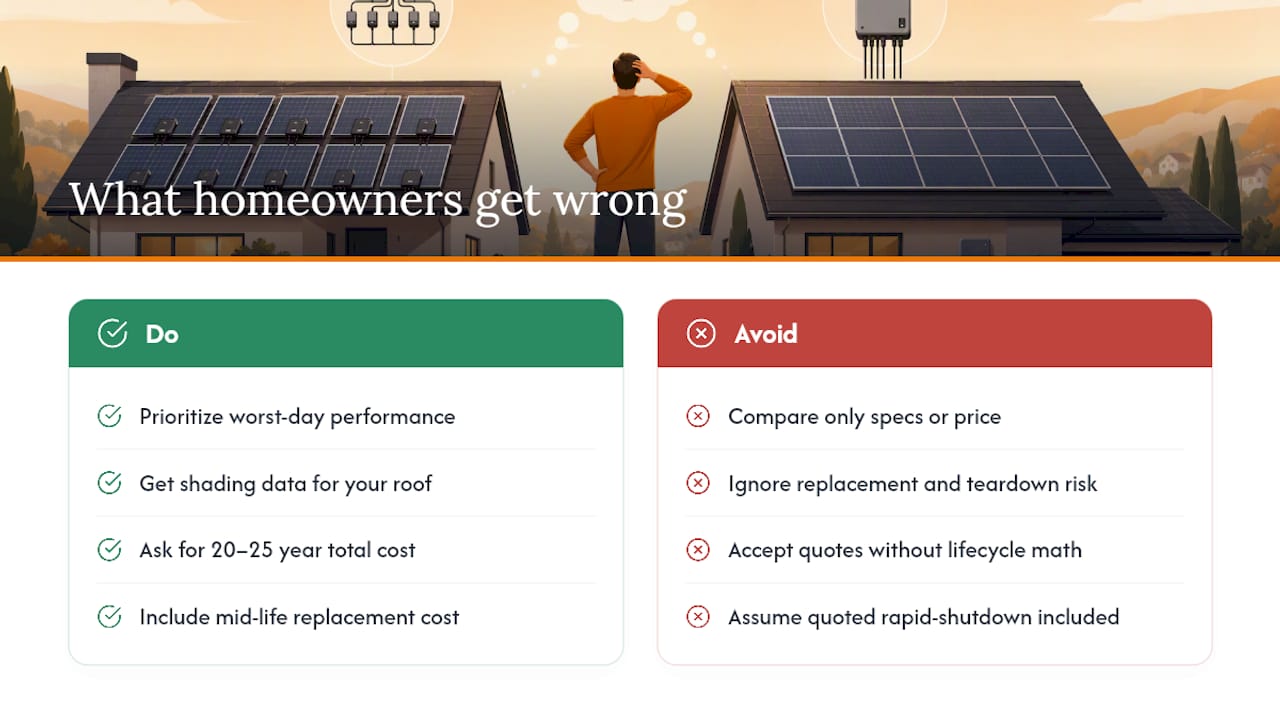
Most homeowners treat this choice as a spec sheet comparison: warranty years, efficiency percentages, price per watt. That’s backward. The real question is what happens on the worst day your system has, not the best one.
A string inverter failure isn’t a minor inconvenience. It’s your entire system going dark until someone climbs a ladder or schedules a service call, and that could stretch into weeks depending on parts availability. Homeowners who’ve lived through that outage rarely make the same choice twice. Meanwhile, a lot of the conventional advice online treats the price gap between the two options as the whole story, when the real gap narrows considerably once you price in a mid-life string inverter replacement and the rapid-shutdown hardware that string quotes sometimes leave out.
What I’d prioritize first: get shading data for your actual roof, not a generic assumption about your climate. A single hour of afternoon shade from a neighbor’s oak tree changes this math more than any warranty comparison does. Second, ask every installer for the total 20 to 25 year cost, not just the invoice total. If they can’t or won’t walk you through that, that tells you something about the quote itself.
Get a Straight Answer for Your Roof, Not a Sales Pitch
Deciding between a microinverter and string inverter setup gets a lot easier once someone actually looks at your roof instead of guessing from a satellite photo. Alphasolarsa designs residential solar systems in San Antonio around your specific shading pattern, roof orientation, and future plans, whether that means adding a battery next year or an EV charger down the road.
A free assessment from our team includes a real shading analysis, a walkthrough of the lifetime cost difference between inverter types for your specific roof, and a live demo of what panel-level monitoring looks like on your phone. We also handle battery integration, EV charger installation, and solar panel cleaning, so your system design accounts for where you’re headed, not just where you are today. If you’re ready to compare real numbers instead of brochure estimates, request a residential solar assessment and get a quote built around your actual roof.
Primary Sources and Further Reading
- Enphase: architecture and warranty comparison.
- EnergySage: homeowner decision guidance.
- AltEnergyMag: failure-mode analysis.
- Energy: rooftop PV background.
Sources
- Types of solar inverters: microinverters vs string inverters | Enphase
- Microinverters Vs. String Inverters: Which Is Right For You? | EnergySage
- Micro Inverter vs Central Inverter: How to Choose for Your Residential PV System | AltEnergyMag
- Microinverters vs. String Inverters: The Complete Guide | JMBIPVTech
- Microinverter vs String Inverter: The Complete 2026 Guide | OhmSnap